
Think like a cardiologist
A rigorous, clinically grounded curriculum — ECG interpretation, advanced hemodynamics, echocardiography, ACS management, and more — built for medical professionals who need cardiology knowledge that actually works at the bedside.

"Confidence at the bedside isn't luck — it's what happens when mechanism, pattern recognition, and clinical reasoning are built together, not memorized in isolation."— Dr. J Raymond ABK
What you'll learn
What you'll be able to do
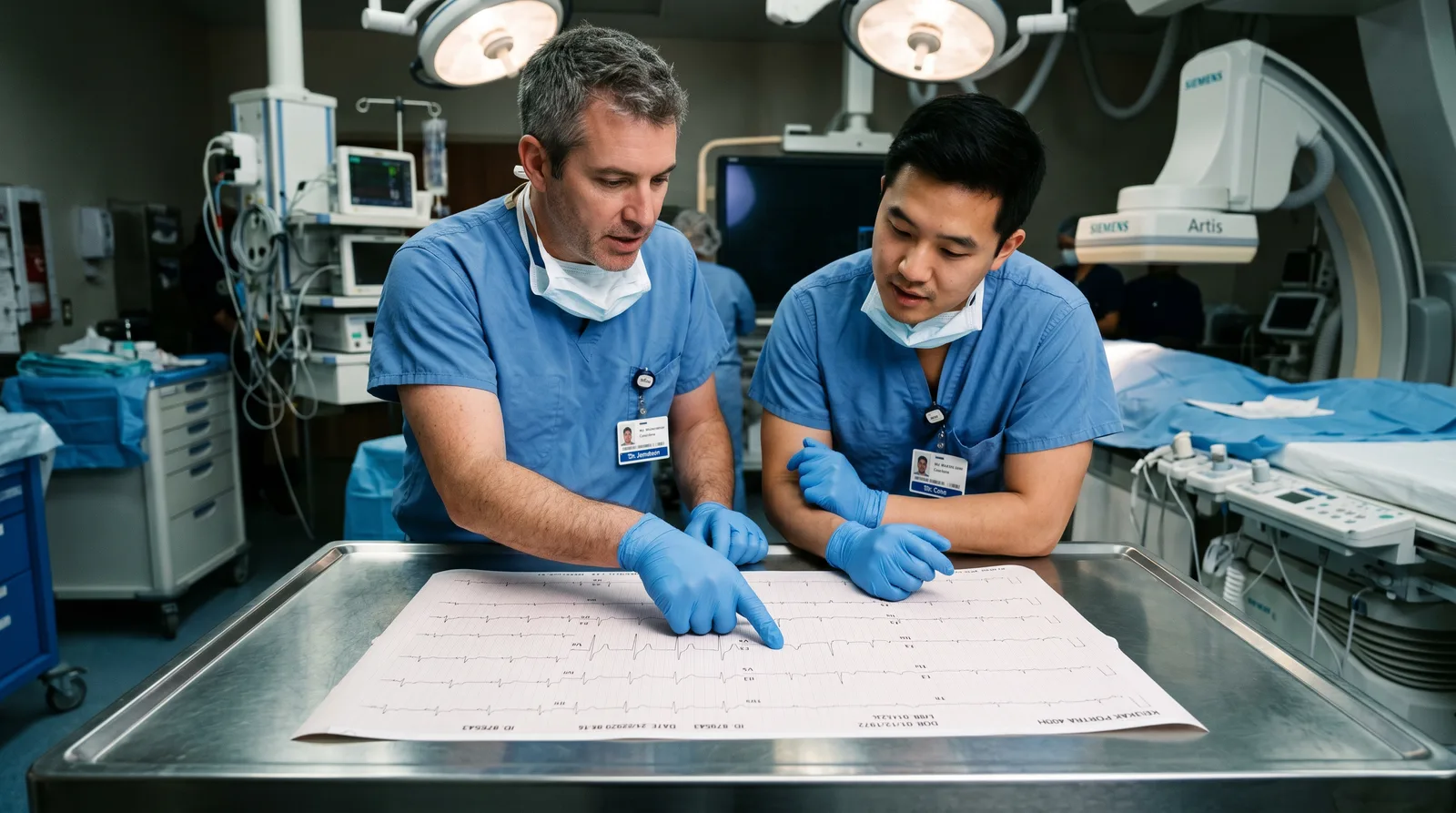
- Interpret complex 12-lead ECGs with confidence, recognizing subtle ischemic patterns, axis deviations, and arrhythmias in real time
- Apply a systematic framework for diagnosing and risk-stratifying acute coronary syndromes at the bedside
- Understand and explain advanced hemodynamic principles, including cardiac output, filling pressures, and valvular gradients
- Read and clinically correlate echocardiographic findings for common structural and functional cardiac pathologies
- Construct evidence-based management plans for heart failure, atrial fibrillation, and hypertensive emergencies
- Counsel patients and families on cardiovascular risk reduction using the latest guideline-directed strategies
How it works
A school that adapts to you
This isn't a set of static videos. Every lesson is generated live and tuned to where you actually are.
We learn your level
A quick placement check tailors your starting point so you're never bored or lost.
Lessons adapt as you go
Each lesson is written for your pace and your goal, adjusting as your skills grow.
Your AI coach keeps you moving
Checkpoints, feedback, and gentle nudges turn progress into a real result.
The curriculum
What's inside your school
6 modules · 30 lessons

ECG Interpretation: From Fundamentals to Complex Patterns
Builds a systematic, confident approach to reading 12-lead ECGs, covering axis, intervals, ischemia, and arrhythmias.
- 1.1The Systematic ECG FrameworkIncluded
- 1.2Axis Deviations and Conduction AbnormalitiesIncluded
- 1.3Ischemia, Injury, and Infarction PatternsIncluded
- 1.4Arrhythmia Recognition and DiagnosisIncluded
- 1.5High-Stakes ECG Cases: Mimics and PitfallsIncluded
Acute Coronary Syndromes: Diagnosis, Risk Stratification, and Management
Provides a rigorous bedside framework for diagnosing, stratifying, and initiating guideline-directed care for ACS.
- 2.1ACS Pathophysiology and Clinical SpectrumIncluded
- 2.2Bedside Diagnosis: History, Exam, and BiomarkersIncluded
- 2.3Risk Stratification Tools and Decision FrameworksIncluded
- 2.4Acute Management and Antiplatelet/Anticoagulation StrategyIncluded
- 2.5Post-ACS Care and Secondary PreventionIncluded
Advanced Hemodynamics: Understanding the Failing and Stressed Heart
Develops fluency in hemodynamic principles — cardiac output, preload, afterload, filling pressures, and valvular gradients — for real clinical application.
- 3.1Core Hemodynamic Principles: CO, Preload, and AfterloadIncluded
- 3.2Filling Pressures and the Pressure-Volume LoopIncluded
- 3.3Valvular Gradients and Hemodynamic ConsequencesIncluded
- 3.4Invasive Hemodynamic Monitoring: Swan-Ganz and BeyondIncluded
- 3.5Hemodynamic Profiles in Shock: Recognition and Targeted TherapyIncluded
Clinical Echocardiography: Reading and Correlating Findings
Trains clinicians to interpret echo reports and images for structural and functional cardiac pathologies in everyday practice.
- 4.1Echo Fundamentals: Views, Modalities, and What to Look ForIncluded
- 4.2Systolic and Diastolic Function AssessmentIncluded
- 4.3Valvular Heart Disease on EchoIncluded
- 4.4Pericardial Disease, Effusions, and TamponadeIncluded
- 4.5Point-of-Care Echo in Acute SettingsIncluded
Heart Failure, Atrial Fibrillation, and Hypertensive Emergencies
Delivers evidence-based, guideline-directed management strategies for the three highest-stakes cardiology syndromes encountered in practice.
- 5.1Heart Failure with Reduced EF: Diagnosis and GDMTIncluded
- 5.2Heart Failure with Preserved EF: A Distinct ChallengeIncluded
- 5.3Acute Decompensated Heart Failure: In-Hospital ManagementIncluded
- 5.4Atrial Fibrillation: Rate, Rhythm, and AnticoagulationIncluded
- 5.5Hypertensive Emergencies: Recognition and Targeted TreatmentIncluded
Cardiovascular Risk Reduction and Patient-Centered Prevention
Equips clinicians to counsel patients on primary and secondary cardiovascular prevention using the latest guideline-directed strategies.
- 6.1Cardiovascular Risk Calculators and Shared Decision-MakingIncluded
- 6.2Lipid Management: Statins, Ezetimibe, and PCSK9 InhibitorsIncluded
- 6.3Hypertension, Diabetes, and Obesity as Cardiac Risk DriversIncluded
- 6.4Lifestyle Medicine: Diet, Exercise, and Smoking CessationIncluded
- 6.5Counseling Skills: Communicating Risk and Building AdherenceIncluded
Who it's for
Is this you?

Internal Medicine Residents
You're managing cardiac patients daily and need the mechanistic depth — from ACS risk stratification to hemodynamic profiling — to move from protocol-follower to independent clinical reasoner.

Hospitalists
You own complex cardiac admissions and need fluency in echo correlation, heart failure management, and hypertensive emergencies that goes far beyond what residency covered.

Medical Students (Clinical Years)
You're entering wards and ICUs where ECG interpretation and ACS management are tested in real time — this curriculum builds the cardiology reasoning that will make you stand out on every rotation.

Primary Care Internists
You're managing atrial fibrillation, heart failure, and cardiovascular risk in your panel every day — this school deepens the evidence-based framework behind your most consequential decisions.

Emergency Medicine Clinicians
From the subtle STEMI equivalent to the undifferentiated shock presentation, advanced ECG interpretation and hemodynamic profiling are the exact skills that sharpen your highest-acuity decisions.

Advanced Practice Providers
NPs and PAs working in cardiology, hospital medicine, or primary care will gain the guideline-grounded, mechanistic fluency needed to function as true clinical partners in complex cardiac care.
Questions
Frequently asked
Your teacher
A note from your teacher

Dr. J Raymond ABK
If you're reading this, you already know the feeling. You're standing at the bedside — or reviewing a chart — and the clinical picture isn't clean. The ECG has something subtle you can't quite name. The hemodynamics don't fit the pattern you expected. You're managing an ACS or a decompensated heart failure patient and you want to be certain, not just approximate.
Most cardiology education doesn't prepare you for that moment. It prepares you for the exam. There's a difference — and if you've spent time in a busy hospital, you feel it every shift.
I designed Cardiology Mastery because the gap between what's taught and what's needed at the bedside is real, and it's closeable. Not with more memorization. Not with another review course that walks you through the easy cases. But with a rigorous, mechanistic approach — the same one a cardiologist uses when reasoning through a difficult presentation — applied systematically to the topics that matter most: ECG interpretation, ACS, hemodynamics, echocardiography, heart failure and arrhythmia management, and cardiovascular risk reduction.
Every module in this curriculum is built around the same principle: understand the mechanism, build the framework, then apply it under clinical pressure. When we cover the pressure-volume loop, it's not an academic exercise — it's so you can look at a hemodynamic profile in a patient in shock and know immediately where the lesion is. When we work through ECG mimics and pitfalls, it's because the real cases don't announce themselves. Confidence at the bedside comes from having seen the pattern before, in a setting where the stakes of learning were lower.
There is no shortcut to genuine clinical expertise in cardiology. But there is a smarter path — one that builds your reasoning from the ground up, treats you as the intelligent professional you are, and keeps every concept anchored in the patient in front of you. If you're ready to think like a cardiologist, I'm glad you're here. Let's get to work.
— Dr. J Raymond ABK
Start your journey today
Join get instant access — learn at your own pace with an AI coach in your corner.
$9.99/mo
Recurring billing · cancel anytime
Secure checkout · Instant access
- 6 modules, 30 lessons
- AI-adaptive lessons tuned to your level
- Quizzes & checkpoints to lock in progress
- Your own AI learning coach
- Learn on any device, at your pace
- Full access for as long as you're subscribed