
Master gastroenterology at the level of a consultant
A rigorous, evidence-anchored curriculum — built for physicians who already know medicine and are ready to operate at the sharp end of GI diagnostics, hepatobiliary emergencies, and advanced endoscopic decision-making.
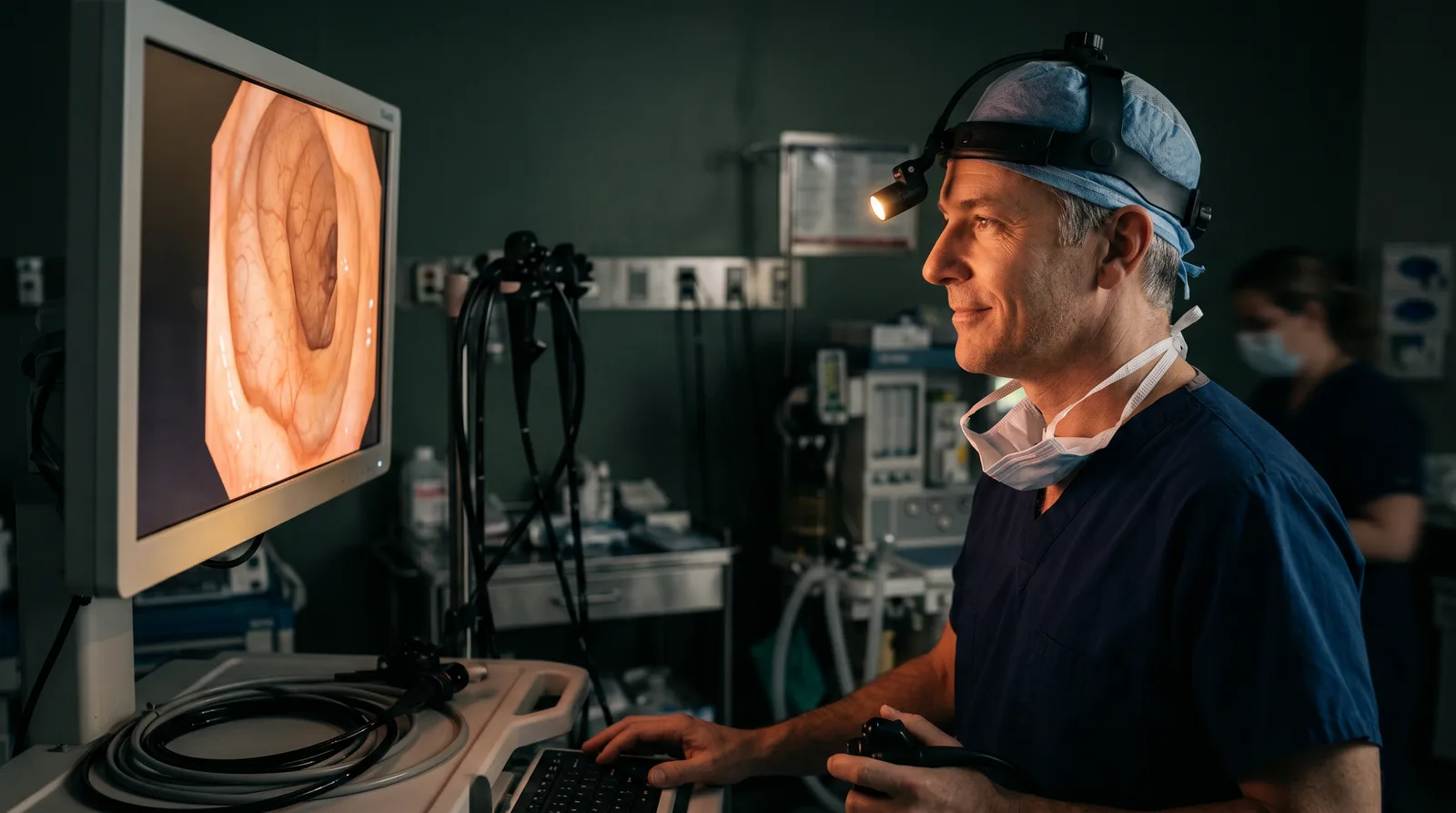
"My goal is simple: when you finish this curriculum, you should be able to walk into any complex GI case — bleeding, biliary emergency, refractory IBD, hereditary cancer syndrome — and know exactly how to think it through."— Dr. J Raymond ABK
What you'll learn
What you'll be able to do
- Systematically evaluate and manage complex GI presentations including GI bleeding, IBD flares, and motility disorders using current evidence-based algorithms.
- Interpret advanced endoscopic and radiologic findings — including EUS, MRCP, and capsule endoscopy — with diagnostic confidence.
- Apply up-to-date pharmacological strategies for conditions such as Crohn's disease, ulcerative colitis, GERD, and hepatic encephalopathy.
- Counsel patients on colorectal cancer screening protocols, surveillance intervals, and risk stratification based on current society guidelines.
- Recognize and manage hepatobiliary emergencies including acute liver failure, variceal hemorrhage, and cholangitis with a structured, protocol-driven approach.
- Navigate procedural decision-making for common GI interventions — including when to escalate, refer, or pursue advanced endoscopic therapy.
How it works
A school that adapts to you
This isn't a set of static videos. Every lesson is generated live and tuned to where you actually are.
We learn your level
A quick placement check tailors your starting point so you're never bored or lost.
Lessons adapt as you go
Each lesson is written for your pace and your goal, adjusting as your skills grow.
Your AI coach keeps you moving
Checkpoints, feedback, and gentle nudges turn progress into a real result.
The curriculum
What's inside your school
6 modules · 28 lessons

Foundations of Advanced GI Diagnostics
Builds a rigorous framework for interpreting clinical presentations and selecting the right diagnostic modality — endoscopic, radiologic, or histologic — with confidence.
- 1.1Clinical Reasoning in Complex GI PresentationsIncluded
- 1.2Endoscopic Interpretation: Upper and Lower GI FindingsIncluded
- 1.3Advanced Endoscopy: EUS and Capsule EndoscopyIncluded
- 1.4Hepatobiliary Imaging: MRCP, CT, and UltrasoundIncluded
- 1.5GI Pathology Essentials for the ClinicianIncluded
Luminal GI Disease: Diagnosis and Evidence-Based Management
Covers the full clinical management of major luminal disorders — from esophagus to colon — using current evidence-based guidelines.
- 2.1GERD, Barrett's Esophagus, and Esophageal Motility DisordersIncluded
- 2.2Peptic Ulcer Disease and H. pylori: Modern ManagementIncluded
- 2.3Crohn's Disease: Phenotyping, Pharmacology, and Treat-to-TargetIncluded
- 2.4Ulcerative Colitis: Induction, Maintenance, and EscalationIncluded
- 2.5Celiac Disease, Malabsorption, and Functional GI DisordersIncluded
GI Bleeding and Acute GI Emergencies
Equips physicians to triage, resuscitate, and definitively manage upper and lower GI bleeding and other acute luminal emergencies using protocol-driven approaches.
- 3.1Risk Stratification and Resuscitation in Acute GI BleedingIncluded
- 3.2Endoscopic Hemostasis: Techniques and Decision-MakingIncluded
- 3.3Lower GI Bleeding: Colonoscopic and Radiologic InterventionIncluded
- 3.4Obscure GI Bleeding and Small Bowel HemorrhageIncluded
Hepatology and Hepatobiliary Emergencies
Provides a structured, protocol-driven approach to chronic liver disease, hepatic emergencies, and biliary conditions encountered in hospital and outpatient practice.
- 4.1Cirrhosis: Staging, Monitoring, and Complication PreventionIncluded
- 4.2Variceal Hemorrhage: From Acute Management to Secondary ProphylaxisIncluded
- 4.3Acute Liver Failure: Recognition, Workup, and EscalationIncluded
- 4.4Hepatic Encephalopathy and Spontaneous Bacterial PeritonitisIncluded
- 4.5Cholangitis and Biliary Emergencies: ERCP Decision-MakingIncluded
Colorectal Cancer Screening, Surveillance, and GI Oncology
Trains physicians to counsel patients on CRC screening, apply society-guideline surveillance intervals, and recognize GI malignancy at key decision points.
- 5.1CRC Screening Modalities and Patient Risk StratificationIncluded
- 5.2Polyp Pathology and Post-Polypectomy Surveillance IntervalsIncluded
- 5.3Hereditary GI Cancer Syndromes: Lynch, FAP, and BeyondIncluded
- 5.4GI Malignancies: Staging, Multidisciplinary Workup, and ReferralIncluded
Procedural Decision-Making and Advanced Endoscopic Therapy
Develops sound clinical judgment for GI procedural indications, escalation decisions, and advanced therapeutic endoscopy in complex patients.
- 6.1Procedural Indications and Contraindications: When to ScopeIncluded
- 6.2Advanced Polypectomy: EMR, ESD, and Piecemeal ResectionIncluded
- 6.3ERCP: Indications, Technique Principles, and Complication ManagementIncluded
- 6.4When to Escalate: Surgery, IR, and Multidisciplinary ReferralIncluded
- 6.5Shared Decision-Making, Informed Consent, and Patient Counseling in GIIncluded
Who it's for
Is this you?

Internal Medicine Residents
Build the diagnostic and management framework for GI rotations and the complex GI presentations you'll encounter as a hospitalist or subspecialty trainee.

GI Fellows
Deepen your subspecialty reasoning — from IBD treat-to-target pharmacology to ERCP decision-making — at the level your attendings expect on advanced rotations.

Hospitalist Physicians
Manage GI bleeding, hepatic encephalopathy, and biliary emergencies with greater protocol-driven confidence before and after GI consultation.

General Internists
Update your clinical knowledge across luminal GI disease, colorectal cancer surveillance, and hepatology to manage more and refer smarter.

Practicing Gastroenterologists
Systematically refresh your expertise in rapidly evolving areas — advanced endoscopy, hereditary cancer syndromes, and current IBD pharmacological strategies.

Primary Care Physicians
Develop the clinical granularity to guide CRC screening, interpret GI workups, and recognize the presentations that warrant urgent GI referral.
Questions
Frequently asked
Your teacher
A note from your teacher

Dr. J Raymond ABK
If you're reading this, you already know the feeling. You're managing a patient with decompensated cirrhosis and a rising creatinine, or fielding a question from a fellow about whether to scope a patient on dual antiplatelet therapy, and you want to be certain — not just confident — that your reasoning is airtight and your plan reflects the best current evidence. You've done the training. You've read the guidelines. But medicine moves fast, and GI and hepatology move faster than most.
This school exists for that gap.
I built this curriculum the way I wish someone had taught me on rounds — not as a catalog of facts to memorize, but as a structured way of thinking through the cases that actually challenge you. When do you add a biologic versus optimizing 5-ASA? How do you differentiate early cholangitis from a benign post-ERCP fever, and what's the threshold for intervention? What does this polyp's pathology actually mean for the surveillance interval, and how do you explain that to a patient who already lost a sibling to colon cancer? These are the questions this curriculum is built to answer.
I've been deliberate about anchoring every section in landmark trial data and current society guidelines — not because guidelines are gospel, but because you need to know exactly what they say before you can reason around them with clinical judgment. The IBD sections walk through treat-to-target strategy and the pharmacological escalation decisions that define modern IBD management. The hepatology modules cover the full arc from cirrhosis staging and prophylaxis through the acute management of variceal hemorrhage and acute liver failure. The procedural section is designed to sharpen the judgment that separates a good endoscopist from a great consulting physician — when to scope, how to counsel, and when the right answer is to pick up the phone for surgery or IR.
I've also included the topics that often get shortchanged in traditional training: capsule endoscopy interpretation, hereditary GI cancer syndromes beyond basic Lynch screening, GI pathology essentials for the non-pathologist, and shared decision-making in high-stakes procedural conversations. These are the competencies that distinguish the physician patients and colleagues trust with their hardest cases.
If you're a resident or fellow in the middle of training, this will help you build the clinical architecture that transforms experience into expertise. If you're an attending who wants to practice with more certainty and less second-guessing, you'll find this curriculum both validating and genuinely expanding. Either way, I'm glad you're here. Let's get to work.
— Dr. J Raymond ABK
Start your journey today
Join get instant access — learn at your own pace with an AI coach in your corner.
$9.99/mo
Recurring billing · cancel anytime
Secure checkout · Instant access
- 6 modules, 28 lessons
- AI-adaptive lessons tuned to your level
- Quizzes & checkpoints to lock in progress
- Your own AI learning coach
- Learn on any device, at your pace
- Full access for as long as you're subscribed