
Master genetics from the molecule up
From the double helix to CRISPR, this school gives serious learners a graduate-caliber command of genetics — rigorous enough to ace your exams, deep enough to change how you think about life itself.
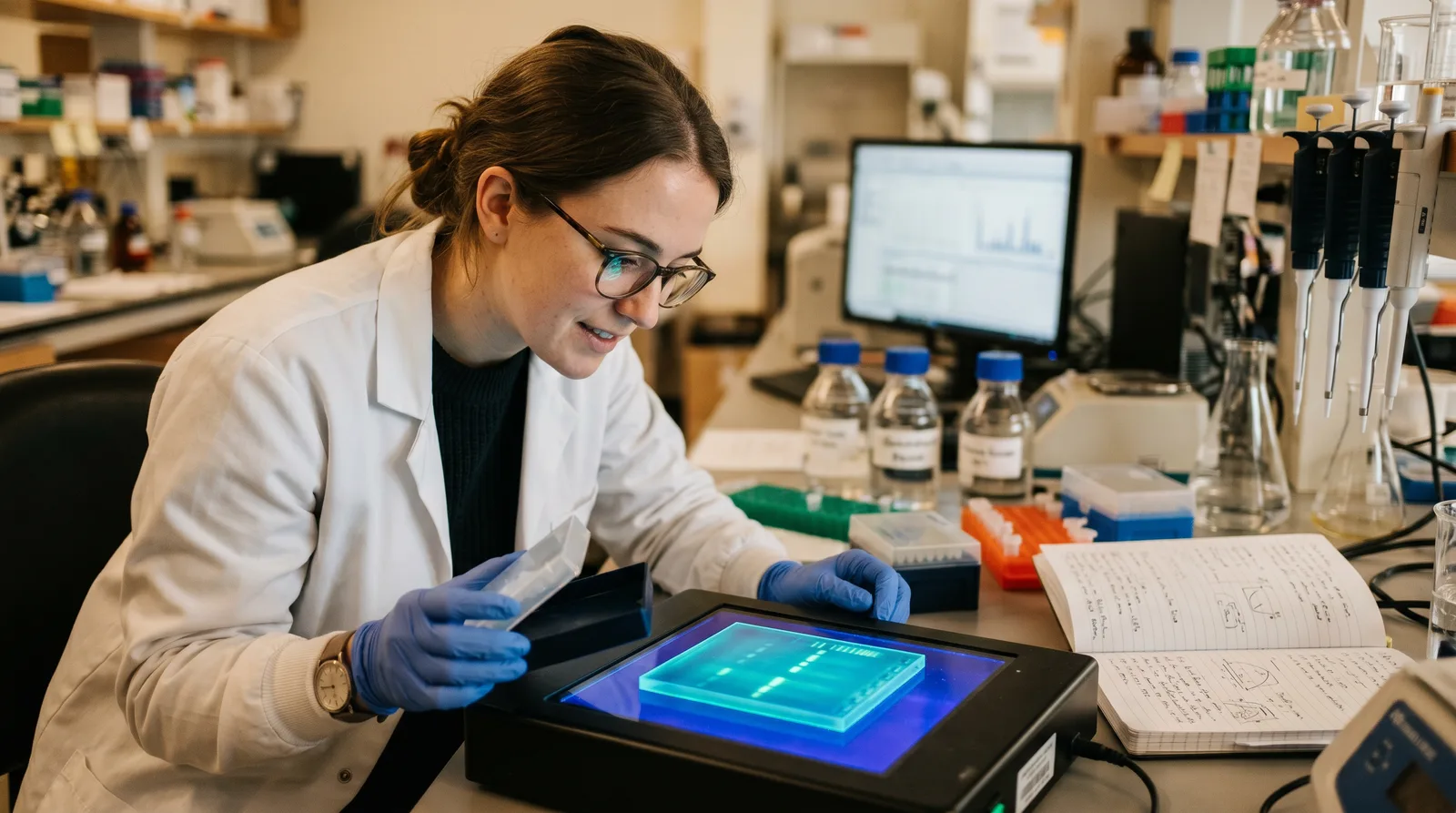
"I will never hand you a rule without showing you the mechanism behind it — because rules you understand can never be forgotten."— Dr. J Raymond ABK
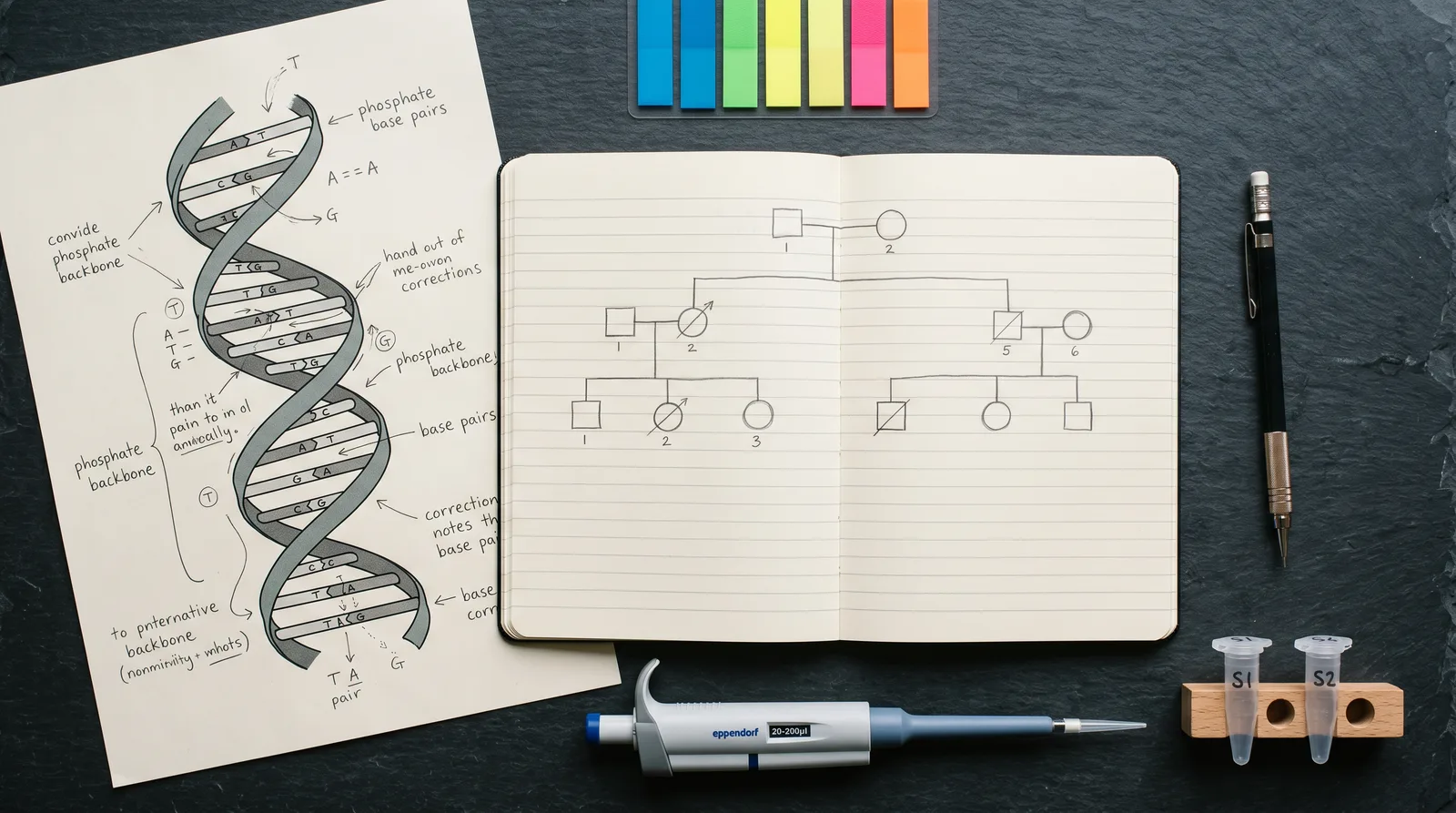
What you'll learn
What you'll be able to do
- Explain the mechanisms of DNA replication, transcription, and translation with molecular-level accuracy
- Solve classical and complex Mendelian genetics problems, including linkage, epistasis, and incomplete dominance
- Interpret real genomic data, pedigree charts, and karyotypes used in clinical and research settings
- Understand how mutations arise, propagate, and drive evolution or disease at the population level
- Describe how CRISPR-Cas9 and modern gene-editing tools work and evaluate their ethical implications
- Design a basic genetic experiment — from hypothesis through cross design, data collection, and statistical analysis
How it works
A school that adapts to you
This isn't a set of static videos. Every lesson is generated live and tuned to where you actually are.
We learn your level
A quick placement check tailors your starting point so you're never bored or lost.
Lessons adapt as you go
Each lesson is written for your pace and your goal, adjusting as your skills grow.
Your AI coach keeps you moving
Checkpoints, feedback, and gentle nudges turn progress into a real result.
The curriculum
What's inside your school
6 modules · 29 lessons

The Molecular Blueprint: DNA Structure & Expression
Establishes the molecular foundation of genetics, covering DNA architecture and the central dogma from replication through protein synthesis.
- 1.1DNA Structure & the Double HelixIncluded
- 1.2DNA Replication: Copying the CodeIncluded
- 1.3Transcription: From DNA to RNAIncluded
- 1.4Translation: Building Proteins from mRNAIncluded
- 1.5Gene Regulation: Turning Genes On and OffIncluded
Mendelian Genetics & Beyond: Inheritance Patterns
Builds problem-solving fluency across classical and non-classical inheritance scenarios, from simple monohybrid crosses to epistasis and linkage.
- 2.1Mendel's Laws: Segregation & Independent AssortmentIncluded
- 2.2Probability & Punnett Squares: Solving Genetics ProblemsIncluded
- 2.3Incomplete Dominance, Codominance & Multiple AllelesIncluded
- 2.4Epistasis & Gene InteractionIncluded
- 2.5Linkage, Recombination & Genetic MappingIncluded
Chromosomes, Mutations & Genomic Variation
Connects chromosomal organization and mutation types to real clinical tools like karyotyping and pedigree analysis.
- 3.1Chromosome Structure & KaryotypingIncluded
- 3.2Sex Determination & X-Linked InheritanceIncluded
- 3.3Reading Pedigree Charts in Clinical ContextsIncluded
- 3.4Types of Mutations: From Point Mutations to Chromosomal RearrangementsIncluded
- 3.5Mutations, DNA Repair & DiseaseIncluded
Population Genetics & Evolutionary Forces
Scales genetics from individuals to populations, showing how allele frequencies shift under mutation, selection, drift, and gene flow.
- 4.1The Hardy-Weinberg EquilibriumIncluded
- 4.2Natural Selection & Adaptive EvolutionIncluded
- 4.3Genetic Drift, Bottlenecks & the Founder EffectIncluded
- 4.4Mutation Rates, Gene Flow & SpeciationIncluded
Genomics, Biotechnology & Gene Editing
Covers modern tools for reading, manipulating, and editing genomes — from sequencing technology to CRISPR — and their real-world applications.
- 5.1Genomic Technologies: Sequencing & Bioinformatics BasicsIncluded
- 5.2Interpreting Genomic Data: SNPs, CNVs & GWASIncluded
- 5.3Recombinant DNA, Cloning & PCRIncluded
- 5.4CRISPR-Cas9: Mechanism & ApplicationsIncluded
- 5.5Ethics, Equity & the Future of Gene EditingIncluded
Designing & Analyzing Genetic Experiments
Translates all prior knowledge into scientific practice by guiding learners through the full arc of designing, executing, and analyzing a genetics experiment.
- 6.1Formulating a Genetic HypothesisIncluded
- 6.2Cross Design & Experimental ControlsIncluded
- 6.3Chi-Square Analysis & Statistical InterpretationIncluded
- 6.4Interpreting Results & Identifying Sources of ErrorIncluded
- 6.5Communicating Genetic FindingsIncluded
Who it's for
Is this you?

Pre-Med Students
Build the mechanistic genetics foundation the MCAT tests and medical school assumes — not just memorized rules, but causal understanding you can apply under pressure.

Undergraduate Bio Majors
Go deeper than your lecture course allows: fill the gaps, master the problem-solving, and arrive at exams and lab rotations genuinely prepared.

Nursing & Allied Health Students
Understand the genetic basis of disease, inheritance patterns in clinical pedigrees, and chromosomal conditions with the rigor your patients will one day depend on.

Science Educators
Teach genetics with the molecular confidence to answer every hard question a curious student throws at you — from DNA repair to CRISPR ethics.

Research Lab Newcomers
Understand the conceptual and statistical foundations behind the experiments you're running, so you contribute ideas, not just pipette technique.

Intellectually Curious Adults
You read science news about gene editing and genomics and want to understand what's actually happening — this school gives you the real framework, not the pop-science summary.
Questions
Frequently asked
Your teacher
A note from your teacher

Dr. J Raymond ABK
If you've ever sat in a genetics lecture and walked out more confused than when you walked in — or opened a textbook, read a paragraph three times, and still couldn't picture what was actually happening inside the cell — I want you to know that the problem almost certainly wasn't you.
Genetics is genuinely hard to teach. The concepts span five orders of magnitude, from a single nucleotide to an entire population. The vocabulary is dense, the diagrams in most textbooks are cluttered or misleading, and the jumps in reasoning that seem obvious to an expert are invisible to someone encountering the material for the first time. Most courses respond to this by simplifying — by trading accuracy for approachability until what you're left with is a set of rules that work until they don't, and no real understanding of why.
I built Genetics Mastery because I believe you deserve better than that. Every lesson in this school is designed around a single question: what does a careful thinker actually need to understand this? That means we build the double helix before we replicate it. We understand why Mendel's laws hold before we explore the conditions under which they break down. We trace the molecular mechanism of CRISPR — the guide RNA, the PAM sequence, the Cas9 conformational change, the choice between HDR and NHEJ — before we discuss what it means to edit a human embryo. The order matters. The mechanism matters. The why always matters.
I also want to be honest with you about what this school is and isn't. It is not a shortcut. If you want to genuinely understand genetics at the level where you can solve problems you've never seen, read primary literature, design a real experiment, and hold your own in a graduate seminar, that requires thinking — careful, sustained, sometimes uncomfortable thinking. What I promise is that every moment of that thinking will be guided, purposeful, and rewarded with the kind of clarity that doesn't fade after the exam.
You'll leave this school able to explain DNA replication with molecular precision, work through multi-gene inheritance problems systematically, read a pedigree chart the way a clinical geneticist does, and understand how population-level forces like drift and selection connect to the molecular events we study at the bench. You'll understand CRISPR well enough to have an informed opinion about it — which, right now, is a rare and valuable thing.
Whether you're a pre-med student looking for the deep foundation the MCAT rewards, a biology major who wants to actually understand what your professor is gesturing at, a science educator ready to teach this material with real confidence, or simply someone who finds the machinery of heredity genuinely fascinating — this school was built for you. Come ready to think, and I'll meet you there.
— Dr. J Raymond ABK
Start your journey today
Join get instant access — learn at your own pace with an AI coach in your corner.
$9.99/mo
Recurring billing · cancel anytime
Secure checkout · Instant access
- 6 modules, 29 lessons
- AI-adaptive lessons tuned to your level
- Quizzes & checkpoints to lock in progress
- Your own AI learning coach
- Learn on any device, at your pace
- Full access for as long as you're subscribed