
Master the immune system from molecule to clinic
A graduate-level, mechanistically rigorous deep-dive — from NF-κB signaling cascades and germinal center dynamics to checkpoint inhibitors and CAR-T cell design — built for scientists and clinicians who need more than surface-level biology.
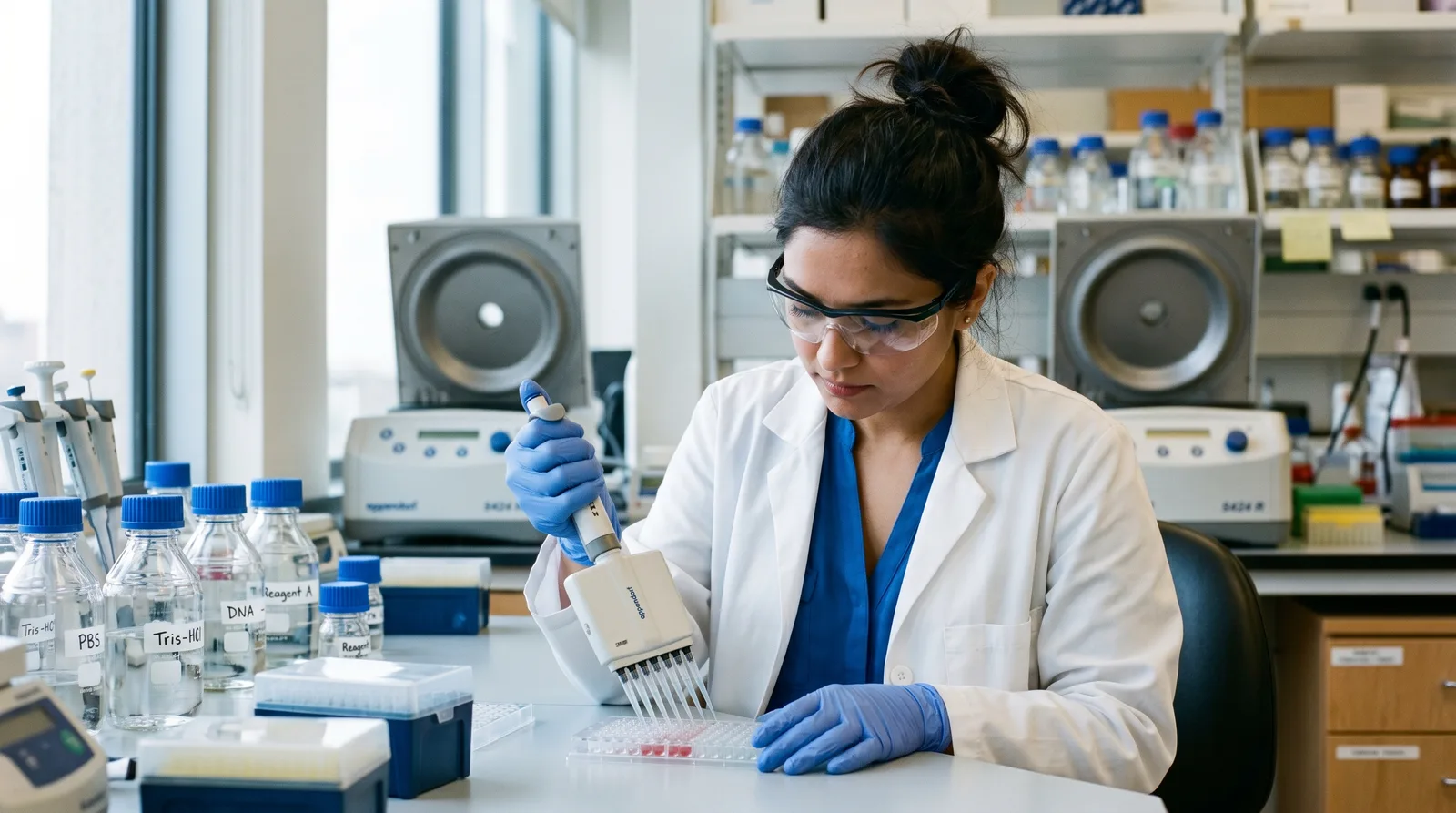
My job isn't to give you answers to memorize — it's to hand you the mechanistic reasoning that makes the right answers obvious.— Dr. J Raymond ABK
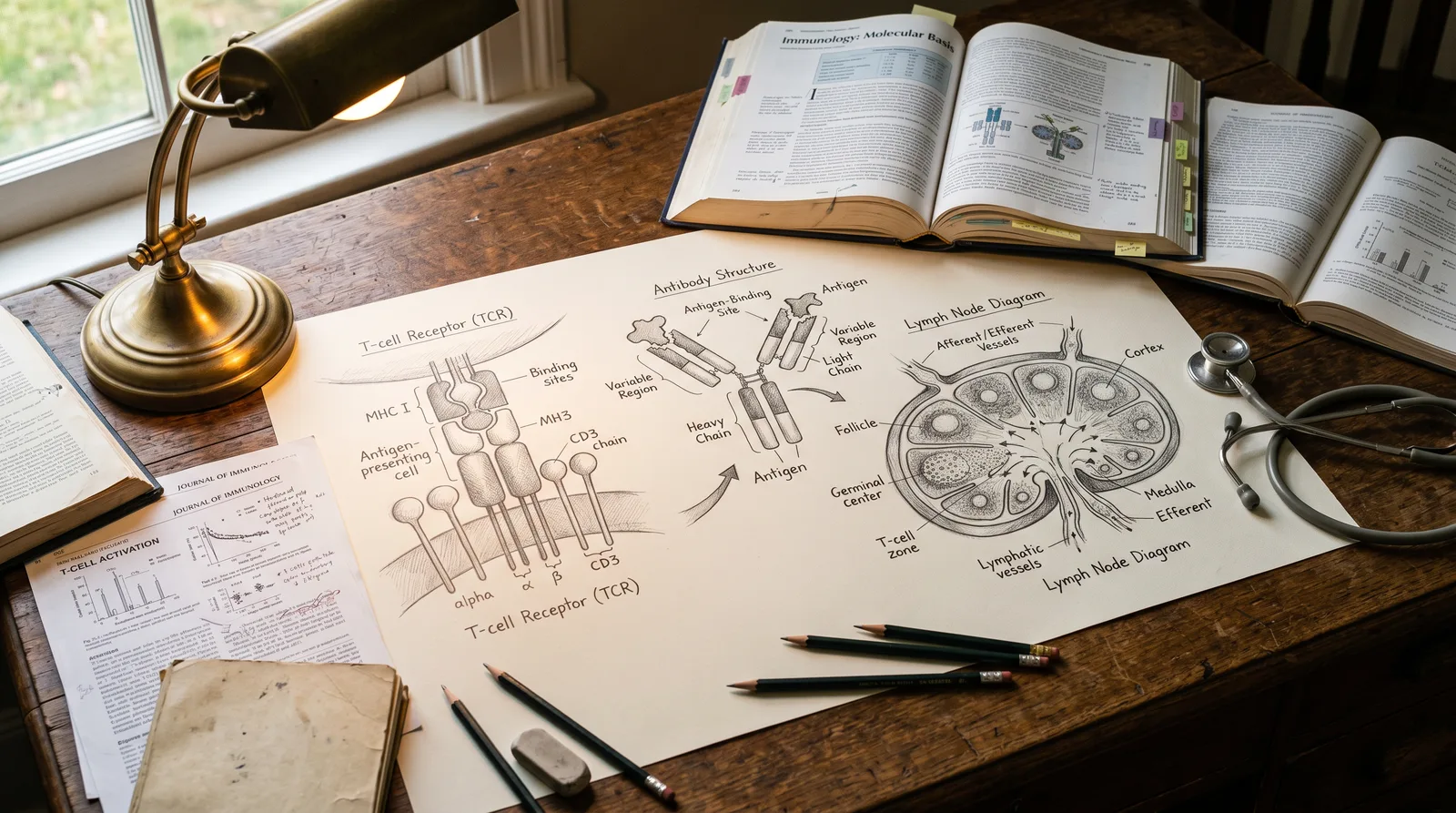
What you'll learn
What you'll be able to do
- Trace the complete activation cascade of both innate and adaptive immune responses at the molecular and cellular level
- Distinguish the mechanisms of MHC class I vs. class II antigen presentation and explain their clinical consequences
- Analyze how immune tolerance breaks down in autoimmune diseases such as lupus, MS, and type 1 diabetes
- Evaluate the immunological rationale behind modern therapies including checkpoint inhibitors, CAR-T cells, and monoclonal antibodies
- Interpret key diagnostic data — ELISA, flow cytometry, and immunofluorescence panels — used in clinical and research immunology
- Design a mechanistically sound hypothesis for how a novel pathogen or vaccine candidate would engage the immune system
How it works
A school that adapts to you
This isn't a set of static videos. Every lesson is generated live and tuned to where you actually are.
We learn your level
A quick placement check tailors your starting point so you're never bored or lost.
Lessons adapt as you go
Each lesson is written for your pace and your goal, adjusting as your skills grow.
Your AI coach keeps you moving
Checkpoints, feedback, and gentle nudges turn progress into a real result.
The curriculum
What's inside your school
6 modules · 30 lessons

Foundations of the Immune System
Establishes the architectural and conceptual framework of immunity — cells, organs, and the cardinal distinction between innate and adaptive responses.
- 1.1The Immune System at a GlanceIncluded
- 1.2Hematopoiesis and Immune Cell LineagesIncluded
- 1.3Innate vs. Adaptive Immunity: Core PrinciplesIncluded
- 1.4Cytokines, Chemokines, and the Language of ImmunityIncluded
Innate Immunity: Sensors, Signals, and Effectors
Dissects the molecular machinery that detects pathogens and mounts the first-line response, from pattern recognition to inflammation.
- 2.1Pattern Recognition Receptors and PAMPs/DAMPsIncluded
- 2.2Intracellular Signaling Cascades: NF-κB and IRF PathwaysIncluded
- 2.3The Inflammatory Response: Initiation and ResolutionIncluded
- 2.4Innate Effector Cells: Neutrophils, Macrophages, NK Cells, and Dendritic CellsIncluded
- 2.5The Complement SystemIncluded
Antigen Presentation and T-Cell Activation
Covers the molecular events of antigen processing and MHC presentation that bridge innate sensing to adaptive T-cell responses.
- 3.1MHC Class I: Endogenous Antigen Processing and CD8⁺ T-Cell ActivationIncluded
- 3.2MHC Class II: Exogenous Antigen Processing and CD4⁺ T-Cell ActivationIncluded
- 3.3Cross-Presentation and Non-Classical Antigen PresentationIncluded
- 3.4T-Cell Receptor Signaling and Co-stimulationIncluded
- 3.5T-Cell Differentiation: Th1, Th2, Th17, Treg, and BeyondIncluded
B Cells, Antibodies, and Humoral Immunity
Examines B-cell development, germinal-center reactions, antibody diversification, and the effector functions of immunoglobulins.
- 4.1B-Cell Development and Central ToleranceIncluded
- 4.2BCR Signaling, T-Dependent and T-Independent ActivationIncluded
- 4.3Germinal Centers: Somatic Hypermutation and Affinity MaturationIncluded
- 4.4Antibody Classes, Isotype Switching, and Effector FunctionsIncluded
- 4.5Immunological Memory: B-Cell and T-Cell Recall ResponsesIncluded
Immune Tolerance, Autoimmunity, and Immunodeficiency
Analyzes the mechanisms that maintain self-tolerance and the molecular and genetic breakdowns that cause autoimmune and immunodeficiency diseases.
- 5.1Central and Peripheral Tolerance MechanismsIncluded
- 5.2Autoimmunity: Genetic, Environmental, and Molecular TriggersIncluded
- 5.3Disease Deep Dives: Lupus, Multiple Sclerosis, and Type 1 DiabetesIncluded
- 5.4Primary Immunodeficiencies: Lessons from NatureIncluded
- 5.5Secondary Immunodeficiencies: HIV/AIDS as a ModelIncluded
Immunity in Action: Vaccines, Cancer, and Therapeutic Immunology
Applies mechanistic immunology to vaccines, tumor immunology, and cutting-edge clinical therapies, culminating in hypothesis-design skills.
- 6.1Vaccine Immunology: Platforms, Adjuvants, and Correlates of ProtectionIncluded
- 6.2Tumor Immunology and Immune EvasionIncluded
- 6.3Checkpoint Inhibitors and CAR-T Cell TherapyIncluded
- 6.4Monoclonal Antibodies and Biologic ImmunotherapiesIncluded
- 6.5Immunological Diagnostics: ELISA, Flow Cytometry, and ImmunofluorescenceIncluded
- 6.6Integrative Capstone: Designing an Immune Response HypothesisIncluded
Who it's for
Is this you?

Pre-med students
Build the graduate-level immunological foundation that sets your medical school application — and your future clinical reasoning — apart from the competition.

Medical students
Move beyond memorized immune pathways to the mechanistic reasoning that connects molecular biology to autoimmune diagnosis, vaccine pharmacology, and therapeutic decision-making.

Biomedical PhD candidates
Systematize and deepen your immunological knowledge so your experimental reasoning is grounded in the full mechanistic picture — from innate sensing to adaptive memory.

Nurses & clinicians
Gain the deep immunological grounding that explains why biologics, checkpoint inhibitors, and immunodiagnostic panels work — and what the results actually mean for your patients.

Life-science researchers
Whether your work touches vaccines, oncology, or infectious disease, this school gives you the systematic immunology fluency to design better experiments and read the literature with confidence.

Immunology self-studiers
For intellectually driven learners who want real graduate-level depth — not a popularized overview — and the Socratic mentorship to build genuine mechanistic intuition.
Questions
Frequently asked
Your teacher
A note from your teacher
Dr. J Raymond ABK
If you're reading this, you've probably already encountered the frustration — you open an immunology textbook, you get a list of cells and cytokines, and when you close it you still can't explain, in your own words, why the immune system does what it does. Or you're preparing for your qualifying exam, or trying to make sense of a patient's autoimmune panel, or reading a CAR-T trial paper, and you realize you're pattern-matching your way through — not actually reasoning from mechanism.
That frustration is the right instinct. It means you know there's a deeper level of understanding available, and you haven't been given the tools to reach it yet.
This school exists to give you those tools. Not a faster way to memorize receptor names — a way to actually think immunologically. When you understand that MHC class I presents endogenous peptides because cytotoxic CD8⁺ T cells need to survey what's happening inside cells, while MHC class II presents exogenous antigen because helper CD4⁺ T cells need to coordinate responses to what's been engulfed from outside — that's not trivia. That's the kind of mechanistic logic that lets you predict, reason, and design. Once you have it, you cannot un-have it.
I built this curriculum the way I wish I had been taught: with rigorous mechanistic grounding at every step, probing questions that force you to explain the why before the what, and a deliberate arc from molecular foundations through clinical consequence. We start with hematopoiesis and cytokine biology — the language of immunity. We move through innate sensing (pattern recognition receptors, NF-κB and IRF cascades, complement) into the adaptive response (TCR signaling, germinal center dynamics, affinity maturation) and out into the immunological challenges that define modern medicine: autoimmunity, cancer immune evasion, checkpoint inhibitors, mRNA vaccines, and therapeutic biologics.
I also want to be honest about what this school demands: intellectual effort. You will be asked to reason, not recite. But I promise to make that reasoning as clear and as well-scaffolded as I possibly can — building each mechanistic layer before I ask you to stand on it. My job is to be the research mentor who pushes you to think harder while making sure you always know exactly where you are in the argument.
If you've ever wanted to read an immunology paper and actually follow the logic — or explain to a colleague exactly why anti-PD-1 therapy works where it does and fails where it does — this school will get you there. I'm genuinely glad you're here. Let's get to work.
— Dr. J Raymond ABK
Start your journey today
Join get instant access — learn at your own pace with an AI coach in your corner.
$9.99/mo
Recurring billing · cancel anytime
Secure checkout · Instant access
- 6 modules, 30 lessons
- AI-adaptive lessons tuned to your level
- Quizzes & checkpoints to lock in progress
- Your own AI learning coach
- Learn on any device, at your pace
- Full access for as long as you're subscribed