
Assess further. Reason sharper. Rehabilitate with confidence.
Musculoskeletal Mastery is the clinical deep-dive for movement and healthcare professionals ready to close the gap between textbook knowledge and real-patient precision — from systematic orthopedic assessment to evidence-based rehab design and diagnostic imaging interpretation.

"Clinical excellence isn't just knowing the anatomy — it's having the reasoning framework to know exactly what it's telling you, in real time, with a real patient in front of you."— Dr. J Raymond ABK
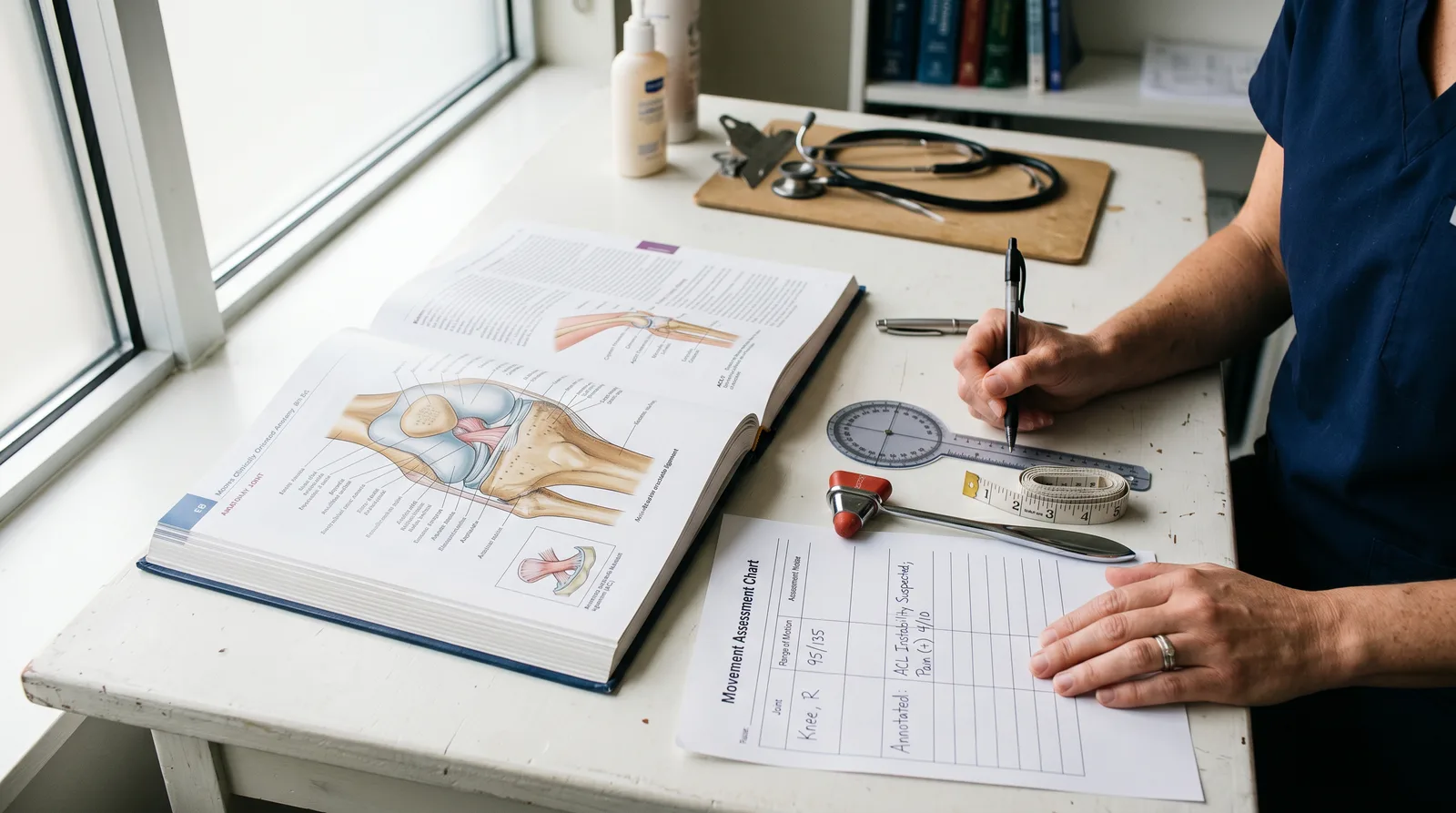
What you'll learn
What you'll be able to do
- Perform systematic orthopedic assessments and confidently identify musculoskeletal pathologies across the spine, shoulder, hip, knee, and ankle
- Apply evidence-based clinical reasoning frameworks to differentiate between contractile, inert, and neural tissue dysfunction
- Design progressive, load-appropriate rehabilitation programs tailored to tissue healing stages and patient presentation
- Interpret diagnostic imaging reports (X-ray, MRI, ultrasound) in clinical context to inform treatment planning
- Execute and teach correct movement patterns that address compensation strategies and restore functional biomechanics
- Communicate findings and prognosis clearly to patients, coaches, and multidisciplinary teams using accurate anatomical language
How it works
A school that adapts to you
This isn't a set of static videos. Every lesson is generated live and tuned to where you actually are.
We learn your level
A quick placement check tailors your starting point so you're never bored or lost.
Lessons adapt as you go
Each lesson is written for your pace and your goal, adjusting as your skills grow.
Your AI coach keeps you moving
Checkpoints, feedback, and gentle nudges turn progress into a real result.
The curriculum
What's inside your school
6 modules · 29 lessons

Foundations of Clinical Musculoskeletal Reasoning
Builds the anatomical and tissue-based framework that underpins every assessment and treatment decision in the school.
- 1.1Contractile, Inert, and Neural Tissue ClassificationIncluded
- 1.2The Selective Tissue Tension ApproachIncluded
- 1.3Tissue Healing Stages and Clinical ImplicationsIncluded
- 1.4Pain Science and Sensitisation in MSK PracticeIncluded
- 1.5Building Your Clinical Reasoning FrameworkIncluded
Systematic Orthopedic Assessment
Teaches a reproducible, head-to-toe assessment methodology across the five key body regions using validated orthopaedic tests.
- 2.1The LOOK–FEEL–MOVE Assessment FrameworkIncluded
- 2.2Spine Assessment — Cervical and LumbarIncluded
- 2.3Shoulder Complex AssessmentIncluded
- 2.4Hip and Pelvis AssessmentIncluded
- 2.5Knee and Ankle–Foot AssessmentIncluded
Diagnostic Imaging Interpretation for Clinicians
Equips practitioners to read and contextualise X-ray, MRI, and ultrasound reports to sharpen treatment planning — not replace radiology.
- 3.1Imaging Fundamentals — X-ray, MRI, and UltrasoundIncluded
- 3.2Reading X-rays in MSK PracticeIncluded
- 3.3Interpreting MRI Reports for Soft-Tissue PathologyIncluded
- 3.4Ultrasound in Point-of-Care AssessmentIncluded
- 3.5Correlating Imaging with Clinical FindingsIncluded
Functional Biomechanics and Movement Pattern Restoration
Develops the eye and language for identifying compensation strategies and restoring efficient, load-tolerant movement.
- 4.1Principles of Human Movement and Load TransferIncluded
- 4.2Identifying Compensation Patterns in AssessmentIncluded
- 4.3Corrective Cuing and Motor Learning PrinciplesIncluded
- 4.4Screening and Reassessment Tools — FMS, SFMA, and BeyondIncluded
Evidence-Based Rehabilitation Program Design
Delivers a systematic process for building progressive, individualised rehab programs anchored in tissue biology and clinical presentation.
- 5.1Principles of Progressive Overload in RehabilitationIncluded
- 5.2Designing Phase-Based Rehab ProgramsIncluded
- 5.3Load Management and Monitoring OutcomesIncluded
- 5.4Sport- and Task-Specific RehabilitationIncluded
- 5.5Return-to-Sport and Return-to-Work ClearanceIncluded
Clinical Communication and Multidisciplinary Practice
Sharpens the professional communication skills needed to convey findings, prognosis, and plans to patients, coaches, and care teams.
- 6.1Anatomical Language for Patient EducationIncluded
- 6.2Writing Clear Clinical Notes and Assessment SummariesIncluded
- 6.3Communicating with Coaches, Trainers, and AthletesIncluded
- 6.4Prognosis, Goal-Setting, and Expectation ManagementIncluded
- 6.5Navigating Referral Pathways and Scope of PracticeIncluded
Who it's for
Is this you?

Physical Therapists
Sharpen your orthopedic assessment logic, formalize your rehabilitation programming, and build the pattern recognition that makes every clinical encounter more efficient and defensible.

Sports Medicine Practitioners
Deepen your diagnostic imaging literacy, refine your return-to-sport clearance criteria, and close the gap between clinical findings and evidence-based intervention.

Osteopaths & Chiropractors
Ground your structural assessment in a systematic tissue-classification framework and enhance your clinical communication across multidisciplinary teams.

Advanced Personal Trainers
Develop a more clinical eye for movement dysfunction, compensation patterns, and load management so you can train high-performing clients with greater precision and safety.

Strength & Conditioning Coaches
Bridge the gap between performance training and clinical reasoning — understand tissue healing, functional screening tools, and how to communicate effectively with the medical team.

Rehabilitation Specialists
Build a structured, phase-based approach to progressive rehabilitation design — from acute tissue management through sport- and task-specific return-to-function clearance.
Questions
Frequently asked
Your teacher
A note from your teacher

Dr. J Raymond ABK
If you've been practising for a few years and you're good at what you do — but you sometimes find yourself running through assessments on autopilot, or writing rehabilitation programs that feel more habitual than scientifically structured — you're not alone, and you're not failing. You're just hitting the ceiling of what initial clinical training was designed to give you.
Clinical degrees and certifications teach you the vocabulary. Continuing education courses teach you isolated techniques. What rarely gets taught explicitly is the reasoning architecture — the systematic way of thinking through a presentation that lets you differentiate a rotator cuff tendinopathy from a cervical radiculopathy in the shoulder, or a labral tear from a psoas impingement at the hip, with confidence rather than guesswork. That gap is exactly what this school is designed to close.
In Musculoskeletal Mastery, I've built the course I wished existed early in my clinical career — one that moves from tissue-level science (understanding contractile, inert, and neural structures and what each one tells you under selective tension testing) through systematic regional assessment, diagnostic imaging literacy, functional biomechanics, evidence-based rehabilitation design, and clinical communication. Every module bridges theory directly to clinical presentation, because anatomical knowledge that doesn't translate to better patient decisions is just information.
I want to be clear about what this school is: it's rigorous, it respects your existing expertise, and it asks you to think carefully. It is not a shortcut and it's not a collection of party tricks. It's a structured investment in your clinical reasoning — the kind that makes your assessments more defensible, your rehab programs more precise, your imaging conversations more informed, and your patient communication more authoritative.
The practitioners who benefit most from this school are the ones who care deeply about doing this well — who feel the discomfort of uncertainty and want to replace it with grounded, evidence-based process. If that's you, you're exactly who I built this for. I'll see you inside.
— Dr. J Raymond ABK
Start your journey today
Join get instant access — learn at your own pace with an AI coach in your corner.
$9.99/mo
Recurring billing · cancel anytime
Secure checkout · Instant access
- 6 modules, 29 lessons
- AI-adaptive lessons tuned to your level
- Quizzes & checkpoints to lock in progress
- Your own AI learning coach
- Learn on any device, at your pace
- Full access for as long as you're subscribed