
Master the kidney from first principles
Renal Mastery is the rigorous, mechanistic nephrology curriculum built for clinicians who refuse to just memorize — covering kidney physiology, AKI, glomerular disease, acid-base, CKD, and dialysis with the depth that holds up on rounds, in the ICU, and at the bedside.

I don't teach nephrology facts — I teach you to think the way the kidney does, so the facts become inevitable conclusions.— Dr. J Raymond ABK
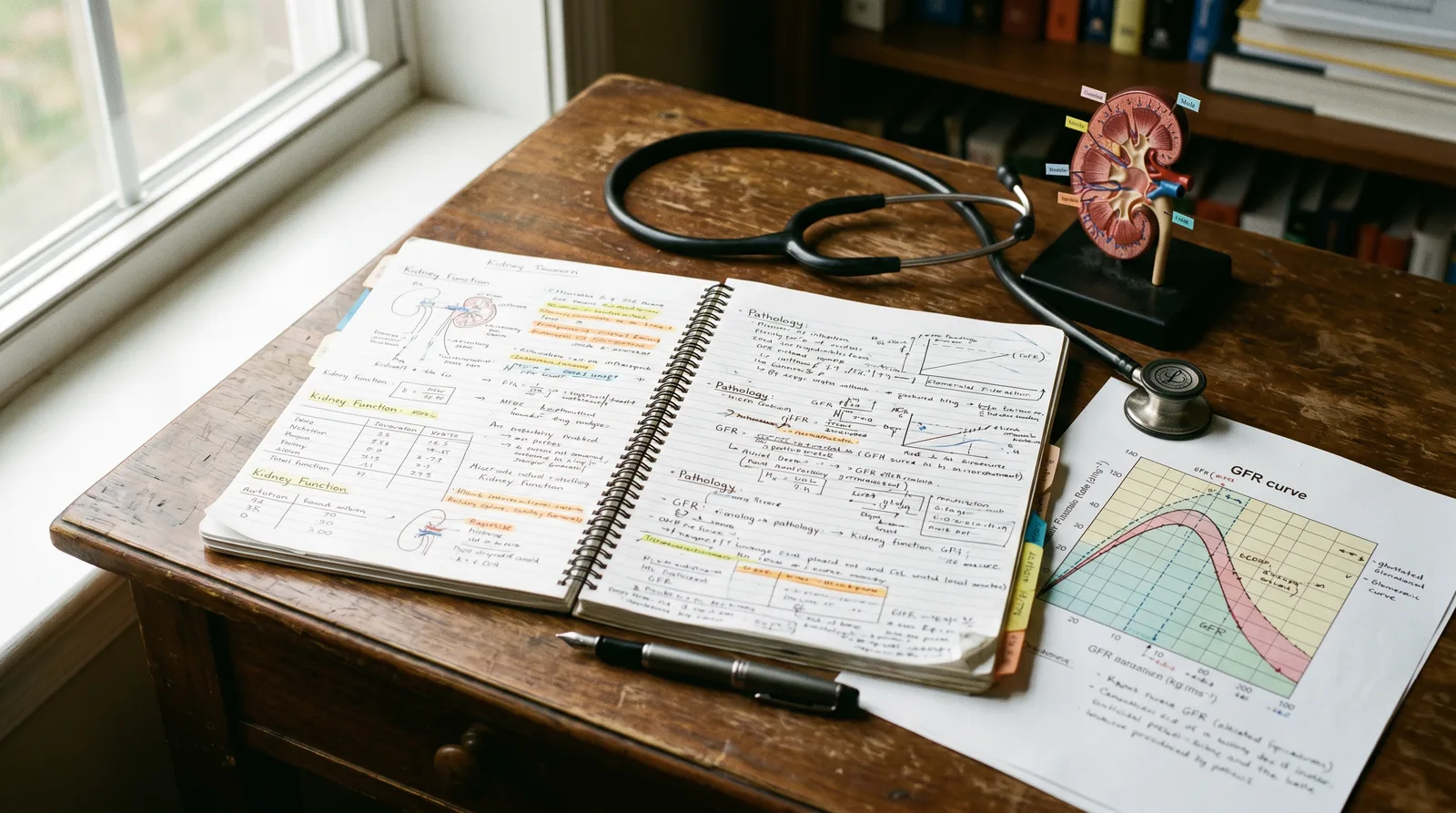
What you'll learn
What you'll be able to do
- Explain the full spectrum of glomerular filtration, tubular reabsorption, and secretion mechanisms at a level that survives attending-level questioning on rounds.
- Diagnose and differentiate acute kidney injury subtypes (prerenal, intrinsic, postrenal) using a systematic, evidence-based framework.
- Interpret acid-base and electrolyte disturbances — including complex mixed disorders — with confidence and speed.
- Construct a clinical management plan for common renal conditions including CKD, nephrotic/nephritic syndromes, and renal tubular acidoses.
- Apply pharmacokinetic principles to dose-adjust medications safely in patients with reduced kidney function.
- Counsel patients and teams on dialysis modalities, transplant considerations, and renal replacement therapy decision-making.
How it works
A school that adapts to you
This isn't a set of static videos. Every lesson is generated live and tuned to where you actually are.
We learn your level
A quick placement check tailors your starting point so you're never bored or lost.
Lessons adapt as you go
Each lesson is written for your pace and your goal, adjusting as your skills grow.
Your AI coach keeps you moving
Checkpoints, feedback, and gentle nudges turn progress into a real result.
The curriculum
What's inside your school
6 modules · 28 lessons

Kidney Physiology: The Mechanistic Foundation
Builds a deep, mechanistic understanding of how the kidney filters, reabsorbs, and secretes — the bedrock for all clinical reasoning that follows.
- 1.1Anatomy & Nephron ArchitectureIncluded
- 1.2Glomerular Filtration: Forces, Barriers, and GFR RegulationIncluded
- 1.3Tubular Reabsorption: Segment-by-SegmentIncluded
- 1.4Tubular Secretion & the Role of the Collecting DuctIncluded
- 1.5Renal Handling of Water: Concentration & Dilution MechanismsIncluded
Acute Kidney Injury: Systematic Diagnosis & Management
Equips clinicians to rapidly classify, investigate, and manage AKI subtypes using a rigorous, evidence-based framework.
- 2.1AKI Framework: Definitions, Staging, and Diagnostic ApproachIncluded
- 2.2Prerenal AKI: Hemodynamics, Causes, and ReversalIncluded
- 2.3Intrinsic AKI Part 1 — Tubular & Vascular CausesIncluded
- 2.4Intrinsic AKI Part 2 — Glomerular & Interstitial CausesIncluded
- 2.5Postrenal AKI & Urinalysis InterpretationIncluded
Glomerular Disease: Nephrotic & Nephritic Syndromes
Builds mechanistic and clinical mastery of the major glomerular diseases, from presentation to biopsy findings to management.
- 3.1The Nephrotic–Nephritic Spectrum: A Conceptual MapIncluded
- 3.2Nephrotic Syndrome: Causes, Workup & ManagementIncluded
- 3.3Nephritic Syndrome & Rapidly Progressive GNIncluded
- 3.4Systemic Diseases and the KidneyIncluded
Acid-Base & Electrolyte Mastery
Trains fast, confident interpretation of acid-base and electrolyte disturbances, including complex mixed disorders, using systematic frameworks.
- 4.1Acid-Base Fundamentals: Buffers, Compensation & the Six-Step ApproachIncluded
- 4.2Metabolic Acidosis: Anion Gap, Non-Anion Gap & Mixed PatternsIncluded
- 4.3Metabolic Alkalosis & Respiratory DisordersIncluded
- 4.4Renal Tubular Acidoses: Mechanisms, Diagnosis & ManagementIncluded
- 4.5Sodium, Potassium & Calcium DisordersIncluded
Chronic Kidney Disease: Progression, Complications & Pharmacology
Covers the full longitudinal management of CKD — from slowing progression to navigating its systemic complications and drug-dosing pitfalls.
- 5.1CKD Staging, Progression & Renoprotective StrategiesIncluded
- 5.2CKD Complications: Anemia, Bone-Mineral Disease & Metabolic AcidosisIncluded
- 5.3Cardiovascular Risk in CKDIncluded
- 5.4Pharmacokinetics in Renal Impairment: Drug Dosing & SafetyIncluded
Renal Replacement Therapy, Dialysis & Transplantation
Prepares clinicians to counsel patients and lead team discussions on dialysis modalities, initiation timing, and transplant decision-making.
- 6.1When to Start Renal Replacement Therapy: Indications & TimingIncluded
- 6.2Hemodialysis: Principles, Access & PrescriptionIncluded
- 6.3Peritoneal Dialysis: Mechanisms, Modalities & Patient SelectionIncluded
- 6.4Acute RRT: CRRT & Intermittent HD in the ICUIncluded
- 6.5Kidney Transplantation: Evaluation, Immunosuppression & ComplicationsIncluded
Who it's for
Is this you?

Clinical-year medical students
Build the mechanistic nephrology foundation that makes shelf exam questions feel logical — not lucky.

Internal medicine residents
Stop dreading nephrology consults and start reasoning through AKI, acid-base, and CKD like you own the differential.

Nurse practitioners & PAs
Close the gaps in renal pathophysiology so you can manage kidney disease patients with real confidence and clinical precision.

Nursing students in advanced programs
Go beyond protocols and understand the why behind renal assessment, fluid management, and electrolyte decisions.

Hospitalists & generalists
Sharpen the nephrology reasoning you use daily — drug dosing in impaired kidneys, AKI workup, and when to escalate to RRT.

Subspecialty fellows & board candidates
Solidify the mechanistic foundations and clinical frameworks that high-stakes nephrology board questions are actually testing.
Questions
Frequently asked
Your teacher
A note from your teacher

Dr. J Raymond ABK
If you're reading this, you've probably had the experience of sitting in a nephrology lecture — or grinding through a textbook chapter — and walking away with a list of facts that felt slippery the moment you tried to apply them. You knew the mnemonic for MUDPILES. You knew the causes of nephrotic syndrome. But when a real patient landed in front of you with an acid-base disorder layered on top of AKI and a creatinine that kept climbing, you weren't sure where to start. That gap between knowing facts and actually thinking in nephrology — that's what this school exists to close.
The way I teach nephrology is the way I wish I had learned it: mechanistically, from the ground up, with no tolerance for hand-waving. We start with the kidney's architecture and work through filtration, tubular transport, and water handling until you can predict what happens when any part of that system breaks. Then we move into disease — not as a catalogue of diagnoses, but as disruptions of mechanisms you already understand. By the time we're working through a mixed metabolic acidosis or staging a patient's CKD and choosing renoprotective therapy, you're not trying to remember what you read. You're reasoning.
I designed this curriculum with one question in mind at every step: does this explanation hold up under questioning by a sharp attending? Not the kind of attending who asks "what are the causes?" — the kind who asks "why does the kidney respond that way, and what does that tell you about what to do next?" That's the standard I hold myself to in every lesson, and it's the standard you'll be ready to meet by the time you've worked through it.
You don't need to be a nephrology genius to succeed here. You need to be willing to think carefully and push past the surface-level explanation. If that's you — whether you're a third-year student preparing for shelf exams, a resident who wants to be genuinely useful on nephrology consults, or a practicing clinician who feels like their renal knowledge has gaps they've never had time to fill — this school was built for you.
Come in with questions. Bring the cases that have confused you. The community here is full of clinicians at every level who are doing exactly what you're doing: trading memorization for understanding. I'll see you inside.
— Dr. J Raymond ABK
Start your journey today
Join get instant access — learn at your own pace with an AI coach in your corner.
$9.99/mo
Recurring billing · cancel anytime
Secure checkout · Instant access
- 6 modules, 28 lessons
- AI-adaptive lessons tuned to your level
- Quizzes & checkpoints to lock in progress
- Your own AI learning coach
- Learn on any device, at your pace
- Full access for as long as you're subscribed