Write the essay only you could write
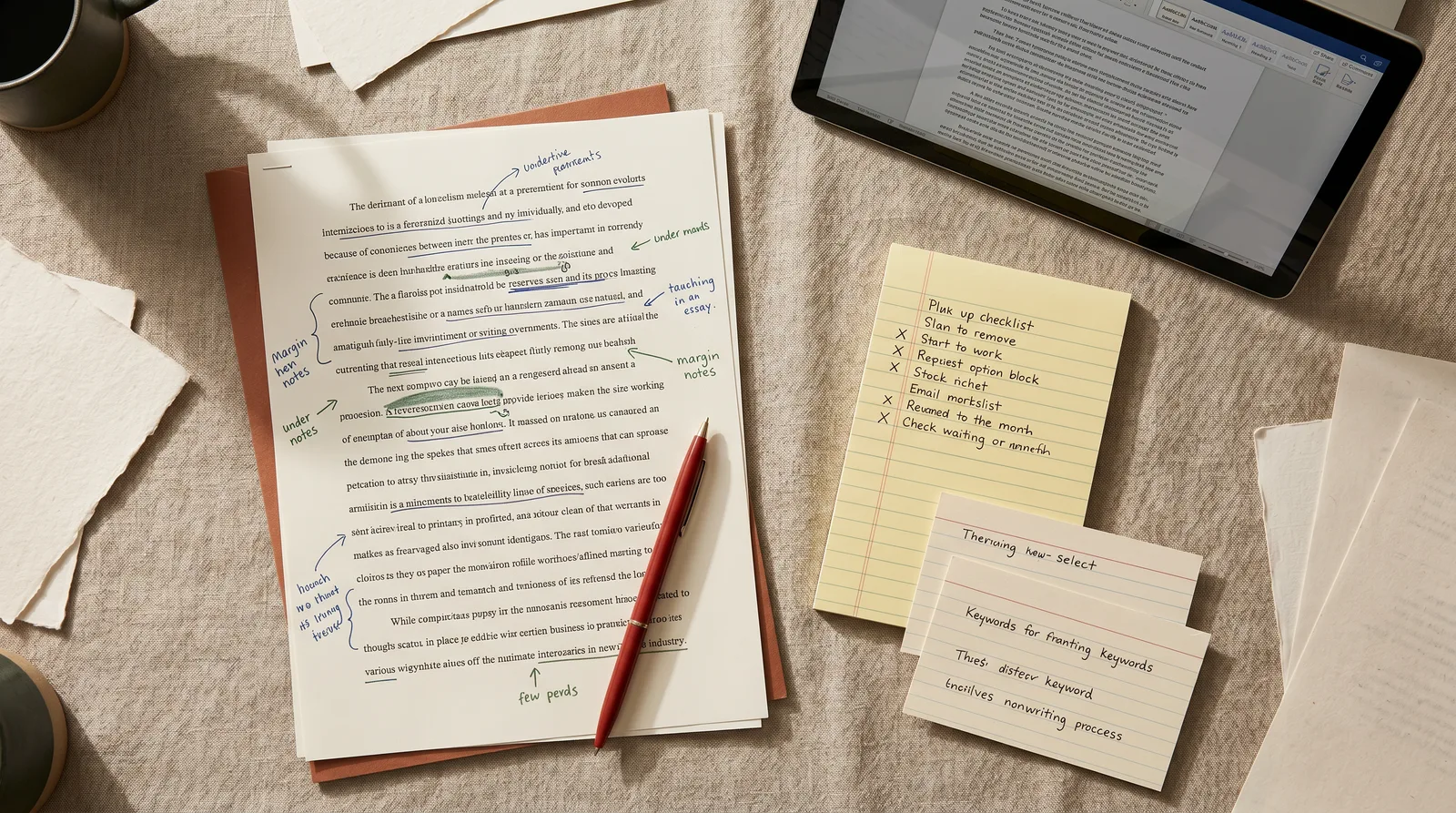
A step-by-step school for high school juniors and seniors — from story-mining your real life to submitting a polished 650-word Common App personal statement you're actually proud of. No generic advice. No ghostwriting. Just you, finally on the page.

"The best college essay isn't the most impressive one in the pile — it's the one that sounds like nobody else could have written it."— Victoria Tyler
What you'll learn
What you'll be able to do
- Identify 3–5 genuinely personal story seeds that reveal character, not just achievements
- Build a clear narrative arc — hook, tension, reflection, and resolution — for any Common App prompt
- Avoid the 10 most common college essay mistakes that make admissions officers stop reading
- Use AI tools ethically and strategically as a brainstorming partner and editing assistant without compromising your authentic voice
- Draft, revise, and self-edit a 650-word Common App personal statement using a professional rubric
- Submit with confidence after completing a final polish checklist that covers tone, structure, originality, and mechanics
How it works
A school that adapts to you
This isn't a set of static videos. Every lesson is generated live and tuned to where you actually are.
We learn your level
A quick placement check tailors your starting point so you're never bored or lost.
Lessons adapt as you go
Each lesson is written for your pace and your goal, adjusting as your skills grow.
Your AI coach keeps you moving
Checkpoints, feedback, and gentle nudges turn progress into a real result.
The curriculum
What's inside your school
6 modules · 17 lessons

Find Your Story
Students discover that the most powerful college essays are rooted in small, specific, deeply personal moments — not résumé highlights. This foundational module reframes what a 'good' essay topic looks like and equips students with a repeatable story-mining process to surface 3–5 genuine story seeds that reveal who they really are.
- 1.1Why the Best Essays Are Never About the TrophyIncluded
- 1.2The Story Mining MethodIncluded
- 1.3Choosing the Right Story to TellIncluded
Build Your Narrative Arc
With a story selected, students learn the structural architecture that transforms a personal anecdote into a compelling, college-admissions-ready essay. This module covers the four-part narrative arc — hook, tension, reflection, and resolution — and guides students through outlining a complete essay blueprint before a single draft word is written.
- 2.1The Four-Part Arc Every Great Essay UsesIncluded
- 2.2Writing Hooks That Demand a Second SentenceIncluded
- 2.3Writing Reflection That Shows You've GrownIncluded
- 2.4Outlining Your Complete Essay BlueprintIncluded
Draft with Confidence
Armed with a story and a blueprint, students move into the drafting phase. This module addresses a prerequisite gap in the original draft by formally introducing the Common App prompts before sprint-drafting begins, ensuring students anchor their narrative to the right prompt from the start. It also tackles the critical skill of writing in an authentic voice — especially important in the age of AI-generated prose.
- 3.1Understanding the Common App Prompts (and How to Pick Yours)Included
- 3.2The Section-by-Section Draft SprintIncluded
- 3.3Voice, Tone, and Sounding Like You (Not Like ChatGPT)Included
Avoid the 10 Fatal Mistakes
This module acts as a targeted quality-control layer between drafting and revision. Students learn the 10 most common college essay mistakes that cause admissions officers to disengage — organized into Story and Structure Traps (Mistakes 1–5) and Voice and Polish Traps (Mistakes 6–10) — and audit their own drafts against each one before entering the revision process.
- 4.1Mistakes 1–5: The Story and Structure TrapsIncluded
- 4.2Mistakes 6–10: The Voice and Polish TrapsIncluded
Use AI Ethically and Strategically
AI tools are already part of students' lives — and college essay writing is no exception. This module takes a clear-eyed, non-alarmist approach: AI can be a powerful brainstorming partner and editing assistant when used thoughtfully, and a voice-erasing liability when used carelessly. Students learn a practical ethics framework and a set of specific, sanctioned AI workflows that enhance their essay without replacing their voice or their thinking.
- 5.1The AI Ethics Framework for College EssaysIncluded
- 5.2AI as Your Brainstorming and Feedback PartnerIncluded
Revise, Polish, and Submit with Confidence
The final module guides students through the complete revision-to-submission pipeline: a structured multi-pass revision process, a framework for receiving feedback without letting it overwrite their voice, and a professional final polish checklist and essay review rubric. Students leave this module with a submission-ready 650-word Common App personal statement and the confidence to click submit.
- 6.1The Structured Revision ProcessIncluded
- 6.2Getting Feedback Without Losing Your VoiceIncluded
- 6.3The Final Polish Checklist and Essay Review RubricIncluded
Who it's for
Is this you?

The Overachiever With Nothing to Say
Your résumé is immaculate and your essay sounds exactly like it — this school helps you get past your accomplishments and find the story underneath.
The Blank-Page Freezer
You open the document, stare at the prompt, and close the laptop — the Story Mining Method and section-by-section draft sprint exist specifically for you.

The 'My Draft Doesn't Sound Like Me' Student
You have something on the page but it reads stiff and formal — the voice and tone module, plus the revision rubric, will help you find yourself in it.

The AI-Curious (and AI-Anxious) Writer
You want to use AI tools without crossing ethical lines or losing your voice — the AI ethics framework gives you a clear, confident answer to exactly that question.

The Supportive Parent
You're watching your teen spiral and want to help without hovering — this school gives them a structured, independent process so you can both breathe again.

The Late-Stage Reviser
Application deadlines are close and you have a draft you don't love — jump straight to the Fatal Mistakes modules and Final Polish Checklist to rescue it fast.
Questions
Frequently asked
Your teacher
A note from your teacher
Victoria Tyler
If you're reading this, there's a good chance a blank white document is open in another tab right now — cursor blinking, prompt staring back at you — and absolutely nothing is happening.
I know that feeling. I've sat across from hundreds of students who are genuinely interesting, funny, thoughtful, surprising human beings, and watched them try to flatten themselves into an essay that sounds like a press release about their own GPA. It breaks my heart every time. Not because the essay is bad — though sometimes it is — but because I can see the real story sitting right there, just underneath the surface, waiting for someone to ask the right question.
That's what this school is: the right questions, in the right order, with honest feedback built in at every step. We start by throwing out the trophy-and-lesson playbook entirely. The Story Mining Method I teach in Module 1 has nothing to do with your most impressive moment — it's about locating the small, specific, telling details of your actual life that reveal who you are to a stranger in 650 words. From there, we build a real narrative arc — hook, tension, reflection, resolution — because a college essay isn't a list of facts about you; it's a story that makes an admissions officer feel something.
I'm also not going to pretend AI doesn't exist. It does, your students are using it, and the question isn't whether — it's how. So we tackle that directly with a clear ethical framework: here's how AI can be a legitimate brainstorming partner and editing assistant, and here's exactly where it stops being helpful and starts erasing your voice. That line matters, and I'll show you where it is.
By the time you finish the Final Polish Checklist in Module 6, you'll have a draft that has been story-mined, outlined, written, stress-tested against the 10 most common fatal mistakes, and revised with a professional rubric. More importantly, you'll read it and recognize yourself in it. That's the goal — not a perfect essay, but an honest one. In my experience, those turn out to be the same thing.
If you're a parent who forwarded this page to your junior or senior: hi, welcome, I see you. The anxiety in your house right now is real, and this school is designed to dissolve it one concrete step at a time. Come on in.
— Victoria Tyler
Start your journey today
Join get instant access — learn at your own pace with an AI coach in your corner.
$49/mo
Recurring billing · cancel anytime
Secure checkout · Instant access
- 6 modules, 17 lessons
- AI-adaptive lessons tuned to your level
- Quizzes & checkpoints to lock in progress
- Your own AI learning coach
- Learn on any device, at your pace
- Full access for as long as you're subscribed