Lead the systems that lead your enterprise
Earn a rigorous executive credential in decision intelligence — designing AI-integrated governance structures, digital twin strategy, and enterprise optimization frameworks your board can act on with confidence.

Every framework in this program was designed to survive contact with a board — because that's the only standard that matters at this level.— Pauline Brown Smith, EdD
What you'll learn
What you'll be able to do
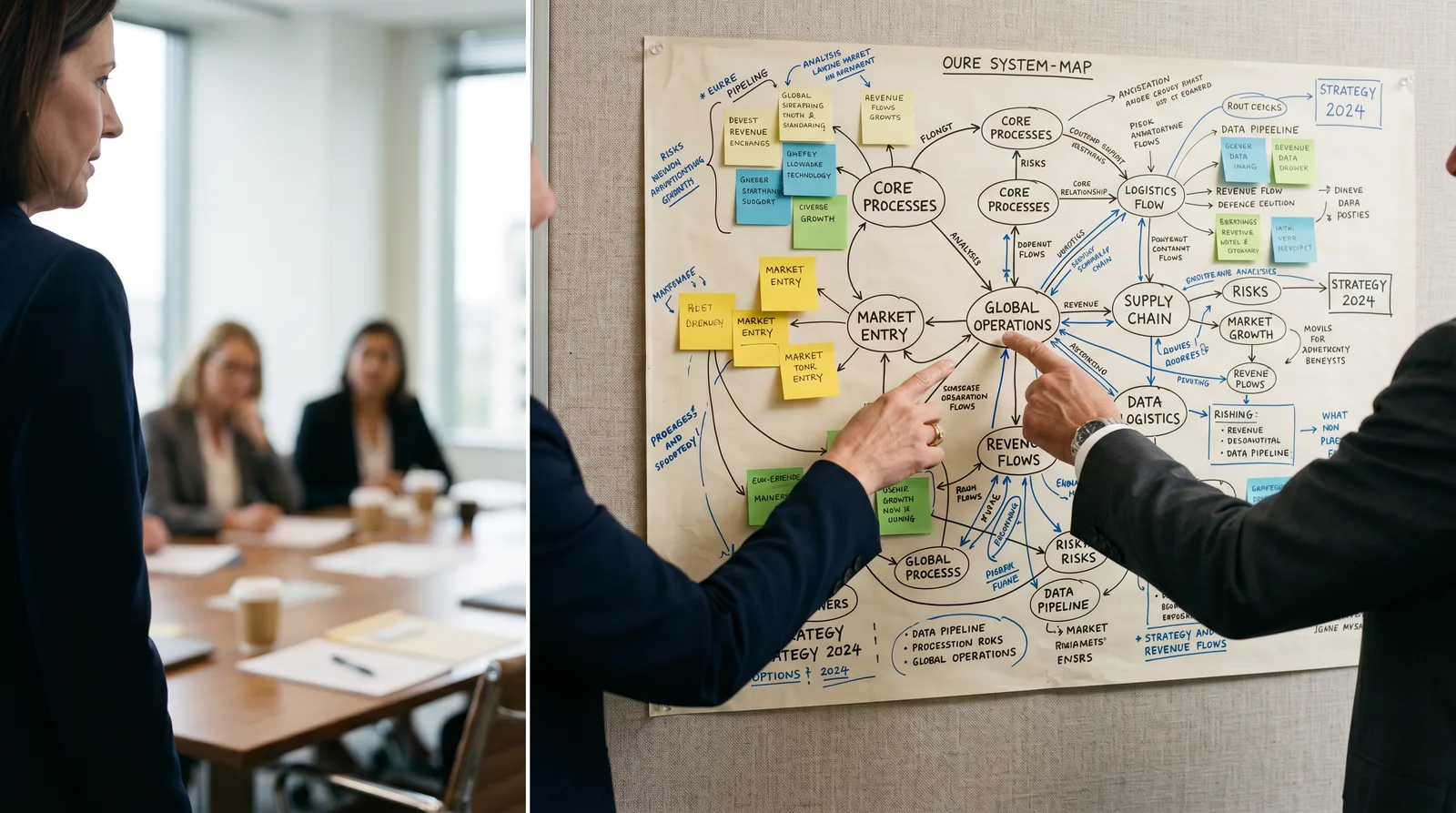
- Build a complex systems framework that maps interdependencies and emergent risks across an enterprise
- Design a decision intelligence roadmap that integrates AI, analytics, and human expertise into accountable governance structures
- Develop an enterprise optimization strategy aligned to operational performance, resource allocation, and customer value
- Author an enterprise governance charter covering model validation, ethics, cybersecurity, and regulatory compliance for digital twin initiatives
- Construct an executive KPI dashboard and risk register that monitors decision quality and optimization outcomes in real time
- Deliver a board-level presentation and five-year optimization roadmap with simulation priorities, stakeholder engagement plans, and continuous improvement milestones
How it works
A school that adapts to you
This isn't a set of static videos. Every lesson is generated live and tuned to where you actually are.
We learn your level
A quick placement check tailors your starting point so you're never bored or lost.
Lessons adapt as you go
Each lesson is written for your pace and your goal, adjusting as your skills grow.
Your AI coach keeps you moving
Checkpoints, feedback, and gentle nudges turn progress into a real result.
The curriculum
What's inside your school
6 modules · 28 lessons

Complex Systems Thinking for Executive Leaders
Equips executives to understand, map, and reason about enterprise-wide complex systems, interdependencies, and emergent risk.
- 1.1Foundations of Complex Systems ScienceIncluded
- 1.2Mapping Enterprise InterdependenciesIncluded
- 1.3Emergent Risk and Resilience DesignIncluded
- 1.4Systems Thinking in Strategic Decision-MakingIncluded
- 1.5Building the Complex Systems FrameworkIncluded
Decision Intelligence Architecture and Roadmap Design
Teaches executives how to architect and govern decision intelligence systems that integrate AI, analytics, simulation, and human judgment.
- 2.1Anatomy of a Decision Intelligence SystemIncluded
- 2.2Integrating AI and Human ExpertiseIncluded
- 2.3Explainability, Transparency, and AccountabilityIncluded
- 2.4Designing the Decision Intelligence RoadmapIncluded
Digital Twins and Simulation Science
Develops executive fluency in digital twin strategy and simulation-driven decision-making across enterprise and operational contexts.
- 3.1Digital Twin Concepts and Executive StrategyIncluded
- 3.2Simulation Science for Complex Decision ProblemsIncluded
- 3.3Prioritizing Simulation InvestmentsIncluded
- 3.4Validating and Trusting Digital Twin OutputsIncluded
Enterprise Optimization Strategy
Builds the executive capability to design and lead enterprise-wide optimization initiatives that align operations, resources, and customer value.
- 4.1Enterprise Optimization Principles and ScopeIncluded
- 4.2Predictive Analytics and Continuous Improvement MethodologiesIncluded
- 4.3Resource Allocation and Value Creation ModelingIncluded
- 4.4Authoring the Enterprise Optimization StrategyIncluded
- 4.5Building the Five-Year Optimization RoadmapIncluded
Enterprise Governance, Ethics, and Compliance for Digital Intelligence
Establishes the executive oversight structures, ethical standards, and regulatory compliance frameworks required to govern digital twin and decision intelligence programs.
- 5.1Governance Architecture for Digital Twin InitiativesIncluded
- 5.2Ethics, Fairness, and Responsible AI in Enterprise DecisionsIncluded
- 5.3Cybersecurity and Data Integrity in Digital Twin EnvironmentsIncluded
- 5.4Regulatory Compliance and Model Lifecycle ManagementIncluded
- 5.5Authoring the Enterprise Governance CharterIncluded
Executive Performance Measurement and Board-Level Leadership
Develops the measurement systems, risk intelligence, and executive communication skills needed to lead and report on decision intelligence programs at board level.
- 6.1Designing the Executive KPI DashboardIncluded
- 6.2Constructing the Enterprise Risk RegisterIncluded
- 6.3Stakeholder Engagement and Change LeadershipIncluded
- 6.4Reflective Leadership Practice in Decision IntelligenceIncluded
- 6.5Delivering the Executive Board PresentationIncluded
Who it's for
Is this you?

Chief Executive Officers
CEOs governing AI-enabled operations need an integrated framework for decision accountability and enterprise optimization that holds up under board scrutiny.

Chief Digital Officers
CDOs leading digital transformation need the governance architecture and simulation strategy to move from pilot projects to enterprise-scale digital intelligence.

Chief Risk Officers
CROs managing emergent risk in complex systems need rigorous governance charters, ethics frameworks, and risk registers built specifically for AI and digital twin environments.

VP-Level Enterprise Leaders
Senior VPs accountable for operational performance gain the optimization strategy and KPI dashboards to drive measurable decision quality across business units.

Strategy & Transformation Executives
Leaders designing five-year enterprise roadmaps need decision intelligence architecture and simulation investment prioritization to underpin durable competitive strategy.

General Managers Pursuing the C-Suite
High-potential enterprise managers preparing for executive roles use this credential to build the governance fluency and boardroom communication authority the next level demands.
Questions
Frequently asked
Your teacher
A note from your teacher

Pauline Brown Smith, EdD
If you are reading this, you are almost certainly already leading inside complexity — navigating AI-augmented operations, governing systems you did not design, and presenting decisions to boards that demand both strategic clarity and rigorous accountability. You are not looking for an introduction to these topics. You are looking for a framework that matches the scope of the problems you actually carry.
That is precisely what this credential was built to provide.
I designed Decision Intelligence Executive because I kept seeing the same gap in senior leadership development: programs that teach data literacy or AI awareness, but stop short of the governance and strategy discipline that executive roles actually demand. Understanding that digital twins exist is not the same as knowing how to validate their outputs, govern their risks, or defend their investment cases at a board level. Knowing that AI is transforming decisions is not the same as architecting the accountability structures that keep those decisions trustworthy and compliant. This program closes that gap — systematically, from complex systems foundations all the way through to board presentation.
You will work through six tightly integrated modules. You will map enterprise interdependencies and emergent risks using the frameworks of complex systems science. You will design a decision intelligence roadmap that places AI and human expertise in the right relationship to each other. You will develop a governance charter that addresses ethics, cybersecurity, and regulatory compliance with the specificity that modern enterprise requires. And you will construct the executive KPI dashboard and risk register that let you monitor decision quality in real time — not after the fact.
I want to be direct about what makes this program different: every module culminates in a board-ready artefact. You are not collecting slides or frameworks to review later. You are building a portfolio — an optimization strategy, a governance charter, a five-year roadmap, a board presentation — that you can deploy inside your organization the moment you complete it. The credential is evidence of strategic command. The portfolio is the instrument of it.
The leaders who will get the most from this program are those who are willing to bring their real organizational challenges into the work — to pressure-test these frameworks against the actual complexity they govern. If that describes you, I'd be glad to have you in the program. The work is demanding. The outcome is worth it.
— Pauline Brown Smith, EdD
Start your journey today
Join get instant access — learn at your own pace with an AI coach in your corner.
$150/mo
Recurring billing · cancel anytime
Secure checkout · Instant access
- 6 modules, 28 lessons
- AI-adaptive lessons tuned to your level
- Quizzes & checkpoints to lock in progress
- Your own AI learning coach
- Learn on any device, at your pace
- Full access for as long as you're subscribed