
Master the forces that decide which economies win, given demography and AI
A doctoral research-grade curriculum — built for serious analysts — that shows you exactly how population dynamics, AI-driven automation, and development economics intersect to create (and destroy) national growth trajectories. Rigorous models, live data systems, and policy-ready frameworks from day one.
I built this curriculum for people who want to understand deep underlying mechanisms, not just the headlines — because that's where the real analytical leverage lives.
— Val (Valdas) Samonis
About your professor
I have been invited to a group of economists and knowledge management & AI researchers to work on AI/HAI at Stanford University, guided by at least 17 (!) Nobelists: “We Must Act Now”: Sixteen Nobel Laureates Join Leading Economists and AI Researchers in Call to Prepare for AI’s Economic Transformation!

What you'll learn
What you'll be able to do
- Analyze how fertility rates, aging populations, and migration flows drive long-run GDP growth and fiscal sustainability across regions
- Apply leading demographic models (Lee-Carter, cohort-component) to forecast labor supply and dependency ratios for specific economies
- Evaluate how AI-driven automation reshapes factor markets, wage distributions, and productivity growth in both advanced and emerging economies
- Construct a structured country-level development diagnostic using institutional, demographic, and technological indicators
- Critically assess competing theories of economic development — from Rostow's stages to Acemoglu's institutions framework — against modern empirical evidence
- Design evidence-based policy recommendations on topics such as pension reform, UBI, immigration strategy, and AI investment for a national or international development context
How it works
A school that adapts to you
This isn't a set of static videos. Every lesson is generated live and tuned to where you actually are.
We learn your level
A quick placement check tailors your starting point so you're never bored or lost.
Lessons adapt as you go
Each lesson is written for your pace and your goal, adjusting as your skills grow.
Your AI coach keeps you moving
Checkpoints, feedback, and gentle nudges turn progress into a real result.
The curriculum
What's inside your school
6 modules · 30 lessons
Foundations: Population, Growth, and Development Frameworks
Establishes the theoretical bedrock — demographic transition theory, growth accounting, and competing development frameworks — that anchors every subsequent module.
- 1.1The Demographic Transition: Stages, Mechanisms, and Global VariationIncluded
- 1.2Growth Accounting and the Sources of Long-Run GDP GrowthIncluded
- 1.3Competing Theories of Economic Development: Rostow to AcemogluIncluded
- 1.4Institutional Quality, Path Dependence, and Development OutcomesIncluded
- 1.5Reading Development Data: World Bank, UN, and OECD Indicator SystemsIncluded
Demographic Dynamics: Measurement, Modeling, and Forecasting
Develops quantitative mastery of demographic measurement and the leading forecasting models used by researchers and international agencies.
- 2.1Core Demographic Measures: Fertility, Mortality, and Life TablesIncluded
- 2.2The Cohort-Component Model: Building a Population ProjectionIncluded
- 2.3The Lee-Carter Model and Stochastic Mortality ForecastingIncluded
- 2.4Dependency Ratios, Labor Supply Forecasts, and Workforce AgingIncluded
- 2.5Subnational and Regional Demography: When National Averages MisleadIncluded
Aging, Fertility, and Migration: Economic Consequences and Policy Levers
Analyzes how population aging, low fertility, and migration flows affect GDP, public finance, and labor markets — and what policies can credibly respond.
- 3.1The Demographic Dividend: Capturing and Squandering the Growth BonusIncluded
- 3.2Population Aging and Fiscal Sustainability: Pensions, Healthcare, and DebtIncluded
- 3.3Pension System Design and Reform Strategies in Aging EconomiesIncluded
- 3.4Low Fertility: Causes, Consequences, and Pro-Natalist Policy EvidenceIncluded
- 3.5Migration as a Demographic and Economic Policy ToolIncluded
AI, Automation, and the Future of Factor Markets
Rigorously examines how AI and automation restructure labor demand, wage distributions, capital returns, and productivity in both advanced and emerging economies.
- 4.1What AI Actually Does: A Technical Primer for EconomistsIncluded
- 4.2Task-Based Models of Automation: Acemoglu, Autor, and BeyondIncluded
- 4.3Wage Polarization, Inequality, and Labor Share DeclineIncluded
- 4.4AI and Productivity: Promise, Paradox, and the Measurement ProblemIncluded
- 4.5Automation in Emerging Economies: Leapfrogging or Premature Deindustrialization?Included
Demography Meets AI: Intersections, Feedback Loops, and New Growth Frontiers
Synthesizes demographic and technological forces, exploring how their interaction creates divergent growth trajectories and new strategic opportunities across regions.
- 5.1AI as a Labor-Scarcity Response: Aging Economies and Automation IncentivesIncluded
- 5.2Human Capital, Education Systems, and the AI-Ready WorkforceIncluded
- 5.3Data as a Demographic Asset: Population Scale and AI CompetitivenessIncluded
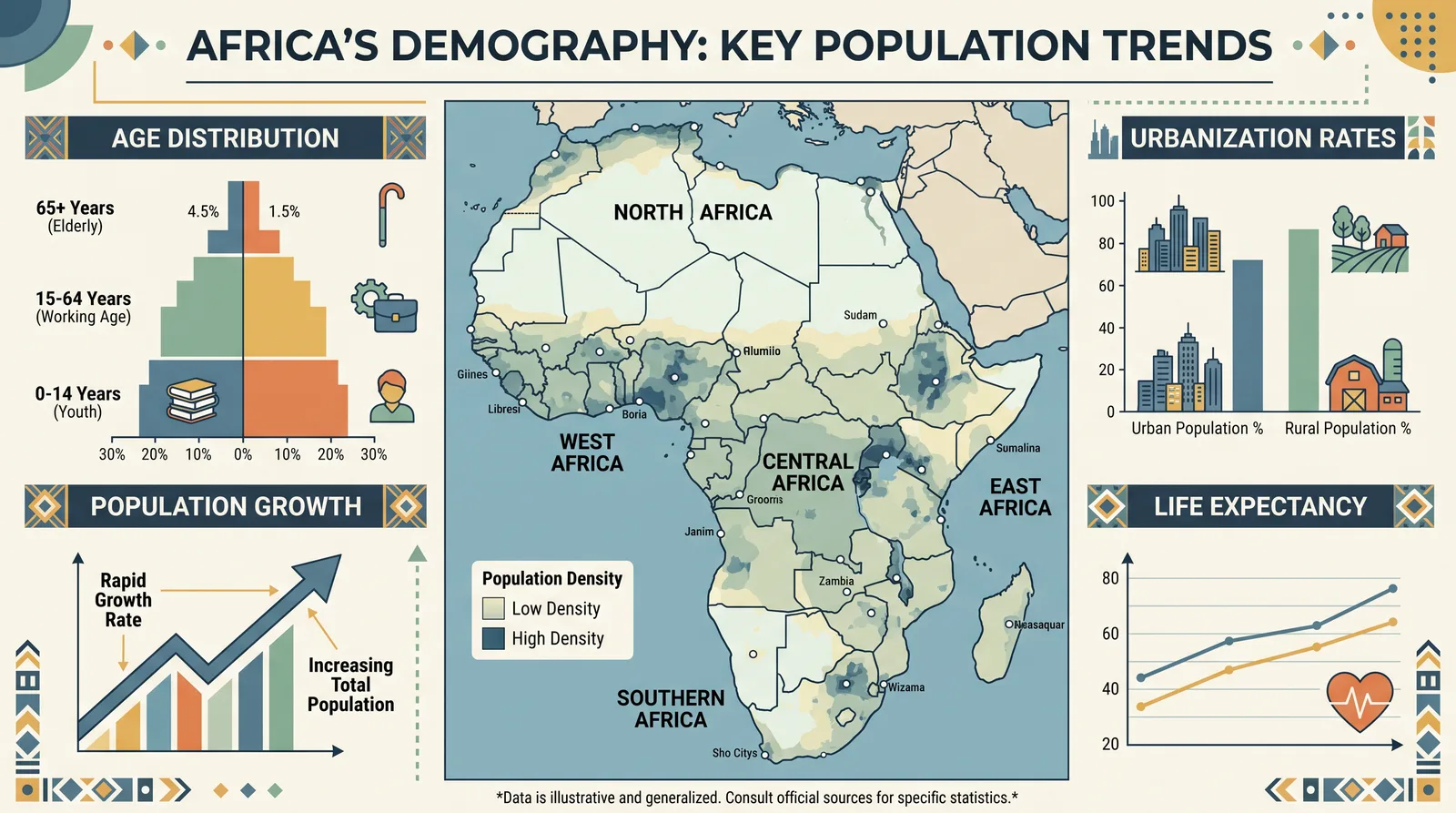
- 5.4Next Growth Frontiers: Africa's Demographic Dividend in an AI WorldIncluded
- 5.5Geopolitics of Demographic and Technological Power ShiftsIncluded
Country Diagnostics and Evidence-Based Policy Design
Translates all prior frameworks into a structured, applied methodology for diagnosing a country's development trajectory and designing rigorous, actionable policy recommendations.
- 6.1The Country Development Diagnostic: A Structured FrameworkIncluded
- 6.2Conducting a Binding-Constraints Analysis: Hausmann-Rodrik-Velasco AppliedIncluded
- 6.3Designing AI Investment and Digital Infrastructure PolicyIncluded
- 6.4Immigration Strategy as Development Policy: Design and Political EconomyIncluded
- 6.5Capstone: Integrated Country Policy BriefIncluded
Who it's for
Is this you?

Economics PhD students
Builds the integrated cross-field foundation — demography, growth theory, AI/labor economics — that no single disciplinary syllabus provides.

Development policy analysts
Provides the quantitative diagnostic frameworks and binding-constraints methodology used at the institutions where their work lands.

Macroeconomists & forecasters
Sharpens long-run structural forecasting by integrating demographic modeling and AI-driven productivity analysis into standard macro frameworks.

Strategy executives
Equips serious business leaders to reason rigorously about the demographic and technological forces reshaping markets over the next two to three decades.

International development professionals
Grounds field practitioners in the evidence-based frameworks — from pension reform to immigration strategy — needed to design and evaluate national-level policy.

Emerging markets investors
Delivers the structural country-diagnostic lens required to identify genuine long-run growth frontiers beyond the consensus narrative.
Questions
Frequently asked
Your teacher
A note from your teacher

Val (Valdas) Samonis
If you are reading this, you are probably already aware that the standard toolkit for thinking about economic growth is not keeping pace with what is actually happening in the world.
Population aging is not a background condition anymore — it is an active fiscal crisis in Japan, a structural labor constraint in Germany, and an impending shock in China. AI is not a future scenario — it is already inside the production function, reshaping task structures and wage distributions in ways that the standard macro models were not built to handle. And in Africa and South Asia, a demographic dividend of extraordinary scale is unfolding at the exact moment that automation may be closing the traditional path from low-wage manufacturing to sustained development. These are not trends you can understand by reading headlines, or even by reading a few good papers in isolation. They require integrated analytical architecture — the kind that connects demographic biology & mechanics, growth theory, and frontier AI economics into a single, coherent framework.
That is what I built this school to provide. The curriculum moves deliberately: we start with the empirical/experiential and theoretical foundations you need to think clearly — growth accounting, the demographic transition, competing development theories from Rostow to Acemoglu, and how to read World Bank, UN, and OECD data systems as working instruments rather than background citations. We then go deep into the technical machinery of demography: cohort-component projection models, Lee-Carter stochastic mortality forecasting, dependency ratio analysis, and subnational disaggregation. Not as academic exercises, but because these are the tools that serious analysts at the IMF, World Bank, and national planning ministries actually use — and you should know how to use them too.
From there, we engage the AI and automation literature head-on. I have no interest in the hype cycle, and I have equally little patience for dismissiveness. The task-based models developed by the Nobelist Acemoglu and others give us the precision to ask the right questions: which tasks are being automated, in which economies, with what consequences for labor share, wage distribution, and productivity? The measurement problem — why AI's productivity impact has been so difficult to observe in aggregate data — is itself a major analytical topic, not a footnote.
The school culminates in applied country diagnostic work, using the Hausmann-Rodrik-Velasco binding-constraints framework to construct the kind of structured policy brief that actually informs decisions at serious institutions. This is where the frameworks become instruments. I designed the capstone specifically so that what you produce is something you could take into a policy conversation, a research proposal, or a board-level strategy discussion and defend with evidence.
My goal throughout is PhD-seminar standards with clear, direct prose — demanding without being obscure, technical without being inaccessible. If you are ready to build the analytical foundation for understanding the most consequential structural forces shaping the global economy over the next half-century, I would be glad to have you in the school.
— Val (Valdas) Samonis
Start your journey today
Get instant access — learn at your own pace with an AI coach in your corner.
$50/mo
Recurring billing · cancel anytime
Secure checkout · Instant access
- 6 modules, 30 lessons
- AI-adaptive lessons tuned to your level
- Quizzes & checkpoints to lock in progress
- Your own AI learning coach
- Learn on any device, at your pace
- Full access for as long as you're subscribed