Understand your mind. Then train it.
The Mindful Mind is the meditation course for people who need to know why something works before they'll do it — six modules of real neuroscience, tested techniques, and zero wellness fluff.

"Your skepticism isn't an obstacle to mindfulness — it's the best possible starting point for actually understanding it."— Dr. J Raymond ABK
What you'll learn
What you'll be able to do
- Sustain a consistent daily meditation practice using at least three distinct techniques tailored to your lifestyle
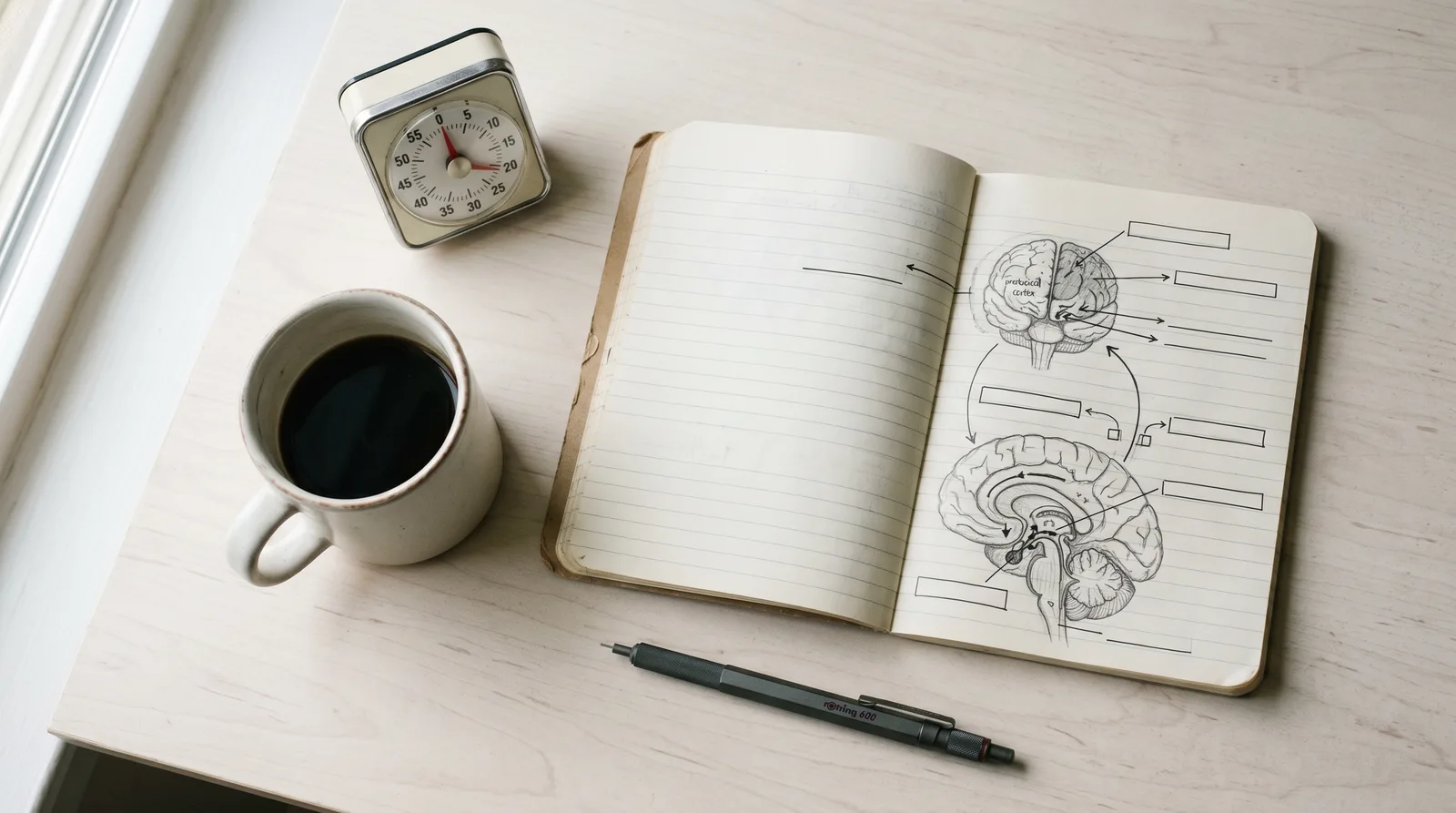
- Explain the neuroscience of attention, including how the default mode network and prefrontal cortex interact during meditation
- Apply self-regulation strategies in real time to manage stress, emotional reactivity, and mental fatigue
- Distinguish evidence-backed mindfulness methods from unfounded wellness claims using a critical, scientific lens
- Design a personal practice plan with clear session lengths, timing, and progress checkpoints
- Teach the core concepts of attention and mindfulness to others in plain, accessible language
How it works
A school that adapts to you
This isn't a set of static videos. Every lesson is generated live and tuned to where you actually are.
We learn your level
A quick placement check tailors your starting point so you're never bored or lost.
Lessons adapt as you go
Each lesson is written for your pace and your goal, adjusting as your skills grow.
Your AI coach keeps you moving
Checkpoints, feedback, and gentle nudges turn progress into a real result.
The curriculum
What's inside your school
6 modules · 16 lessons

What Is Actually Happening When You Meditate
Establishes a rigorous, jargon-free foundation by defining mindfulness on scientific terms, distinguishing it from popular misconceptions, and equipping learners with the critical-reading tools they will need to evaluate all subsequent research encountered in the course. This module acts as the essential prerequisite 'decoder ring' before any neuroscience or technique content is introduced.
- 1.1Defining Mindfulness Without the FluffIncluded
- 1.2Reading the Science: How to Evaluate Mindfulness ResearchIncluded
The Neuroscience of Attention
Delivers the core brain-science content that underpins everything else in the course. Learners build a mechanistic understanding of how the default mode network, prefrontal cortex, and neuroplasticity interact during meditation — giving the 'why it works' explanation that makes every subsequent technique lesson meaningful rather than merely procedural.
- 2.1Your Brain on Autopilot: The Default Mode NetworkIncluded
- 2.2The Prefrontal Cortex and the Attention Control SystemIncluded
- 2.3Neuroplasticity: Does Meditation Actually Change the Brain?Included
Core Meditation Techniques — Practiced and Explained
Provides direct, experiential training in four evidence-supported meditation modalities, pairing each session of practice with its neuroscientific and psychological mechanism. By the end of this module learners have a firsthand felt sense of each technique and can articulate what each one trains, enabling them to make informed, lifestyle-fit choices in Module 5.
- 3.1Focused Attention Meditation: Training the ReturnIncluded
- 3.2Open Monitoring Meditation: Observing Without GrabbingIncluded
- 3.3Body Scan and Interoceptive AwarenessIncluded
- 3.4Loving-Kindness and Compassion: The Science of Prosocial PracticeIncluded
Self-Regulation in Real Life
Bridges the lab and the lived experience by translating the neuroscience and techniques learned so far into practical, deployable self-regulation skills for everyday stressors, emotional reactivity, and cognitive fatigue. This module is deliberately placed after learners have firsthand technique experience so they can immediately connect the strategies to practices they have already embodied.
- 4.1The Stress Response: What's Actually HappeningIncluded
- 4.2Real-Time Regulation TechniquesIncluded
- 4.3Mental Fatigue, Attention Restoration, and RecoveryIncluded
Building and Sustaining Your Personal Practice
Guides learners to synthesise everything from Modules 1–4 into a personalised, sustainable, evidence-informed daily meditation practice. Applies behavioural science to the challenge of habit formation and gives learners concrete design tools — session structures, timing heuristics, progress metrics, and troubleshooting protocols — so the practice survives real-world friction.
- 5.1The Behavioral Science of Habit FormationIncluded
- 5.2Designing Your Personal Practice PlanIncluded
Teaching What You Know
Develops learners' capacity to communicate the science and practice of mindfulness clearly and accurately to others — whether a sceptical colleague, a curious family member, or a group they are asked to facilitate. Closes the loop back to Module 1's critical-appraisal skills and the personal baseline journal, so learners can witness and articulate their own transformation as a teaching asset.
- 6.1Translating Neuroscience for Non-ScientistsIncluded
- 6.2Teaching a Beginner: Facilitation and Practice SharingIncluded
Who it's for
Is this you?

The Skeptical Professional
Has dismissed meditation as pseudoscience but is quietly curious — and needs the research laid out honestly before they'll commit to a practice.

The Lapsed Meditator
Tried an app or a class, felt some benefit, but it never stuck — and wants to understand the behavioral science of why before trying again.

The Science Communicator
A researcher, educator, or science writer who wants to explain mindfulness and attention accurately to non-specialist audiences.

The Burned-Out High Performer
Running on cognitive fumes and wants real, evidence-based strategies for stress regulation and mental fatigue — not a wellness retreat.

The Intellectually Curious Beginner
Has never meditated but reads broadly in psychology and neuroscience and wants a first practice that's grounded in what they already understand.

The Wellbeing Lead
Responsible for workplace or community wellbeing programs and needs to teach mindfulness to others without overstating the evidence or losing credibility.
Questions
Frequently asked
Your teacher
A note from your teacher

Dr. J Raymond ABK
If you've picked up a mindfulness book, made it to page 40, and then quietly put it back on the shelf because something about it felt too soft, too certain, or too disconnected from how brains actually work — I built this course for you.
I understand the skepticism, because I share it. The wellness industry has done something impressive: it took a set of genuinely well-researched cognitive practices and wrapped them in so much ambient music and vague promise that the people who would benefit most — the analytical ones, the show-me-the-data ones — checked out. That's a real loss. Because the research, when you read it carefully and critically, is actually interesting. Not miraculous. Not transformative in the way the apps advertise. But genuinely, mechanistically interesting.
What I teach in this course is what I'd want someone to have taught me: the neuroscience of attention explained clearly enough to be useful, the meditation techniques practiced honestly enough to be real, and the behavioral science applied practically enough to actually build a habit. Module by module, you'll move from understanding what's happening in your brain during meditation, to doing the practices, to wiring them into your daily life, to being able to explain all of it to someone else. That arc is intentional. Understanding why something works is what makes you trust it enough to keep doing it.
I'll be honest with you about what the research does and doesn't show. Neuroplasticity is real, and its limits are also real — we'll look at both. Some mindfulness claims are well-supported; others are significantly overstated, and you'll leave with the evaluative framework to tell the difference. That critical lens isn't a detour from the practice; it's what makes the practice sustainable for someone like you.
This course is not a retreat. It's not a transformation. It's an education — a rigorous, warm, sometimes drily funny education in one of the most practically important things a human brain can learn to do. Come curious. Bring your skepticism. It belongs here.
I'll see you in the first module.
— Dr. J Raymond ABK
Start your journey today
Join get instant access — learn at your own pace with an AI coach in your corner.
$40/yr
Recurring billing · cancel anytime
Secure checkout · Instant access
- 6 modules, 16 lessons
- AI-adaptive lessons tuned to your level
- Quizzes & checkpoints to lock in progress
- Your own AI learning coach
- Learn on any device, at your pace
- Full access for as long as you're subscribed