
Build a Disruptive Strategy That Actually Breaks Markets
A Harvard Business School Online–inspired 12‑week strategy lab for founders, senior marketers, and operators who are done with safe playbooks. You’ll use disruption theory, Jobs to Be Done, and the Resources–Processes–Profit (RPP) framework to spot opportunities others miss, design bold moves competitors can’t copy, and leave with one battle‑ready disruptive strategy for your own market.
“I don’t want you memorizing buzzwords. I want you seeing markets through the same disruptive lenses I learned at Harvard Business School Online, then breaking them with a strategy that lets you own your market.”— Dr. Patrick McAvoy
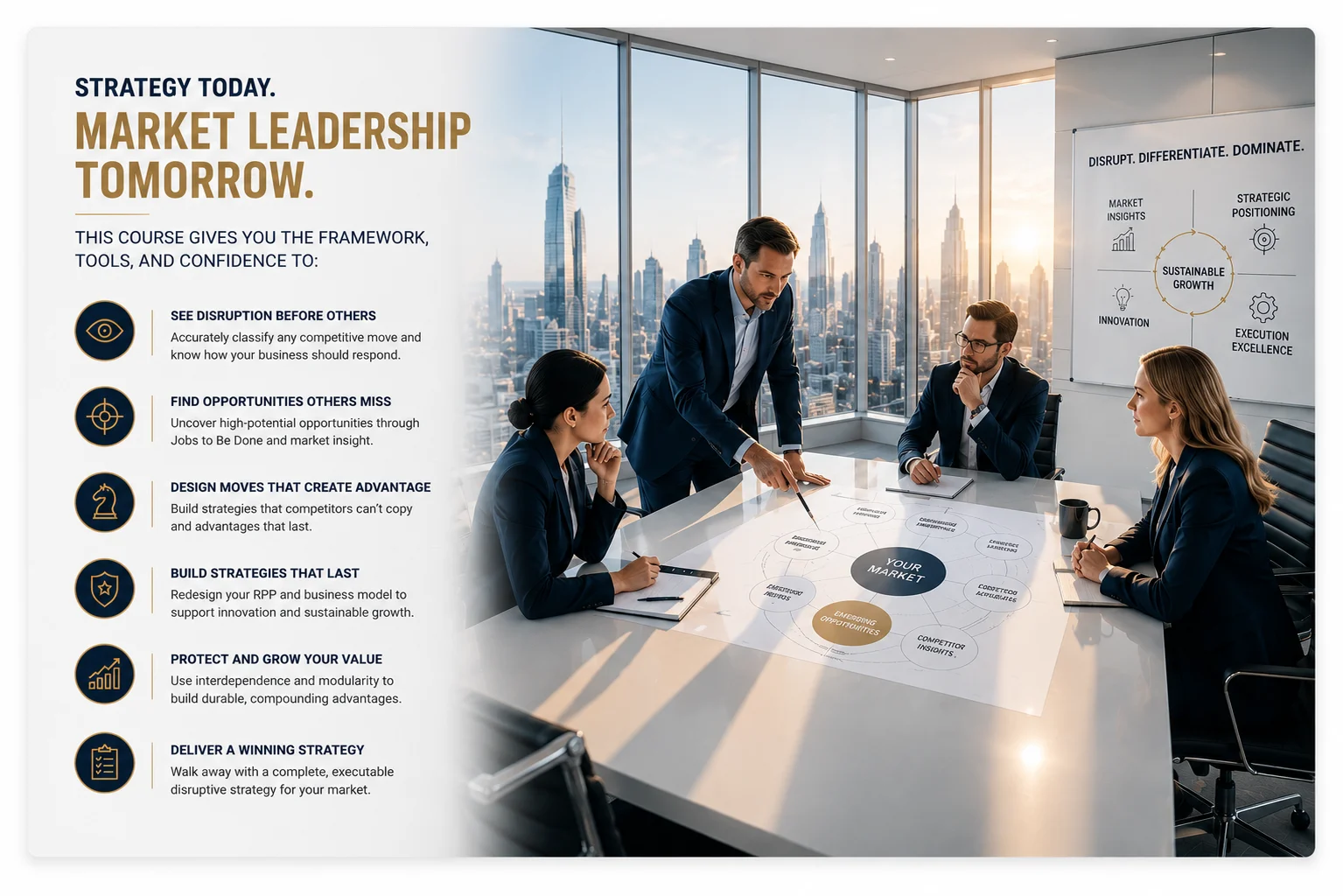
What you'll learn
What you'll be able to do
- Accurately classify any competitive move in your industry as sustaining, low-end, or new-market disruption — and know which type your business is positioned to execute
- Conduct a full Jobs to Be Done discovery for your customers, surfacing functional, social, and emotional jobs that your current offer leaves unfinished
- Redesign your Resources, Processes, and Profit formula (RPP) so your organization is structurally capable of supporting a disruptive innovation — not just talking about one
- Apply interdependence vs. modularity analysis to protect your value chain from commoditization and identify where proprietary integration creates durable advantage
- Architect a dual-track strategy that sequences deliberate moves with emergent learning across market-creating, sustaining, and efficiency phases of growth
- Deliver one complete, pressure-tested disruptive strategy document — including a sharp strategic question, a defined beachhead market, and an executable go-to-market path — for your own company or a client
How it works
A school that adapts to you
This isn't a set of static videos. Every lesson is generated live and tuned to where you actually are.
We learn your level
A quick placement check tailors your starting point so you're never bored or lost.
Lessons adapt as you go
Each lesson is written for your pace and your goal, adjusting as your skills grow.
Your AI coach keeps you moving
Checkpoints, feedback, and gentle nudges turn progress into a real result.
The curriculum
What's inside your school
5 modules · 17 lessons
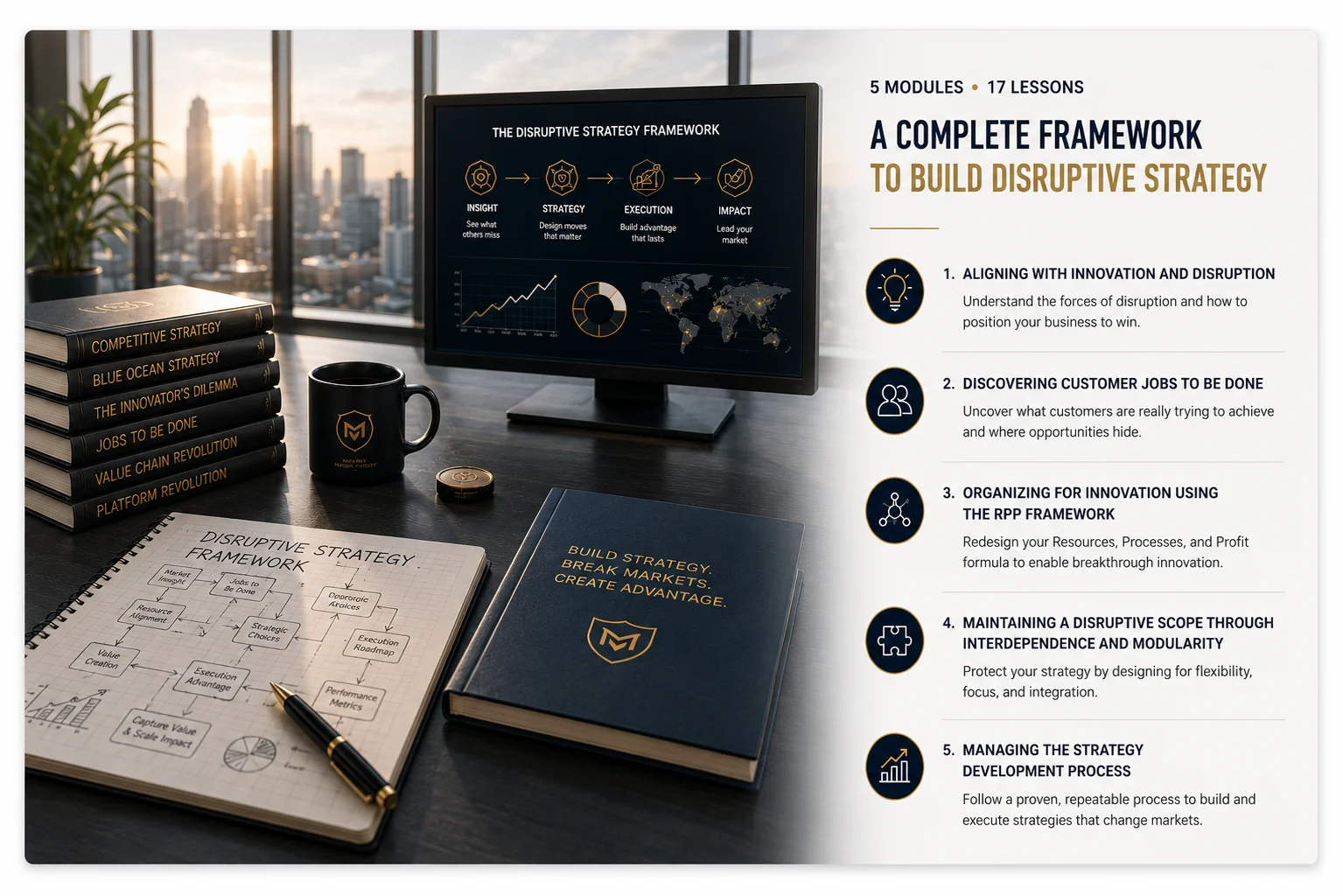
Aligning with Innovation and Disruption
Establish the strategic foundation for the entire lab. Students learn to precisely classify competitive moves — sustaining, low-end, and new-market disruption — using performance trajectory analysis, and then anchor their learning by selecting a real beachhead market they will develop throughout the 12-week journey. This module ensures every subsequent tool is applied with a clear disruptive lens, not a sustaining one.
- 1.1The Disruption Spectrum: Sustaining, Low-End, and New-MarketIncluded
- 1.2Performance Trajectories and the Overshoot TrapIncluded
- 1.3Beachhead Markets and the Foothold StrategyIncluded
Discovering Customer Jobs to Be Done
Teaches students to move beneath demographics and surface-level preferences to uncover the causal, multi-dimensional jobs customers are actually hiring products and services to do. Students learn all three job dimensions, conduct real discovery interviews, and translate raw insights into disruptive offer design — culminating in a validated Job Story they will use to anchor their strategy. This module includes a prerequisite bridge: students must have a draft beachhead from Module 1 before interviewing.
- 2.1The Three Dimensions of a Job: Functional, Social, and EmotionalIncluded
- 2.2JTBD Discovery: Interviewing for Causality, Not OpinionIncluded
- 2.3Turning Job Insights into Disruptive Offer DesignIncluded
- 2.4Segmenting by Job, Not DemographicsIncluded
Organizing for Innovation Using the RPP Framework
Reveals the organizational truth that most disruptive strategies fail not because the idea is wrong but because the organization is structurally incapable of executing it. Students systematically audit their Resources, Processes, and Profit Formula through the disruption lens, diagnose where organizational DNA fights the new strategy, and design a concrete reorganization path — including when to build, borrow, or spin out. Prerequisites: students should have a defined Disruptive Offer Sketch from Module 2 to use as the target for their RPP audit.
- 3.1Resources: What You Have vs. What Disruption RequiresIncluded
- 3.2Processes: How Your Organization Gets Things Done (and What It Can't)Included
- 3.3Profit Formula: When the Business Model Is the BarrierIncluded
Maintaining a Disruptive Scope Through Interdependence and Modularity
Teaches students how to protect disruptive advantage over time by making smart architectural choices about where to own and integrate the value chain versus where to modularize and open it up. Students learn why commoditization is the inevitable long-run threat to any disruptive strategy and how interdependence at the right layer creates durable, defensible advantage. This module also introduces platform thinking as a specific modularity-based growth strategy.
- 4.1Interdependence vs. Modularity: Choosing Where to Own the Value ChainIncluded
- 4.2The Commoditization Cycle: Staying Ahead of the MigrationIncluded
- 4.3Platform Thinking: Using Modularity to Create Ecosystem Lock-InIncluded
Managing the Strategy Development Process
Synthesizes every prior module into a coherent, executable strategy development process. Students learn to run two tracks simultaneously — deliberate strategy (planned, hypothesis-driven moves) and emergent strategy (learning-driven adjustments from market signals) — and to sequence those tracks across the three phases of growth. The module culminates in each student delivering a complete, pressure-tested Disruptive Strategy Document that integrates every artifact built across the 12 weeks.
- 5.1Deliberate vs. Emergent Strategy: Designing for BothIncluded
- 5.2The Three Phases of Growth: Market-Creating, Sustaining, and EfficiencyIncluded
- 5.3Sequencing Your Go-to-Market: From Beachhead to MainstreamIncluded
- 5.4Pressure-Testing and Delivering Your Disruptive StrategyIncluded
Who it's for
Is this you?

Scaling founders
You've hit product-market fit and now face a market that's starting to push back — this lab gives you the strategic architecture to move deliberately rather than reactively.

Senior marketers with P&L ownership
You're responsible for category strategy, not just campaigns, and you need frameworks that hold up in a boardroom conversation about where the business is actually going.

Business unit operators
You're restructuring or building a unit from the inside and need to diagnose whether your organization's resources, processes, and profit formula can actually support the move leadership is asking for.

Strategy consultants
You work across multiple clients and markets, and want a rigorous, portable toolkit — disruption classification, JTBD discovery, RPP diagnostics — that sharpens every engagement.

Venture-backed operators
Your investors expect a defensible, long-range competitive position, and you need the analytical vocabulary to design and articulate a strategy that goes beyond traction metrics.

Intrapreneurs launching new ventures
You're building something new inside a large organization and need to understand why the business model itself may be the biggest barrier — and how to architect around it.
Questions
Frequently asked
Your teacher
A note from your teacher

Dr. Patrick McAvoy
If you're reading this, you've probably sat through enough strategy off-sites to know what they produce: a vision statement, a prioritization matrix, and a slide deck that looks bold in the room and gets quietly shelved by Thursday.
That's not a cynicism problem. It's a framework problem. Most strategy tools were designed to optimize what already exists — to make the current business faster, cheaper, or more defensible. They are sustaining tools. And if you're trying to build something genuinely disruptive, a sustaining tool will steer you wrong every time.
What I built in this lab is different. It's grounded in the most rigorous body of work in innovation strategy — disruption theory, Jobs to Be Done, and the RPP organizational framework — and it's structured the way I believe serious strategic thinking has to be: applied to a real decision, in a real market, with real constraints. Every module is a tool you pick up and use on your own business. The Socratic pressure is deliberate. I'm not going to tell you what your strategy should be. I'm going to give you frameworks sharp enough to figure that out yourself — and to defend your thinking when someone pushes back.
I also want to be honest about what this lab will ask of you. You'll need to conduct actual JTBD discovery interviews. You'll need to run an honest RPP diagnostic on your own organization, including its profit formula. You'll need to map your value chain for interdependence and modularity — and sit with what that reveals. This is not comfortable work. But it is the work that separates companies that talk about disruption from companies that execute it.
The people who get the most out of this are founders and operators who are already far enough along to feel the specific friction of a market resisting them — and who suspect the answer isn't more tactics, but clearer strategic architecture. If that's where you are, I built this for you. Come in ready to challenge your own assumptions. Leave with a strategy document you'd actually stake a decision on.
— Dr. Patrick McAvoy
Start your journey today
Join get instant access — learn at your own pace with an AI coach in your corner.
$125/mo
Recurring billing · cancel anytime
Secure checkout · Instant access
- 5 modules, 17 lessons
- AI-adaptive lessons tuned to your level
- Quizzes & checkpoints to lock in progress
- Your own AI learning coach
- Learn on any device, at your pace
- Full access for as long as you're subscribed