Read Any Rhythm Strip with Confidence
Master cardiac waveforms, arrhythmia recognition, and 12-lead technique — then walk into your CET or CRAT exam ready to pass it on the first attempt.

I teach EKG the way it should be learned: understand the electricity first, and the patterns follow naturally.— Tracy Burke
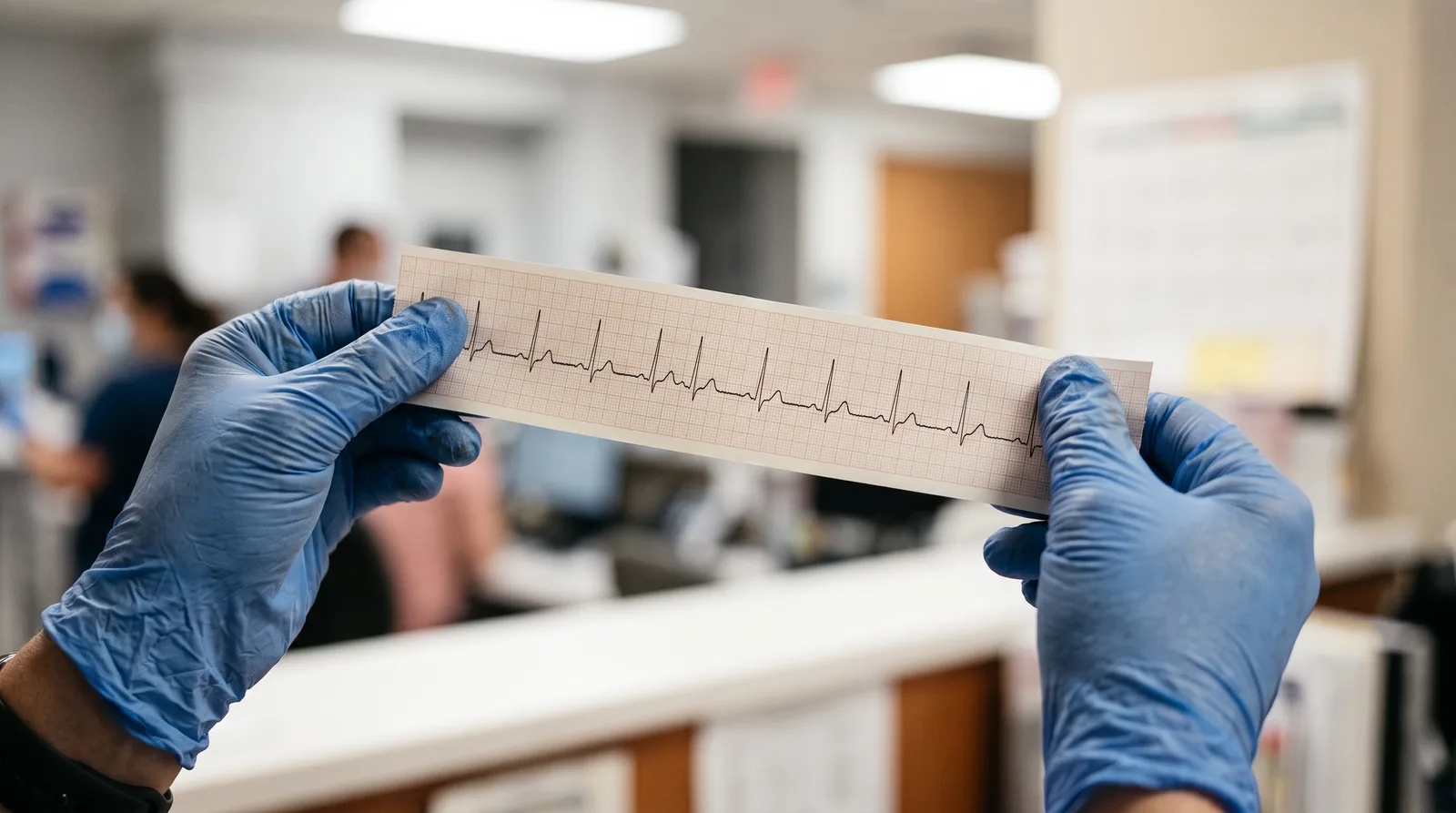
What you'll learn
What you'll be able to do
- Identify and label every component of a normal PQRST waveform with clinical accuracy
- Recognize and classify the 12 most common cardiac arrhythmias from a rhythm strip
- Correctly place all 12 leads on a patient and troubleshoot poor signal artifacts
- Calculate heart rate, PR interval, QRS duration, and QT interval from any strip
- Apply systematic rhythm-analysis protocols used on real hospital floors
- Pass a nationally recognized EKG technician certification exam (CET or equivalent) on the first attempt
How it works
A school that adapts to you
This isn't a set of static videos. Every lesson is generated live and tuned to where you actually are.
We learn your level
A quick placement check tailors your starting point so you're never bored or lost.
Lessons adapt as you go
Each lesson is written for your pace and your goal, adjusting as your skills grow.
Your AI coach keeps you moving
Checkpoints, feedback, and gentle nudges turn progress into a real result.
The curriculum
What's inside your school
6 modules · 28 lessons

The Cardiac Foundation
Builds the anatomical and electrophysiological knowledge every EKG technician must have before touching a lead or reading a strip.
- 1.1Heart Anatomy & the Conduction SystemIncluded
- 1.2Cardiac Cell ElectrophysiologyIncluded
- 1.3How the EKG Machine WorksIncluded
- 1.4The Normal PQRST WaveformIncluded
Measurements & Intervals
Develops the precise calculation skills needed to measure heart rate and all critical intervals from any rhythm strip.
- 2.1Calculating Heart RateIncluded
- 2.2Measuring the PR IntervalIncluded
- 2.3Measuring QRS DurationIncluded
- 2.4Measuring the QT & Corrected QTc IntervalIncluded
- 2.5Systematic Rhythm Analysis ProtocolIncluded
Lead Setup & Artifact Troubleshooting
Covers correct electrode placement for all 12 leads and teaches technicians to identify and eliminate common signal artifacts.
- 3.1Limb Lead PlacementIncluded
- 3.2Precordial (Chest) Lead PlacementIncluded
- 3.3Acquiring a Diagnostic-Quality 12-Lead EKGIncluded
- 3.4Recognizing & Eliminating ArtifactsIncluded
Sinus & Atrial Arrhythmias
Teaches recognition and classification of rhythms originating in the SA node and atria, using systematic strip analysis.
- 4.1Normal Sinus Rhythm & Sinus VariantsIncluded
- 4.2Premature Atrial Contractions (PACs)Included
- 4.3Atrial FlutterIncluded
- 4.4Atrial FibrillationIncluded
- 4.5Supraventricular Tachycardia (SVT)Included
Ventricular & Junctional Arrhythmias + Heart Blocks
Covers dangerous ventricular rhythms, junctional rhythms, and the spectrum of AV heart blocks critical for certification exams.
- 5.1Junctional RhythmsIncluded
- 5.2Premature Ventricular Contractions (PVCs)Included
- 5.3Ventricular Tachycardia & Ventricular FibrillationIncluded
- 5.4First-, Second-, & Third-Degree AV Heart BlocksIncluded
- 5.5Bundle Branch BlocksIncluded
Certification Exam Preparation & Practice
Consolidates all skills into timed practice, exam strategy, and simulated testing to ensure first-attempt certification success.
- 6.1Exam Blueprint & Question StrategiesIncluded
- 6.2High-Yield Rhythm Strip DrillIncluded
- 6.3Measurements & Intervals Speed ReviewIncluded
- 6.4Full-Length Practice ExamIncluded
- 6.5Final Review & Exam-Day Game PlanIncluded
Who it's for
Is this you?

Aspiring EKG Technicians
You're entering the field and need a complete, exam-ready foundation — from waveform basics to rhythm classification and 12-lead technique.

Nursing Students
You need to interpret rhythm strips confidently on the floor, and this school gives you the clinical framework that nursing school covers too quickly.

Medical Assistants
You're already performing EKGs in clinic and want to deepen your interpretation skills and correct any technique gaps with proper lead placement and artifact troubleshooting.
Allied Health Students
Whether you're in an MA, PCT, or cardiovascular tech program, this curriculum aligns directly with the content tested on your certification exam.

Exam Re-takers
If you've sat for the CET or CRAT before and didn't pass, this school fills the gaps — especially in arrhythmia recognition, intervals, and exam strategy.
Healthcare Career Changers
You're moving into a clinical role and need to build cardiac knowledge from scratch — the school starts with anatomy and electrophysiology, so no background is assumed.
Questions
Frequently asked
Your teacher
A note from your teacher

Tracy Burke
If you're reading this, you're probably somewhere between excited and a little overwhelmed. Maybe you've flipped through an EKG textbook and felt the pages blur together. Maybe you've watched a rhythm strip scroll across a monitor and had no idea where to start. Maybe your exam date is approaching and you want to feel genuinely prepared — not just hoping for the best.
That's exactly where this school begins.
Cardiac rhythm interpretation has a reputation for being difficult, and honestly, some of that reputation is earned. It involves real physiology, precise measurements, and split-second pattern recognition. But most of the difficulty doesn't come from the content itself — it comes from learning it out of order, or without a clear framework, or from resources that either oversimplify the science or bury you in it. My goal with EKG Certified is to give you the framework first, build every concept on the last, and never ask you to memorize something I haven't first explained.
We start with the heart: its anatomy, its conduction system, and the electrical events that produce each wave on the strip. That foundation isn't just background — it's the reason you'll be able to look at an unfamiliar rhythm and reason your way through it, not just guess. From there, we move into measurements and intervals, 12-lead technique, the full arrhythmia spectrum from sinus variants to ventricular fibrillation to heart blocks, and finally into focused, strategic exam preparation. Nothing is skipped. Nothing is padded.
I built this curriculum the way a seasoned cardiac instructor teaches at the bedside: with clinical precision, with visual clarity, and with the understanding that what you're learning matters beyond the exam. The patients you'll monitor are real. The rhythms you'll recognize are real. The skills you'll build here go with you.
So if you're ready to stop feeling uncertain in front of a rhythm strip and start reading them with the calm confidence of someone who actually knows what they're looking at — let's get to work.
— Tracy Burke
Start your journey today
Join get instant access — learn at your own pace with an AI coach in your corner.
$49.99/mo
Recurring billing · cancel anytime
Enrolling a child? Sign up as a parent — you'll add your student right here after.
Secure checkout · Instant access
- 6 modules, 28 lessons
- AI-adaptive lessons tuned to your level
- Quizzes & checkpoints to lock in progress
- Your own AI learning coach
- Learn on any device, at your pace
- Full access for as long as you're subscribed