
Go from zero to real, working circuits
This diploma-level electronics course puts you at the bench from day one — building, measuring, and troubleshooting actual circuits until the theory isn't just understood, it's felt in your hands.
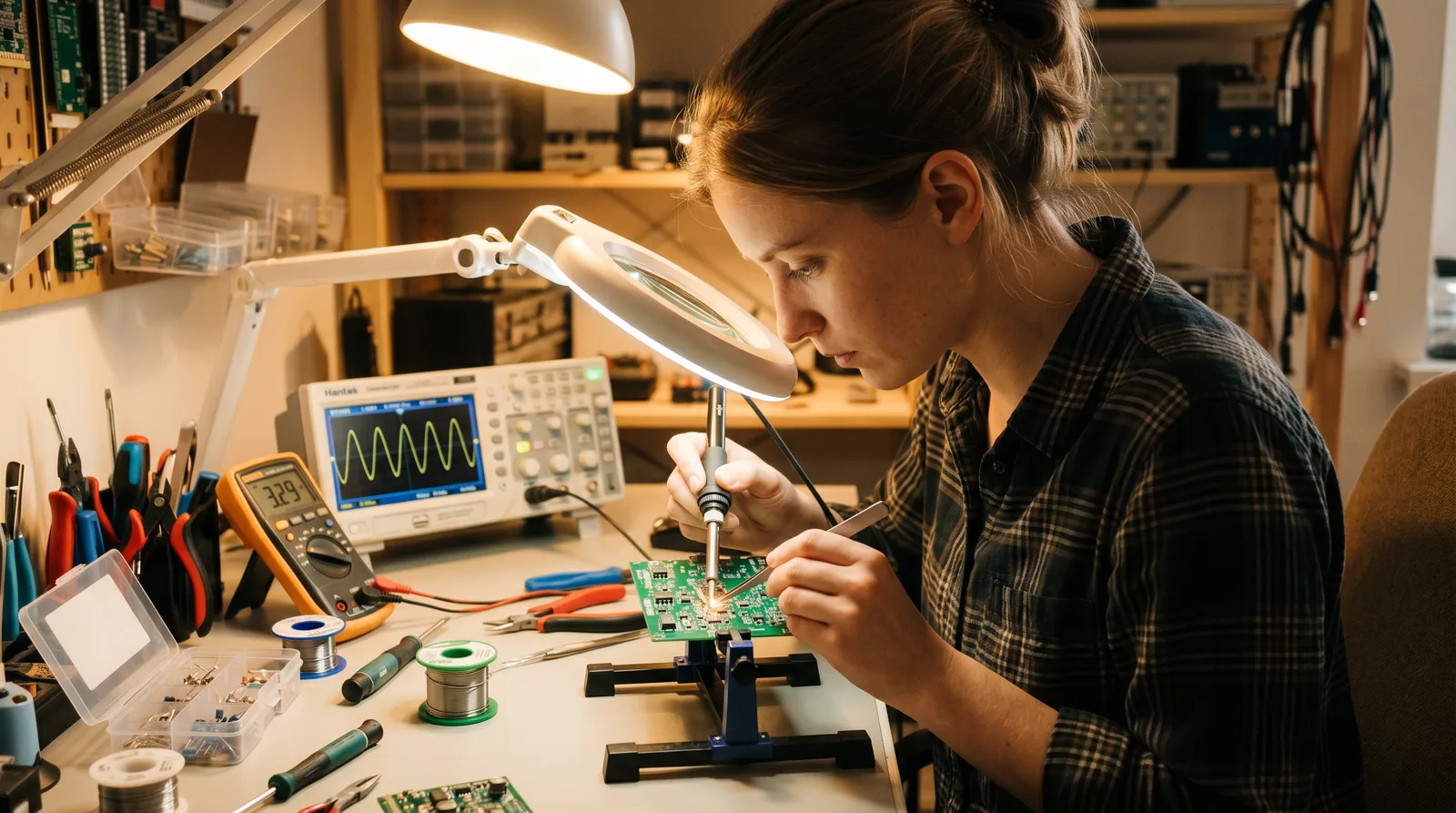
"I'd rather you understand one circuit deeply than memorise ten — so we always start with what you can see, measure, or touch."
— Renstay College
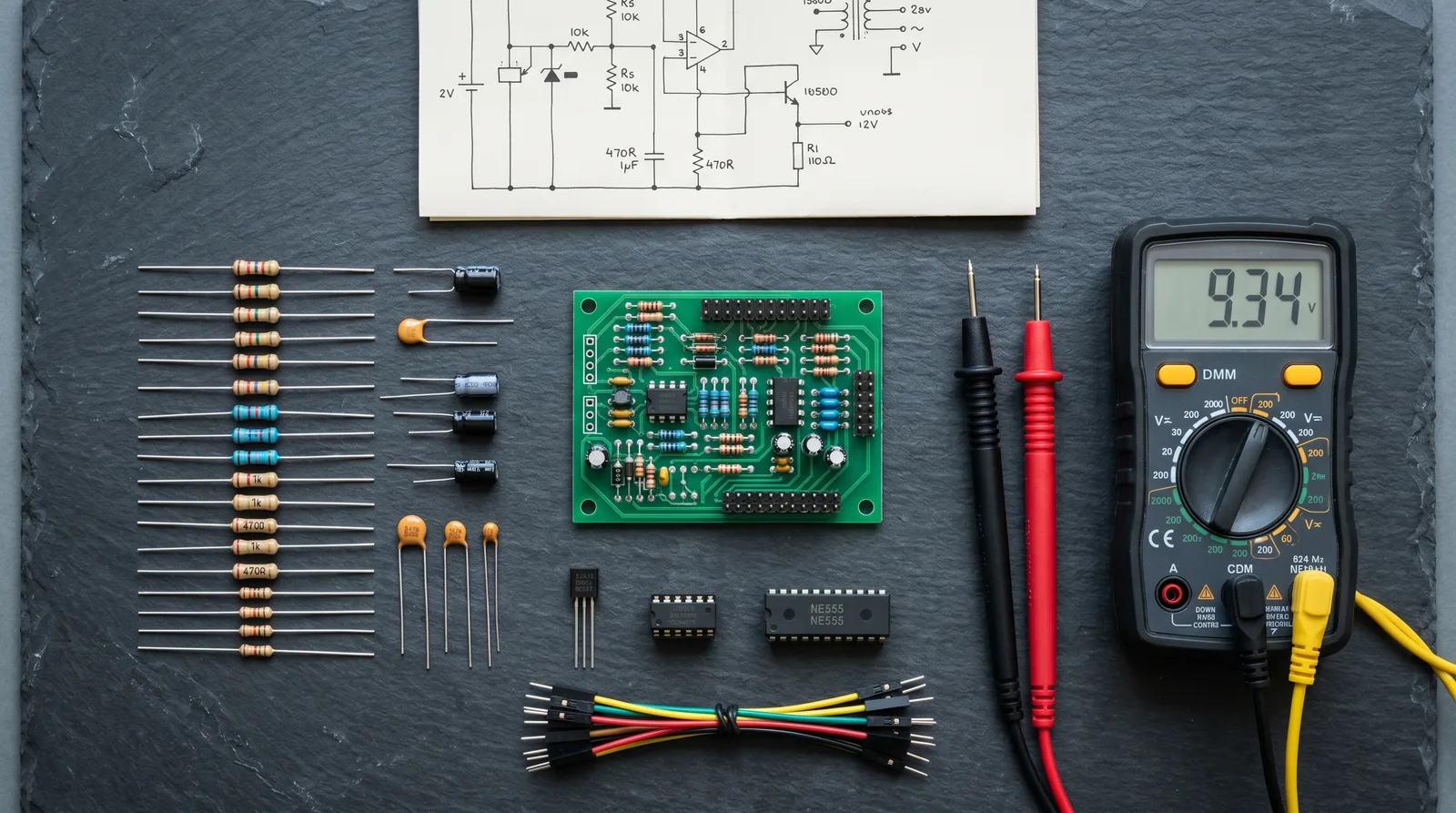
What you'll learn
What you'll be able to do
- Read and interpret professional circuit schematics and PCB layouts with confidence
- Build, test, and troubleshoot analog and digital circuits on a breadboard and soldered PCB
- Use essential bench instruments — multimeter, oscilloscope, and power supply — to measure and diagnose circuit behaviour
- Understand and apply core electronics principles: Ohm's Law, Kirchhoff's laws, transistor biasing, and op-amp configurations
- Design and assemble practical projects including a regulated power supply, audio amplifier, and microcontroller-based device
- Identify faulty components and systematically debug real-world circuit failures using a structured fault-finding methodology
How it works
A school that adapts to you
This isn't a set of static videos. Every lesson is generated live and tuned to where you actually are.
We learn your level
A quick placement check tailors your starting point so you're never bored or lost.
Lessons adapt as you go
Each lesson is written for your pace and your goal, adjusting as your skills grow.
Your AI coach keeps you moving
Checkpoints, feedback, and gentle nudges turn progress into a real result.
The curriculum
What's inside your school
0 modules · 0 lessons

The Electronics Workbench — Tools, Safety & Schematics
Establishes the foundation: setting up a safe workspace, mastering bench instruments, and confidently reading professional schematics and PCB layouts.
- 1.1Your Bench, Your Rules — Workspace Setup & Electrical SafetyIncluded
- 1.2Reading Circuit Schematics — Symbols, Conventions & LayoutIncluded
- 1.3Understanding PCB Layouts — From Schematic to BoardIncluded
- 1.4Mastering the Multimeter — Voltage, Current & Resistance MeasurementIncluded
- 1.5The Oscilloscope & Bench Power Supply in PracticeIncluded
Core Electronics Principles — Theory You Can Touch
Builds the essential theoretical and mathematical foundations — Ohm's Law, Kirchhoff's laws, and component behaviour — verified immediately through hands-on breadboard experiments.
- 2.1Ohm's Law in Action — Voltage, Current & Resistance on the BreadboardIncluded
- 2.2Kirchhoff's Laws — Analysing Series and Parallel CircuitsIncluded
- 2.3Capacitors & Inductors — Energy Storage and AC BehaviourIncluded
- 2.4Diodes in Practice — Rectification, Clipping & ProtectionIncluded
- 2.5Transistor Biasing — BJT as a Switch and AmplifierIncluded
Analog Circuits — Building & Testing Real Amplifiers
Applies analog theory to build, measure, and troubleshoot amplifier and signal-conditioning circuits using discrete transistors and op-amps.
- 3.1Small-Signal Amplifier Design — Common-Emitter StageIncluded
- 3.2Op-Amp Fundamentals — Inverting, Non-Inverting & Voltage Follower ConfigurationsIncluded
- 3.3Op-Amp Applications — Comparators, Summing Amplifiers & Active FiltersIncluded
- 3.4Audio Amplifier Project — Design, Build & ListenIncluded
Digital Electronics — Logic, Signals & Microcontrollers
Introduces digital logic fundamentals and progresses to programming and interfacing a microcontroller with real-world hardware.
- 4.1Digital Logic Fundamentals — Gates, Truth Tables & Boolean AlgebraIncluded
- 4.2Combinational & Sequential Logic — Flip-Flops and CountersIncluded
- 4.3Analog–Digital Interfacing — ADCs, DACs & Signal LevelsIncluded
- 4.4Microcontroller Basics — Programming, GPIO & Serial CommunicationIncluded
- 4.5Microcontroller Project — Sensor-Driven Device BuildIncluded
Power Electronics — Regulated Supplies & PCB Soldering
Covers mains-safe power supply design and transforms breadboard prototypes into permanent, soldered PCB assemblies.
- 5.1Power Supply Theory — Transformers, Rectifiers & SmoothingIncluded
- 5.2Voltage Regulation — Linear Regulators and the 78xx SeriesIncluded
- 5.3Introduction to Switch-Mode Power SuppliesIncluded
- 5.4PCB Soldering Skills — Through-Hole and Surface-Mount TechniquesIncluded
- 5.5Regulated Power Supply Project — Full PCB Assembly & TestingIncluded
Fault-Finding & Professional Practice — Diagnose, Debug & Qualify
Develops a systematic, professional fault-finding methodology and consolidates all diploma skills through a capstone project and portfolio assessment.
- 6.1Fault-Finding Methodology — A Structured Approach to DebuggingIncluded
- 6.2Identifying Faulty Components — Testing Resistors, Caps, Diodes & TransistorsIncluded
- 6.3Fault-Finding Workshop — Diagnosing Pre-Faulted BoardsIncluded
- 6.4Capstone Project — Design, Build, Test & Document a Complete CircuitIncluded
- 6.5Portfolio Review & Diploma AssessmentIncluded
Who it's for
Is this you?

Career changers
You want to move into electronics or electrical work and need a credible, practical qualification that proves bench competence to employers.

Engineering students
Your degree is theory-heavy — this course gives you the hands-on instrument skills, soldering experience, and fault-finding ability your university modules skip.

Serious hobbyists
You've outgrown Arduino starter kits and want to understand the electronics underneath — schematics, amplifiers, power supplies, and all.

Aspiring technicians
You're aiming for a bench technician or field service role and need structured, assessable training that goes beyond YouTube tutorials.

Makers going deeper
You can follow a wiring diagram but want to design and debug your own circuits — this course teaches you to think like an engineer, not just assemble like one.

STEM returners
You studied science or engineering years ago and want to refresh and extend your electronics knowledge with a modern, practical, hands-on course.
Questions
Frequently asked
Your teacher
A note from your teacher

Renstay College
If you've ever stared at a circuit diagram and felt like it was written in a foreign language — or built something from a tutorial, had it not work, and had absolutely no idea where to start looking — then I want you to know that's not a talent gap. That's a teaching gap. And it's exactly what this course was built to close.
I designed Practical Electronics Lab because I kept seeing the same problem: smart, motivated people learning electronics from resources that were either too abstract to be useful or too recipe-like to build real understanding. They could follow a wiring diagram step-by-step, but the moment something went wrong — or they needed to design something themselves — they were stuck. Theory without bench time is just vocabulary. Bench time without theory is just guesswork. You need both, together, from the start.
So that's how this course is structured. Every principle — Ohm's Law, Kirchhoff's laws, transistor biasing, op-amp feedback — gets introduced in plain language, then immediately tested on a real circuit you build yourself. When we cover capacitors, you'll watch them charge and discharge on the oscilloscope. When we cover voltage regulation, you'll wind up with a bench power supply you soldered yourself. When we cover fault-finding, you'll work on boards with real, deliberate faults — because that's the only way the skill actually sticks.
I also believe strongly in teaching the why behind every step. Not because I want to slow you down, but because understanding why a common-emitter amplifier is biased the way it is means you can adapt it, fix it, and eventually design your own — rather than copying it and hoping for the best. That's the difference between someone who knows electronics and someone who can follow instructions.
By the time you reach the capstone project, you'll design a complete circuit from a brief, build it, test it with instruments you now know how to use, document it professionally, and submit it for assessment. That project goes straight into your portfolio — and it represents something you can be genuinely proud of, because you made every decision in it.
Whether you're aiming for a role as a technician, bolting real skills onto an engineering degree, switching careers, or just finally getting serious about a long-standing passion — you're in the right place. Let's get your bench set up and get started.
— Renstay College
Start your journey today
Get instant access — learn at your own pace with an AI coach in your corner.
$19/mo
Recurring billing · cancel anytime
Secure checkout · Instant access
- 6 modules, 29 lessons
- AI-adaptive lessons tuned to your level
- Quizzes & checkpoints to lock in progress
- Your own AI learning coach
- Learn on any device, at your pace
- Full access for as long as you're subscribed