
Earn your TESOL certification — and actually know how to teach
ELLGI TESOL Certification takes you from zero teaching background to classroom-ready through rigorous linguistics, evidence-based methodology, and a real capstone unit — built for every context, from local ESL classrooms to global online platforms.

"Theory only counts when it changes what you do in the classroom — and that's the standard every lesson in this program is held to."
— Kimberly Williams
What you'll learn
What you'll be able to do
- Apply core linguistics concepts — phonology, morphology, syntax, semantics, pragmatics — to diagnose learner errors and design targeted instruction
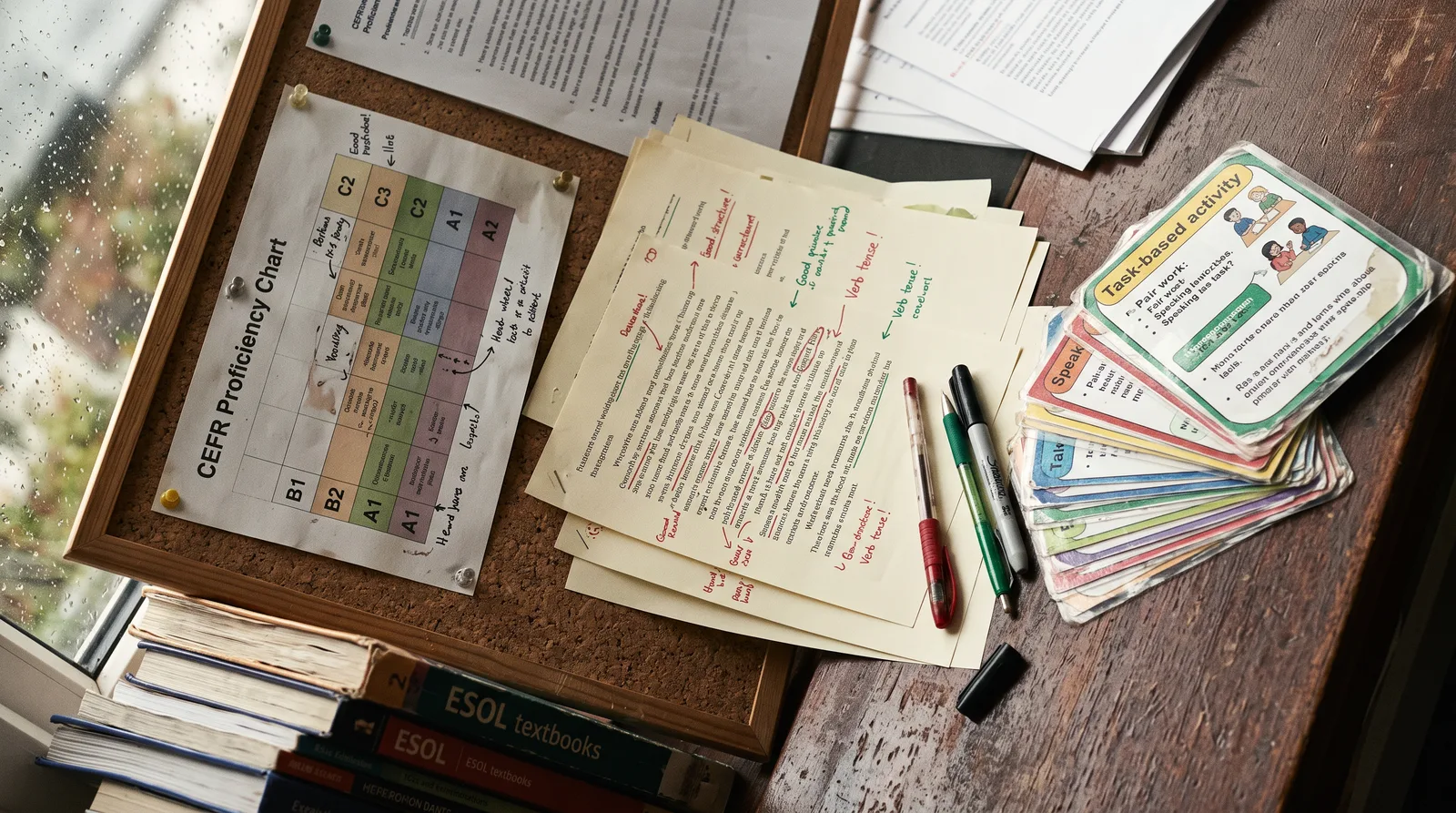
- Plan and execute communicative, task-based lessons aligned to CEFR proficiency levels for learners of different ages, goals, and cultural backgrounds
- Teach all four language skills — listening, speaking, reading, and writing — using evidence-informed strategies and appropriate scaffolding
- Select, adapt, and create materials for in-person, private, and online teaching environments, integrating technology and AI responsibly
- Conduct diagnostic, formative, and summative assessments, deliver constructive feedback, and use error analysis to guide instructional decisions
- Complete a capstone TESOL unit and comprehensive final exam demonstrating readiness to teach ethically and effectively in real-world settings
How it works
A school that adapts to you
This isn't a set of static videos. Every lesson is generated live and tuned to where you actually are.
We learn your level
A quick placement check tailors your starting point so you're never bored or lost.
Lessons adapt as you go
Each lesson is written for your pace and your goal, adjusting as your skills grow.
Your AI coach keeps you moving
Checkpoints, feedback, and gentle nudges turn progress into a real result.
The curriculum
What's inside your school
12 modules · 56 lessons

TESOL Foundations and Teaching Contexts
Establishes the field's core terminology, teaching contexts, and ELLGI's professional philosophy before candidates encounter any pedagogy or linguistics.
- 1.1TESOL, TEFL, TESL, ESL, EFL — What the Acronyms Actually MeanIncluded
- 1.2Domestic, International, Private, and Online Teaching SettingsIncluded
- 1.3The ELLGI Teaching Philosophy and Professional StandardsIncluded
- 1.4The CEFR Proficiency Framework in PracticeIncluded
- 1.5Certification Requirements, Employer Realities, and Jurisdiction VariationsIncluded
Linguistics for Language Teachers
Builds the linguistic knowledge base — phonetics, phonology, morphology, syntax, semantics, pragmatics, and discourse — that underpins all instructional decisions in the program.
- 2.1Sound Systems: Phonetics and Phonology for TeachersIncluded
- 2.2Word Structure: Morphology and Its Classroom ApplicationsIncluded
- 2.3Sentence Structure: Syntax Teachers Need to KnowIncluded
- 2.4Meaning in Context: Semantics and PragmaticsIncluded
- 2.5Discourse, Cohesion, and the Larger TextIncluded
Language Acquisition and the Learner
Examines how first and second languages are acquired, the factors that influence learning, and how acquisition theory directly informs instructional choices.
- 3.1How Children Acquire Language: First-Language AcquisitionIncluded
- 3.2Second-Language Acquisition: Theories and Implications for TeachingIncluded
- 3.3Factors That Affect SLA: Age, Motivation, Affect, and IdentityIncluded
- 3.4Interlanguage, Transfer, and the Role of the First LanguageIncluded
- 3.5Learning Styles, Strategies, and Learner AutonomyIncluded
TESOL Methodologies and Lesson Design
Traces the history of language teaching methods, establishes communicative and task-based teaching as the program's core framework, and develops foundational lesson-planning skills.
- 4.1A History of Language Teaching MethodsIncluded
- 4.2Communicative Language Teaching: Principles and PracticeIncluded
- 4.3Task-Based Language Teaching in the ClassroomIncluded
- 4.4Writing Lesson Plans: Objectives, Procedures, and SequencingIncluded
- 4.5Classroom Management, Engagement, and Creating a Safe Learning EnvironmentIncluded
Teaching Listening and Speaking
Develops evidence-informed strategies for teaching receptive listening skills and productive oral communication, including pronunciation, conversation, and intelligibility.
- 5.1Teaching Listening: Processes, Challenges, and StrategiesIncluded
- 5.2Teaching Speaking and ConversationIncluded
- 5.3Pronunciation, Stress, Rhythm, and IntonationIncluded
- 5.4Developing Oral Fluency and Interaction SkillsIncluded
Teaching Reading and Writing
Provides a comprehensive skill-by-skill approach to developing learners' literacy in English, from decoding and comprehension strategies through the complete writing process.
- 6.1Teaching Reading: Skills, Strategies, and Text SelectionIncluded
- 6.2Reading Comprehension: From Literal Understanding to Critical AnalysisIncluded
- 6.3Teaching Writing: Process, Genre, and PurposeIncluded
- 6.4Vocabulary Instruction: Teaching Words Deeply and SystematicallyIncluded
- 6.5Grammar Instruction in Meaningful ContextsIncluded
Learner Diversity, Error Analysis, and Feedback
Equips candidates to differentiate instruction across age groups, proficiency levels, and learning needs, and to use error analysis and feedback as core pedagogical tools.
- 7.1Teaching Across Ages: Children, Adolescents, and AdultsIncluded
- 7.2Teaching Across Proficiency Levels: Beginner Through AdvancedIncluded
- 7.3Differentiation, Scaffolding, and Meeting Diverse Learner NeedsIncluded
- 7.4Error Analysis: Diagnosing, Understanding, and Responding to ErrorsIncluded
- 7.5Feedback That Works: Oral, Written, and Peer Feedback StrategiesIncluded
Assessment and Materials Development
Develops candidates' ability to assess learner progress rigorously and fairly, and to select, adapt, and create high-quality materials for any teaching context.
- 8.1Assessment Principles: Validity, Reliability, and WashbackIncluded
- 8.2Diagnostic, Formative, and Summative Assessment in PracticeIncluded
- 8.3Performance Assessment and Portfolio EvidenceIncluded
- 8.4Selecting and Adapting Published MaterialsIncluded
- 8.5Creating Original Teaching MaterialsIncluded
Online Teaching and Educational Technology
Prepares candidates to deliver effective, ethical, and engaging instruction in virtual and hybrid environments using current and emerging technology tools.
- 9.1Principles of Effective Online Language TeachingIncluded
- 9.2Digital Tools, Platforms, and the Virtual ClassroomIncluded
- 9.3Responsible Use of AI in Language Teaching and LearningIncluded
- 9.4Learner Privacy, Digital Safety, and Professional Conduct OnlineIncluded
Culture, Intercultural Communication, and Responsive Teaching
Develops cultural awareness and intercultural communication competence, enabling candidates to create inclusive, culturally responsive classrooms anywhere in the world.
- 10.1Culture, Language, and Identity in the Language ClassroomIncluded
- 10.2Intercultural Communicative Competence and World EnglishesIncluded
- 10.3Culturally Responsive Teaching: Principles and Classroom PracticeIncluded
- 10.4Navigating Sensitive Topics and Inclusive Classroom DynamicsIncluded
Professional Ethics, Careers, and Ongoing Development
Grounds candidates in TESOL professional ethics, safeguarding responsibilities, global career pathways, and the mindset of a reflective, career-long practitioner.
- 11.1Professional Ethics and Boundaries in TESOLIncluded
- 11.2Safeguarding, Duty of Care, and Vulnerable LearnersIncluded
- 11.3TESOL Career Pathways: Domestic, International, Private, and OnlineIncluded
- 11.4Reflective Practice and Continuing Professional DevelopmentIncluded
Teaching Practicum, Capstone, and Certification Assessment
Synthesizes the entire program through observed microteaching, a complete capstone lesson unit, and a comprehensive final exam demonstrating readiness to teach.
- 12.1Preparing for the Practicum: Observation, Reflection, and ReadinessIncluded
- 12.2Microteaching: Planning, Delivering, and Debriefing a Lesson SegmentIncluded
- 12.3Capstone TESOL Unit: Design, Rationale, and Full DocumentationIncluded
- 12.4Comprehensive Final Exam: Applied Knowledge Across the ProgramIncluded
- 12.5Certification Review, Portfolio Submission, and Next StepsIncluded
Who it's for
Is this you?

Career changers
She's leaving her current field and wants a credential with enough intellectual depth to stand up to scrutiny from real employers.

Aspiring online tutors
He's ready to build a private or platform-based English tutoring practice and needs the methodology, ethics, and tech know-how to do it professionally.

Teach-abroad dreamers
She has a destination in mind and understands that a credible, rigorous certification is what separates serious candidates from the crowd.

Community ESL volunteers
He's been tutoring immigrants and refugees informally and wants the linguistic and pedagogical foundation to do it with real competence and care.

Returning-to-work adults
She's re-entering the workforce after time away and sees TESOL as a flexible, globally portable profession worth preparing for properly.

Recent graduates
His degree didn't include teacher training, and he wants a rigorous TESOL qualification that complements his academic background and opens global doors.
Questions
Frequently asked
Your teacher
A note from your teacher
Kimberly Williams
If you're reading this, you're probably at one of a few points: you've decided you want to teach English — maybe abroad, maybe online, maybe right in your own city — but you're not sure your preparation is solid enough to do it well. Or you've looked at other TESOL programs and felt uneasy about how thin the content seemed. Or you simply know yourself well enough to understand that a credential only means something if the knowledge behind it is real.
That instinct is worth trusting — and it's exactly what this program is built for.
I designed ELLGI TESOL Certification around a conviction I hold firmly: theory only counts when it changes what you do in the classroom. So yes, we cover linguistics — phonology, morphology, syntax, semantics, pragmatics, and discourse. But we cover them because understanding how English sound systems work helps you teach pronunciation with precision; because knowing how morphology operates makes vocabulary instruction dramatically more effective; because pragmatics is the difference between a learner who is grammatically correct and one who actually communicates. Every concept earns its place by being useful to you as a teacher.
The same principle applies to second-language acquisition theory, assessment design, materials development, intercultural communication, and professional ethics. This is not a collection of loosely related topics. It is a coherent, sequenced program that builds your knowledge and your practice simultaneously — from the first lesson on the CEFR all the way through to your capstone unit, your microteaching experience, and your final exam. By the time you complete the program, you won't just hold a certificate. You'll have a professional vocabulary, a theoretical framework, and practical tools you can use on day one in any teaching context.
I also want to be direct with you about something: teaching English is a responsibility. You will work with real people — children and adults, immigrants and international students, learners with high stakes and real vulnerability. The program takes ethics, safeguarding, and culturally responsive practice seriously, not as compliance requirements, but as the foundation of what it means to be a trustworthy professional in this field.
If you're ready to be treated as an emerging colleague — challenged intellectually, supported practically, and prepared honestly — I'd be glad to have you in the program. Let's do this properly.
— Kimberly Williams
Start your journey today
Get instant access — learn at your own pace with an AI coach in your corner.
$97/mo
Recurring billing · cancel anytime
Secure checkout · Instant access
- 12 modules, 56 lessons
- AI-adaptive lessons tuned to your level
- Quizzes & checkpoints to lock in progress
- Your own AI learning coach
- Learn on any device, at your pace
- Full access for as long as you're subscribed