Learn to open up — even when shutting down is all you've ever known
Open Hands™ is a step-by-step guided journey for adults who go quiet when it hurts most — rebuilding emotional language, relational safety, and honest connection through compassion, not pressure.

I've never met someone who felt too little — only people who learned too early that feeling was dangerous, and I built this school to gently prove them wrong.— Leigh Baumann

What you'll learn
What you'll be able to do
- Identify your personal emotional shutdown patterns, triggers, and the childhood roots that shaped them
- Build a working emotional vocabulary so you can name what you feel in real time — beyond 'fine' or 'nothing'
- Use the Pause–Breathe–Name–Respond method to stay present during conflict instead of going numb or withdrawing
- Practice graded vulnerability — small, safe disclosures that gradually rebuild trust in yourself and others
- Repair relational ruptures after shutdown episodes with concrete, low-pressure reconnection tools
- Sustain emotional presence in close relationships by expressing needs, holding boundaries, and choosing honesty over performance
How it works
A school that adapts to you
This isn't a set of static videos. Every lesson is generated live and tuned to where you actually are.
We learn your level
A quick placement check tailors your starting point so you're never bored or lost.
Lessons adapt as you go
Each lesson is written for your pace and your goal, adjusting as your skills grow.
Your AI coach keeps you moving
Checkpoints, feedback, and gentle nudges turn progress into a real result.
The curriculum
What's inside your school
5 modules · 23 lessons

Recognize: Understanding Your Emotional Shutdown
Uncover the personal patterns, triggers, and childhood roots behind emotional withdrawal so learners understand why they close off — not as failure, but as learned protection.
- 1.1What Emotional Shutdown Actually IsIncluded
- 1.2Your Shutdown SignatureIncluded
- 1.3Tracing the Roots: Family of OriginIncluded
- 1.4What Lives Under 'Nothing'Included
- 1.5Your Trigger MapIncluded
Release: Letting Go of Suppression
Help learners loosen the grip of shame, fear, and the belief that emotions are dangerous, so feelings can be acknowledged without escape or collapse.
- 2.1The Cost of Keeping It InIncluded
- 2.2Shame, Fear, and the Silence They CreateIncluded
- 2.3Allowing Without EscapingIncluded
- 2.4Body Awareness as an Early Warning SystemIncluded
Renew: Building Emotional Language and Regulation
Expand learners' emotional vocabulary and equip them with the Pause–Breathe–Name–Respond method to stay present and regulated in real time.
- 3.1Beyond 'Fine': Expanding Your Emotional VocabularyIncluded
- 3.2The Pause–Breathe–Name–Respond MethodIncluded
- 3.3Naming in Real TimeIncluded
- 3.4Daily Emotion Check-InsIncluded
Restore: Rebuilding Emotional Safety in Relationships
Guide learners through graded vulnerability and low-pressure repair tools to gradually rebuild trust with themselves and the people they love.
- 4.1Why Safety — Not Intensity — Unlocks OpennessIncluded
- 4.2Graded Vulnerability: Starting SmallIncluded
- 4.3Repairing After a Shutdown EpisodeIncluded
- 4.4Staying Present Instead of RetreatingIncluded
- 4.5For Partners: Supporting Without PursuingIncluded
Respond: Living with Sustained Emotional Presence
Equip learners to express needs, hold boundaries, and choose honesty over performance — sustaining emotional connection as an ongoing daily practice.
- 5.1Expressing Needs Without Disappearing or ExplodingIncluded
- 5.2Holding Boundaries Without Going ColdIncluded
- 5.3Honesty Over Performance in Close RelationshipsIncluded
- 5.4Staying Engaged in ConflictIncluded
- 5.5Your Ongoing Emotional PracticeIncluded
Who it's for
Is this you?

The withdrawer in a relationship
You love your partner, but the moment conflict rises, you go somewhere they can't reach — and you're ready to understand why, and what to do instead.

Adult child of an emotionally closed home
Feelings were never named, asked about, or safe in your family growing up, and you're only now connecting the dots between then and your struggles to open up today.

The 'I'm fine' person
You've said 'I'm fine' so many times it has lost all meaning — and somewhere underneath it, you know there's more, but you don't yet have the words.

The pursuing partner
You're on the other side of a pursue-withdraw cycle, and you want to understand your partner's shutdown — and learn how to create safety instead of accidentally adding pressure.

The quietly exhausted high-achiever
You've built a capable, functional life and kept your emotional world strictly managed — and the cost of that is finally becoming impossible to ignore.

Someone returning to relationships after hurt
A past relationship — or several — taught you that being open gets you hurt, and you're looking for a way back to connection that doesn't ask you to pretend the fear isn't real.
Questions
Frequently asked
Your teacher
A note from your teacher
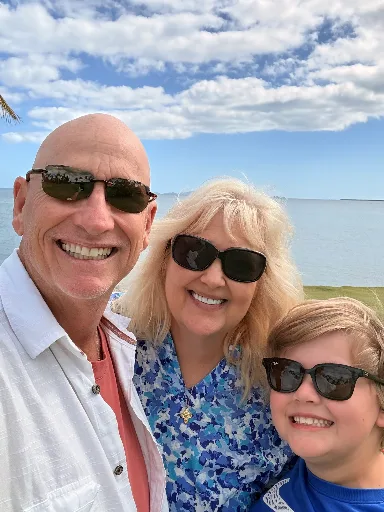
Leigh Baumann
I want to speak directly to you — the person who just read that headline and felt something quiet shift.
Maybe you've been told by someone you love that you "shut down." Maybe you already know it — you feel yourself go somewhere unreachable in the middle of an argument, and by the time you come back, the damage is done and you don't quite know how to explain where you went. Or maybe it's subtler than that: a low-grade distance you carry even in close relationships, a habit of saying "I'm fine" so automatically that you sometimes can't tell anymore whether it's true.
I created Open Hands™ because I kept meeting people — thoughtful, caring, self-aware people — who were suffering not from a lack of love, but from a lack of language. They'd grown up in homes where feelings were treated as problems to be managed, or weaknesses to be hidden, or simply never mentioned at all. So they learned to get quiet. They learned to wait it out. They learned that the most efficient thing to do with a hard feeling was to make it disappear. And it worked — until it didn't. Until the cost showed up in their marriages, their friendships, their sense of who they were underneath the performance of "fine."
What I know, and what this school is built on, is that emotional shutdown isn't a character flaw. It's an adaptation. It was smart, once. And it can be unlearned — not through pressure, not through someone demanding that you "just talk to me," but through safety, through language, and through very small, very honest moments stacked over time. The Pause–Breathe–Name–Respond method you'll learn here isn't a trick. It's a way of buying yourself just enough space to stay present instead of disappearing. The graded vulnerability work isn't about forcing yourself to be raw — it's about discovering that small disclosures don't destroy you, and that trust can be rebuilt incrementally, on your terms.
I am not here to tell you that you feel too little, or that something is broken in you. I believe the opposite: that the capacity is there, waiting — held back not by a flaw in your character, but by a set of very old, very understandable beliefs about whether it's safe to be seen. This school is an invitation to test those beliefs, carefully and at your own pace, and to find out what becomes possible on the other side.
You don't have to be ready. You just have to be willing to begin. I'm glad you're here.
— Leigh Baumann
Start your journey today
Join get instant access — learn at your own pace with an AI coach in your corner.
$47/mo
Recurring billing · cancel anytime
Secure checkout · Instant access
- 5 modules, 23 lessons
- AI-adaptive lessons tuned to your level
- Quizzes & checkpoints to lock in progress
- Your own AI learning coach
- Learn on any device, at your pace
- Full access for as long as you're subscribed