Get any band sounding good in 10 minutes flat
The Fast Live Mix System gives you a field-tested, step-by-step workflow — patch to fader balance to dynamics to EQ — so you stop guessing at the console and start executing like you've done it a hundred times.
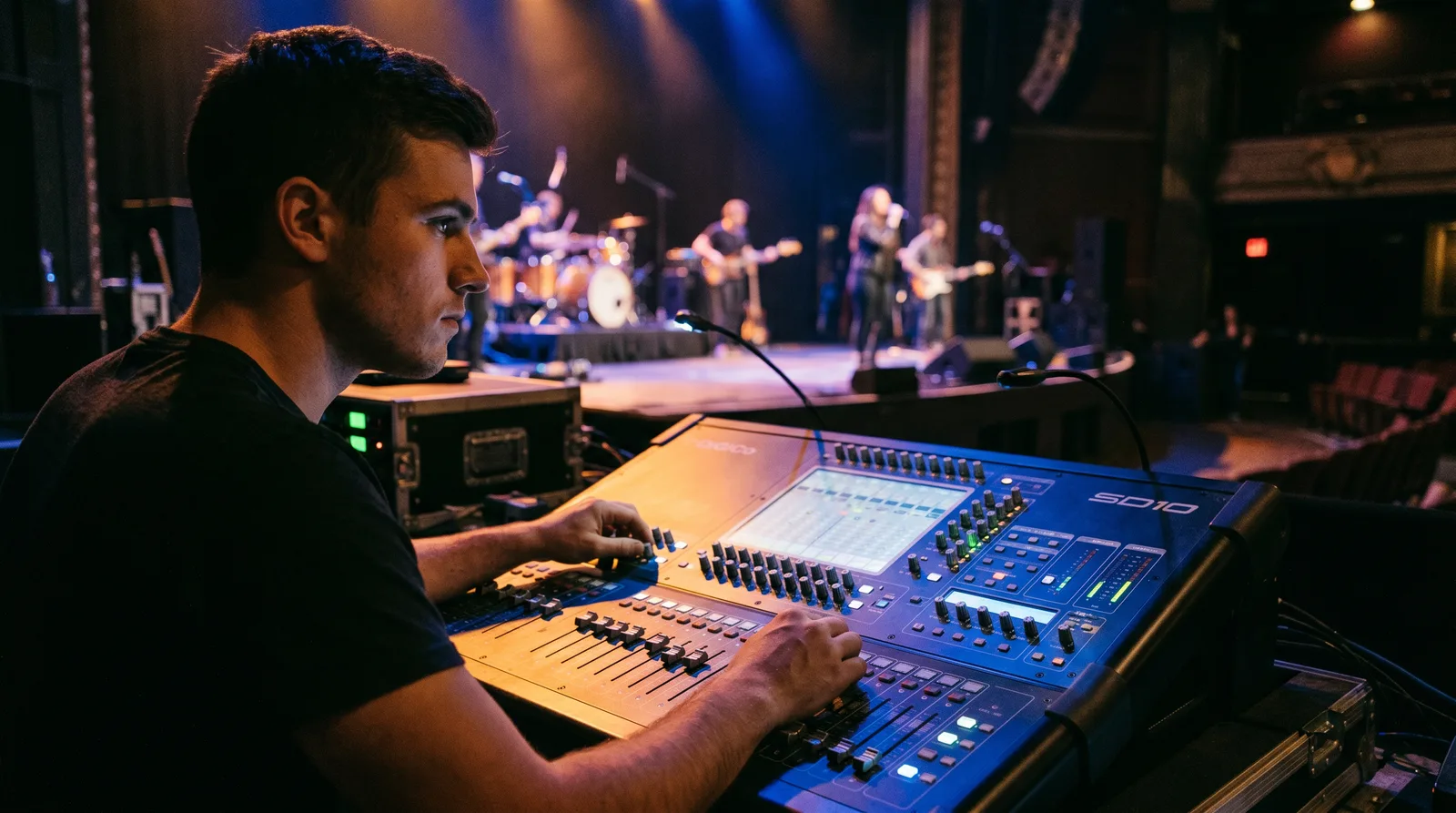
"Once you work the hierarchy in the right order, you stop chasing the mix — the mix comes to you."— Matt Jones
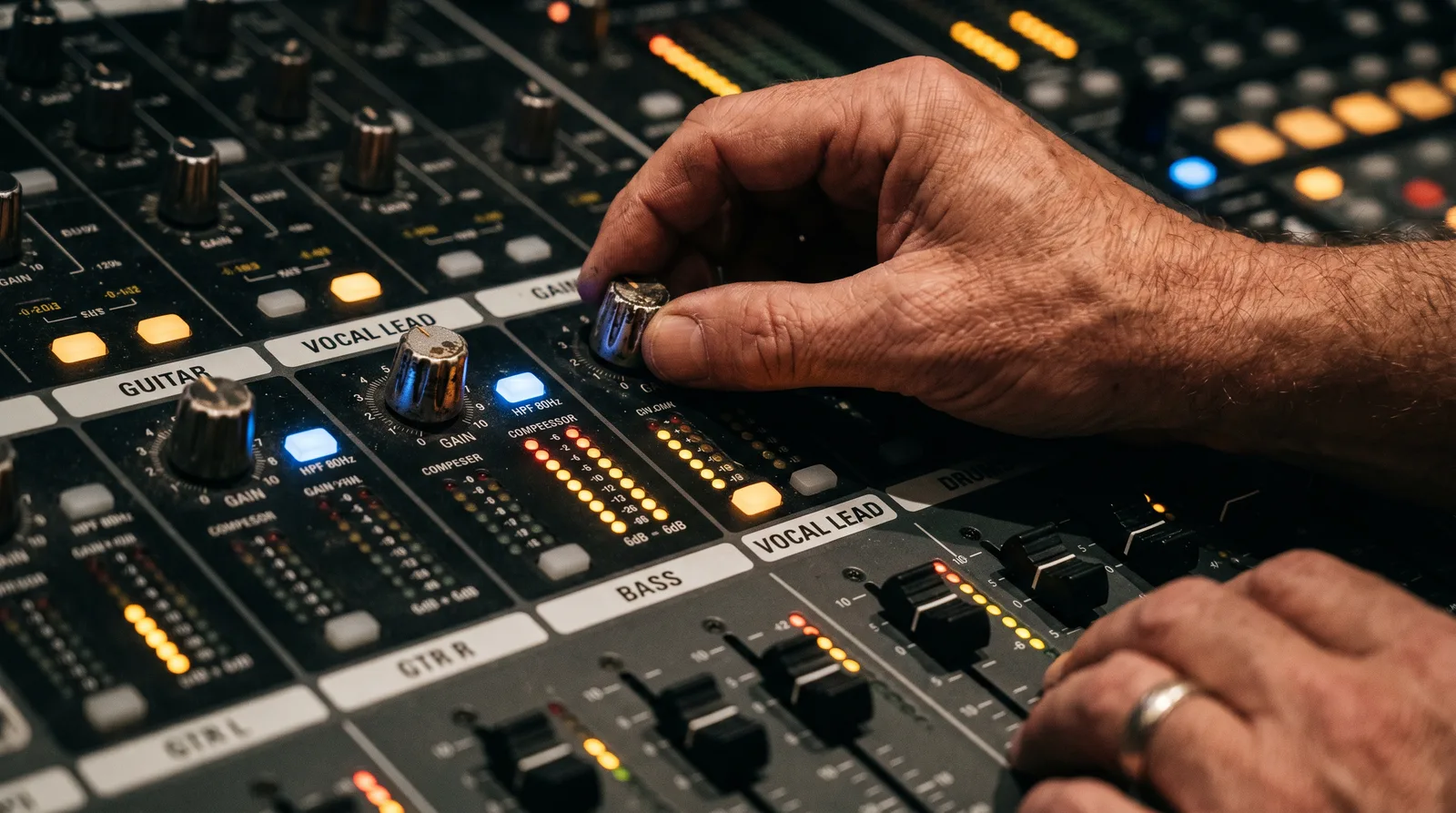
What you'll learn
What you'll be able to do
- Patch, label, and gain-stage a full band's inputs correctly in under 10 minutes during a live line check or changeover
- Apply HPF, gates/expanders, and compression as a first line of defense to stabilize every source before touching EQ
- Build a working fader balance that establishes source priority and a controlled mix foundation from scratch
- Diagnose and clean up the six most common sources — vocal, kick, snare, bass, guitars, and keys — using source-specific dynamics and EQ playbooks
- Use subtractive EQ surgically and only after dynamics are set, eliminating the habit of endlessly chasing tone with EQ alone
- Build and save a repeatable show file template, then pass a timed 10-minute mix challenge on a full live band
How it works
A school that adapts to you
This isn't a set of static videos. Every lesson is generated live and tuned to where you actually are.
We learn your level
A quick placement check tailors your starting point so you're never bored or lost.
Lessons adapt as you go
Each lesson is written for your pace and your goal, adjusting as your skills grow.
Your AI coach keeps you moving
Checkpoints, feedback, and gentle nudges turn progress into a real result.
The curriculum
What's inside your school
7 modules · 27 lessons

The 10-Minute Live Mix Workflow
Establishes the mental model and operational framework for the entire course. Students learn why a strict signal-chain order exists, how to read a room and a stage plot before touching a single knob, and how to pace every task against a real clock. This module is the prerequisite lens through which every subsequent module is understood — without internalizing the hierarchy here, students will revert to chasing EQ.
- 1.1Why Order Matters: The Workflow HierarchyIncluded
- 1.2Reading the Room Before You Touch a KnobIncluded
- 1.3The 10-Minute Clock: Pacing and PrioritizationIncluded
Patch, Label, Gain Stage, HPF
The physical and technical foundation of every live mix. Students build the habit of working methodically from the stage box to the console: every input gets a cable check, a label, a correctly set gain, and an HPF before any other processing is touched. Speed and accuracy here define everything downstream. A wrong gain or a missing label costs minutes during changeover.
- 2.1Patching and Labeling at SpeedIncluded
- 2.2Gain Staging: Setting the FoundationIncluded
- 2.3High-Pass Filters: The Non-Negotiable First CutIncluded
- 2.4Pre-Fader Checks: Confirming Signal IntegrityIncluded
Fader Balance and Source Priority
With gain and HPF set, students learn to build a working mix from the fader level alone — before any dynamics or EQ are applied. This module establishes the concept of source priority: not all sources are equal in a live mix, and the fader balance must reflect what the audience paid to hear. Students also learn to manage low-end energy through fader relationships, not EQ, as a prerequisite to the dynamics module.
- 3.1Source Priority: What the Audience Came to HearIncluded
- 3.2Building the Fader Balance from the Ground UpIncluded
- 3.3Controlling the Low End Before You Touch EQIncluded
Dynamics First: Gates, Expanders, and Compression
The technical and philosophical core of the FLMS method. Students learn to apply dynamics processing in the correct order — noise reduction (gates/expanders) before level control (compression) — and understand that every dynamics decision is a listening decision, not a number-plugging exercise. By the end of this module, students can stabilize any live source with dynamics before EQ is ever touched.
- 4.1Gates and Expanders: Silencing What Doesn't Need to Be HeardIncluded
- 4.2Compression: Controlling Dynamics Without Killing ThemIncluded
- 4.3Dynamics in Context: The Full Signal ChainIncluded
- 4.4Starter Settings by Source: Dynamics Reference ChartIncluded
Source Playbooks: Vocal, Kick, Snare, Bass, Guitars, Keys, Tracks
Applies the FLMS dynamics-first method source by source, giving students a repeatable, field-ready playbook for each of the six primary source families. Each playbook covers what the source should contribute to the mix, its unique challenges in a live context, the dynamics chain tailored to it, and the specific EQ moves that may still be needed after dynamics are set. This module bridges dynamics and EQ and prepares students for the surgical EQ module that follows.
- 5.1Vocal Playbook: Clarity, Control, and Feedback SafetyIncluded
- 5.2Kick and Snare Playbook: The Rhythmic FoundationIncluded
- 5.3Bass Guitar Playbook: Low-End Clarity Without BoomIncluded
- 5.4Electric Guitar, Keys, and Tracks Playbook: Managing the MiddleIncluded
- 5.5Source Playbook Speed Review and Flash AssessmentIncluded
EQ Second: Subtractive Cleanup and Feedback Control
EQ is applied only after gain staging, HPF, and dynamics are set. This module teaches students to use EQ as a precision tool — narrow subtractive notches to remove problem frequencies, never broad additive boosts to add character. Feedback control through ring-out is treated as a system-level EQ skill, not a channel-level one. Students who complete this module will have permanently broken the habit of chasing tone with EQ first.
- 6.1The EQ Mindset: Subtractive Before AdditiveIncluded
- 6.2Frequency Identification by EarIncluded
- 6.3Subtractive EQ by Source: The Six Common FixesIncluded
- 6.4Feedback Control and Ring-OutIncluded
Fast Changeover Drill: Build a Show File and Pass the 10-Minute Mix Challenge
The capstone module. Students synthesize every skill from the course into a repeatable show file template and then execute the full FLMS workflow against a real clock on a real or virtual band. The goal is a listenable, controlled, dynamic-stable mix in 10 minutes or less — not a perfect mix, but a professional, safe, and audience-ready one. Two full challenge attempts are included with a structured diagnosis and refinement session between them.
- 7.1Building Your FLMS Show File TemplateIncluded
- 7.2The Fast Changeover Protocol: Field ExecutionIncluded
- 7.3The 10-Minute Mix Challenge: Attempt 1Included
- 7.4Diagnosis, Refinement, and the 10-Minute Mix Challenge: Attempt 2Included
Who it's for
Is this you?

New FOH Engineer
Just landed your first regular FOH gig and need a reliable system that holds up when the band's already on stage and waiting.

Church Audio Tech
Running weekend services with limited soundcheck time and need a repeatable workflow that delivers consistent results every Sunday.

Venue House Tech
Handling back-to-back changeovers at a club or venue and need to get unfamiliar bands dialed in fast — every night.

AV & Event Tech
Working corporate events and multi-act shows where you have one shot to get the mix right before the program starts.

Self-Taught Mixer
Learned by watching and experimenting but ready to replace guesswork with a proper signal-chain workflow that actually scales.

Aspiring Touring Tech
Building the foundational skills and professional habits you'll need before stepping onto a tour or into a larger production.
Questions
Frequently asked
Your teacher
A note from your teacher
Matt Jones
If you've ever stood behind a console with a band waiting, a clock running, and a mix that just wasn't coming together — I built this course for that exact moment.
I've been in that spot. Early in my career, I knew enough to get by, but I didn't have a system. I was reacting instead of executing. I'd reach for EQ before I'd even checked gain structure. I'd spend ten minutes on the kick when the vocal wasn't even stable yet. The mix wasn't bad because my ears were wrong — it was bad because I had no order of operations.
What changed things for me wasn't a piece of gear or a new plugin. It was understanding that live audio has a hierarchy — and that when you work it in the right sequence, almost everything falls into place faster than you'd believe. Patch correctly, gain stage properly, HPF every source, build your fader balance around source priority, let dynamics do their job, then reach for EQ with precision. That's the whole system. And once you have it, you stop chasing and start controlling.
The Fast Live Mix System is how I've trained newer techs to get real results on real gigs — not in theory, but on stage, under pressure, with a band looking at them. Every module in this course is sequenced the way an actual professional workflow runs: no filler, no hand-waving, just concrete techniques, specific starter settings, and "what to listen for" cues you can use tonight.
The 10-Minute Mix Challenge at the end isn't a gimmick — it's a proof-of-concept. When you can patch a full band, build a working mix foundation, and have it sounding controlled and musical inside ten minutes, you're not a beginner anymore. You have a repeatable process. That's what this course delivers.
If you're ready to stop guessing and start executing, I'll see you at the console.
— Matt Jones
Start your journey today
Join get instant access — learn at your own pace with an AI coach in your corner.
$49/mo
Recurring billing · cancel anytime
Secure checkout · Instant access
- 7 modules, 27 lessons
- AI-adaptive lessons tuned to your level
- Quizzes & checkpoints to lock in progress
- Your own AI learning coach
- Learn on any device, at your pace
- Full access for as long as you're subscribed