Solder with confidence, every single joint
From setting up your iron safely to soldering surface-mount ICs by hand — this is the hands-on, bench-side course that turns nervous beginners into capable makers, one clean joint at a time.
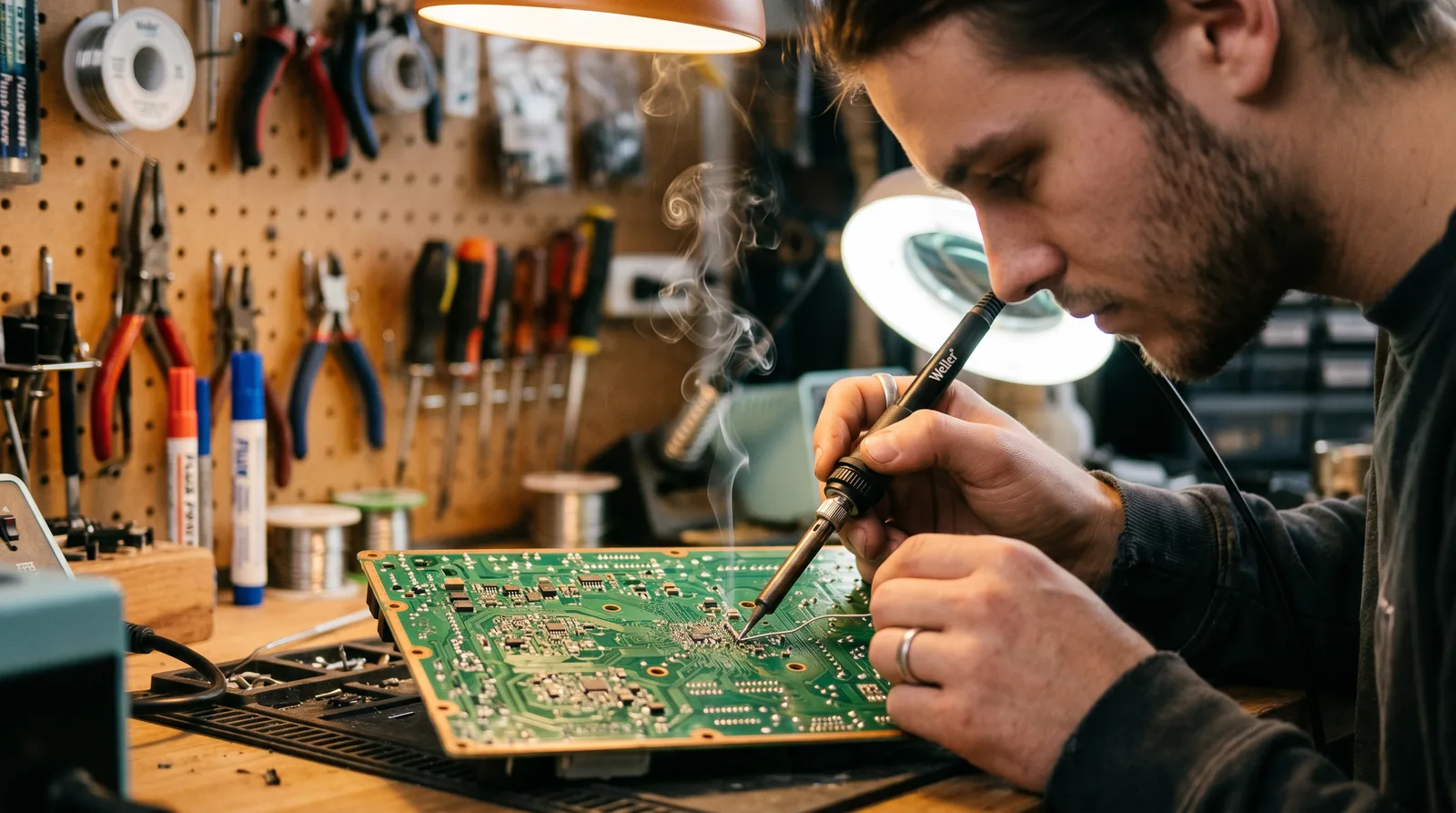
"I'd rather show you why the joint works than just tell you what to do — because understanding is what follows you to the next project."— Dave Idell
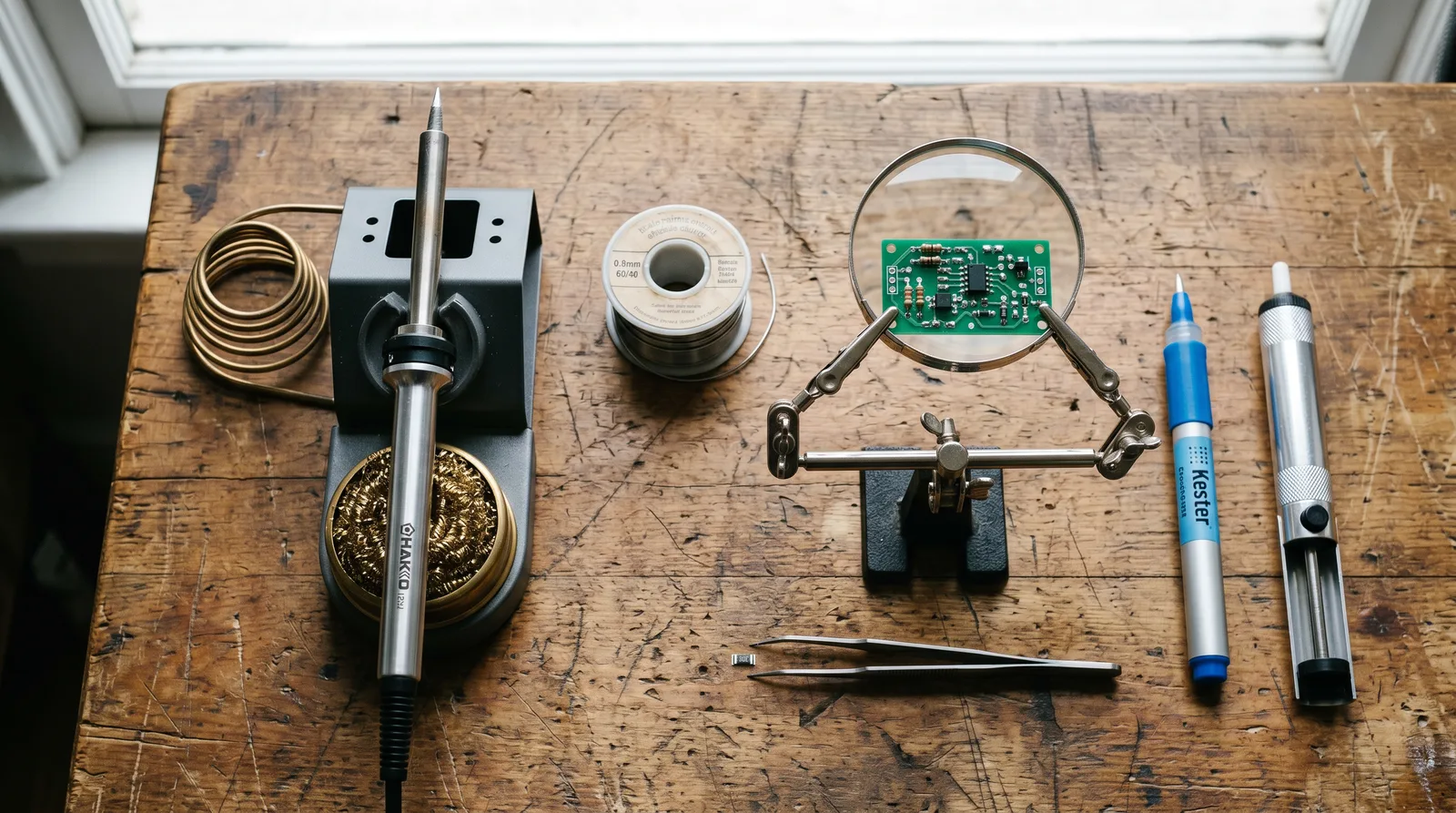
What you'll learn
What you'll be able to do
- Set up a safe, well-organized soldering station with the right tools and consumables for small electronics work
- Execute clean, shiny through-hole solder joints on resistors, capacitors, and headers every time
- Identify and fix cold joints, bridges, and lifted pads using proper rework and desoldering techniques
- Solder surface-mount (SMD) components — including 0805 passives and SOT-23 ICs — by hand with confidence
- Read a basic PCB schematic and component placement diagram to assemble a kit from scratch
- Apply flux, tip-tinning, and iron-temperature discipline to protect delicate components and extend tool life
How it works
A school that adapts to you
This isn't a set of static videos. Every lesson is generated live and tuned to where you actually are.
We learn your level
A quick placement check tailors your starting point so you're never bored or lost.
Lessons adapt as you go
Each lesson is written for your pace and your goal, adjusting as your skills grow.
Your AI coach keeps you moving
Checkpoints, feedback, and gentle nudges turn progress into a real result.
The curriculum
What's inside your school
6 modules · 18 lessons

Your Soldering Station: Tools, Safety & Setup
Establishes the physical and safety foundation before any iron is ever switched on. Students leave this module with a fully configured, safe, and organized workstation — eliminating the most common beginner mistakes before they happen. This module deliberately precedes all practical soldering work so every subsequent skill is practiced in a safe, properly equipped environment.
- 1.1Choosing Your Iron & Essential ToolsIncluded
- 1.2Safe Workspace Setup & Fume ManagementIncluded
- 1.3Iron Temperature Discipline & Tip CareIncluded
Through-Hole Soldering: Clean Joints Every Time
Builds core hand-soldering muscle memory using through-hole (PTH) components — the most forgiving and instructive format for beginners. By the end, students can reliably produce shiny, volcano-shaped joints on resistors, capacitors, and headers, and understand why each step of the process produces the result it does. Schematic reading is intentionally placed after this module so students first develop tactile confidence before adding the cognitive load of diagram interpretation.
- 2.1Anatomy of a Perfect Through-Hole JointIncluded
- 2.2Component Prep, Placement & Lead FormingIncluded
- 2.3Assembling a Through-Hole Kit End-to-EndIncluded
Reading Schematics & PCB Placement Diagrams
Equips students to decode the two key documents they will encounter when assembling any kit or following a design: the schematic (what components do and how they connect) and the PCB placement diagram (where they physically go). Positioned after through-hole practice so students have tactile context for what they are reading — they have already handled resistors, caps, and headers — making abstract symbols immediately concrete. This module is a prerequisite for the SMD kit assembly in Module 5.
- 3.1Schematic Symbols & Component Reference DesignatorsIncluded
- 3.2Reading a PCB Placement Diagram & Catching ErrorsIncluded
Rework, Desoldering & Fixing Common Defects
Transforms students from people who panic at a bad joint into confident rework technicians. Covers systematic defect diagnosis, all major desoldering methods, and board-level repair of damaged pads and traces. Placed after through-hole soldering (which generates the defects to practice on) and before SMD work (which demands the highest rework precision) — making this the ideal bridge module. Flux application as a rework aid is previewed here and deepened in Module 6.
- 4.1Diagnosing Cold Joints, Bridges & Lifted PadsIncluded
- 4.2Desoldering Techniques: Wick, Pump & Hot AirIncluded
- 4.3Pad Repair & Trace JumpersIncluded
Surface-Mount Soldering: SMD by Hand
Advances students into the world of surface-mount technology — the dominant assembly format in modern electronics. Builds skills progressively: component familiarity, passive soldering, IC soldering, rework, and a full SMD kit capstone. Placed after through-hole, schematic reading, and rework modules so students arrive with solid iron control, the ability to read placement diagrams, and the rework confidence to fix any mistakes they make on fine-pitch work.
- 5.1SMD Fundamentals: Components, Pads & ToolsIncluded
- 5.2Soldering 0805 Passives by HandIncluded
- 5.3Drag Soldering SOT-23 & Small IC PackagesIncluded
- 5.4SMD Rework & Full SMD Kit AssemblyIncluded
Flux, Finishing & Long-Term Tool Mastery
Synthesizes the chemistry and maintenance knowledge that separates hobbyists from professionals. Students deepen their understanding of flux — the single most under-used and misunderstood consumable in the course — learn to finish boards to a professional standard, and build the maintenance habits that keep tools performing for years. Placed last because students now have enough hands-on experience to fully appreciate why each practice matters, making this a meaningful capstone rather than abstract theory.
- 6.1Flux Deep Dive: Types, Application & When to Use ItIncluded
- 6.2Board Cleaning, Inspection & Conformal Coating BasicsIncluded
- 6.3Iron Maintenance, Troubleshooting & Skill ProgressionIncluded
Who it's for
Is this you?

Curious beginners
You've never held a soldering iron but you're ready to start — the course opens with exactly the setup, safety, and first-joint instruction you need.

Kit builders
You love assembling electronics kits but want cleaner joints, fewer mistakes, and the ability to actually read the PCB diagram before you start.

Gadget repairers
You'd rather fix a broken device than bin it — the rework, desoldering, and pad-repair module gives you the techniques to make that happen.

Teen makers
You're building your first projects and want real skills, not just YouTube trial and error — this course gives you a solid, structured foundation.

Self-taught tinkerers
You've picked up some soldering informally but your habits are shaky — this course helps you reset, identify bad technique, and build it back properly.

SMD-curious makers
Through-hole feels comfortable but surface-mount components intimidate you — the SMD module takes you from fundamentals to a full SMD kit build by hand.
Questions
Frequently asked
Your teacher
A note from your teacher

Dave Idell
If you're reading this, there's a good chance you've got a soldering iron somewhere — maybe still in the box, maybe lightly used — and a quiet suspicion that you're not quite doing it right. Your joints work sometimes. Other times they don't, and you're not sure why. You've maybe burnt a pad, or created a bridge you had to scrape away, or just ended up with joints that look dull and lumpy when every photo online shows them bright and smooth.
I've been in that exact place. And I've watched a lot of other makers sit at a bench with that same hesitant grip on the iron, poking at a joint and hoping for the best. What I've learned — and what I want to pass on in this course — is that confident soldering isn't a talent you either have or don't. It's a set of specific, learnable techniques. Temperature discipline. Flux timing. The angle you hold the iron. Knowing what a clean joint feels like before you even lift the iron away. Once those things click, the whole activity transforms.
Fine Point Solder is the course I wish had existed when I was starting out. It's structured the way a real project unfolds — station setup and safety first, through-hole fundamentals next, then schematics, rework, surface-mount, and finally the finishing and maintenance habits that make everything last. Nothing is skipped because it seemed too basic, and nothing is hand-waved because it seemed too advanced. Rework gets a full module because being able to fix things is genuinely half the skill. SMD gets the same careful treatment as through-hole, because that's where modern electronics actually live.
I've tried to teach the way I'd want someone to explain it across a workbench: plain language, precise terms introduced when you actually need them, and — wherever possible — the "here's why this works" explanation rather than just the instruction. I want you to finish this course not just able to follow steps, but able to look at any new PCB and know what to do.
If you've got an iron and the drive to make things work, that's all you need. Let's get that tip tinned and get started.
— Dave Idell
Start your journey today
Join get instant access — learn at your own pace with an AI coach in your corner.
$29/mo
Recurring billing · cancel anytime
Secure checkout · Instant access
- 6 modules, 18 lessons
- AI-adaptive lessons tuned to your level
- Quizzes & checkpoints to lock in progress
- Your own AI learning coach
- Learn on any device, at your pace
- Full access for as long as you're subscribed