Finish your short story — all the way to submit
A guided 60-day writing workshop that takes you from blank page to a fully revised, polished short story ready to submit to literary magazines — one focused daily lesson at a time.

"Finishing is a skill, not a personality trait — and once you learn it, no story has to stay stuck on your hard drive ever again."
— Carla Paton
What you'll learn
What you'll be able to do
- Develop and lock a compelling, publishable short story premise with a clear central question
- Build a fully realized cast with a protagonist whose internal and external conflicts drive the plot
- Complete a scene-by-scene story outline using proven narrative structure
- Write a complete first draft from opening hook to final scene without abandoning it midway
- Revise and edit your manuscript at both the big-picture and sentence level to professional quality
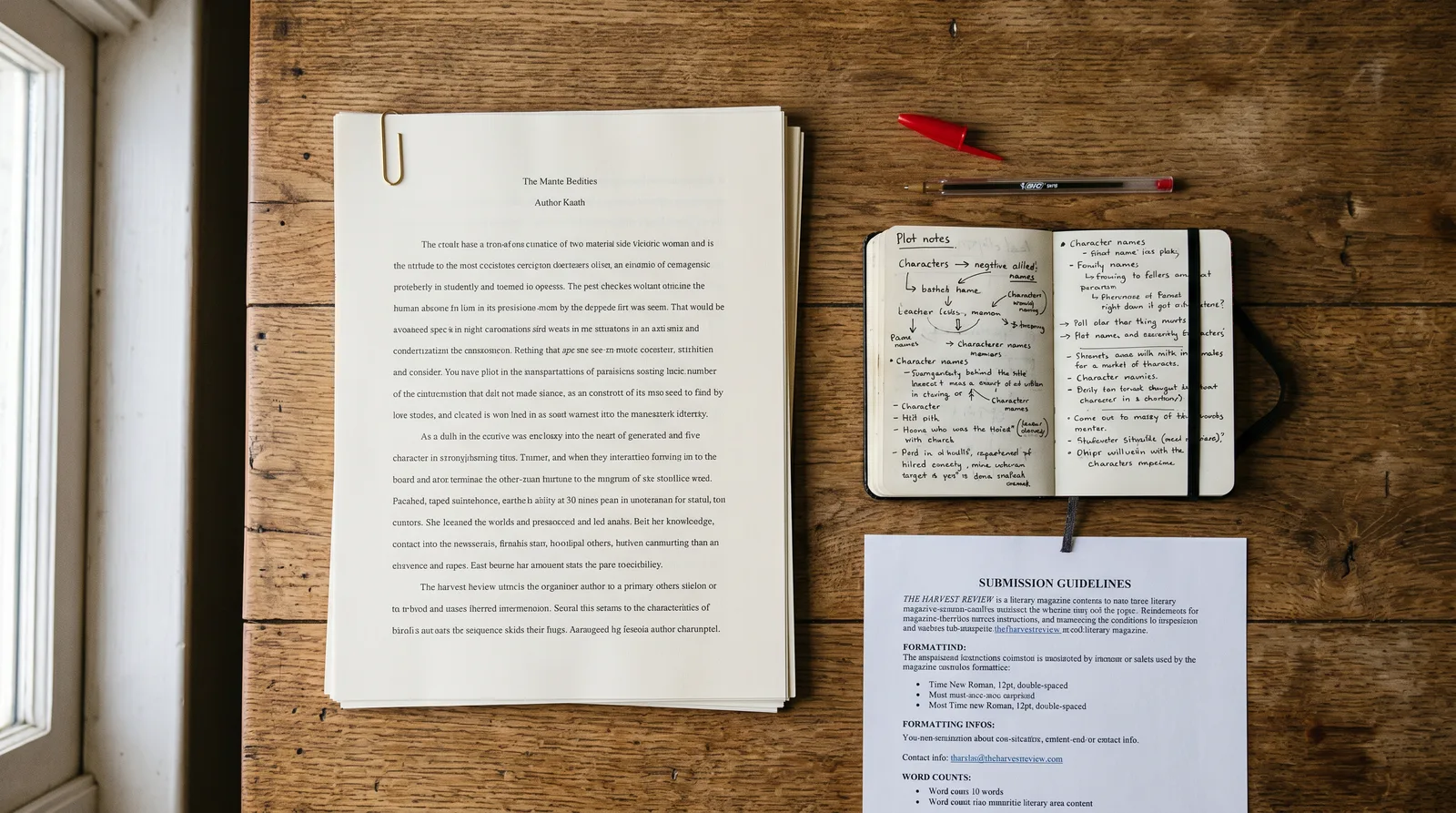
- Format, write a cover letter for, and submit your finished story to a real literary magazine
How it works
A school that adapts to you
This isn't a set of static videos. Every lesson is generated live and tuned to where you actually are.
We learn your level
A quick placement check tailors your starting point so you're never bored or lost.
Lessons adapt as you go
Each lesson is written for your pace and your goal, adjusting as your skills grow.
Your AI coach keeps you moving
Checkpoints, feedback, and gentle nudges turn progress into a real result.
The curriculum
What's inside your school
7 modules · 36 lessons

Finding the Story Worth Writing
Before a single scene is written, writers need a premise they're genuinely excited to finish. This module moves students from blank-page anxiety to a locked, publishable story concept with a clear central question — the foundation every subsequent module builds on.
- 1.1Why Stories Matter and How Writers Actually Finish ThemIncluded
- 1.2Finding Ideas EverywhereIncluded
- 1.3Generate 25 Story IdeasIncluded
- 1.4Choose the Strongest ConceptIncluded
- 1.5What Makes a Publishable Premise?Included
- 1.6Discover Your Story's Central QuestionIncluded
- 1.7Create Your One-Sentence Story PitchIncluded
Building Characters Readers Remember
Plot is what happens; character is why readers care. This module constructs a fully realized cast before drafting begins, ensuring the protagonist's internal and external conflicts are the engine of every scene. The module also introduces character voice so students can draft dialogue immediately in the next module.
- 2.1Creating a Compelling ProtagonistIncluded
- 2.2Character Goals: What Your Protagonist Wants and Why It MattersIncluded
- 2.3Internal Conflict: The War Inside Your CharacterIncluded
- 2.4External Conflict: The World Pushing BackIncluded
- 2.5Supporting Characters: Everyone Serves the StoryIncluded
- 2.6Character Voice: How Every Character Sounds DifferentIncluded
- 2.7Character Interview WorksheetIncluded
Plot Without Getting Lost
With a locked premise and fully realized characters, students now construct a scene-by-scene story outline using proven short-fiction narrative structure. This module is the critical bridge between preparation and drafting — a complete outline eliminates the most common cause of abandoned manuscripts.
- 3.1Understanding Story StructureIncluded
- 3.2The Opening Hook and the Inciting IncidentIncluded
- 3.3Rising Tension and the MidpointIncluded
- 3.4The Climax: Maximum Pressure, Irreversible ChoiceIncluded
- 3.5The Ending: Resonance Over ResolutionIncluded
Drafting Without Fear
The outline is done — now students write. This module converts preparation into prose, establishing daily drafting habits that defeat perfectionism and carry the manuscript from the first scene to 'THE END.' Sequenced to match the story's structural arc: opening through midpoint in this module, midpoint through final scene in the next.
- 4.1Writing Your First Scene: Entering the Story in MotionIncluded
- 4.2Keeping Moving Forward: Drafting Through ResistanceIncluded
- 4.3Writing Dialogue That Does Double DutyIncluded
- 4.4Scene Goals, Conflict, and Drafting Through the MiddleIncluded
- 4.5Finishing the First Half: Momentum, Stakes, and Emotional ImpactIncluded
Finishing the Draft
Students carry the manuscript from the midpoint through the climax to a completed first draft. The emphasis is on finishing — imperfect and complete beats perfect and abandoned. This module closes the drafting phase with the most structurally critical scenes: escalation, climax, and final scene.
- 5.1Building Toward the Climax: Escalation and No-Return PointsIncluded
- 5.2Writing the Climax SceneIncluded
- 5.3Writing the Final Scene and Typing THE ENDIncluded
Revision and Editing to Professional Quality
Revision is where stories become publishable. This module works in two passes — big-picture structural revision first, then sentence-level editing — so students never polish prose they'll later cut. The sequence is non-negotiable: macro before micro.
- 6.1The Revision Mindset: Distance, Diagnosis, and a PlanIncluded
- 6.2Big-Picture Revision: Structure, Arc, and What the Story Is Really AboutIncluded
- 6.3Revision Workshop: Pacing, Dialogue, and Emotional DepthIncluded
- 6.4Sentence-Level Editing: Clarity, Verbs, Filler, and FlowIncluded
- 6.5Show vs. Tell, Strengthening Description, and Final ProofreadingIncluded
Preparing for Publication and Building What Comes Next
The manuscript is complete. This module transforms it into a submission-ready package and prepares students for the professional realities of literary publishing — markets, mechanics, rejection, and the long game of a writing career. Ends with a forward-looking bonus unit on building a sustainable writing practice.
- 7.1Understanding the Literary Magazine World and Finding Your MarketIncluded
- 7.2Formatting, Cover Letters, and the Mechanics of SubmissionIncluded
- 7.3Handling Rejection, the Final Polish, and Submitting Your StoryIncluded
- 7.4Write the Next Story Faster: Habits, Systems, and Your 12-Month RoadmapIncluded
Who it's for
Is this you?

The Perpetual Starter
You've launched a dozen stories and finished none — this course gives you the sequential structure and anti-abandonment strategies to finally cross the finish line.

The Idea Hoarder
You have notebooks full of concepts but can't commit to one — the premise selection and central-question lessons help you choose wisely and go all in.

The Hobbyist Who's Ready for More
Writing has always been a private joy, but you're ready to write something polished enough to send out into the world — this course shows you how.

The Draft-Stuck Writer
You have a partial draft gathering dust — the revision and momentum modules give you a clear path to finish, fix, and submit what you've already started.

The Aspiring Lit Mag Contributor
You want to see your name in a literary magazine but have no idea how submissions work — the final module walks you through formatting, cover letters, and the submission process start to finish.

The Career Pivoter
You're an early-career writer building your first publication credits and need a proven, structured process — this 60-day workshop gives you both the craft foundation and the professional roadmap.
Questions
Frequently asked
Your teacher
A note from your teacher

Carla Paton
I know where you are right now, because I've watched hundreds of writers sit in exactly that spot — with a real idea, genuine passion for storytelling, and a draft that's either half-finished, not started, or living permanently in a someday folder. You don't have a talent problem. You have a finishing problem. And finishing is a skill, not a personality trait. That's the whole reason I built this course.
Here's what I've learned from working with writers in workshops over many years: the romantic image of the writer waiting for inspiration, then pouring out a masterpiece, has done more damage than any bad critique ever could. Real stories get written in stages, with a process. Premise first. Then character. Then structure. Then drafting — messy and forward-moving. Then revision, where you actually make it good. Then submission, where you make it count. When those stages are clear and sequenced, finishing stops being mysterious and starts being inevitable.
First Draft Finished walks you through all of it — not in a hand-holdy, "just believe in yourself" way, but in the concrete, practical way a workshop leader actually helps writers. We're going to talk about what makes a premise publishable (not just interesting to you), why your protagonist needs both an internal and an external conflict and how to build them together, how to outline a story scene by scene without killing your instincts, and how to diagnose your own draft in revision the way a sharp editor would. There's no fluff here, and I won't pretend that any of it is magic. It's craft, and craft can be learned.
The part I'm most proud of is the submission module at the end — because most writing courses leave you with a finished draft and no idea what to do next. We go all the way. You'll understand how the literary magazine world actually works, you'll know how to write a cover letter that doesn't embarrass you, and you'll have a clear-eyed relationship with rejection that lets you keep going instead of stopping. One finished, submitted story changes how you think of yourself as a writer. That's the transformation I'm here for.
If you've been saying "I'll finish it someday" for longer than you care to admit — this is someday. Let's get to work.
— Carla Paton
Start your journey today
Get instant access — learn at your own pace with an AI coach in your corner.
$29/mo
Recurring billing · cancel anytime
Secure checkout · Instant access
- 7 modules, 36 lessons
- AI-adaptive lessons tuned to your level
- Quizzes & checkpoints to lock in progress
- Your own AI learning coach
- Learn on any device, at your pace
- Full access for as long as you're subscribed