Build your clinical foundation in orthopaedics
Built for medical students, interns, and junior residents who need skills that work at the bedside — not just in textbooks. Learn orthopaedics through real clinical contexts drawn from East African practice, with lessons that translate anywhere in the world.
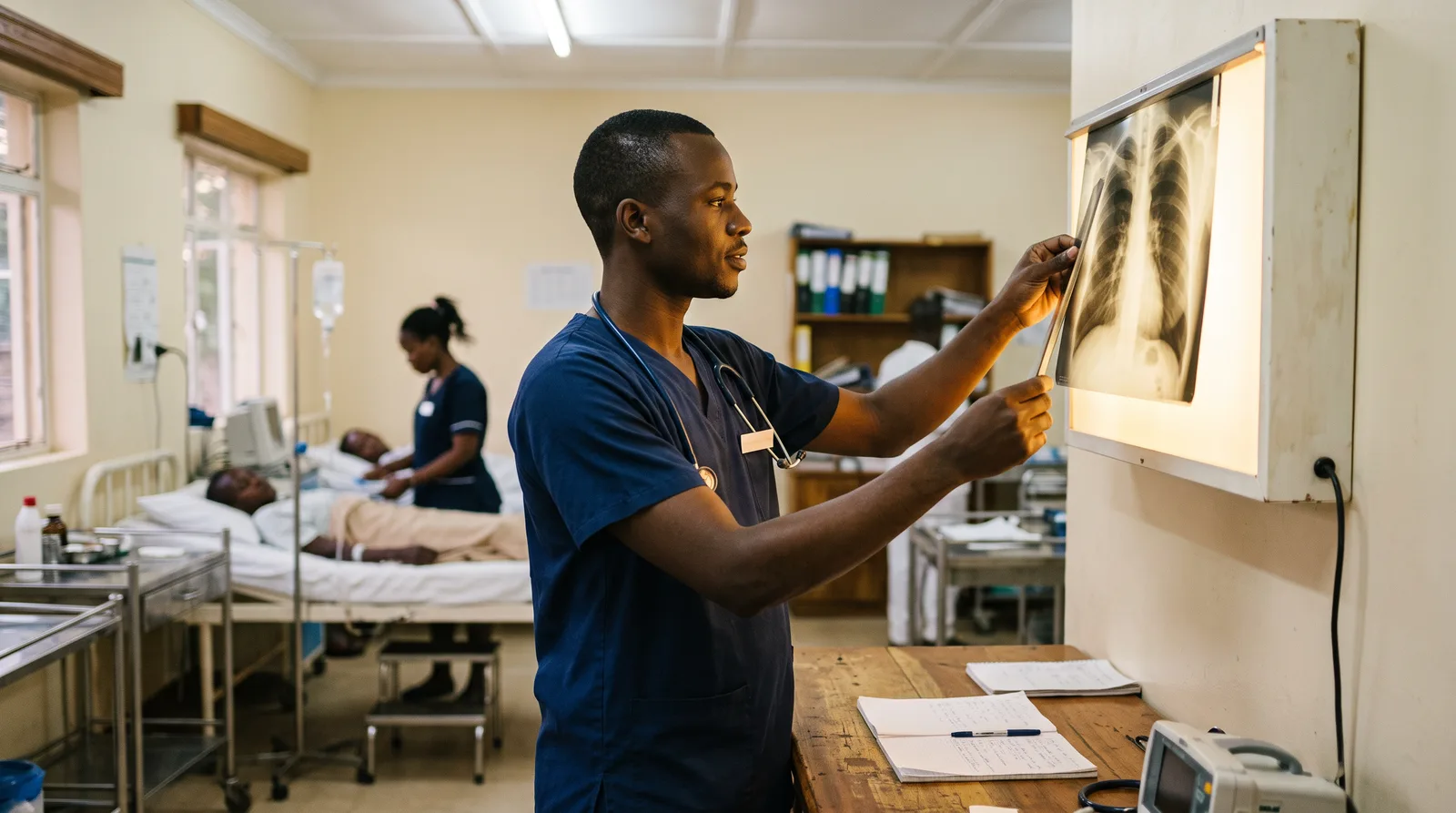
I teach the 'why' behind every decision — because a junior doctor who understands the reasoning will always outperform one who only memorised the answer.
— Dr. Benjamin Kyama Ngau - Orthopaedics and Trauma Surgeon
What you'll learn
What you'll be able to do
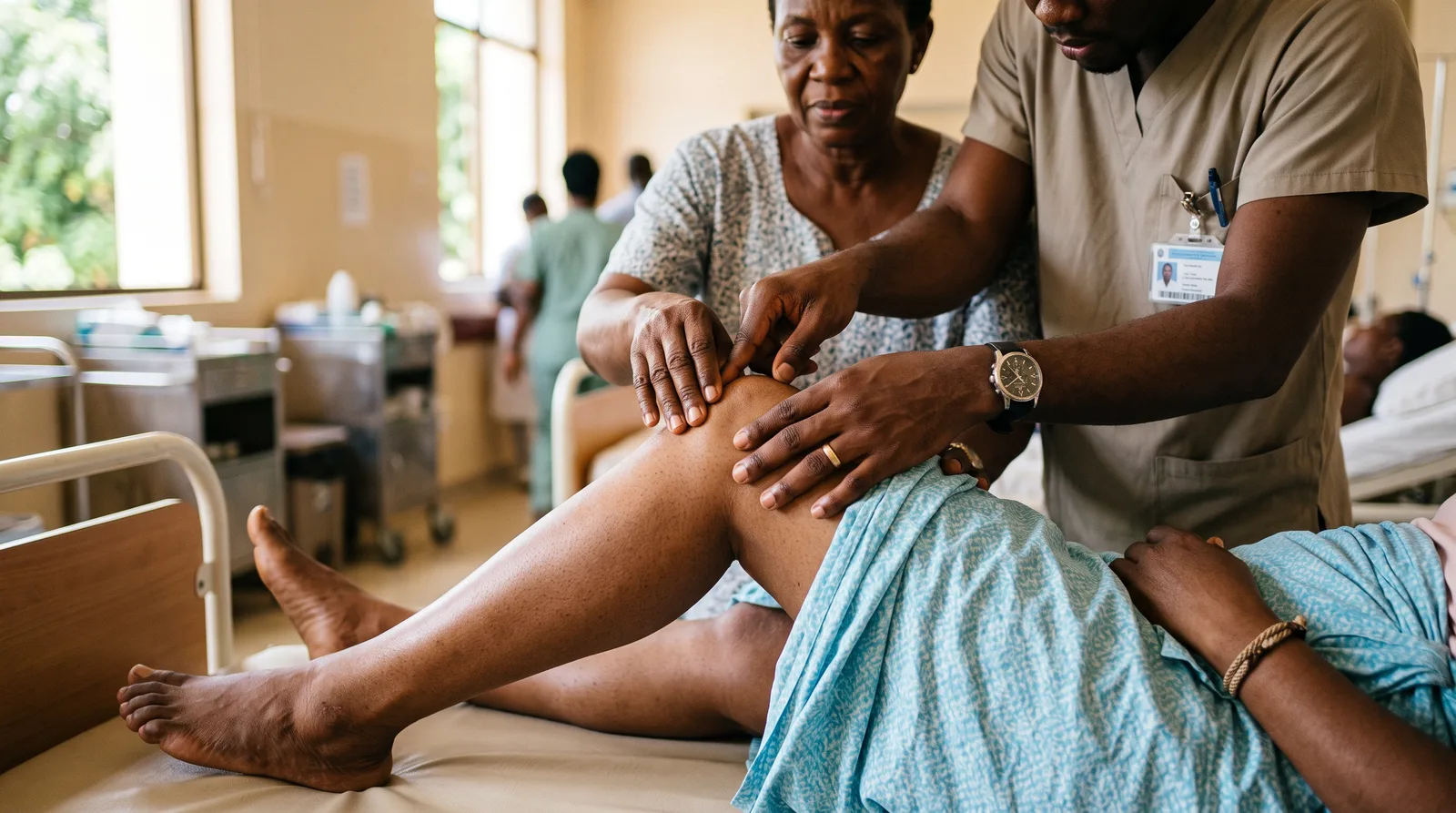
- Conduct a structured, systematic musculoskeletal history and physical examination — including look, feel, and move — and document findings in accepted clinical format.
- Apply a systematic approach to interpreting musculoskeletal X-rays, accurately describe any fracture's pattern, displacement, and associated soft-tissue findings, and identify common radiographic red flags.
- Explain the biological and mechanical principles underlying fracture healing, and recognise the clinical and radiographic features of delayed union, nonunion, and malunion.
- Perform a focused neurovascular assessment of an injured limb, identify early compartment syndrome, and initiate appropriate emergency management and referral decisions.
- Select and justify initial fracture management — closed versus open, operative versus non-operative — applying the principles of reduction, retention, and rehabilitation within resource-appropriate settings.
- Recognise orthopaedic emergencies and common clinician mistakes across all six foundational domains, and communicate findings confidently in structured viva and clinical handover formats.
How it works
A school that adapts to you
This isn't a set of static videos. Every lesson is generated live and tuned to where you actually are.
We learn your level
A quick placement check tailors your starting point so you're never bored or lost.
Lessons adapt as you go
Each lesson is written for your pace and your goal, adjusting as your skills grow.
Your AI coach keeps you moving
Checkpoints, feedback, and gentle nudges turn progress into a real result.
The curriculum
What's inside your school
6 modules · 43 lessons

Introduction to Orthopaedics
Orients learners to the field of orthopaedics — its scope, subspecialties, core terminology, patient approach, and the emergencies that must never be missed.
- 1.1Scope and Subspecialties of OrthopaedicsIncluded
- 1.2Structure and Function of the Musculoskeletal SystemIncluded
- 1.3Common Orthopaedic TerminologyIncluded
- 1.4Approach to the Orthopaedic PatientIncluded
- 1.5Orthopaedic Emergencies and Red FlagsIncluded
- 1.6In a NutshellIncluded
Applied Orthopaedic Anatomy
Builds clinically applied anatomical knowledge of the musculoskeletal system, emphasising structures most relevant to assessment, injury, and decision-making.
- 2.1Bone, Joint, Cartilage, Muscle, Tendon, and Ligament AnatomyIncluded
- 2.2Anatomical Planes, Movements, and Directional TerminologyIncluded
- 2.3Upper-Limb Functional AnatomyIncluded
- 2.4Lower-Limb Functional AnatomyIncluded
- 2.5Spine and Pelvic AnatomyIncluded
- 2.6Neurovascular Anatomy Relevant to Orthopaedic AssessmentIncluded
Bone Biology and Fracture Healing
Explains how bone is built, maintained, and repaired — providing the biological and mechanical foundation for understanding fracture management decisions.
- 3.1Bone Structure, Composition, and Blood SupplyIncluded
- 3.2Bone Growth and RemodellingIncluded
- 3.3Primary and Secondary Fracture HealingIncluded
- 3.4Stages of Fracture HealingIncluded
- 3.5Mechanical and Biological Factors Affecting UnionIncluded
- 3.6Delayed Union, Nonunion, and MalunionIncluded
- 3.7Principles of Bone Infection and OsteomyelitisIncluded
Orthopaedic History and Examination
Develops a systematic, reproducible approach to the musculoskeletal history and physical examination, from initial observation to structured clinical documentation.
- 4.1Structured Musculoskeletal HistoryIncluded
- 4.2Look, Feel, and Move: The Examination SequenceIncluded
- 4.3Assessment of Gait, Posture, and Limb AlignmentIncluded
- 4.4Joint-Specific Examination PrinciplesIncluded
- 4.5Neurovascular Examination of an Injured LimbIncluded
- 4.6Examination of a Patient with Suspected Fracture or DislocationIncluded
- 4.7Documentation and Presentation of Orthopaedic FindingsIncluded
Orthopaedic Imaging Fundamentals
Equips learners to select, request, and systematically interpret musculoskeletal imaging — with emphasis on plain X-ray as the frontline tool in resource-limited settings.
- 5.1Choosing Appropriate Initial ImagingIncluded
- 5.2Systematic Interpretation of Musculoskeletal X-RaysIncluded
- 5.3Adequacy, Alignment, Bones, Cartilage, and Soft TissuesIncluded
- 5.4How to Describe a Fracture on an X-RayIncluded
- 5.5Recognising Dislocations and Common Radiographic AbnormalitiesIncluded
- 5.6Basic Indications for CT, MRI, and UltrasoundIncluded
- 5.7Common Imaging Errors and Missed InjuriesIncluded
Principles of Fracture Management
Builds a confident, principled approach to fracture management — from initial assessment and emergency stabilisation through to rehabilitation and complication recognition.
- 6.1Definition and Classification of FracturesIncluded
- 6.2Initial Assessment of an Injured PatientIncluded
- 6.3Closed Versus Open FracturesIncluded
- 6.4Reduction, Retention, and RehabilitationIncluded
- 6.5Principles of Splinting, Casting, and TractionIncluded
- 6.6Indications for Operative and Non-Operative TreatmentIncluded
- 6.7Basic Principles of Internal and External FixationIncluded
- 6.8Soft-Tissue Management in Fracture CareIncluded
- 6.9Compartment Syndrome and Other Early ComplicationsIncluded
- 6.10Follow-Up, Rehabilitation, and Complications of Fracture TreatmentIncluded
Who it's for
Is this you?

Final-year medical student
Heading into clinical rotations and wants a structured framework for orthopaedics before facing the ward for the first time.

Surgical intern
Rotating through surgery and needs to perform and document musculoskeletal examinations and initial fracture assessments with confidence.

Junior orthopaedic resident
Beginning formal orthopaedic training and wants a principle-based foundation before advancing to subspecialty topics.

District hospital medical officer
Managing musculoskeletal presentations in a resource-limited setting and needs practical, context-appropriate decision-making frameworks.

Clinical officer
Working in a busy casualty or outpatient setting in East Africa and wants to assess, describe, and triage orthopaedic injuries correctly.

Exam-focused postgrad candidate
Preparing for a licensing or postgraduate examination and needs to articulate orthopaedic reasoning clearly in viva and clinical assessment formats.
Questions
Frequently asked
Your teacher
A note from your teacher
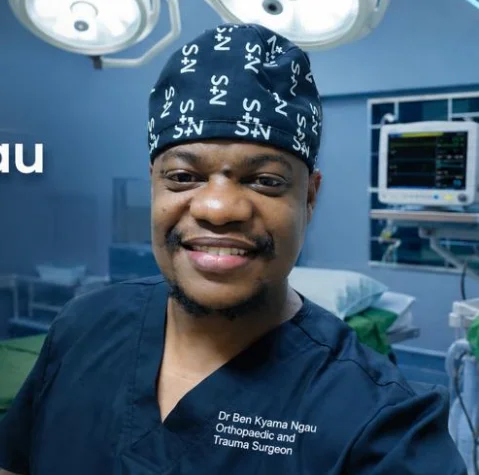
Dr. Benjamin Kyama Ngau
If you are a medical student, intern, medical officer or junior resident rotating through orthopaedics for the first time, you may know the feeling I am describing. You walk onto the ward or into the casualty bay and find a patient with a swollen or deformed limb, but you are not quite sure where to begin. This is not because you lack intelligence or commitment. Often, it is because nobody has taken the time to guide you through a systematic approach.
My name is Dr Benjamin Kyama Ngau, an Orthopaedic and Trauma Surgeon with qualifications in **MBChB, MCS(ECSA) and FCS(ECSA–Orthopaedics). Alongside clinical practice, I have a deep passion for teaching and mentoring medical students, junior doctors and residents. I particularly enjoy helping learners understand difficult orthopaedic concepts in a clear, practical and clinically relevant way.
Orthopaedics has its own language, examination sequence and clinical logic. Without a structured foundation, it can feel as though you are guessing. This course is my attempt to give you what I wish I had been given at the beginning of my own orthopaedic training: a clear, unhurried and logical framework that starts with the fundamentals and builds deliberately.
We begin with the structure of bone and how it heals. When you understand the biology of fracture healing, it becomes easier to appreciate why delayed union occurs, why infection matters and why particular management decisions make sense. We then explore anatomy in a clinically relevant way, paying close attention to the neurovascular relationships that can make orthopaedic injuries dangerous.
From there, we move into history-taking and examination, including the familiar sequence of look, feel and move. The aim is to help you perform, document and present an orthopaedic assessment confidently and systematically.
The sections on imaging and fracture management are especially practical. The X-ray interpretation framework is presented as a repeatable sequence that should gradually become automatic with use, rather than simply another list to memorize. Fracture management is organized around the principles of Reduction, Retention and Rehabilitation, with attention to both well-equipped centers and settings where resources may be limited.
I have kept the language precise because precision matters in medicine. Technical terms are defined when they first appear, emergencies are clearly highlighted, and common mistakes are addressed openly. These are often not mistakes of negligence, but the result of gaps in a learner’s foundation. My hope is that each section will leave you not only better informed, but also more confident and capable when caring for patients.
If you are preparing for clinical placements, surgical rotations, postgraduate examinations or the early stages of orthopaedic residency—particularly within East Africa and sub-Saharan Africa—this course has been developed with your learning environment in mind.
It is a privilege to share this journey with you. I look forward to teaching, guiding and learning alongside you as we build a strong foundation in orthopaedics together.
— Dr. Benjamin Kyama Ngau
Start your journey today
Join 1 others and get instant access — learn at your own pace with an AI coach in your corner.
$19 · 30 days access
One-time payment · no subscription
Secure checkout · Instant access
- 6 modules, 43 lessons
- AI-adaptive lessons tuned to your level
- Quizzes & checkpoints to lock in progress
- Your own AI learning coach
- Learn on any device, at your pace
- 30 days of full access