
Master O-Level E-Math — from shaky foundations to exam-ready confidence
A complete, syllabus-precise journey through every SEAB GCE O-Level Elementary Mathematics topic — delivered in encouraging 30-minute sessions that fit your school schedule and actually make the maths click.
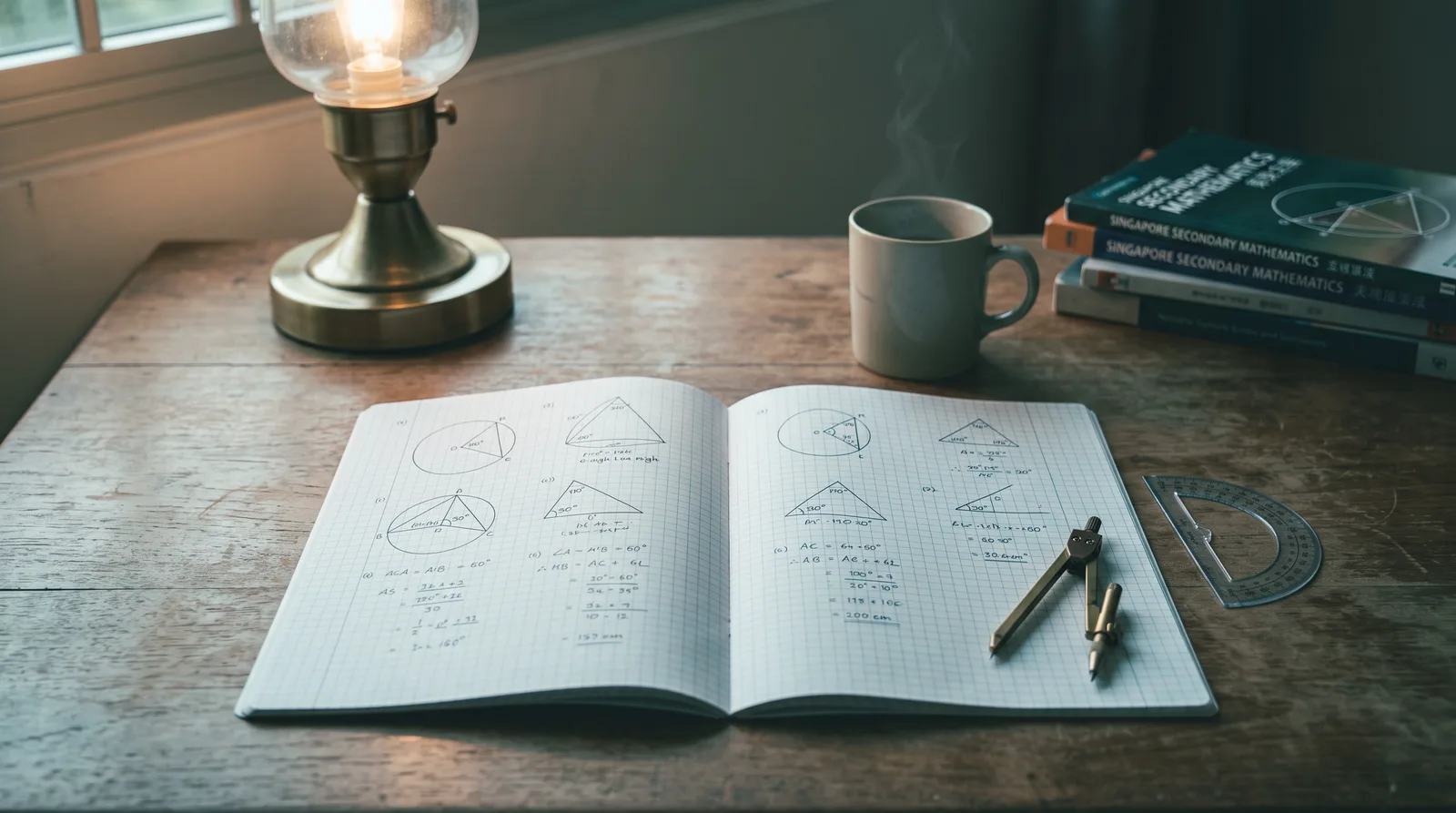
I've never met a student who couldn't do this maths — only students who hadn't yet found the explanation that made it click for them.
— Tuition on Demand Academy
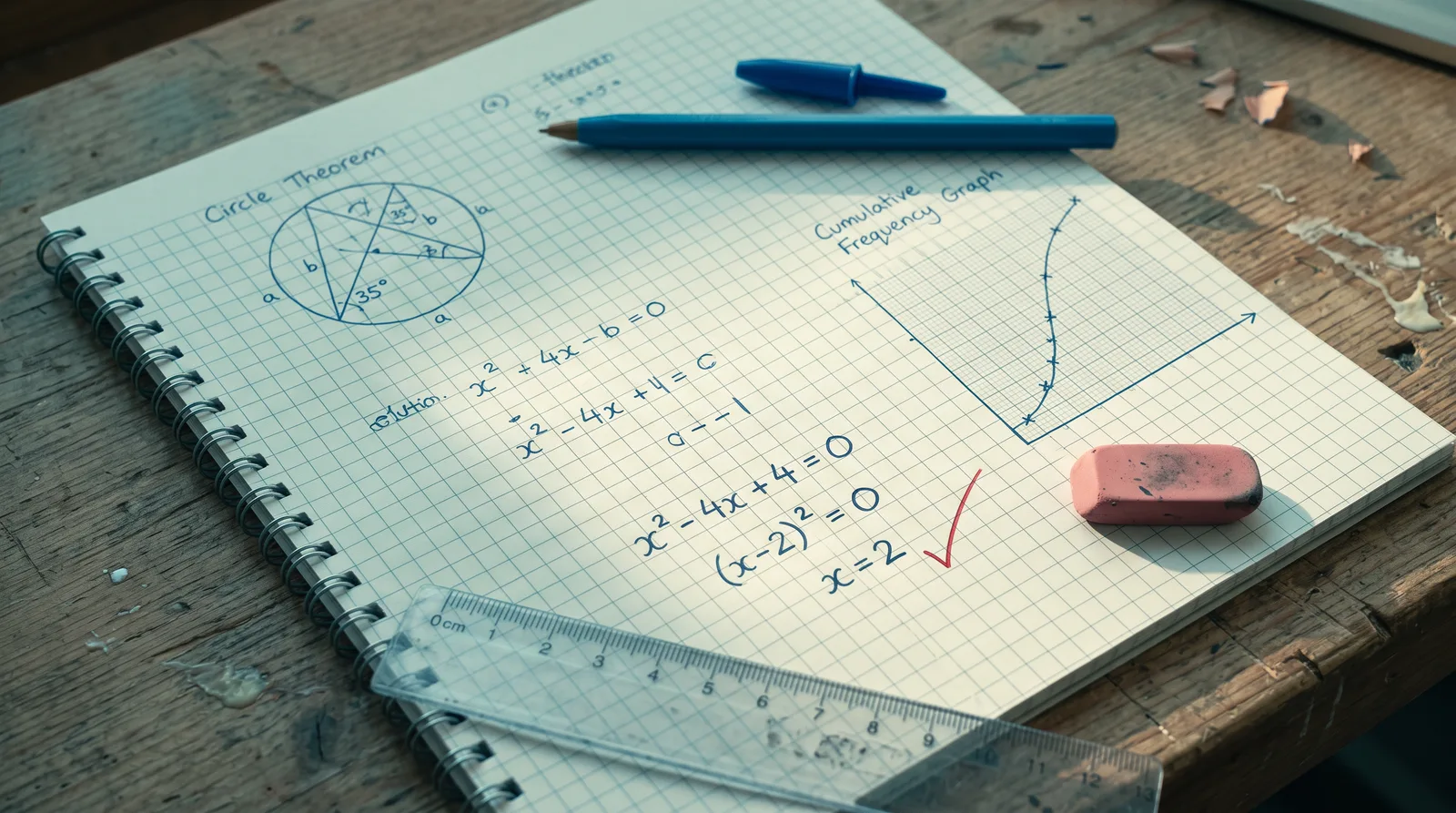
What you'll learn
What you'll be able to do
- Confidently solve Number & Algebra problems including surds, indices, quadratics, and financial mathematics in O-Level exam contexts
- Apply Geometry & Measurement concepts — congruence, similarity, circle theorems, and trigonometry — to multi-step diagram-based questions
- Interpret and construct statistical representations (histograms, cumulative frequency curves, box-and-whisker plots) and calculate measures of central tendency
- Calculate theoretical and experimental probability, including combined events using possibility diagrams and tree diagrams
- Work through any SEAB O-Level E-Math paper systematically using proven time-management and question-decoding strategies
- Identify and correct their own common mistakes through structured self-check routines, building genuine exam confidence
How it works
A school that adapts to you
This isn't a set of static videos. Every lesson is generated live and tuned to where you actually are.
We learn your level
A quick placement check tailors your starting point so you're never bored or lost.
Lessons adapt as you go
Each lesson is written for your pace and your goal, adjusting as your skills grow.
Your AI coach keeps you moving
Checkpoints, feedback, and gentle nudges turn progress into a real result.
The curriculum
What's inside your school
12 modules · 73 lessons

Number & Algebra — Foundations
Builds rock-solid fluency with numbers, factors, indices, and standard form as the bedrock for all algebraic work ahead.
- 1.1The Number System & OrderingIncluded
- 1.2Factors, Multiples, HCF & LCMIncluded
- 1.3Indices — Laws & Integer PowersIncluded
- 1.4Zero, Negative & Fractional IndicesIncluded
- 1.5Standard Form (Scientific Notation)Included
Surds & Algebraic Manipulation
Develops confident handling of surds and the algebraic skills — expansion, factorisation, and fractions — that unlock every algebra topic.
- 2.1Introduction to SurdsIncluded
- 2.2Multiplying Surds & Rationalising the DenominatorIncluded
- 2.3Expansion of Algebraic ExpressionsIncluded
- 2.4Factorisation TechniquesIncluded
- 2.5Algebraic Fractions — Simplification & OperationsIncluded
Equations, Inequalities & Formulae
Equips students to form and solve linear, quadratic, and simultaneous equations, and manipulate formulae — all essential O-Level skills.
- 3.1Linear Equations & Problem SolvingIncluded
- 3.2Linear Inequalities & Number LinesIncluded
- 3.3Changing the Subject of a FormulaIncluded
- 3.4Simultaneous Linear EquationsIncluded
- 3.5Quadratic Equations — Factorisation & FormulaIncluded
- 3.6Completing the SquareIncluded
Functions, Graphs & Proportionality
Connects algebraic relationships to their graphs — linear, quadratic, and beyond — and covers direct and inverse proportion.
- 4.1Functions & Function NotationIncluded
- 4.2Graphs of Linear FunctionsIncluded
- 4.3Graphs of Quadratic FunctionsIncluded
- 4.4Other Graphs — Cubic, Reciprocal & ExponentialIncluded
- 4.5Gradient of a Curve & Area Under a GraphIncluded
- 4.6Direct & Inverse ProportionIncluded
Financial Mathematics & Sequences
Applies arithmetic to everyday money contexts — percentages, interest, and currency — and introduces number patterns and sequences.
- 5.1Percentages — Increase, Decrease & ReverseIncluded
- 5.2Simple & Compound InterestIncluded
- 5.3Money, Tax, Wages & Household FinanceIncluded
- 5.4Number Sequences & PatternsIncluded
- 5.5Ratio, Rate & SpeedIncluded
Geometry — Angles, Polygons & Congruence
Establishes geometric reasoning with angle properties, polygon rules, congruence, and similarity as the foundation for all shape topics.
- 6.1Angle Properties — Lines & PointsIncluded
- 6.2Parallel Lines & TransversalsIncluded
- 6.3Angles in Triangles & Special TrianglesIncluded
- 6.4Quadrilaterals & Their PropertiesIncluded
- 6.5Polygons — Interior & Exterior AnglesIncluded
- 6.6Congruence & Similarity — Concepts & TestsIncluded
- 6.7Scale Factors — Length, Area & VolumeIncluded
Mensuration — Perimeter, Area & Volume
Covers all O-Level measurement formulae for 2D and 3D shapes, including arcs, sectors, and composite figures.
- 7.1Perimeter & Area of PolygonsIncluded
- 7.2Circles — Circumference, Area, Arc & SectorIncluded
- 7.3Volume & Surface Area of Prisms & CylindersIncluded
- 7.4Volume & Surface Area of Pyramids, Cones & SpheresIncluded
- 7.5Composite Solids & Real-World ProblemsIncluded
Trigonometry
Builds complete O-Level trigonometry skills from right-angled triangles through sine and cosine rules and 3D problems.
- 8.1Trigonometric Ratios — SOH CAH TOAIncluded
- 8.2Finding Unknown Angles with TrigonometryIncluded
- 8.3Angles of Elevation & DepressionIncluded
- 8.4Bearings & TrigonometryIncluded
- 8.5The Sine RuleIncluded
- 8.6The Cosine Rule & Area of a TriangleIncluded
- 8.73D Trigonometry & Problem SolvingIncluded
Coordinate Geometry & Vectors
Connects algebra and geometry through coordinate methods and introduces vectors for describing movement and geometric proof.
- 9.1Distance, Midpoint & GradientIncluded
- 9.2Equation of a Straight LineIncluded
- 9.3Introduction to VectorsIncluded
- 9.4Vector Addition, Subtraction & Scalar MultiplicationIncluded
- 9.5Vectors in Geometry & ProofIncluded
Circle Theorems
Covers all SEAB circle theorems systematically, building students' ability to chain theorems and write clear geometric reasoning.
- 10.1Angle at Centre & Angle at CircumferenceIncluded
- 10.2Angles in the Same Segment & SemicircleIncluded
- 10.3Cyclic QuadrilateralsIncluded
- 10.4Tangent Properties & Tangent-Chord AngleIncluded
- 10.5Chords — Perpendicular Bisector & Intersecting ChordsIncluded
- 10.6Mixed Circle Theorem Problems & ProofIncluded
Statistics
Covers the full O-Level statistics strand — from data collection to interpreting cumulative frequency curves and comparing distributions.
- 11.1Data Collection, Classification & SamplingIncluded
- 11.2Pictograms, Bar Charts & Pie ChartsIncluded
- 11.3Dot Plots & Stem-and-Leaf DiagramsIncluded
- 11.4Histograms with Unequal Class WidthsIncluded
- 11.5Mean, Median & Mode — Ungrouped DataIncluded
- 11.6Mean & Modal Class from Frequency TablesIncluded
- 11.7Cumulative Frequency Curves & Box-and-Whisker PlotsIncluded
- 11.8Comparing Distributions & Drawing ConclusionsIncluded
Probability & Exam Mastery
Completes the syllabus with probability — from single events to combined events — then sharpens exam technique, timing, and self-checking strategies.
- 12.1Basic Probability — Theory & ExperimentIncluded
- 12.2Complementary Events & Mutually Exclusive EventsIncluded
- 12.3Combined Events — Possibility DiagramsIncluded
- 12.4Tree Diagrams — With & Without ReplacementIncluded
- 12.5Independent & Dependent EventsIncluded
- 12.6Exam Paper Strategy & Time ManagementIncluded
- 12.7Common Mistakes Clinic & Self-Check RoutinesIncluded
- 12.8Full Paper Practice & ReflectionIncluded
Who it's for
Is this you?

The anxious Secondary 4 student
Exams are months away and the panic is real — this school's structured, topic-by-topic syllabus coverage and exam strategy unit give her a clear, calm path from today to O-Level day.

The Secondary 3 early starter
He's got time and wants to use it wisely — starting from foundations and building steadily through every topic means he'll arrive at Secondary 4 genuinely ahead of the curve.

The A1 hunter
She's solid on the basics but needs to conquer the hard stuff — circle theorem proofs, 3D trigonometry, vectors in geometry — and sharpen the multi-step technique that separates good from exceptional.

The self-study student
Without a tutor, he needs a complete, trustworthy resource — and this school's 200-hour syllabus-precise curriculum means he never has to wonder whether he's missed something important.

The student who feels behind
Gaps from earlier years have made recent lessons feel overwhelming — the school's foundations-first approach rebuilds her confidence from the number system up, at a pace that lets understanding catch up.

The supportive parent
She wants structured, credible exam prep she can point her child to — a full SEAB-aligned curriculum with clear progression and encouraging delivery she can feel confident about.
Questions
Frequently asked
Your teacher
A note from your teacher
Tuition on Demand Academy
Hey — I'm really glad you found your way here, and I want to say something before anything else: wherever you're starting from right now, it's okay. Maybe maths has felt confusing for a while. Maybe you've convinced yourself you're just "not a maths person." Maybe your O-Level exam is closer than feels comfortable, and that quiet panic is starting to set in. I've seen all of it, and I want you to know — you are not behind, you are not hopeless, and you are definitely not alone.
I built O-Level E-Math Pro because I believe that almost every student who struggles with E-Math isn't struggling because they lack ability. They're struggling because somewhere along the way, a concept wasn't explained in a way that clicked for them — and then the next concept built on that shaky foundation, and then the next, until the whole subject started to feel like a foreign language. My job — the entire purpose of this school — is to go back, find that gap, and fill it properly. Then keep building, clearly and steadily, until the whole SEAB syllabus feels manageable. Because it is.
Every topic in this school is taught the way I'd teach it to a student sitting across the table from me: plain language first, the proper mathematical vocabulary introduced gradually so it feels natural rather than intimidating, and worked examples that don't just show the answer but show every step and why each step earns marks. When you make a mistake — and you will, because that's how learning works — there's a structured self-check routine to help you understand exactly what happened and make sure it doesn't happen again in the exam. The Common Mistakes Clinic exists precisely because the errors most students make are predictable, and knowing them in advance is a genuine advantage.
I also know that Secondary 3 and 4 students have a lot going on. That's why every session is designed to be done in 30 minutes. You don't need to clear a whole Saturday. You just need to show up consistently, and the curriculum does the rest — building from number systems and indices, through surds, quadratics, and financial maths, through geometry, trigonometry, circle theorems, vectors, statistics, and probability, all the way to full paper strategy and timed practice. Nothing is skipped, nothing is left vague.
I genuinely believe you can do this. Not in a motivational-poster way — in a practical, specific, "I've seen students just like you get there" way. The path is right here. Come walk it with me.
— Tuition on Demand Academy
Start your journey today
Get instant access — learn at your own pace with an AI coach in your corner.
$35/mo
Recurring billing · cancel anytime
Secure checkout · Instant access
- 12 modules, 73 lessons
- AI-adaptive lessons tuned to your level
- Quizzes & checkpoints to lock in progress
- Your own AI learning coach
- Learn on any device, at your pace
- Full access for as long as you're subscribed