
Master O-Level History — and actually love doing it
Structured 30-minute lessons guide Secondary 3 and 4 students through every corner of Singapore's MOE Pure History syllabus — from the Pangkor Treaty to the fall of the Soviet Union — with real SEAB exam questions, hands-on SBQ skills coaching, and full mock papers that make exam day feel familiar, not frightening.
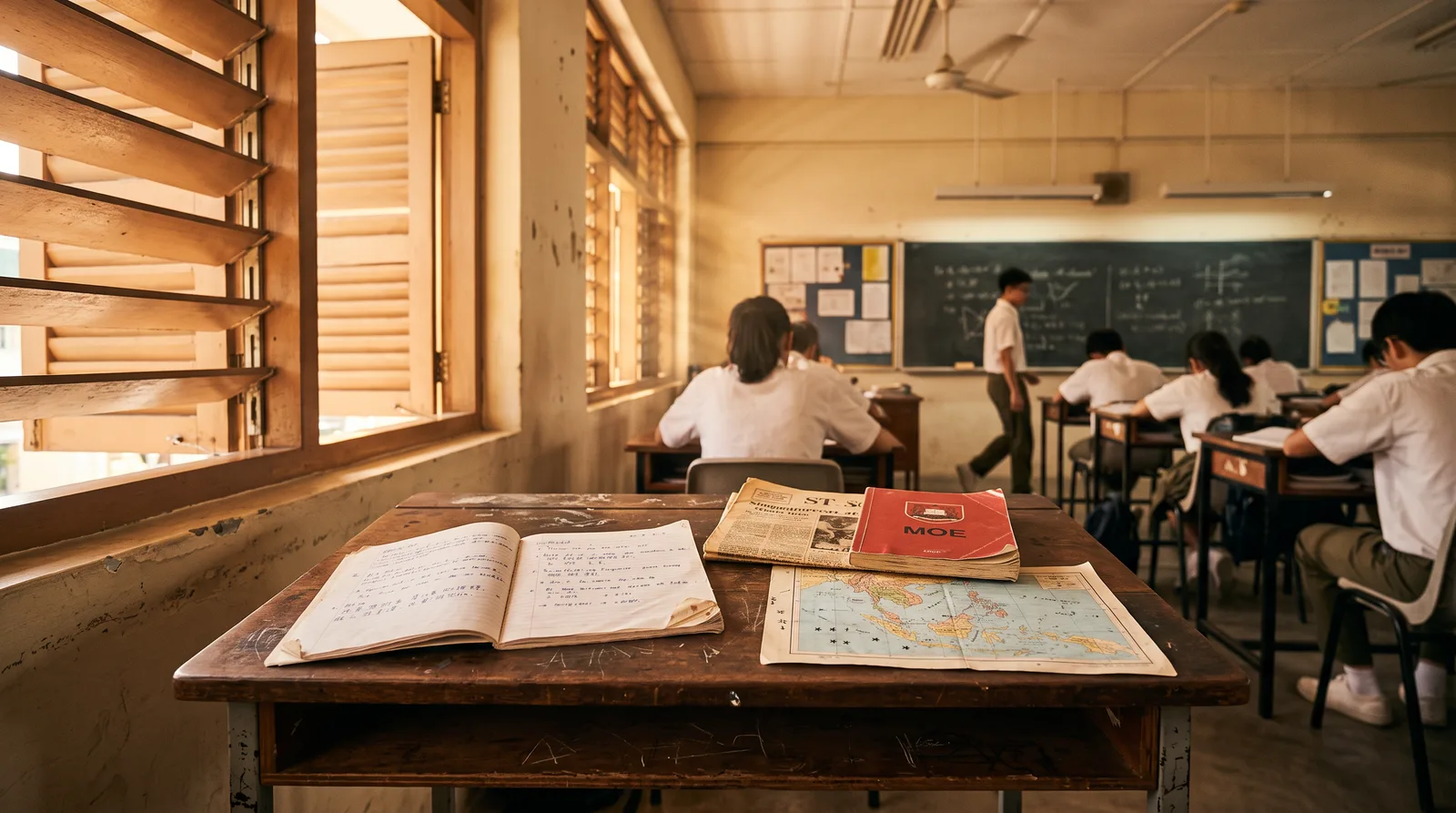
I will never dumb the history down — because you deserve to understand it fully, and the examiners will know when you do.
— Tuition on Demand Academy
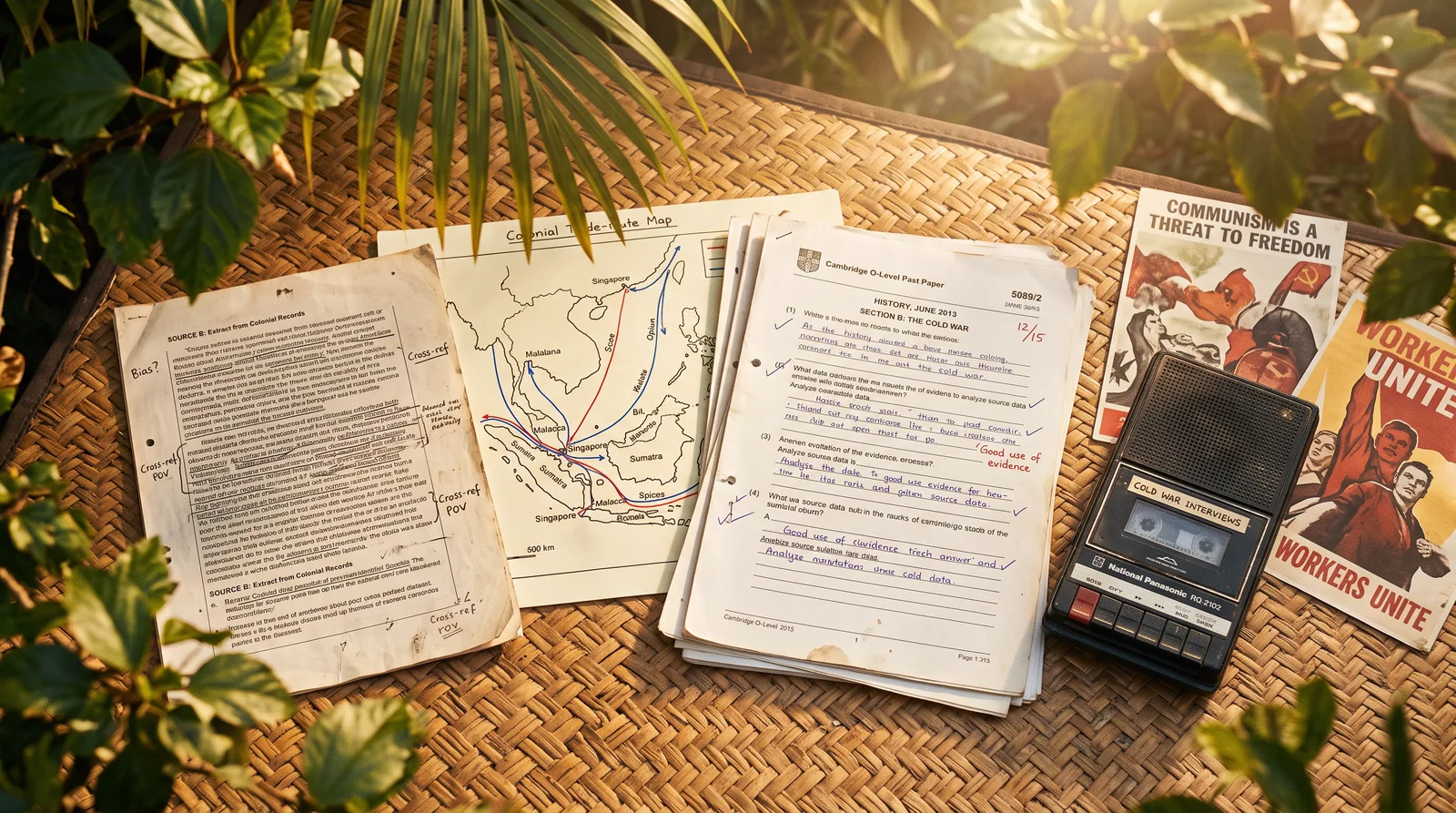
What you'll learn
What you'll be able to do
- Analyse and evaluate up to six primary and secondary sources using the full range of SBQ skills — inference, comparison, reliability, and usefulness — to score confidently in Section A
- Construct well-structured, evidence-rich SEQ essays that deliver direct historical judgement, balanced argument, and causal depth for both Paper 1 and Paper 2
- Explain the key drivers of Western imperialism and trace the establishment and intensification of colonial rule across Malaya, Vietnam, and Indonesia from the 1870s to 1942
- Describe and evaluate the origins, global spread, and superpower interventions of the Cold War, and explain how the Soviet bloc's collapse reshaped the post-war world by 1991
- Identify and interpret real SEAB O-Level exam questions, applying syllabus concepts directly to past-paper scenarios under timed, exam-realistic conditions
- Complete full mock examinations for both Paper 1 and Paper 2 — each 1 hour 50 minutes — and use structured feedback to diagnose gaps and refine exam technique before the actual sitting
How it works
A school that adapts to you
This isn't a set of static videos. Every lesson is generated live and tuned to where you actually are.
We learn your level
A quick placement check tailors your starting point so you're never bored or lost.
Lessons adapt as you go
Each lesson is written for your pace and your goal, adjusting as your skills grow.
Your AI coach keeps you moving
Checkpoints, feedback, and gentle nudges turn progress into a real result.
The curriculum
What's inside your school
12 modules · 64 lessons

How to Ace O-Level History: Exam Skills Foundations
Equips students with a clear roadmap of the syllabus, exam format, and the core SBQ and SEQ skills they will build throughout the two years.
- 1.1Meet Your Syllabus: What to Expect Over 2 YearsIncluded
- 1.2Cracking Section A: The SBQ Skills ToolkitIncluded
- 1.3Cracking Section B: The SEQ Essay ToolkitIncluded
- 1.4Reading Sources Like a DetectiveIncluded
- 1.5Your First Timed Practice: Mini SBQ and SEQ Warm-UpIncluded
- 1.6Mastering the Synthesis Question: 'How Far Do the Sources Support the View?'Included
Paper 1 — Why Europe Came: The Drivers of Western Imperialism
Explains the economic, political, strategic, and ideological forces that drove European powers to expand aggressively into Southeast Asia from the 1870s.
- 2.1What Is Imperialism? Setting the Scene (1870s)Included
- 2.2Economic Motives: Raw Materials, Markets, and MoneyIncluded
- 2.3Political and Strategic Motives: Rivalry, Prestige, and PowerIncluded
- 2.4Ideological Motives: The 'Civilising Mission' and Social DarwinismIncluded
- 2.5Exam Lens: SBQ on Imperialism MotivesIncluded
Paper 1 — Colonial Rule in Malaya: Establishment and Intensification
Traces how Britain extended and tightened control over Malaya from the 1870s through the Residential System, the FMS, and the broader Straits Settlements.
- 3.1Britain Moves In: The Pangkor Treaty and the Residential SystemIncluded
- 3.2Consolidating Control: The Federated and Unfederated Malay StatesIncluded
- 3.3The Colonial Economy: Tin, Rubber, and Migrant LabourIncluded
- 3.4Social and Cultural Impact of British Rule on Malayan SocietyIncluded
- 3.5Exam Lens: SEQ on British Rule in MalayaIncluded
- 3.6The Malayan Union Crisis and the Birth of UMNO (1946–1948)Included
Paper 1 — Contrasting Paths: Vietnam and Indonesia Under Colonial Rule
Compares French direct rule in Vietnam and Dutch cultivation/ethical policies in Indonesia as contrasting models of intensifying colonial control.
- 4.1French Indochina: Conquest, Direct Rule, and ExploitationIncluded
- 4.2Colonial Economy in Vietnam: Rice, Rubber, and TaxationIncluded
- 4.3Dutch Indonesia: The Cultivation System and the Ethical PolicyIncluded
- 4.4Comparing Colonial Models: What Made Each System Different?Included
- 4.5Exam Lens: SBQ Comparison and Reliability on Colonial SourcesIncluded
Paper 1 — Challenges to European Dominance and the Rise of Japan (1900s–1942)
Examines the emergence of nationalist movements across Southeast Asia and how Japan's military expansion shattered the myth of European invincibility.
- 5.1Seeds of Resistance: Early Nationalism in Malaya, Vietnam, and IndonesiaIncluded
- 5.2Japan Rises: Imperial Ambitions and the Pan-Asian MessageIncluded
- 5.3The Fall of Malaya and Singapore, 1941–1942Included
- 5.4Why Did European Defences Collapse So Quickly?Included
- 5.5Exam Lens: Full SBQ Practice — Paper 1 Section AIncluded
- 5.6Life Under the Japanese Occupation of Malaya and Singapore (1942–1945)Included
Paper 1 — Mock Exam and Targeted Feedback
Consolidates all Paper 1 content through a full timed mock exam followed by detailed, skill-by-skill diagnostic feedback.
- 6.1Paper 1 Mock Exam — Section A: SBQ (Full 1 hr 50 min Format)Included
- 6.2Paper 1 Mock Exam — Section B: SEQ EssaysIncluded
- 6.3Unpacking Your Paper 1 Results: SBQ DiagnosticIncluded
- 6.4Unpacking Your Paper 1 Results: SEQ DiagnosticIncluded
- 6.5Closing the Gaps: Targeted Paper 1 Revision PlanIncluded
Paper 2 — Origins of the Cold War (1940s–1950s)
Explains how ideological conflict, wartime mistrust, and post-war power vacuums ignited the Cold War rivalry between the USA and USSR.
- 7.1Two Worlds Collide: Capitalism vs CommunismIncluded
- 7.2From Allies to Rivals: Wartime Conferences and Growing MistrustIncluded
- 7.3The Iron Curtain Falls: Soviet Control of Eastern EuropeIncluded
- 7.4America Strikes Back: The Truman Doctrine and Marshall PlanIncluded
- 7.5Exam Lens: SBQ on Cold War OriginsIncluded
Paper 2 — The Cold War Heats Up: Key Crises and Superpower Confrontations
Traces the escalating cycle of superpower confrontation through Berlin, Korea, Cuba, and the nuclear arms race from the late 1940s to early 1960s.
- 8.1The Berlin Blockade and Airlift, 1948–1949Included
- 8.2Hot War in a Cold War: The Korean War, 1950–1953Included
- 8.3The Arms Race and the Nuclear ShadowIncluded
- 8.4Thirteen Days: The Cuban Missile Crisis, 1962Included
- 8.5Exam Lens: SEQ on Superpower ConfrontationsIncluded
Paper 2 — Superpower Interventions Around the World
Examines how the USA and USSR intervened militarily, economically, and politically across Asia, Latin America, and beyond to win the global Cold War.
- 9.1America's War: US Intervention in VietnamIncluded
- 9.2The USSR's War: Soviet Intervention in AfghanistanIncluded
- 9.3Proxy Wars and the Third World: Latin America and BeyondIncluded
- 9.4Détente: When Superpowers Chose DialogueIncluded
- 9.5Exam Lens: SBQ Usefulness and Cross-Referencing on InterventionsIncluded
Paper 2 — Decolonisation in Southeast Asia (1940s–1960s)
Examines how WWII, nationalist movements, and Cold War pressures combined to end European colonial rule across Southeast Asia.
- 10.1Why Empires Crumbled: The Global Forces Behind DecolonisationIncluded
- 10.2Vietnam's Long Road to Independence: Ho Chi Minh and the Viet MinhIncluded
- 10.3Indonesia's Independence: Sukarno and the Proclamation of 1945Included
- 10.4Malaya's Path: The Emergency, the Alliance, and Merdeka 1957Included
- 10.5Exam Lens: Comparing Decolonisation Paths in an SEQIncluded
- 10.6Singapore’s Road to Self-Governance and Merger (1955–1963)Included
Paper 2 — The End of the Cold War and Collapse of the Soviet Bloc (1970s–1991)
Traces the internal decay of the Soviet system, Gorbachev's reforms, the fall of communist regimes, and the dissolution of the USSR in 1991.
- 11.1Cracks in the Bloc: Economic Stagnation and Political RepressionIncluded
- 11.2Gorbachev's Gamble: Glasnost, Perestroika, and Their ConsequencesIncluded
- 11.3The Dominoes Fall: Revolutions Across Eastern Europe, 1989Included
- 11.4The End: Dissolution of the USSR, December 1991Included
- 11.5Exam Lens: Full SBQ Practice — Paper 2 Section AIncluded
Paper 2 — Mock Exam, Final Revision, and Exam-Day Masterclass
Consolidates all Paper 2 content and exam skills through a full timed mock, diagnostic feedback, and a final confidence-building exam strategy session.
- 12.1Paper 2 Mock Exam — Section A: SBQ (Full 1 hr 50 min Format)Included
- 12.2Paper 2 Mock Exam — Section B: SEQ EssaysIncluded
- 12.3Unpacking Your Paper 2 Results: SBQ and SEQ DiagnosticIncluded
- 12.4The Final Stretch: Rapid Revision of Both PapersIncluded
- 12.5Exam-Day Masterclass: Time Management, Mindset, and Top TipsIncluded
Who it's for
Is this you?

The Sec 3 head-starter
Starting early in Secondary 3 to build content knowledge and SBQ skills at a steady pace — no last-minute panic, just two years of compounding progress.

The Sec 4 exam sprinter
In Secondary 4 with the O-Levels approaching fast, needing structured revision, full mock papers, and targeted diagnostic feedback to close gaps quickly.

The essay-skills struggler
Knows the content well but loses marks because essays narrate instead of argue — ready to master the SEQ toolkit and write with genuine historical judgement.

The supportive parent
Wants to understand exactly what the MOE syllabus requires so they can ask the right questions at home and recognise when their child is truly on track.

The private tutor
Uses the school as a structured syllabus backbone — lesson sequences, Exam Lens practices, and diagnostics that complement and sharpen one-to-one coaching sessions.

The source-analysis avoider
Dreads Section A because SBQ skills feel arbitrary and confusing — here to finally understand inference, reliability, and usefulness as logical, learnable techniques.
Questions
Frequently asked
Your teacher
A note from your teacher
Tuition on Demand Academy
If you're a Secondary 3 or 4 student reading this, I want to start by acknowledging something honestly: O-Level Pure History is hard. Not because the content is impossible, but because it asks two very different things of you at once. It wants you to genuinely understand sweeping historical forces — why European powers carved up Southeast Asia, how two superpowers brought the world to the brink of nuclear war, what it actually took for Malaya, Vietnam, and Indonesia to break free from colonial rule. And then, in the same exam hall, it wants you to demonstrate precise analytical skills under timed pressure — reading sources like a detective, writing essays that argue, not just describe. That's a lot to carry. I built this school because I believe every student can carry it — with the right guide.
Here's what I've seen again and again: students who struggle with History aren't lazy or uninterested. They're just missing the bridge between the story and the skill. They can tell you about the Truman Doctrine or the fall of Singapore — but they freeze when a source-based question asks them to evaluate reliability, or when an SEQ prompt demands a direct historical judgement rather than a narrative retelling. This school is that bridge. Every content unit — from the Pangkor Treaty and the Residential System to Gorbachev's glasnost and the revolutions of 1989 — is taught with both the story and the exam skill woven together. You'll never finish a topic wondering, "But how do I actually answer a question on this?"
The lessons are designed to fit your life. Thirty minutes is enough time to genuinely move forward when the lesson is well-structured — and these are. But more importantly, the sequence matters. We begin with the foundations: the SBQ toolkit, the SEQ toolkit, the habits of reading a source like a historian. Those skills then get practised, sharpened, and tested in every unit that follows, so that by the time you sit the full Paper 1 and Paper 2 mock exams under timed, exam-realistic conditions, you're not encountering the format for the first time. You're repeating something you've already done well.
I want to say something to the parents and tutors here too. You are not bystanders in this process — you're partners. The diagnostic frameworks built into this school after every mock exam are designed to give you clear, plain-language insight into where a student's marks are being lost and what to do about it. Whether you want to understand the difference between 'inference' and 'reliability' so you can coach at home, or you're a tutor looking for a structured backbone to supplement your sessions, this school was built with you in mind as well.
Here is my promise to every student who joins: I will never dumb this down. History deserves better than that, and so do you. What I will do is make it vivid, make it logical, and make it manageable — one well-crafted lesson at a time. The story of imperialism, colonialism, Cold War confrontation, and hard-won independence is genuinely one of the most gripping stories humanity has ever lived through. Let's learn it together — and let's get you that distinction.
— Tuition on Demand Academy
Start your journey today
Get instant access — learn at your own pace with an AI coach in your corner.
$35/mo
Recurring billing · cancel anytime
Secure checkout · Instant access
- 12 modules, 64 lessons
- AI-adaptive lessons tuned to your level
- Quizzes & checkpoints to lock in progress
- Your own AI learning coach
- Learn on any device, at your pace
- Full access for as long as you're subscribed