See the world in shapes — and finally make sense of it
From your very first angle to 3D solids, coordinate planes, and trigonometry, The Shape of Things builds your geometric intuition step by step — with clear explanations, everyday analogies, and the kind of patient guidance that makes "I'm not a math person" a thing of the past.

"I don't just want you to remember the formula — I want you to close your eyes and see why it has to be true."
— Tracy Burke
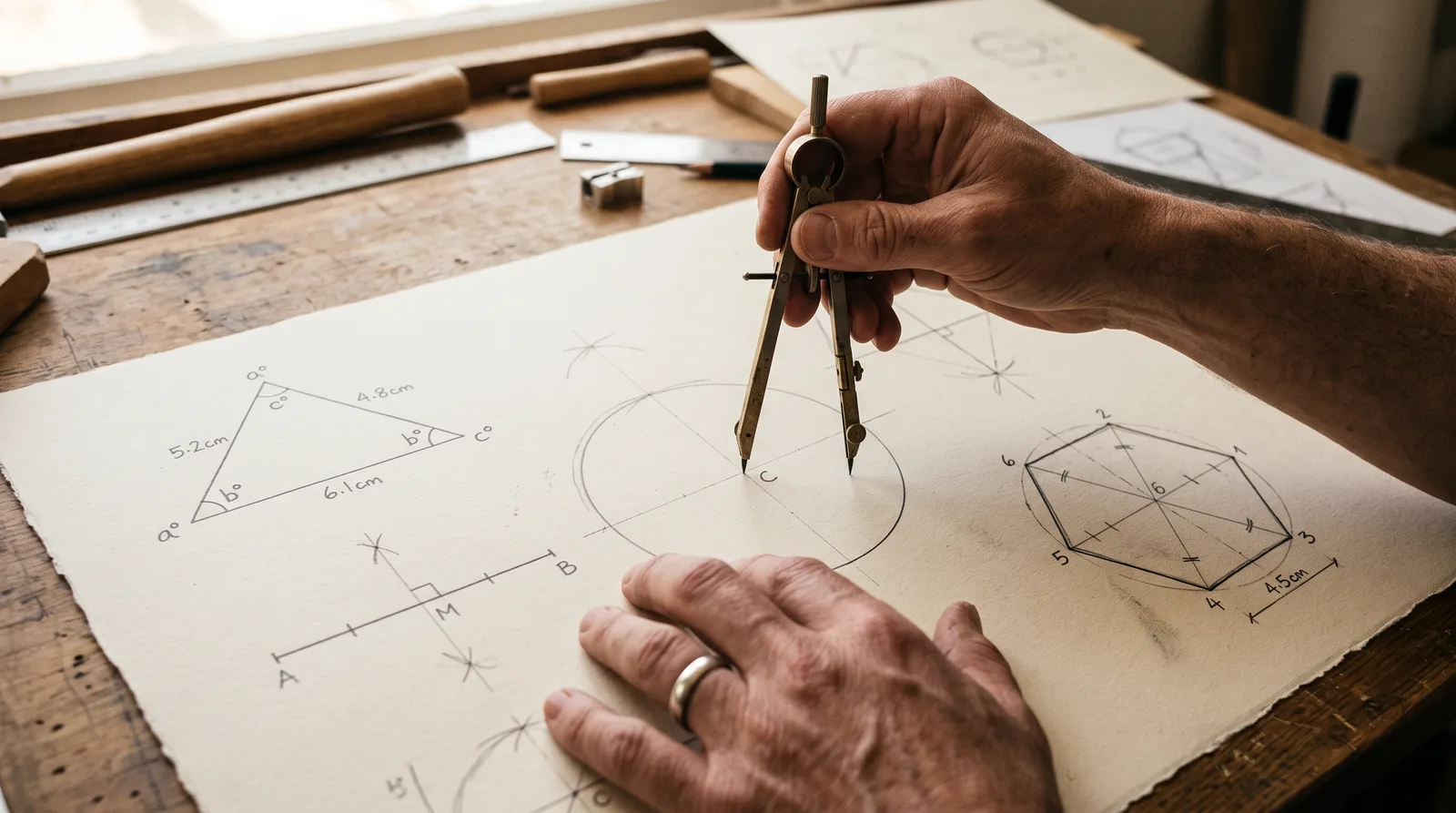
What you'll learn
What you'll be able to do
- Identify and apply the properties of lines, angles, and polygons to solve real problems
- Write and follow formal geometric proofs using logical, step-by-step reasoning
- Calculate area, perimeter, surface area, and volume for a wide range of 2D and 3D shapes
- Apply the Pythagorean theorem and trigonometric ratios to find unknown sides and angles
- Understand circle theorems, arc lengths, and sector areas with confidence
- Use coordinate geometry to graph shapes, find distances, and analyze transformations
How it works
A school that adapts to you
This isn't a set of static videos. Every lesson is generated live and tuned to where you actually are.
We learn your level
A quick placement check tailors your starting point so you're never bored or lost.
Lessons adapt as you go
Each lesson is written for your pace and your goal, adjusting as your skills grow.
Your AI coach keeps you moving
Checkpoints, feedback, and gentle nudges turn progress into a real result.
The curriculum
What's inside your school
6 modules · 30 lessons

Lines, Angles, and the Language of Geometry
Builds the foundational vocabulary and properties of points, lines, and angles that every later topic depends on.
- 1.1Points, Lines, and PlanesIncluded
- 1.2Types of Angles and Angle RelationshipsIncluded
- 1.3Parallel Lines and TransversalsIncluded
- 1.4Introduction to Geometric ProofIncluded
- 1.5Reasoning and Logic in GeometryIncluded
Triangles and Formal Proofs
Develops rigorous proof-writing through the rich properties and congruence relationships of triangles.
- 2.1Triangle Classification and Angle SumIncluded
- 2.2Congruent Triangles: SSS, SAS, ASA, and AASIncluded
- 2.3Isosceles and Equilateral Triangle TheoremsIncluded
- 2.4Similar Triangles and Proportional ReasoningIncluded
- 2.5The Pythagorean Theorem and Its ConverseIncluded
Polygons: Area, Perimeter, and Properties
Extends geometric reasoning to quadrilaterals and other polygons, with a strong focus on measurement.
- 3.1Quadrilateral Family: Properties and HierarchyIncluded
- 3.2Perimeter and Area of PolygonsIncluded
- 3.3Regular Polygons and Interior Angle SumsIncluded
- 3.4Scale Factor, Similarity, and Area RatiosIncluded
Circles: Theorems, Arc Length, and Sector Area
Covers the key theorems, measurements, and relationships that govern circles and their parts.
- 4.1Circle Vocabulary: Radius, Diameter, Chords, and TangentsIncluded
- 4.2Central Angles, Inscribed Angles, and Arc MeasureIncluded
- 4.3Chord, Tangent, and Secant TheoremsIncluded
- 4.4Arc Length and Sector AreaIncluded
- 4.5Circles in the Real WorldIncluded
3D Geometry: Surface Area and Volume
Moves geometry into three dimensions, building skills to visualize, measure, and apply solid figures.
- 5.1Classifying 3D SolidsIncluded
- 5.2Surface Area of Prisms and CylindersIncluded
- 5.3Surface Area of Pyramids, Cones, and SpheresIncluded
- 5.4Volume of Prisms, Cylinders, Pyramids, and ConesIncluded
- 5.5Volume and Surface Area of SpheresIncluded
Coordinate Geometry and Trigonometry
Unifies algebra and geometry on the coordinate plane and introduces trigonometric ratios for right triangles.
- 6.1The Coordinate Plane: Distance and MidpointIncluded
- 6.2Slope and Equations of LinesIncluded
- 6.3Graphing and Analyzing Geometric Shapes on the PlaneIncluded
- 6.4Transformations: Translations, Reflections, Rotations, and DilationsIncluded
- 6.5Trigonometric Ratios: Sine, Cosine, and TangentIncluded
- 6.6Applying Trigonometry to Real-World ProblemsIncluded
Who it's for
Is this you?

Struggling geometry students
She's keeping up in class but proofs and theorems aren't clicking — this school gives her the patient, step-by-step explanations her textbook skips.

Motivated middle schoolers
He wants to get ahead of the high school geometry curve and build a real foundation before the pace picks up.

Adults returning to math
She last studied geometry decades ago and wants to fill the gaps with clear, judgment-free teaching that respects her intelligence.

Test-prep learners
He needs solid geometry skills for the SAT, ACT, or a college placement exam and wants structured coverage of every tested topic.

Homeschooling parents
She's teaching her kids at home and wants a rigorous, well-sequenced geometry curriculum she can follow alongside them with confidence.

Curious lifelong learners
He never studied formal geometry but wants to understand the spatial and logical structures he encounters in architecture, design, and everyday life.
Questions
Frequently asked
Your teacher
A note from your teacher

Tracy Burke
If you've ever stared at a geometry problem and felt your mind go blank — not because you're bad at math, but because nobody ever explained why any of it works — I want you to know that's not a you problem. That's a teaching problem. And it's exactly what this school is designed to fix.
I built The Shape of Things because geometry has a reputation it doesn't deserve. People remember it as a subject full of rules to memorize and proofs to survive, disconnected from anything real. But here's what I've come to believe after spending a long time thinking about how spatial reasoning actually develops: geometry is one of the most visual, intuitive, and satisfying branches of mathematics there is — if someone takes the time to show you how to see it.
In this school, we take that time. We start with the genuine basics: what a point is, what makes lines parallel, what "angle" even means in a formal sense. Then we layer in triangles, congruence, similarity, the Pythagorean theorem, polygons, circles, 3D solids, and coordinate geometry — each unit building on the last, each concept anchored in an analogy or a diagram before it ever becomes a formula. Proofs aren't treated as a necessary evil; they're introduced as a skill you build gradually, the same way you'd learn to construct a logical argument in any other field. By the time trigonometry arrives in the final unit, it won't feel like a foreign language — it'll feel like the natural next step.
Whether you're a high school student trying to get ahead, a middle schooler who wants to understand the why behind the formulas, or an adult who wants to finally close the gap on a subject that never quite made sense — there's a place for you here. You don't need to be a "math person." You just need to be willing to look at a shape and wonder how it works. I'll take it from there.
Come build something with me.
— Tracy Burke
Start your journey today
Get instant access — learn at your own pace with an AI coach in your corner.
$39.99/mo
Recurring billing · cancel anytime
Enrolling a child? Sign up as a parent — you'll add your student right here after.
Secure checkout · Instant access
- 6 modules, 30 lessons
- AI-adaptive lessons tuned to your level
- Quizzes & checkpoints to lock in progress
- Your own AI learning coach
- Learn on any device, at your pace
- Full access for as long as you're subscribed