Diagnose cognitive impairment with clinical authority
A rigorous, bedside-ready deep-dive for PAs and NPs — covering validated screening tools, dementia subtyping, workup interpretation, ICD-10 documentation, and longitudinal care planning for older adult patients.

"Cognitive assessment done well is one of the most consequential clinical skills in geriatric practice — and it's entirely learnable."
— Gary R Uremovich MS DMin PhD PA (Emeritus)
What you'll learn
What you'll be able to do
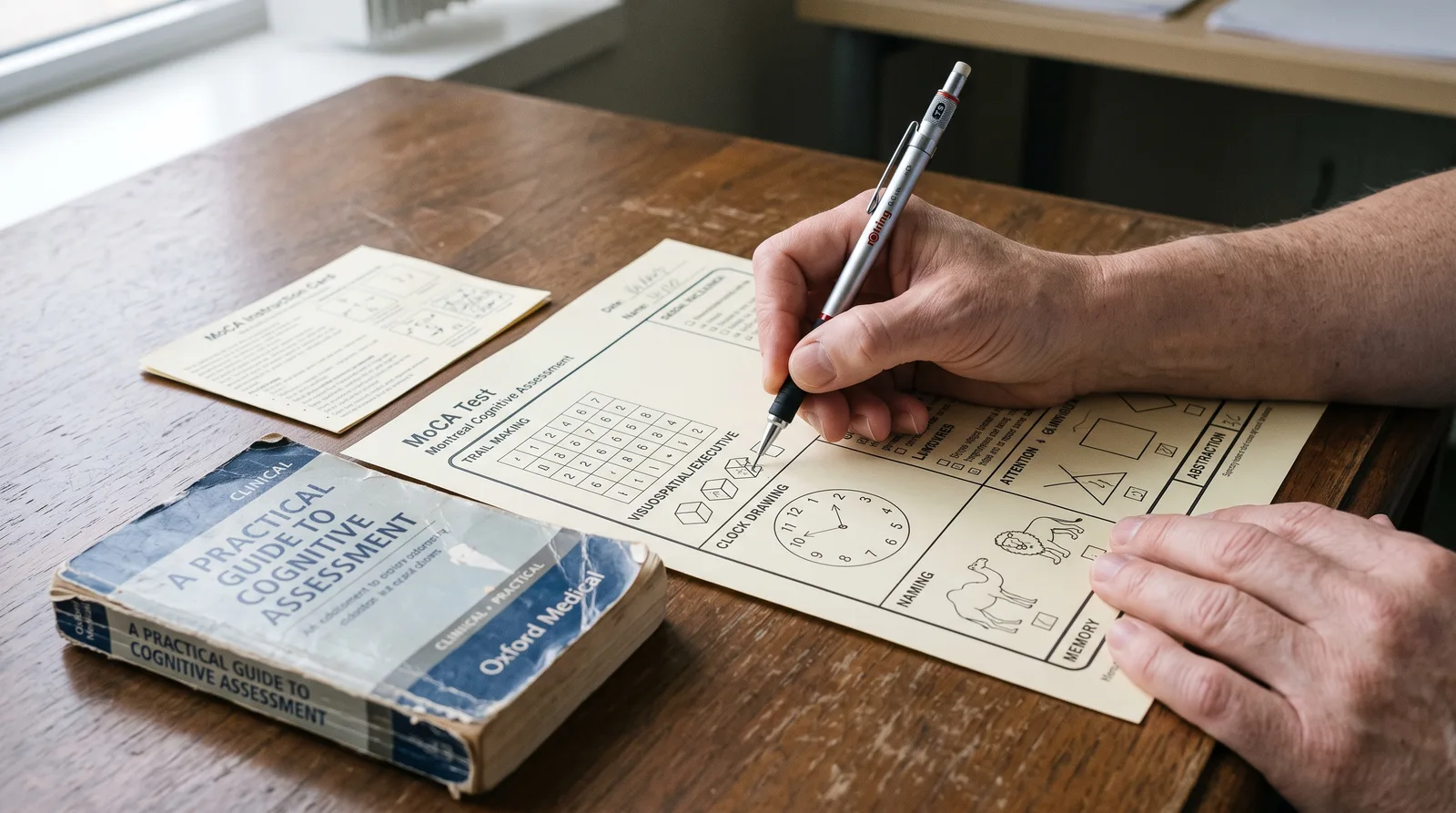
- Administer and accurately score validated cognitive screening tools (MMSE, MoCA, SLUMS, CDT) and select the right instrument for each clinical context
- Differentiate normal age-related cognitive change from MCI, dementia subtypes (Alzheimer's, vascular, Lewy body, FTD), and reversible delirium
- Conduct a structured, time-efficient cognitive history interview with the patient and an informed collateral source
- Interpret and integrate lab panels, neuroimaging findings, and medication reviews that directly affect cognitive diagnosis
- Document cognitive assessments to meet coding, billing, and medico-legal standards including ICD-10 specificity for dementia diagnoses
- Develop an evidence-based management and referral plan — including safety assessments, caregiver counseling, and advance care planning conversations
How it works
A school that adapts to you
This isn't a set of static videos. Every lesson is generated live and tuned to where you actually are.
We learn your level
A quick placement check tailors your starting point so you're never bored or lost.
Lessons adapt as you go
Each lesson is written for your pace and your goal, adjusting as your skills grow.
Your AI coach keeps you moving
Checkpoints, feedback, and gentle nudges turn progress into a real result.
The curriculum
What's inside your school
6 modules · 26 lessons

Foundations of Cognitive Aging
Establishes the biological and clinical baseline by distinguishing normal aging from pathological cognitive decline across the major dementia subtypes.
- 1.1How the Aging Brain Changes — and What's NormalIncluded
- 1.2Dementia Subtypes at a Glance: Alzheimer's, Vascular, Lewy Body, and FTDIncluded
- 1.3Mild Cognitive Impairment: Recognizing the Critical Middle GroundIncluded
- 1.4Delirium vs. Dementia: A High-Stakes DifferentialIncluded
Taking a Structured Cognitive History
Builds the interviewing skills needed to gather accurate, time-efficient cognitive histories from both patients and collateral informants.
- 2.1Structuring the Patient Interview for Cognitive ComplaintsIncluded
- 2.2Engaging the Collateral Source: Getting the Story Behind the StoryIncluded
- 2.3Validated Informant Scales: AD8, Functional Activities Questionnaire, and Zarit Burden InterviewIncluded
- 2.4Documenting the Cognitive History for Clinical and Legal ClarityIncluded
Administering and Interpreting Cognitive Screening Tools
Provides step-by-step mastery of the MMSE, MoCA, SLUMS, and Clock Drawing Test, including scoring accuracy and instrument selection logic.
- 3.1MMSE: Administration, Scoring, and LimitationsIncluded
- 3.2MoCA: The Clinician's Go-To for Mild ImpairmentIncluded
- 3.3SLUMS: Sensitivity Advantages and When to Choose ItIncluded
- 3.4Clock Drawing Test: Scoring Systems and What the Clock RevealsIncluded
- 3.5Choosing the Right Tool for the Right PatientIncluded
Workup: Labs, Imaging, and Medication Review
Equips clinicians to order, interpret, and integrate the diagnostic studies and medication reviews that directly impact cognitive diagnosis.
- 4.1The Cognitive Lab Panel: What to Order and WhyIncluded
- 4.2Reversible Causes of Cognitive Impairment: Don't Miss the TreatableIncluded
- 4.3Neuroimaging in Cognitive Assessment: CT, MRI, and BeyondIncluded
- 4.4Polypharmacy and Cognitive Toxicity: The Medication ReviewIncluded
Diagnosis, Documentation, Coding, and Billing
Translates clinical findings into accurate ICD-10-coded diagnoses and compliant documentation that satisfies medico-legal and reimbursement standards.
- 5.1ICD-10 Coding for Dementia and MCI: Getting Specificity RightIncluded
- 5.2Writing a Defensible Cognitive Assessment NoteIncluded
- 5.3Billing for Cognitive Services: AWV, CCM, and Evaluation and Management CodesIncluded
- 5.4Medico-Legal Considerations: Capacity, Driving, and Mandatory ReportingIncluded
Management, Safety, and Longitudinal Care Planning
Builds evidence-based, patient-centered management plans covering pharmacotherapy, safety, caregiver support, referral, and advance care planning.
- 6.1Pharmacologic Management: Approved Agents, Realistic ExpectationsIncluded
- 6.2Safety Assessment at Home: Falls, Driving, Wandering, and FinancesIncluded
- 6.3Caregiver Counseling and Community Resource ReferralIncluded
- 6.4Advance Care Planning Conversations in Cognitive DeclineIncluded
- 6.5When and How to Refer: Neurology, Neuropsychology, and Geriatric PsychiatryIncluded
Who it's for
Is this you?

Primary care NPs
She sees a high volume of older adults and needs validated, time-efficient cognitive assessment workflows she can use starting Monday morning.

Geriatric-adjacent PAs
He works in internal medicine or hospital medicine and wants the dementia subtyping and delirium differential skills to close the gap between his current practice and subspecialty-level care.

Rural or independent practice clinicians
Without easy access to neuropsychology or geriatric psychiatry referrals, she needs to take the cognitive workup as far as possible herself — and document it defensibly.

Documentation and billing-focused PAs
He's confident clinically but knows his ICD-10 specificity for dementia diagnoses and his cognitive billing practices need a systematic upgrade.
Experienced NPs re-sharpening skills
She has years of geriatric practice but wants evidence-based fluency with newer validated tools — MoCA, SLUMS, AD8 — and a structured framework for collateral-source interviews.

New-to-geriatrics PAs and NPs
He's recently transitioned into a practice with a significant older adult population and needs a rigorous foundational curriculum that respects his clinical training and fills the geriatrics gap fast.
Questions
Frequently asked
Your teacher
A note from your teacher
Gary R Uremovich MS DMin PhD PA (Emeritus)
If you're a PA or NP seeing older adults in practice, you already know the feeling: a patient's family mentions that "something seems off," the patient themselves deflects or minimizes, and you're holding a 15-minute appointment and a clinical picture that doesn't quite resolve. You document your concern, order a TSH, and make a follow-up. But you leave the room not entirely sure you caught what you needed to catch.\n\nThat uncertainty is not a reflection of your competence. It's a reflection of how inadequately most training programs — PA school, NP programs, and even most CME — prepare clinicians for the genuine complexity of geriatric cognitive assessment. Dementia subtyping, MCI diagnosis, validated screening instrument selection, collateral-source interviewing, reversible cause workup, ICD-10 specificity, medico-legal documentation — these are taught in fragments, if at all. This school exists to put all of it together, systematically, in a format built for clinicians who are already in practice and need frameworks that transfer directly to patient care.\n\nWhat I've built here is the curriculum I wish had existed earlier in my clinical work with older adults: evidence-based, precise, and organized the way a clinician actually thinks through a cognitive case. We start with the foundational neuroscience — what aging actually does to cognition, and where the line is between normal and pathological. We move through structured history-taking, hands-on screening tool mastery, and a rigorous diagnostic workup module that covers labs, neuroimaging, and polypharmacy review. Then we tackle the parts most courses skip: documentation that's defensible, coding that's compliant, and management plans that hold up across time.\n\nI want to be honest with you about what this school is and isn't. It's not a shortcut, and it won't hand you a simple algorithm. Cognitive assessment done well requires clinical judgment — and that's what we're building here, together. But it is a rigorous, structured, collegial deep-dive that will give you language, tools, and frameworks you can use in your next cognitive encounter.\n\nIf you're ready to walk into every cognitive visit with diagnostic confidence and clinical authority, I'm glad you're here. Let's get to work.
— Gary R Uremovich MS DMin PhD PA (Emeritus)
Start your journey today
Get instant access — learn at your own pace with an AI coach in your corner.
$79/mo
Recurring billing · cancel anytime
Secure checkout · Instant access
- 6 modules, 26 lessons
- AI-adaptive lessons tuned to your level
- Quizzes & checkpoints to lock in progress
- Your own AI learning coach
- Learn on any device, at your pace
- Full access for as long as you're subscribed