
Stop knowing grammar. Start using it.
Grammar in Use takes you from rules you've already learned to English you actually speak through real Canadian conversations, workplace moments, and everyday writing that sound natural, not textbook.

"Grammar only becomes yours when you use it in a situation that feels like real life — and that's exactly what we practice here, every single lesson."
— ESL Made Easy
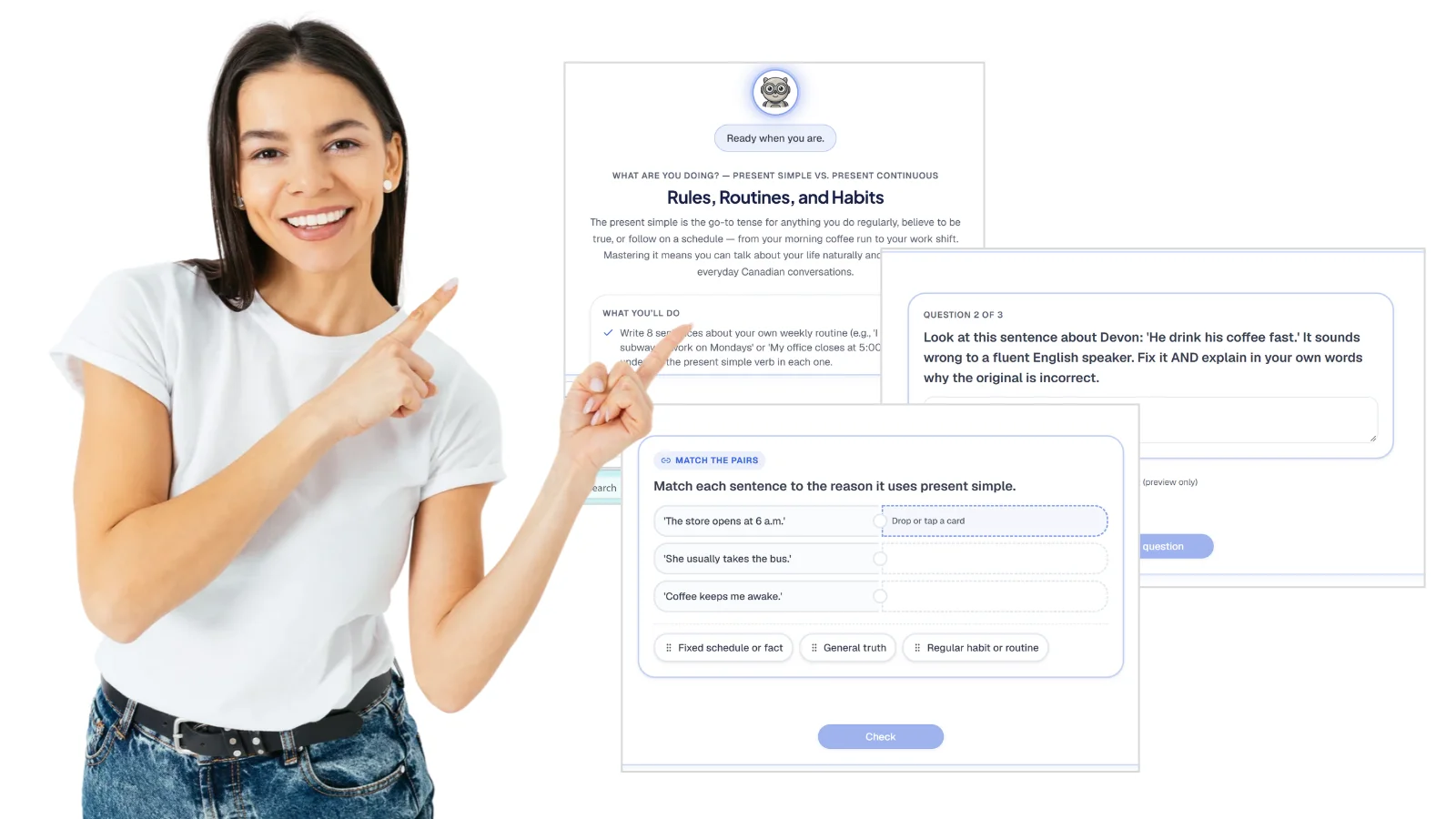
What you'll learn
What you'll be able to do
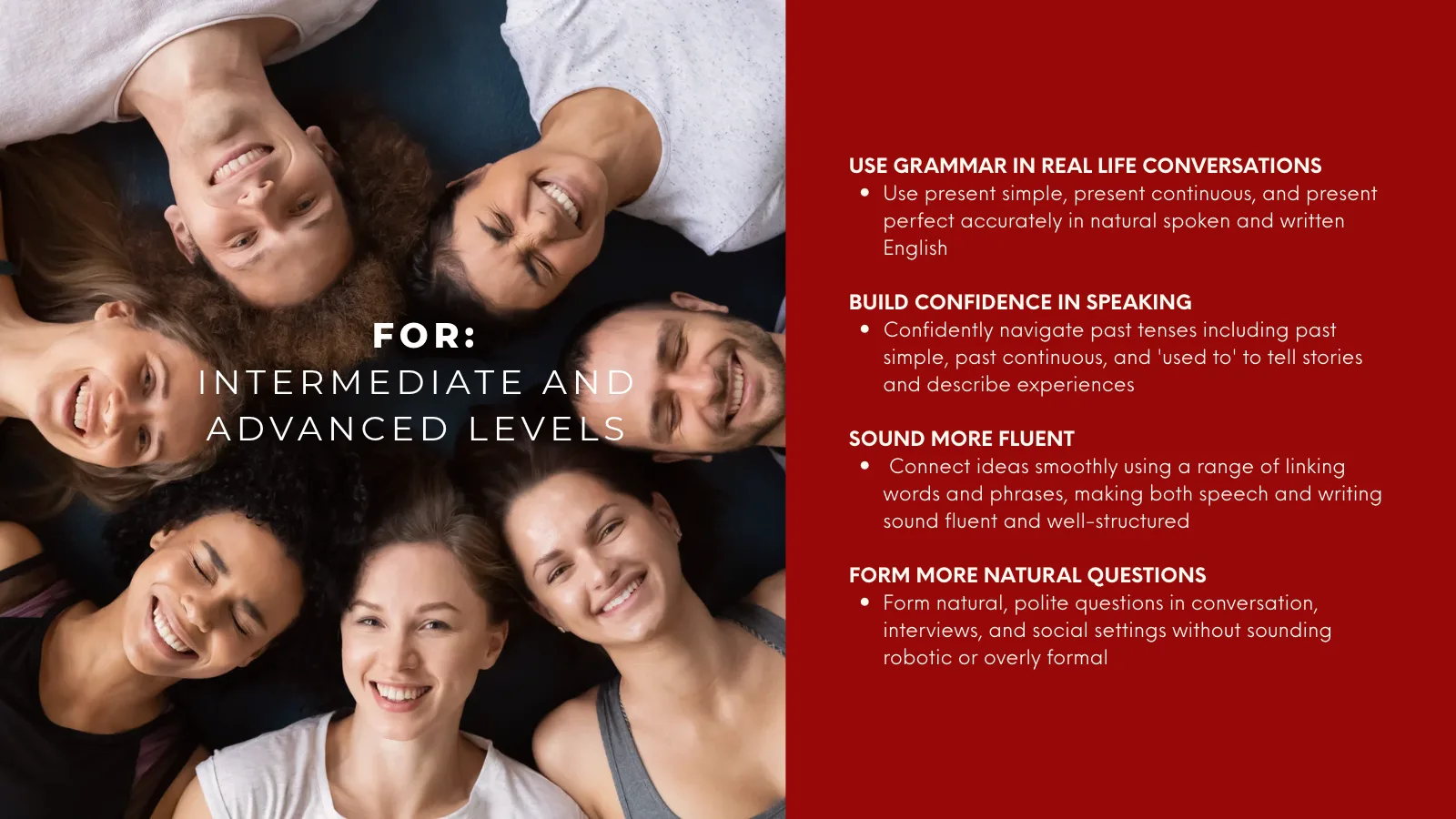
- Use present simple, present continuous, and present perfect accurately in natural spoken and written Canadian English
- Confidently navigate past tenses — including past simple, past continuous, and 'used to' — to tell stories and describe experiences
- Choose the right future form (will, going to, present continuous) for plans, predictions, and spontaneous decisions in real conversations
- Apply modal verbs and all conditional forms to express possibility, advice, regret, and hypothetical situations at work and in daily life
- Connect ideas smoothly using a range of linking words and phrases, making both speech and writing sound fluent and well-structured
- Form natural, polite questions in conversation, interviews, and social settings without sounding robotic or overly formal
How it works
A school that adapts to you
This isn't a set of static videos. Every lesson is generated live and tuned to where you actually are.
We learn your level
A quick placement check tailors your starting point so you're never bored or lost.
Lessons adapt as you go
Each lesson is written for your pace and your goal, adjusting as your skills grow.
Your AI coach keeps you moving
Checkpoints, feedback, and gentle nudges turn progress into a real result.

The curriculum
What's inside your school
12 modules · 61 lessons

What Are You Doing? — Present Simple vs. Present Continuous
Teaches the difference between habits and routines versus actions happening right now, using real Canadian workplace and daily-life conversations.
- 1.1Rules, Routines, and HabitsIncluded
- 1.2Right Now, In ProgressIncluded
- 1.3Stative Verbs — Why You Can't Say 'I'm knowing'Included
- 1.4At Work and at Home — Choosing the Right TenseIncluded
- 1.5Real-Life Writing: A Typical DayIncluded
Life Before — Used To and Past Simple
Builds confidence using 'used to' alongside the past simple to talk about past habits, situations, and completed events in personal stories.
- 2.1Things That Used to Be TrueIncluded
- 2.2It Happened — The Past SimpleIncluded
- 2.3'Used to' vs. Past Simple — What's the Difference?Included
- 2.4Conversation: Talking About Life Before CanadaIncluded
- 2.5Real-Life Writing: How My Life Has ChangedIncluded
Experience and Connection — The Present Perfect
Teaches the present perfect for life experiences, recent events, and situations still connected to the present, in Canadian conversational and workplace contexts.
- 3.1Have You Ever…? — Experiences and FirstsIncluded
- 3.2Just, Already, Yet, and StillIncluded
- 3.3Present Perfect vs. Past Simple — The Key SwitchIncluded
- 3.4At the Office — Updates and NewsIncluded
- 3.5Real-Life Writing: A Professional Bio or Update EmailIncluded
Telling the Story — Past Simple and Past Continuous
Develops storytelling skills by combining the past simple and past continuous to narrate events, set scenes, and describe interruptions.
- 4.1Setting the SceneIncluded
- 4.2When and While — Actions That InterruptIncluded
- 4.3Sequencing Events ClearlyIncluded
- 4.4Conversation: Sharing a Memorable StoryIncluded
- 4.5Real-Life Writing: A Short Personal AnecdoteIncluded
What's Going to Happen? — Future Forms
Covers 'will,' 'going to,' and the present continuous as future, helping learners choose the right form for plans, predictions, and spontaneous decisions.
- 5.1Plans and Intentions — Going ToIncluded
- 5.2Predictions and Spontaneous Decisions — WillIncluded
- 5.3Arranged Events — Present Continuous as FutureIncluded
- 5.4Conversation: Making Plans and Talking About the FutureIncluded
- 5.5Real-Life Writing: A Message About Upcoming PlansIncluded
Could You Help Me? — Modal Verbs for Real Life
Teaches the core modal verbs for ability, possibility, obligation, advice, and polite requests in workplace and social Canadian contexts.
- 6.1Ability and Possibility — Can, Could, and Be Able ToIncluded
- 6.2Obligation and Advice — Must, Have To, Should, and Ought ToIncluded
- 6.3Permission and Polite RequestsIncluded
- 6.4Conversation: Navigating Workplace Interactions PolitelyIncluded
- 6.5Real-Life Writing: An Advice EmailIncluded
What If? — Conditionals in Everyday Life
Covers all major conditional forms — zero, first, second, and third — through real conversations about decisions, regrets, and hypothetical situations.
- 7.1Facts and Habits — The Zero ConditionalIncluded
- 7.2Real Possibilities — The First ConditionalIncluded
- 7.3Imagining Differently — The Second ConditionalIncluded
- 7.4Looking Back — The Third ConditionalIncluded
- 7.5Mixed Conditionals and Natural ConversationIncluded
- 7.6Real-Life Writing: A Reflective or Hypothetical ScenarioIncluded
Better, Best, and Beyond — Comparatives and Superlatives
Teaches comparative and superlative structures for making decisions, recommendations, and evaluations in work, travel, and daily life.
- 8.1Comparing Two Things — ComparativesIncluded
- 8.2The Best Option — SuperlativesIncluded
- 8.3As…as, Not as…as, and Other Comparison StructuresIncluded
- 8.4Conversation: Making Recommendations and DecisionsIncluded
- 8.5Real-Life Writing: A Review or RecommendationIncluded
Linking It All Together — Connecting Ideas in Speech and Writing
Builds fluency and cohesion by teaching a wide range of linking words and discourse markers for spoken conversation and structured writing.
- 9.1Adding and Contrasting IdeasIncluded
- 9.2Cause, Effect, and ResultIncluded
- 9.3Giving Examples and EmphasisingIncluded
- 9.4Conversation: Sounding Fluent and Well-OrganisedIncluded
- 9.5Real-Life Writing: A Structured Opinion ParagraphIncluded
Can I Ask You Something? — Natural Question Forms
Teaches natural, polite question formation — including direct, indirect, and tag questions — for social, professional, and conversational settings.
- 10.1Direct Questions — Getting the Structure RightIncluded
- 10.2Indirect Questions — Polite and ProfessionalIncluded
- 10.3Tag Questions — Checking and ConnectingIncluded
- 10.4Conversation: An Interview and a Social ChatIncluded
- 10.5Real-Life Writing: A Follow-Up Email with QuestionsIncluded
Expressing Nuance — Advanced Modals and Perfect Forms
Develops advanced grammar accuracy using modal perfect structures and nuanced expressions of likelihood, speculation, and regret.
- 11.1Must Have, Might Have, Can't Have — Speculating About the PastIncluded
- 11.2Should Have and Could Have — Regret and CriticismIncluded
- 11.3Degrees of Certainty in ConversationIncluded
- 11.4Conversation: Discussing News and SituationsIncluded
- 11.5Real-Life Writing: A Reflective Work Email or Journal EntryIncluded
Putting It All Together — Grammar in Real Canadian Life
A capstone module that integrates all course grammar through extended real-life scenarios in work, social, and community settings across Canada.
- 12.1Review: Tenses in ActionIncluded
- 12.2Review: Modals, Conditionals, and NuanceIncluded
- 12.3Extended Conversation: A Real Canadian ScenarioIncluded
- 12.4Real-Life Writing: A Complete Multi-Purpose TextIncluded
- 12.5Your Grammar Goals — What's NextIncluded
Who it's for
Is this you?

New Canadian professionals
She's building her career in Canada and needs grammar that works in real workplaces — emails, meetings, and professional small talk included.

Skilled immigrants job-hunting
He has strong technical skills but wants to sound more natural and confident in interviews, from forming polite questions to navigating workplace English.

International students staying on
She passed her English placement tests but wants to speak and write the way fluent Canadians actually do — not the way textbooks taught her.

Intermediate learners hitting a wall
She's past the basics but stuck at a plateau — this course gives her the tenses, conditionals, and nuance that take her from good to genuinely fluent-sounding.

Remote workers with Canadian teams
He collaborates with Canadian colleagues daily and wants to write clearer emails and hold his own in casual team conversations without hesitating.

Community-connected adults
She's been living in Canada for years and wants to close the gap between understanding English and using it freely — in volunteer work, parent meetings, and everyday life.
Questions
Frequently asked

A Note From Us
ESL MADE EASY

ESL Made Easy
If you're here, we're guessing you've been learning English for a while. You can hold a conversation, you can read and write, and you understand most of what people say to you. But there's still this gap, this moment where you pause before you speak, or you re-read an email three times because something feels off, or a colleague uses a phrase and you smile and nod but you're not quite sure what they meant. That gap is real. And it's incredibly frustrating when you've already worked so hard.
Here's what we know about that gap: it's almost never about not knowing enough English. It's about not having seen the grammar in the right context often enough for it to feel automatic. That's not a personal failing, that's just how language learning actually works. Rules you read in a textbook don't stick the same way as rules you've heard, used, and practised in situations that feel like your real life. So that's what we built this course around. Real situations. Real conversations. Writing that actually goes somewhere.
Every module in Grammar for Real Life follows the same honest rhythm: we explain the grammar clearly, no jargon, no condescension, then we look at how it shows up in a coffee shop, a workplace email, a text to a friend, a job interview. Then you write something real. Not a gap-fill. Not a multiple-choice quiz. An actual piece of writing you could use. A bio. An update email. A short story about something that happened to you. Because the only way grammar becomes yours is if you actually do something with it.
We also want to be upfront about something: this course covers a lot of ground from present and past tenses, future forms, modal verbs, conditionals, comparatives, question forms, to the more nuanced stuff like speculating about the past or expressing regret because all of that comes up in real life, often in the same conversation. But we take it one step at a time, and every step connects back to something you recognise. You won't feel lost. You'll feel like things are finally clicking.
If you're building your life in Canada or another English speaking country, growing your career in an English-speaking workplace, or just tired of second-guessing yourself every time you open your mouth, we made this for you. You already have so much. Let's close that gap together.
Come on in. We're really glad you're here.
— ESL Made Easy
Start your journey today
Get instant access — learn at your own pace with an AI coach in your corner.
$25/6 mo
Recurring billing · cancel anytime
Secure checkout · Instant access
- 12 modules, 61 lessons
- AI-adaptive lessons tuned to your level
- Quizzes & checkpoints to lock in progress
- Your own AI learning coach
- Learn on any device, at your pace
- Full access for as long as you're subscribed