
Draft Grants that Score - and WIN!
A practitioner-built course for nonprofit staff, college access coordinators, and program directors who are done losing on points they should have earned — and ready to submit proposals that reviewers AWARD WITH FUNDING!
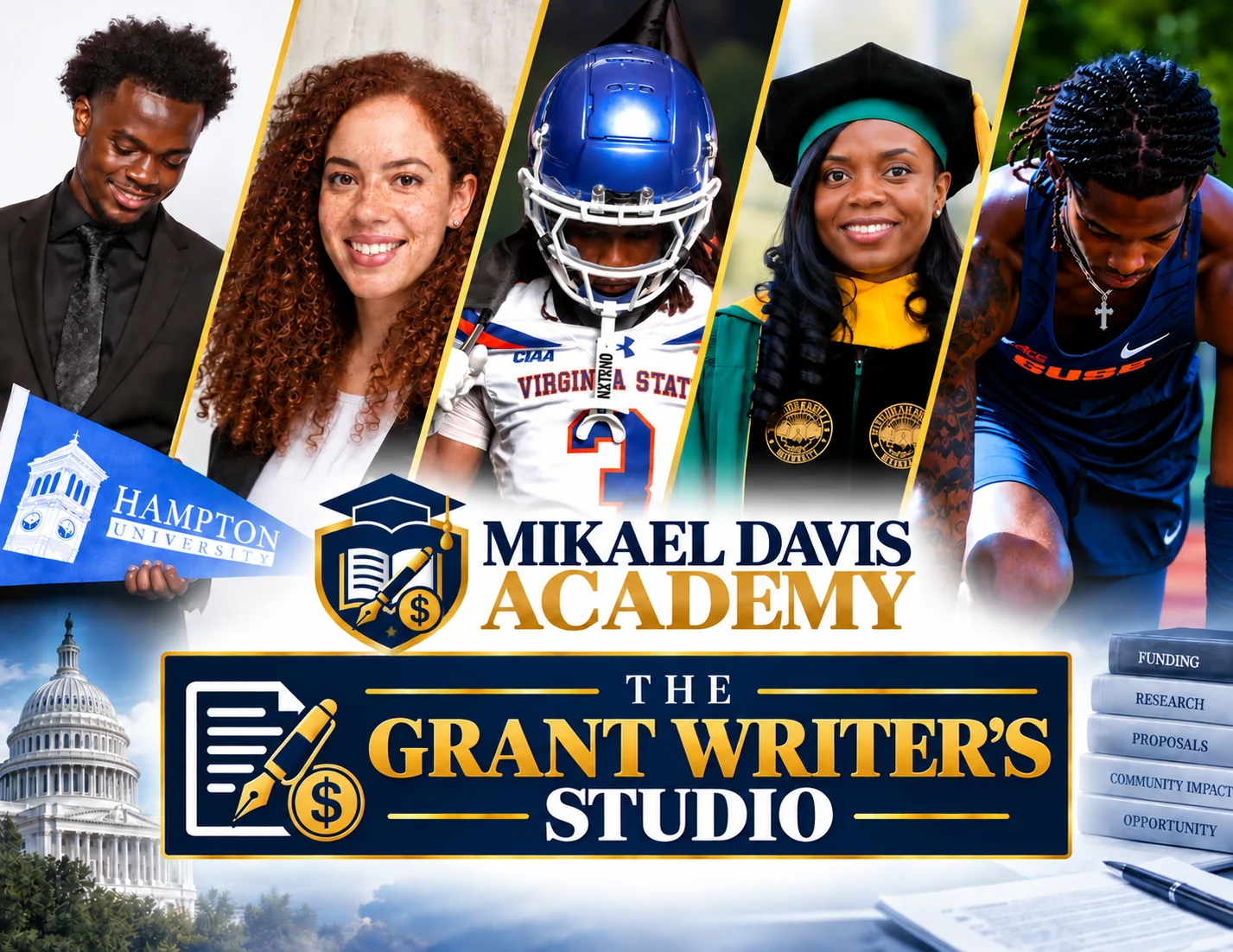
"Whether you are writing municipal, state, or federal grants to fund your educational organization, non-profit, or faith-based organization, every point on that grant's Technical Review Form is either earned or surrendered. My goal is to make sure you earn EVERY SINGLE ONE."
— Mikael Davis

What you'll learn
What you'll be able to do
- Decode any RFP and extract eligibility rules, scoring criteria, required activities, formatting requirements, and submission deadlines before writing a single word.
- Build a persuasive needs statement that integrates local data, national context, disparity evidence, and comparison groups — and connects every statistic to a specific program response.
- Write fundable, measurable objectives that specify population, percentage target, timeframe, and baseline — and defend their ambitiousness and attainability against real data.
- Design a logic model and operations plan with explicit inputs, activities, outputs, and short-, intermediate-, and long-term outcomes tied directly to documented student, client, or participant needs.
- Construct a compliant, cost-effective budget with a three-way narrative crosswalk that ensures every expenditure advances an objective and every narrative promise is funded.
- Conduct a pre-submission peer review using a scored rubric — identifying earned versus deducted points and verifying alignment across need, objectives, design, evaluation, and budget.
How it works
The Grant Writer's Studio Adapts to You
Grounded in Evidence-Based Protocols that have garnered over $20 million in federal grants, EVERY LESSON is generated live and tuned to where you actually are.
The Grant Writer's Studio learns your level of expertise
A quick placement check tailors your starting point so you're never bored or lost.
Lessons adapt as you go
Each lesson is written for your pace and your goal, adjusting as your skills grow.
Built-in progress guidance helps you every step of the way
Checkpoints, feedback, and gentle nudges turn progress into a real result.
The curriculum
What's inside your school
9 modules · 33 lessons

Mission Alignment & RFP Mastery
Students learn how funded grants connect organizational mission to population needs, and how to dissect an RFP completely before committing to any design or budget decision.
- 1.1Mission, Vision, Goals, and the Population You ServeIncluded
- 1.2Reading the Entire RFP Before You Write a WordIncluded
- 1.3Extracting What the Funder Is Really Asking ForIncluded
The Reviewer's Mindset: Scoring and Specificity
Students adopt a field reviewer's perspective — learning how points are earned or lost — and master the twin disciplines of radical specificity and zero-inference writing.
- 2.1Proposals Start at Zero: How Every Point Is EarnedIncluded
- 2.2If You Don't Tell Them, They Won't KnowIncluded
- 2.3Assume Nothing: Closing Every Inferential GapIncluded
- 2.4Would a Field Reader Call This Strong or Weak?Included
Building a Persuasive Needs Statement
Students learn to distinguish the core components of a needs statement and assemble them into a data-rich, locally grounded argument that connects documented disparities to a specific proposed response.
- 3.1The Seven Building Blocks: Problem, Evidence, Population, Disparity, Consequence, Need, and Proposed ResponseIncluded
- 3.2Using Data Like a Pro: Multiple Sources, Baselines, and ContextIncluded
- 3.3Local Data vs. Institutional Claims: Saying It With EvidenceIncluded
- 3.4Qualitative Evidence and the Human Dimension of NeedIncluded
Transforming Data Into Narrative and Program Response
Students move from raw statistics to a persuasive, action-oriented proposal narrative that connects every data point to a specific program activity addressing a documented need.
- 4.1Every Stat Must Perform a FunctionIncluded
- 4.2From Five Disconnected Stats to One Persuasive NarrativeIncluded
- 4.3Designing Activities That Answer What, Who, When, Where, How Often, by Whom, and WhyIncluded
Evidence-Based Program Design and Logic Models
Students build a fully specified logic model and translate documented student needs into concrete, evidence-based program elements tied to short-, intermediate-, and long-term outcomes.
- 5.1Anatomy of a Logic Model: Inputs, Activities, Outputs, and OutcomesIncluded
- 5.2Translating Student Needs Into Program ElementsIncluded
- 5.3Ensuring Every Program Element Traces Back to a Documented NeedIncluded
Writing Fundable, Measurable Objectives
Students master the distinction between goals, outputs, and process, performance, and outcome objectives — and write ambitious, baseline-defended, fundable objective statements.
- 6.1Goals vs. Outputs vs. Objectives: Getting the Terminology RightIncluded
- 6.2The Anatomy of a Fundable ObjectiveIncluded
- 6.3From Weak to Fundable: Rewriting Objectives That Lose PointsIncluded
- 6.4Defending Ambitiousness: Comparing Objectives Against Baseline DataIncluded
Operations Plan and Evaluation Design
Students construct a management structure and evaluation plan that demonstrate organizational capacity, accountability, and a rigorous data-collection strategy tied to every objective.
- 7.1Building an Operations Plan That Proves CapacityIncluded
- 7.2Constructing an Evaluation Plan Around Every ObjectiveIncluded
- 7.3Quantitative and Qualitative Evaluation for Accountability and ImprovementIncluded
- 7.4Institutional Commitment: Showing the Funder You Can DeliverIncluded
Budget Development and the Three-Way Crosswalk
Students build a complete, cost-effective, and compliant budget from the ground up and master the three-way crosswalk that keeps narrative, budget, and objectives in perfect alignment.
- 8.1Building the Budget From Objectives and Program DesignIncluded
- 8.2The Three-Way Crosswalk: Narrative, Budget, and Objectives in AlignmentIncluded
- 8.3Writing the Budget NarrativeIncluded
- 8.4Finding and Fixing a Flawed BudgetIncluded
Peer Review, Pre-Submission, and Final Submission
Students conduct scored peer reviews of full proposals, verify alignment across all sections, and execute a rigorous pre-submission checklist to ensure a reviewer-ready, on-time submission.
- 9.1Scored Peer Review: Earning vs. Deducting PointsIncluded
- 9.2Alignment Check: Need, Objectives, Design, Evaluation, and BudgetIncluded
- 9.3Pre-Submission Review: Approvals, Attachments, Formatting, and Portal PreparationIncluded
- 9.4Deadline Management, Early Data Collection, and Team ExpectationsIncluded
Who it's for
Is this you?

First-time Grant Writer
She's been handed grant-writing duties with little guidance and needs a rigorous, from-scratch process she can trust — not a template that falls apart at the first unfamiliar RFP.

College Access Coordinator
She writes Title IV and TRIO-adjacent proposals year after year and wants the discipline and reviewer vocabulary to move from competitive to consistently funded.

Nonprofit Program Director
He designs strong programs but loses points on paper — and needs to learn how to translate his program's real capacity into a document that scores.

Workforce Development Manager
She pursues state and federal workforce grants and needs a repeatable proposal-building process that holds up across funders with different RFPs and priorities.

Aspiring Grants Professional
He wants to grow into a dedicated grants management role and needs practitioner-level training — not theory — to build a credible, hirable skill set.

Executive Director Wearing All Hats
She oversees development at a small nonprofit where grant writing lands on her desk, and she needs to produce competitive, compliant submissions without a dedicated grants team behind her.
Questions
Frequently asked
Your teacher
A note from your teacher

Mikael Davis
If you've ever submitted a grant proposal you believed in — and lost — you know the particular frustration of not knowing exactly why. Was it the needs statement? The objectives? The budget? The alignment? Most applicants never find out. They revise vaguely, resubmit hopefully, and lose again for the same reasons.
I built The Grant Writer's Studio because that cycle is completely avoidable — and because the knowledge that breaks it isn't secret. It lives in the scoring rubrics, the reviewer guidance documents, and the patterns that show up again and again across winning and losing proposals. I've worked on both sides of the panel: writing proposals under real deadlines with real stakes and scoring applications as a reviewer who has seen every mistake you can imagine. The gap between a proposal that scores in the fundable range and one that doesn't is almost never a gap in the applicant's mission or the quality of their program. It's a gap in craft — in knowing how to translate a strong program into a document that earns points.
That's what this course teaches, section by section, without shortcuts. You'll learn to read an RFP the way a compliance officer reads a contract — extracting every requirement, every scoring criterion, every formatting rule before you write a word. You'll learn to build a needs statement that doesn't just describe a problem but constructs a documented, data-supported case that makes your proposed program feel like the only logical response. You'll write objectives that are specific enough to score — population, percentage, timeframe, baseline, all present and defensible — and you'll build a logic model and operations plan where nothing floats free of a documented need. Then you'll construct a budget from the inside out, crosswalk it against your narrative and your objectives, and run your own scored peer review before submission.
I won't pretend this is easy work. Grant writing is hard, and competitive federal and foundation grants are harder. But hard is different from mysterious. Every section of your proposal has a knowable anatomy, a scorable structure, and a set of reviewer expectations you can learn and meet. I'm here to make those expectations explicit — and to hold your work to the same standard a field reader will. That's what this studio was specifically designed to do.
If you're ready to stop guessing and start scoring, I'd like to partner with you.
LET'S GET TO WORK!
— Mikael Davis
Start your journey today
Get instant access — learn at your own pace with an AI coach in your corner.
$147/mo
Recurring billing · cancel anytime
Secure checkout · Instant access
- 9 modules, 33 lessons
- AI-adaptive lessons tuned to your level
- Quizzes & checkpoints to lock in progress
- Your own AI learning coach
- Learn on any device, at your pace
- Full access for as long as you're subscribed