Know the minds that shaped your faith
A guided journey through 2,000 years of Christian thought — from the early Church Fathers to Karl Barth and beyond — taught in plain language that respects your curiosity and assumes no seminary degree.
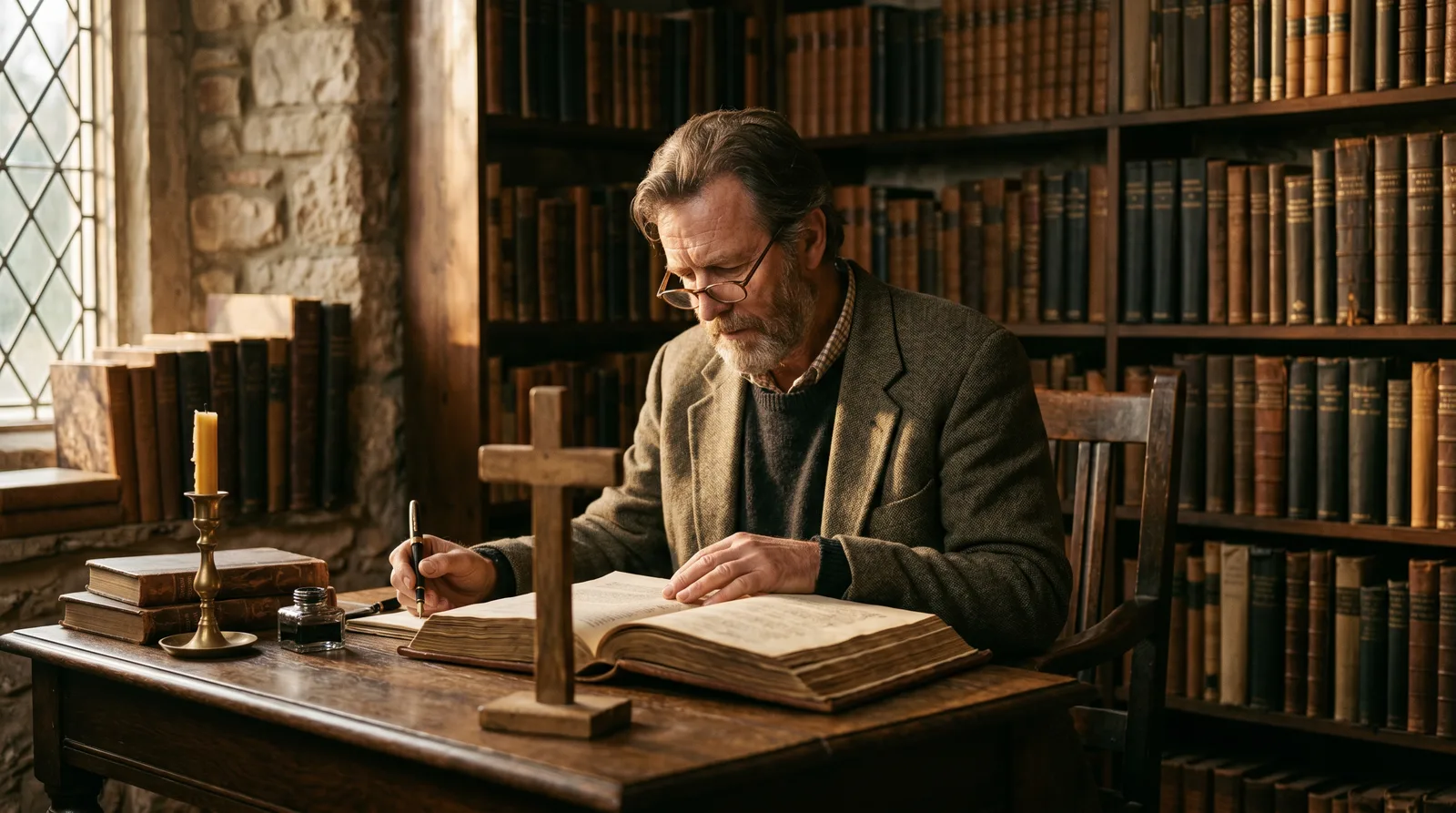
Doctrine was never handed down in silence — it was hammered out in controversy, and understanding that story will change how you read every page of Scripture and every line of your creed.— Carla Paton
What you'll learn
What you'll be able to do
- Identify the major Christian theologians from the early Church through the modern era and explain what made each one historically significant
- Describe the central doctrinal contributions of figures such as Athanasius, Augustine, Aquinas, Luther, Calvin, and Barth in plain, accurate language
- Place each thinker within their cultural and historical context, understanding the real-world crises and controversies that drove their ideas
- Trace how foundational doctrines — including the Trinity, the nature of Christ, grace, and salvation — were debated, refined, and settled across the centuries
- Recognize how the ideas of past theologians continue to shape contemporary worship, ethics, biblical interpretation, and denominational distinctives
- Read and engage primary theological texts and arguments with greater confidence, laying a foundation for deeper seminary-level or personal study
How it works
A school that adapts to you
This isn't a set of static videos. Every lesson is generated live and tuned to where you actually are.
We learn your level
A quick placement check tailors your starting point so you're never bored or lost.
Lessons adapt as you go
Each lesson is written for your pace and your goal, adjusting as your skills grow.
Your AI coach keeps you moving
Checkpoints, feedback, and gentle nudges turn progress into a real result.
The curriculum
What's inside your school
8 modules · 28 lessons

Foundations: What Is Theology and Why Does History Matter?
Before meeting the great thinkers, students need a shared vocabulary and a clear map of the terrain. This opening module defines theology, distinguishes its major branches (biblical, systematic, historical, practical), and establishes why studying theology through its historical figures is a uniquely powerful approach. It also introduces the recurring pattern by which doctrine develops — not arbitrarily, but in response to real crises — giving students the analytical lens they will apply throughout the entire course. A brief survey of primary sources and how to read them prepares students for the text-engagement outcome from the first week.
- 1.1Theology as a Human EndeavorIncluded
- 1.2How Doctrine Develops: Crisis, Controversy, and ClarificationIncluded
The Early Church Fathers: Defending and Defining the Faith (100–325 AD)
This module introduces the first generation of post-apostolic theologians — men who wrote while Christianity was an illegal minority religion facing persecution from Rome and intellectual attack from competing philosophies and heresies. Students encounter Ignatius, Justin Martyr, Irenaeus, Tertullian, and Origen as real historical figures navigating life-and-death stakes, and they see how the canon of Scripture, the rule of faith, and early Trinitarian language all emerged from these pressures. The module establishes the indispensable foundation upon which every subsequent thinker in the course builds.
- 2.1Ignatius of Antioch and Justin Martyr: Faith Under FireIncluded
- 2.2Irenaeus: Scripture, Tradition, and the Rule of FaithIncluded
- 2.3Tertullian and Origen: Two Roads in Early TheologyIncluded
The Age of Councils: Settling the Great Doctrines (325–451 AD)
The fourth and fifth centuries saw Christianity move from persecuted minority to the empire's official religion — and simultaneously face its most explosive internal doctrinal crises. This module traces the great Christological and Trinitarian controversies through the councils of Nicaea (325), Constantinople (381), Ephesus (431), and Chalcedon (451). Students meet Athanasius, the Cappadocian Fathers (Basil, Gregory of Nazianzus, Gregory of Nyssa), and the conciliar documents themselves, understanding how precise creedal language was forged under enormous political and theological pressure. By the end, students can trace the full arc from Arius's challenge to the Chalcedonian definition.
- 3.1Athanasius: The Man Who Stood Contra MundumIncluded
- 3.2The Cappadocian Fathers: Naming the TrinityIncluded
- 3.3Chalcedon and the Nature of Christ: Fully God, Fully HumanIncluded
Augustine and the Latin West: Grace, Sin, and the Shape of History (354–430 AD)
Augustine of Hippo is the single most influential theologian in Western Christianity — Catholic and Protestant alike. This module treats him as his own unit, which the depth and breadth of his influence fully justifies. Students follow Augustine's intellectual and spiritual journey through the Confessions, examine his defining debates with Pelagius over grace, free will, and original sin, and engage his sweeping theology of history in The City of God. The module deliberately corrects a common misconception: Augustine is not simply a pessimist about human nature but a theologian of restless longing for God and of grace as the deepest form of freedom. Prerequisites from Module 3 (Nicene theology) underpin Augustine's Trinitarian thought, which surfaces throughout.
- 4.1Augustine's Journey: From Restlessness to GraceIncluded
- 4.2Sin, Grace, and Free Will: Augustine vs. PelagiusIncluded
- 4.3The City of God: History, Politics, and Christian HopeIncluded
The Medieval Synthesis: Faith Seeking Understanding (600–1500 AD)
The medieval period is often caricatured as a theological dark age, but it was in fact one of the most intellectually creative eras in Christian history. This module recovers that richness by introducing students to Anselm's ontological argument and satisfaction theory of atonement, Thomas Aquinas's monumental synthesis of Aristotelian philosophy and Christian theology, and the flourishing mystical tradition represented by Bernard of Clairvaux, Hildegard of Bingen, and others. A lesson on John Wycliffe and Jan Hus — the pre-Reformers — has been added to this module to provide the crucial bridge to the Reformation and prevent the jarring jump from Aquinas directly to Luther. Students will see that the Reformation had deep medieval roots.
- 5.1Anselm of Canterbury: Faith Seeking UnderstandingIncluded
- 5.2Thomas Aquinas: The Angelic Doctor and the Scholastic SummitIncluded
- 5.3Bernard, Hildegard, and the Mystical TraditionIncluded
- 5.4Wycliffe, Hus, and the Pre-Reformation ChallengeIncluded
The Reformation: Scripture, Grace, and the Fracturing of Western Christianity (1500–1700 AD)
The Protestant Reformation is the most consequential theological rupture in Western Christian history, and this module treats it with the depth it demands. Students meet Luther, Calvin, and the Radical Reformers (Anabaptists), understanding not only their famous slogans but the precise theological arguments behind them. The module also introduces the Council of Trent as the Catholic Church's defining response — an essential counterpart that is too often omitted — ensuring students understand the Reformation as a conversation between competing visions of Christianity, not a one-sided Protestant triumph. By the end, students can explain the major fault lines between Catholic, Lutheran, Reformed, and Anabaptist theologies.
- 6.1Martin Luther: Grace Alone, Faith Alone, Scripture AloneIncluded
- 6.2John Calvin: Sovereignty, Covenant, and the Reformed TraditionIncluded
- 6.3Radical Reformers and the Anabaptist VisionIncluded
- 6.4The Catholic Response: Trent and the Counter-ReformationIncluded
Early Modern Voices: Wesley, Edwards, and the Renewal Traditions (1650–1900 AD)
The seventeenth through nineteenth centuries saw Christianity diversify dramatically: Puritan moral theology, Pietist renewal movements, the Great Awakenings, Methodist revival, and the birth of modern missions. This module focuses on two towering figures — Jonathan Edwards and John Wesley — who represent the two great streams of Protestant renewal in this period (Calvinist and Arminian), while also briefly surveying the broader context of Pietism and the emergence of global mission. A lesson on the rise of biblical criticism and Enlightenment challenges has been added here as a necessary prerequisite for understanding the modern theology module that follows — without it, students have no framework for understanding Schleiermacher or Barth.
- 7.1Jonathan Edwards: Revival, Beauty, and Reformed PietyIncluded
- 7.2John Wesley: Grace for All, Holiness, and the Wesleyan HeritageIncluded
- 7.3Pietism, Mission, and the Spread of Global ChristianityIncluded
- 7.4The Enlightenment Challenge: Reason, Criticism, and the Crisis of AuthorityIncluded
Modern Theology: Responding to a Secular World (1800–Present)
The final module traces Christian theology's varied and sometimes conflicting responses to modernity, secularism, and the crises of the twentieth century. Students encounter Schleiermacher's liberal accommodation of Christianity to modern culture, Barth's thunderous neo-orthodox rejection of that accommodation, Bonhoeffer's theology under Nazi pressure, C. S. Lewis's popular apologetics, and finally the emergence of liberation theology, feminist theology, and the diverse voices of Global South Christianity. The Enlightenment Challenge lesson in Module 7 makes this module fully accessible, and the course ends by returning students to their opening timeline and initial questions, synthesizing two thousand years of theological reflection.
- 8.1Schleiermacher and Liberal Theology: Christianity Meets ModernityIncluded
- 8.2Karl Barth: The Word of God Against ReligionIncluded
- 8.3Dietrich Bonhoeffer: Costly Grace and Theology Under PressureIncluded
- 8.4C. S. Lewis: Apologetics, Imagination, and the Accessible GospelIncluded
- 8.5Liberation Theology, Global Voices, and the Expanding TraditionIncluded
Who it's for
Is this you?

The Curious Layperson
You have attended church for years and love your faith, but the intellectual history behind your beliefs has always felt just beyond your grasp — this course finally brings it within reach.

The Small Group Leader
You field deep questions every week and want the theological grounding to answer them with confidence, context, and genuine depth.

The Pre-Seminary Student
You are heading toward formal theological study and want a clear, well-organized map of the tradition before you arrive in the classroom.

The Lifelong Learner
Retired or simply at a season of life where you want to go deeper, you are hungry for the kind of serious intellectual engagement that enriches faith rather than threatening it.

The Denomination-Curious Christian
You have encountered Reformed, Catholic, Wesleyan, or Orthodox Christians and want to understand where their distinct convictions came from and how they fit into the larger story.

The Ministry Volunteer
You serve faithfully in your church and sense that a richer grasp of church history and doctrine would make you a more thoughtful, better-equipped member of your community.
Questions
Frequently asked
Your teacher
A note from your teacher

Carla Paton
Maybe you have sat in a pew for years — or served in ministry, or led a small group, or taught a Sunday school class — and a nagging question has stayed with you: Where did all of this come from? You recite the Nicene Creed, you talk about grace and salvation, you hear about the sovereignty of God or the importance of Scripture — but the history behind those words, the arguments that forged them, the people who bled for them, has always felt slightly out of reach. Like something that happened in a world too distant and too scholarly to be yours.
I understand that feeling, and I designed this course to answer it directly. The Great Theologians is the guided journey I wish I had been given early on — a walk through two millennia of Christian thought that treats every student as a capable, curious adult. We will travel together from the tiny, embattled communities of the early Church all the way to the twenty-first century, meeting the men and women who asked the hardest questions about God, humanity, and salvation — and who answered them in ways that still shape your worship, your ethics, and your Bible reading today.
What I want you to experience in this course is not just information but orientation. When you understand why Athanasius refused to bend even when every bishop in the empire abandoned him, you understand something essential about the doctrine of the Trinity — and about courage. When you sit with Augustine's account of his own restlessness and hear him describe grace as something that arrived before he was looking for it, the doctrine of grace stops being abstract. When you watch Luther reading Paul and realizing the medieval church has misread justification for centuries, you feel the Reformation rather than merely memorize it. That is what good theological history does: it puts flesh on doctrine.
I want to be honest with you about what this course is and is not. It is not a replacement for seminary, and I will not pretend it is. But it is a serious, substantive, beautifully organized foundation — one that will give you the vocabulary, the context, and the confidence to go deeper in whatever direction your curiosity leads. Whether you are preparing for formal study, growing in your own faith, or simply trying to understand why Christians across different traditions believe such different things, this course is built for you. Come as you are. Bring your questions. The tradition is richer and stranger and more alive than you may have imagined — and I would be honored to introduce you to it.
— Carla Paton
Start your journey today
Join get instant access — learn at your own pace with an AI coach in your corner.
$19/mo
Recurring billing · cancel anytime
Secure checkout · Instant access
- 8 modules, 28 lessons
- AI-adaptive lessons tuned to your level
- Quizzes & checkpoints to lock in progress
- Your own AI learning coach
- Learn on any device, at your pace
- Full access for as long as you're subscribed