Master the Art and Science of Drawing Blood
Haus of Healthcare Academy's phlebotomy course takes complete beginners from "what is a vacutainer?" to certification-exam-ready — covering venous anatomy, venipuncture technique, infection control, and career preparation in one polished, self-paced program.
"The patient in that chair deserves your very best technique — and my job is to make sure you arrive there fully prepared, deeply confident, and proud of the care you give."
— LATISHA COLEMAN
What you'll learn
What you'll be able to do
- Perform safe, professional venipuncture and capillary blood collection using correct technique and equipment
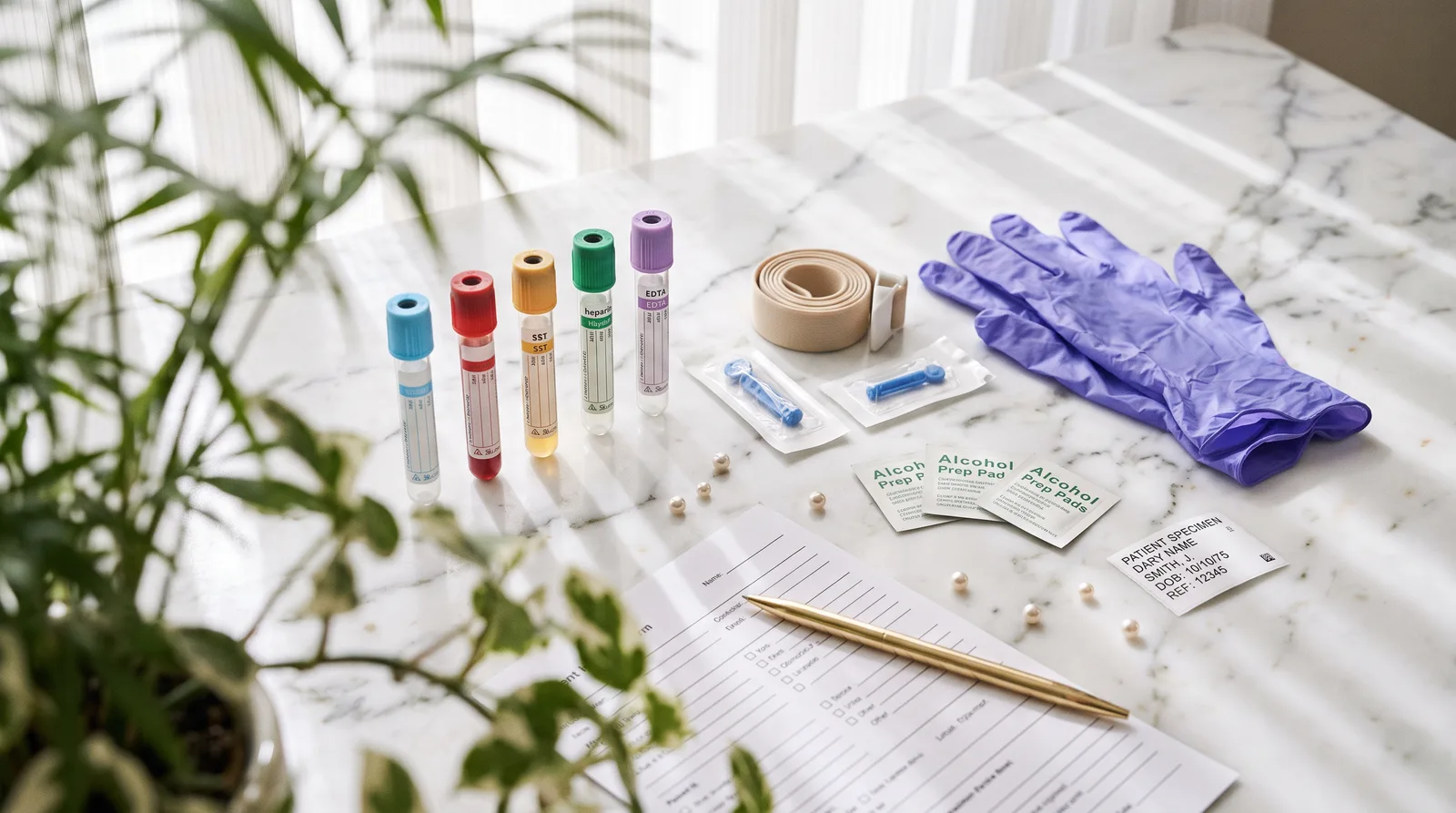
- Identify venous anatomy, tube types, and additives — and apply the correct order of draw every time
- Execute proper specimen labeling, handling, and transportation to protect sample integrity
- Apply infection control protocols, standard precautions, and safety procedures in every patient interaction
- Communicate professionally with diverse patients — including pediatric and geriatric populations — and manage complications confidently
- Prepare a competitive phlebotomy career portfolio and approach third-party certification exams with a structured study strategy
How it works
A school that adapts to you
This isn't a set of static videos. Every lesson is generated live and tuned to where you actually are.
We learn your level
A quick placement check tailors your starting point so you're never bored or lost.
Lessons adapt as you go
Each lesson is written for your pace and your goal, adjusting as your skills grow.
Your AI coach keeps you moving
Checkpoints, feedback, and gentle nudges turn progress into a real result.
The curriculum
What's inside your school
12 modules · 69 lessons
Introduction to Phlebotomy
Establishes the role, scope, and professional standards of a phlebotomist in modern healthcare settings.
- 1.1What Is Phlebotomy?Included
- 1.2The Phlebotomist's Role and ResponsibilitiesIncluded
- 1.3Healthcare Settings and the Lab TeamIncluded
- 1.4Legal and Ethical FoundationsIncluded
- 1.5Module Quiz: Introduction to PhlebotomyIncluded
Anatomy and Physiology
Builds essential knowledge of the circulatory system and blood composition needed to support safe specimen collection.
- 2.1The Circulatory System OverviewIncluded
- 2.2Blood Composition and FunctionIncluded
- 2.3How Blood Flows: Arteries, Veins, and CapillariesIncluded
- 2.4Module Quiz: Anatomy and PhysiologyIncluded
Venous Anatomy
Maps the specific veins used for venipuncture and teaches how to locate and assess them confidently.
- 3.1Antecubital Fossa Veins: The Primary SitesIncluded
- 3.2Alternate and Hand Vein SitesIncluded
- 3.3Vein Assessment: Palpation and Site SelectionIncluded
- 3.4Vein Variations and Anatomical ConsiderationsIncluded
- 3.5Module Quiz: Venous AnatomyIncluded
Blood Collection Equipment
Familiarizes students with every piece of equipment used in venipuncture and capillary collection.
- 4.1Needles, Gauges, and Safety DevicesIncluded
- 4.2Evacuated Tube Systems and SyringesIncluded
- 4.3Winged Infusion (Butterfly) SetsIncluded
- 4.4Tourniquets, Gloves, and Ancillary SuppliesIncluded
- 4.5Module Quiz: Blood Collection EquipmentIncluded
Patient Identification
Establishes the critical patient identification protocols that prevent misidentification errors and protect patient safety.
- 5.1Why Correct Patient ID Is a Non-Negotiable StepIncluded
- 5.2The Two-Identifier StandardIncluded
- 5.3Inpatient vs. Outpatient ID ProceduresIncluded
- 5.4Handling Unclear or Unresponsive PatientsIncluded
- 5.5Module Quiz: Patient IdentificationIncluded
Venipuncture
Delivers a thorough, step-by-step guide to performing a safe, professional venipuncture from preparation to post-procedure care.
- 6.1Pre-Draw Preparation and Patient PositioningIncluded
- 6.2Site Preparation and Tourniquet ApplicationIncluded
- 6.3Needle Insertion and Tube Collection TechniqueIncluded
- 6.4Tube Mixing, Needle Removal, and Post-Draw CareIncluded
- 6.5Venipuncture Skill Simulation and Practice ScenariosIncluded
- 6.6Module Quiz: VenipunctureIncluded
Capillary Collection
Teaches the theory and technique of skin puncture for capillary blood collection in adults and children.
- 7.1When to Use Capillary CollectionIncluded
- 7.2Capillary Puncture Devices and Lancet SelectionIncluded
- 7.3Fingerstick Technique: Step by StepIncluded
- 7.4Heelstick Technique for NewbornsIncluded
- 7.5Module Quiz: Capillary CollectionIncluded
Order of Draw and Tube Types
Mastery module combining the CLSI order-of-draw sequence with tube additive knowledge to prevent cross-contamination errors.
- 8.1Why Order of Draw MattersIncluded
- 8.2The CLSI Order of Draw: Every Tube in SequenceIncluded
- 8.3Tube Colors, Additives, and Their TestsIncluded
- 8.4Order-of-Draw Practice: Interactive Drag-and-DropIncluded
- 8.5Tube Identification Practice: Flashcard DrillIncluded
- 8.6Module Quiz: Order of Draw and Tube TypesIncluded
Specimen Labeling, Handling, and Transportation
Covers the complete post-collection chain from accurate label application to safe laboratory delivery.
- 9.1Specimen Labeling Requirements and StandardsIncluded
- 9.2Common Labeling Errors and How to Prevent ThemIncluded
- 9.3Specimen Handling: Temperature, Light, and TimeIncluded
- 9.4Centrifugation Basics and Specimen IntegrityIncluded
- 9.5Transportation Protocols and Chain of CustodyIncluded
- 9.6Specimen-Handling Scenarios: Practice CasesIncluded
- 9.7Module Quiz: Specimen Labeling, Handling, and TransportationIncluded
Infection Control and Safety
Equips students with the infection prevention protocols, standard precautions, and safety procedures required in every patient encounter.
- 10.1Chain of Infection and How to Break ItIncluded
- 10.2Standard Precautions in Phlebotomy PracticeIncluded
- 10.3Hand Hygiene: The Single Most Important StepIncluded
- 10.4Sharps Safety and Needlestick Injury ResponseIncluded
- 10.5OSHA Bloodborne Pathogen StandardsIncluded
- 10.6Workplace Safety: Electrical, Chemical, and Ergonomic HazardsIncluded
- 10.7Module Quiz: Infection Control and SafetyIncluded
Special Populations, Complications, and Quality
Addresses pediatric and geriatric collection adaptations, adverse reactions, complication management, and quality assurance.
- 11.1Phlebotomy with Pediatric PatientsIncluded
- 11.2Phlebotomy with Geriatric PatientsIncluded
- 11.3Difficult Draws: Strategies for Hard-to-Access VeinsIncluded
- 11.4Complications and Adverse ReactionsIncluded
- 11.5Quality Specimen Collection and Pre-Analytical VariablesIncluded
- 11.6Module Quiz: Special Populations, Complications, and QualityIncluded
Documentation, Professionalism, and Career Preparation
Closes the course by building documentation skills, professional communication excellence, and a complete certification and career launch plan.
- 12.1Phlebotomy Documentation EssentialsIncluded
- 12.2Patient Communication and Therapeutic InteractionIncluded
- 12.3Professionalism, Appearance, and Workplace ConductIncluded
- 12.4Building Your Phlebotomy Career PortfolioIncluded
- 12.5Certification Pathway and Exam PreparationIncluded
- 12.6Certification and Career Pathway — Important NoticeIncluded
- 12.7Final Comprehensive AssessmentIncluded
- 12.8Certificate of Course CompletionIncluded
Who it's for
Is this you?

Career changers
She's leaving retail or admin work behind and wants a healthcare credential with a clear, structured path — this course gives her the foundational knowledge and certification roadmap to make the pivot with confidence.

Recent high school grads
He wants to enter healthcare fast without a four-year degree, and phlebotomy offers immediate, real-world clinical work — this course is his professional launchpad.

Allied health students
She's studying nursing or medical assisting and needs a solid phlebotomy foundation to complement her program — the anatomy, technique, and safety content fits perfectly alongside her other coursework.

Returning-to-work adults
She stepped away from the workforce to raise a family and is ready to re-enter with a healthcare skill that's in demand — the self-paced, 24/7 format fits her schedule without compromise.

Internationally trained clinicians
He holds medical credentials from another country and needs to understand US phlebotomy standards, OSHA regulations, and certification pathways before re-entering the American healthcare workforce.
Veteran healthcare support staff
She's worked as a CNA or medical receptionist for years and is ready to formalize her clinical skills and earn a phlebotomy credential to expand her scope and her paycheck.
Questions
Frequently asked
Your teacher
A note from your teacher
LATISHA COLEMAN
If you've landed here, something has already shifted for you. Maybe you've been circling a healthcare career for a while, not sure where to begin. Maybe you're changing direction entirely and phlebotomy caught your attention — the direct patient contact, the clear skill set, the tangible way of contributing to someone's care. Or maybe you've simply decided: this is the year I actually do it.
I designed Haus of Healthcare Academy because I believe foundational education should feel as professional as the career it's preparing you for. Too many phlebotomy resources treat beginners like an afterthought — dense textbooks with no context, videos that skip the "why," programs that leave you technically drilled but clinically unprepared. That's not what this is. Every lesson in this course was built to honor both the seriousness of patient care and the reality that you are starting from the beginning, and that is completely okay.
Here is what I want you to understand about what you'll actually learn here: this isn't a surface-level overview. You'll study the venous anatomy that determines where you draw, the equipment specifications that determine how you draw, and the order-of-draw science that determines what you draw into — in that sequence, the way clinical practice actually flows. You'll work through specimen labeling requirements, infection control protocols, OSHA bloodborne pathogen standards, and patient communication strategies for populations from newborns to elderly patients. You'll practice through simulations and scenarios, not just read and forget. And when you reach the end, you won't just have a certificate — you'll have a career portfolio framework and a real certification study plan.
I also want to be honest with you about something: I can't guarantee an outcome I don't control. What I can promise is that every concept in this course is grounded in clinical standards, presented in language that respects your intelligence without assuming your experience, and structured so that a dedicated student finishes genuinely prepared — for the exam room, the draw station, and the patient in front of them.
You chose a field where someone extends their arm and trusts you. That trust deserves excellent preparation. I'd be honored to be part of yours. Welcome to the Haus.
— LATISHA COLEMAN
Start your journey today
Get instant access — learn at your own pace with an AI coach in your corner.
$97/mo
Recurring billing · cancel anytime
Secure checkout · Instant access
- 12 modules, 69 lessons
- AI-adaptive lessons tuned to your level
- Quizzes & checkpoints to lock in progress
- Your own AI learning coach
- Learn on any device, at your pace
- Full access for as long as you're subscribed