Master the human body from the inside out
Two full semesters of Anatomy & Physiology — every system, every structure, every physiological pathway — delivered through precise, visually rich lessons that make complex biology feel logical, not overwhelming.

"When you understand why the body is built the way it is, memorization becomes the easy part."
— biologyteachermae
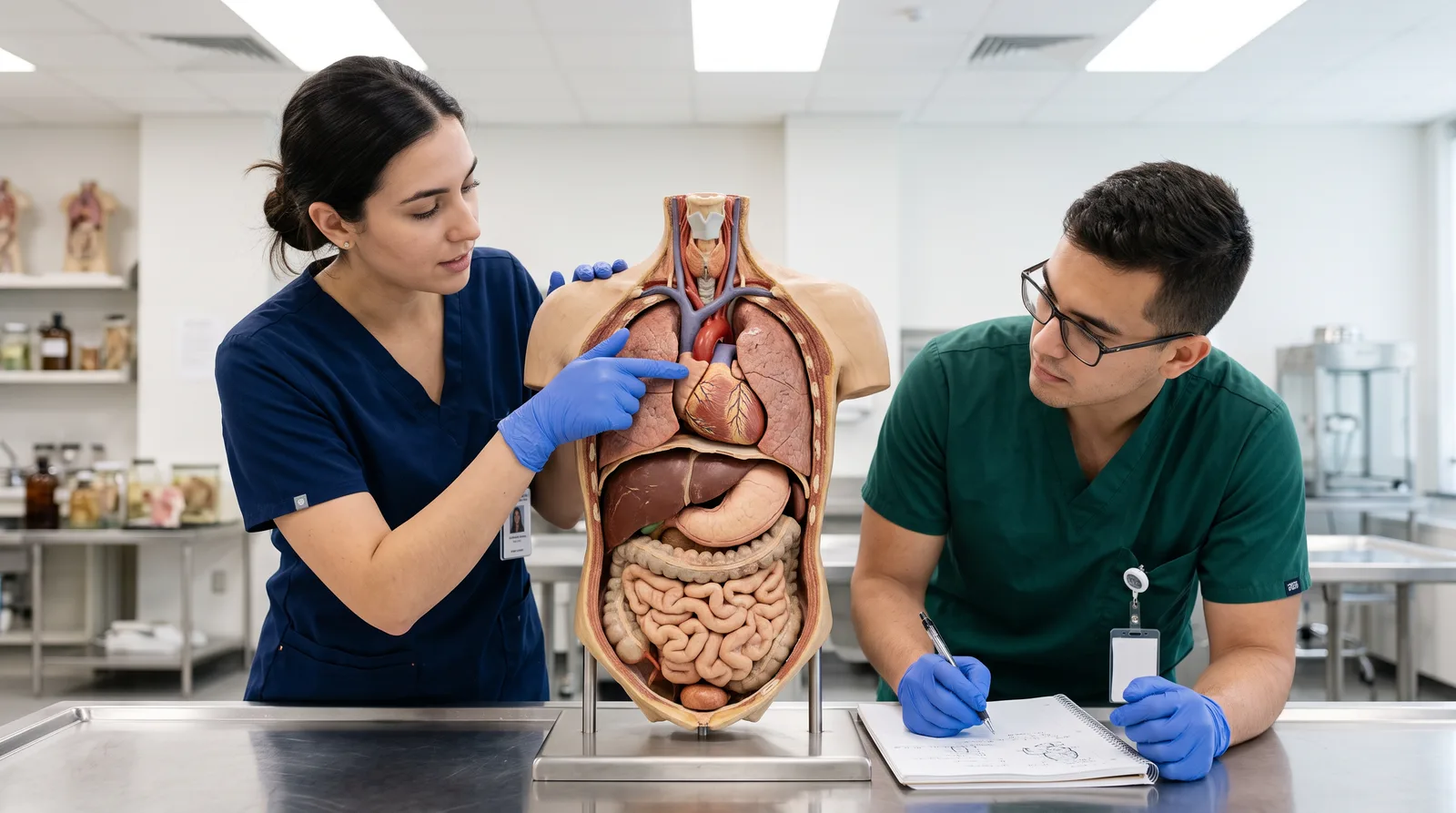
What you'll learn
What you'll be able to do
- Identify and describe every major organ, tissue type, and body structure covered in a two-semester A&P curriculum
- Explain how each body system — skeletal, muscular, nervous, cardiovascular, respiratory, and more — functions independently and in coordination
- Trace the physiological pathways of key processes such as nerve impulse transmission, muscle contraction, and gas exchange
- Interpret anatomical terminology and directional language to read clinical diagrams and medical texts confidently
- Connect structural anatomy to functional physiology, understanding how form dictates function at the cellular and organ level
- Apply foundational A&P knowledge to real-world clinical scenarios, preparing for nursing boards, pre-med coursework, or allied health exams
How it works
A school that adapts to you
This isn't a set of static videos. Every lesson is generated live and tuned to where you actually are.
We learn your level
A quick placement check tailors your starting point so you're never bored or lost.
Lessons adapt as you go
Each lesson is written for your pace and your goal, adjusting as your skills grow.
Your AI coach keeps you moving
Checkpoints, feedback, and gentle nudges turn progress into a real result.
The curriculum
What's inside your school
6 modules · 29 lessons

Foundations of Anatomy & Physiology
Establishes the language, organizational levels, and core principles that underpin every body system studied throughout the course.
- 1.1Welcome to A&P: Why Structure Meets FunctionIncluded
- 1.2Anatomical Terminology & Directional LanguageIncluded
- 1.3Levels of Structural OrganizationIncluded
- 1.4Homeostasis & Feedback MechanismsIncluded
- 1.5Cells: Structure, Function & the Cell CycleIncluded
Tissues, Skin & the Integumentary System
Covers the four primary tissue types and the body's outer protective barrier, linking microscopic structure to whole-organ function.
- 2.1The Four Primary Tissue TypesIncluded
- 2.2Epithelial & Connective Tissue in DepthIncluded
- 2.3Integumentary System: Skin Layers & Accessory StructuresIncluded
- 2.4Skin Physiology: Thermoregulation, Sensation & RepairIncluded
Support & Movement: Skeletal & Muscular Systems
Details the bones, joints, and muscles that give the body its framework and produce every voluntary and involuntary movement.
- 3.1Bone Tissue, Classification & the Axial SkeletonIncluded
- 3.2The Appendicular Skeleton & JointsIncluded
- 3.3Skeletal Muscle Anatomy: From Gross to MicroscopicIncluded
- 3.4Muscle Contraction: The Sliding-Filament MechanismIncluded
- 3.5Muscle Mechanics, Metabolism & FatigueIncluded
Communication & Control: Nervous & Endocrine Systems
Explores how electrical signals and chemical messengers coordinate every other body system to maintain dynamic homeostasis.
- 4.1Nervous System Organization & Neuron AnatomyIncluded
- 4.2Nerve Impulse Transmission & Synaptic CommunicationIncluded
- 4.3The Brain, Spinal Cord & Reflex ArcsIncluded
- 4.4The Autonomic Nervous System: Sympathetic vs. ParasympatheticIncluded
- 4.5Endocrine System: Hormones, Glands & Feedback LoopsIncluded
Transport & Gas Exchange: Cardiovascular & Respiratory Systems
Covers the heart, blood vessels, blood, and lungs as an integrated delivery system for oxygen, nutrients, and waste removal.
- 5.1Blood: Components, Types & FunctionsIncluded
- 5.2Heart Anatomy & the Cardiac CycleIncluded
- 5.3Blood Vessels, Circulation Routes & Blood PressureIncluded
- 5.4Respiratory Anatomy: Airways & the LungsIncluded
- 5.5Pulmonary Ventilation & Gas ExchangeIncluded
Regulation & Defense: Digestive, Urinary, Immune & Reproductive Systems
Completes the two-semester survey by examining how the body processes nutrients, filters waste, defends itself, and continues the species.
- 6.1Digestive System Anatomy & Mechanical DigestionIncluded
- 6.2Chemical Digestion, Absorption & MetabolismIncluded
- 6.3Urinary System: Kidney Structure & Urine FormationIncluded
- 6.4Immune System: Innate & Adaptive DefensesIncluded
- 6.5Reproductive Systems & A&P IntegrationIncluded
Who it's for
Is this you?

Nursing students
Building the deep A&P foundation that the NCLEX and clinical rotations demand — from cardiac cycles to kidney filtration.

Pre-med undergrads
Reinforcing the mechanistic biological reasoning that pre-med coursework and the MCAT expect you to already have.

Allied health students
Physical therapy, radiography, respiratory care — any allied health path that requires fluency in anatomy and physiology.
Lifelong learners
Curious adults who want a rigorous, no-nonsense understanding of how their own body actually works.

Career changers
Professionals pivoting into healthcare who need to fill foundational science gaps before entering a formal program.

A&P retakers
Students who struggled through a traditional course and need the visual, step-by-step clarity that lecture halls rarely provide.
Questions
Frequently asked
Your teacher
A note from your teacher
biologyteachermae
If you're reading this, there's a good chance A&P has felt like drinking from a firehose — a torrent of Latin terms, microscopic structures, and physiological cascades that seem designed to overwhelm rather than illuminate. Maybe you've sat through lectures that moved too fast, stared at diagrams that didn't quite click, or passed the test but felt like you didn't really understand what you studied. I know that feeling. And I built this school specifically to fix it.
Here's what I believe, and what every lesson in this curriculum reflects: the human body is not a collection of isolated parts to memorize. It is a coordinated, self-regulating system where every structure exists because of what it has to do. When you understand the why behind the anatomy — why a sarcomere is built the way it is, why the nephron loops the way it does, why the autonomic nervous system has two branches pulling in opposite directions — the details stop feeling arbitrary. They become logical. And logical things are remembered.
This school walks you through a complete two-semester A&P sequence, starting with the foundational language and organizational framework every clinician relies on, and building systematically through every major body system. We don't skip the hard parts. We spend real time on nerve impulse transmission, on the mechanics of gas exchange, on the feedback loops that regulate hormones and blood pressure and temperature. We trace physiological pathways start to finish, so you don't just know the steps — you understand the mechanism. That understanding is what transfers to boards, to clinical rotations, to bedside reasoning.
I also want to be honest about what this school requires: your engagement. The video lessons are detailed and visually rich, but anatomy and physiology reward active study. Pause. Rewind. Draw out the pathway we just walked through. Ask your question in the community. This is not a passive experience — it's a structured, guided deep dive, and the depth is the point.
Whether you're a nursing student who needs to nail the NCLEX foundations, a pre-med building the biological reasoning your future coursework assumes, or a curious lifelong learner who simply wants to understand the body you inhabit — you belong here. I am genuinely glad you found this. Let's get to work.
— biologyteachermae
Start your journey today
Get instant access — learn at your own pace with an AI coach in your corner.
$59/mo
Recurring billing · cancel anytime
Secure checkout · Instant access
- 6 modules, 29 lessons
- AI-adaptive lessons tuned to your level
- Quizzes & checkpoints to lock in progress
- Your own AI learning coach
- Learn on any device, at your pace
- Full access for as long as you're subscribed