Lead when the world needs it most
Humanitarian Command is a rigorous executive credential program that equips mid-to-senior professionals with the governance frameworks, operational architectures, and strategic communication tools to design and lead large-scale humanitarian and disaster response systems — from acute crisis through long-term resilience.

The humanitarian sector doesn't need more managers who can describe a cluster system — it needs executives who can build one, govern it, and lead it through a crisis.— Pauline Brown Smith, EdD
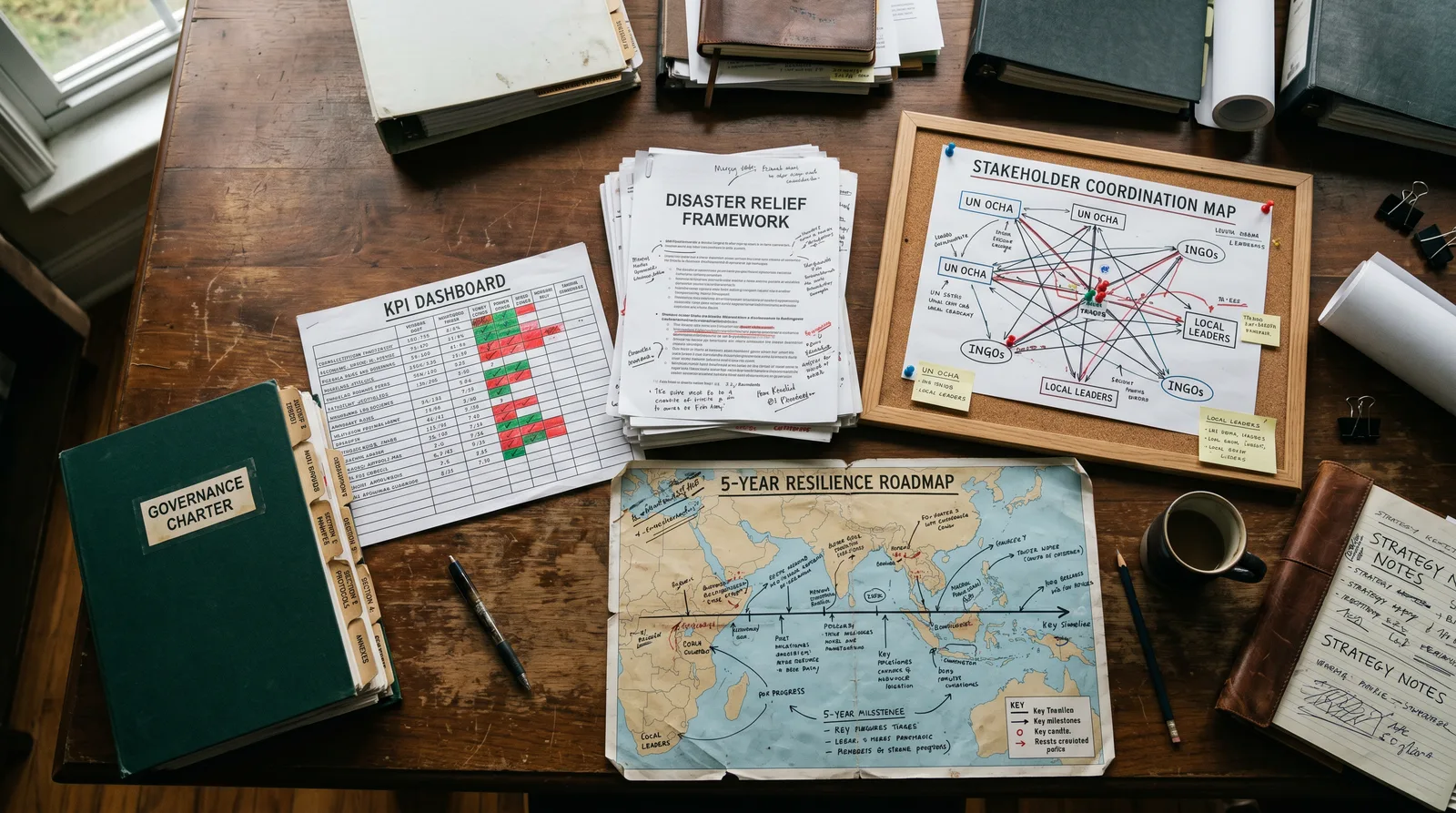
What you'll learn
What you'll be able to do
- Design a comprehensive humanitarian response roadmap with governance checkpoints, stakeholder roles, and phased recovery milestones
- Build a disaster relief framework integrating rapid damage assessment, logistics pipelines, and vulnerable-population protection protocols
- Develop an international coordination strategy with interoperable planning structures and mutual aid agreements across government, NGO, and private-sector partners
- Construct a humanitarian governance charter covering legal compliance, donor accountability, workforce safety, and ethical resource allocation
- Create an executive KPI dashboard and enterprise risk register to monitor operational performance and drive continuous improvement
- Produce board-ready presentations and a five-year humanitarian resilience roadmap that communicates strategic priorities to executive and donor audiences
How it works
A school that adapts to you
This isn't a set of static videos. Every lesson is generated live and tuned to where you actually are.
We learn your level
A quick placement check tailors your starting point so you're never bored or lost.
Lessons adapt as you go
Each lesson is written for your pace and your goal, adjusting as your skills grow.
Your AI coach keeps you moving
Checkpoints, feedback, and gentle nudges turn progress into a real result.
The curriculum
What's inside your school
6 modules · 30 lessons

Humanitarian Assistance: Foundations and Ethical Frameworks
Establishes the conceptual, ethical, and operational foundations of humanitarian assistance across disaster, conflict, and public health emergency contexts.
- 1.1The Humanitarian Imperative: Principles, Scope, and ActorsIncluded
- 1.2Needs Assessment and Population Vulnerability AnalysisIncluded
- 1.3Culturally Responsive and Equitable Service DeliveryIncluded
- 1.4Emergency Services Coordination: Food, Shelter, WASH, and Medical CareIncluded
- 1.5Protection Services and Recovery SupportIncluded
Disaster Relief Operations and Logistics
Builds operational expertise in rapid damage assessment, logistics pipelines, supply distribution, and emergency operations management for disaster relief.
- 2.1Rapid Damage and Needs Assessment MethodologiesIncluded
- 2.2Humanitarian Logistics and Supply Chain ManagementIncluded
- 2.3Emergency Operations Center Design and ManagementIncluded
- 2.4Volunteer Coordination and Surge Workforce ManagementIncluded
- 2.5Vulnerable Population Protection in Disaster ResponseIncluded
Designing the Humanitarian Response Roadmap
Guides leaders through building a comprehensive, phased humanitarian response roadmap with governance checkpoints, stakeholder roles, and recovery milestones.
- 3.1Phased Response Architecture: Acute, Stabilization, and RecoveryIncluded
- 3.2Governance Checkpoints and Decision Authority MappingIncluded
- 3.3Stakeholder Role Definition and Accountability MatricesIncluded
- 3.4Recovery Milestones and Resilience IntegrationIncluded
- 3.5Portfolio Workshop: Building Your Humanitarian Response RoadmapIncluded
International Coordination and Cross-Sector Partnership
Develops the strategic and diplomatic competencies needed to lead cross-border, multi-sector coordination among governments, NGOs, multilateral bodies, and private partners.
- 4.1The International Humanitarian Architecture: UN, NGOs, and ClustersIncluded
- 4.2Interoperable Planning and Joint Operational StandardsIncluded
- 4.3Mutual Aid Agreements and Cross-Border Legal FrameworksIncluded
- 4.4Private Sector and Civil Society Engagement StrategiesIncluded
- 4.5Portfolio Workshop: International Coordination StrategyIncluded
Humanitarian Governance, Legal Compliance, and Ethical Leadership
Establishes the executive oversight structures, legal obligations, ethical standards, and accountability mechanisms that define sound humanitarian governance.
- 5.1Humanitarian Governance Frameworks and Executive OversightIncluded
- 5.2Legal Compliance: International Humanitarian Law and Donor RegulationsIncluded
- 5.3Ethical Resource Allocation and Anti-Corruption ControlsIncluded
- 5.4Workforce Safety, Duty of Care, and Staff WellbeingIncluded
- 5.5Portfolio Workshop: Humanitarian Governance CharterIncluded
Executive Performance, Risk, and Strategic Communication
Equips leaders to build KPI dashboards, enterprise risk registers, board-ready presentations, and a five-year resilience roadmap that drives organizational excellence.
- 6.1Executive KPI Dashboard Design for Humanitarian OperationsIncluded
- 6.2Enterprise Risk Register: Identification, Scoring, and MitigationIncluded
- 6.3Continuous Improvement Systems in Humanitarian OrganizationsIncluded
- 6.4Board and Donor Communication: Crafting Executive PresentationsIncluded
- 6.5Capstone: Five-Year Humanitarian Resilience Roadmap and Portfolio DefenseIncluded
Who it's for
Is this you?

NGO Program Directors
Preparing to step into a country director or executive director role and needing the governance, legal, and strategic frameworks to lead at that level.

UN & Multilateral Agency Staff
Deepening executive fluency in cluster coordination, interoperable planning, and cross-sector partnership architecture to advance into senior leadership positions.

Government Emergency Managers
Building the international coordination and governance competencies needed to lead complex multi-agency disaster response at a national or regional level.

Military & Civil Defense Planners
Bridging military operational planning expertise with the humanitarian governance, IHL compliance, and NGO coordination frameworks required in joint civil-military responses.

Global Health Executives
Expanding beyond health programming into the broader humanitarian response architecture — logistics, governance, protection, and resilience — essential for leading integrated emergency health operations.

Corporate CSR & ESG Leaders
Positioning their organizations as credible, accountable humanitarian partners by mastering the governance standards, ethical resource allocation, and coordination frameworks the sector demands.
Questions
Frequently asked
Your teacher
A note from your teacher

Pauline Brown Smith, EdD
If you have spent years in this sector, you already know the gap I am talking about.
You have managed programs, coordinated with partners, written situation reports at midnight, and navigated the particular institutional complexity of working across UN clusters, donor requirements, government counterparts, and NGO consortia — sometimes simultaneously. You are good at this work. And now you are being asked — or are asking yourself — to step into something larger. A directorship. A head-of-operations role. A seat at the table where the frameworks get designed, not just implemented.
That transition is not automatic. The skills that made you effective in the field or at the program level are necessary but not sufficient for executive humanitarian leadership. At that level, you are not just coordinating a response — you are governing one. You are accountable for legal compliance with international humanitarian law, for donor transparency, for the duty of care owed to your workforce, for the strategic architecture that determines whether your organization can scale in a surge and sustain through a recovery. You are briefing boards, negotiating mutual aid frameworks, and making resource allocation decisions with ethical and operational consequences that extend far beyond the immediate operation.
Humanitarian Command was built to close that gap — systematically. The curriculum moves through every domain an executive humanitarian leader is responsible for: the ethical and legal foundations, the operational mechanics of disaster relief and logistics, the international coordination architecture that defines how the humanitarian system actually functions, the governance and accountability structures that make organizations trustworthy to their donors and their beneficiaries, and the performance management tools that distinguish organizations that learn from organizations that repeat the same failures.
Every module produces something you keep: a response roadmap, a coordination strategy, a governance charter, a risk register, a resilience roadmap. By the time you reach the capstone, you will not be summarizing what you learned — you will be presenting a portfolio of executive work that reflects the leader you have become. That is what this program delivers. I hope to work alongside you in building it.
— Pauline Brown Smith, EdD
Start your journey today
Join get instant access — learn at your own pace with an AI coach in your corner.
$150/mo
Recurring billing · cancel anytime
Secure checkout · Instant access
- 6 modules, 30 lessons
- AI-adaptive lessons tuned to your level
- Quizzes & checkpoints to lock in progress
- Your own AI learning coach
- Learn on any device, at your pace
- Full access for as long as you're subscribed