Diagnose faster, install smarter, and master every system in the field
Learn how modern HVAC systems really work — from compressors to furnaces — with hands-on, component-level instruction built for technicians who want to diagnose faster and install smarter.
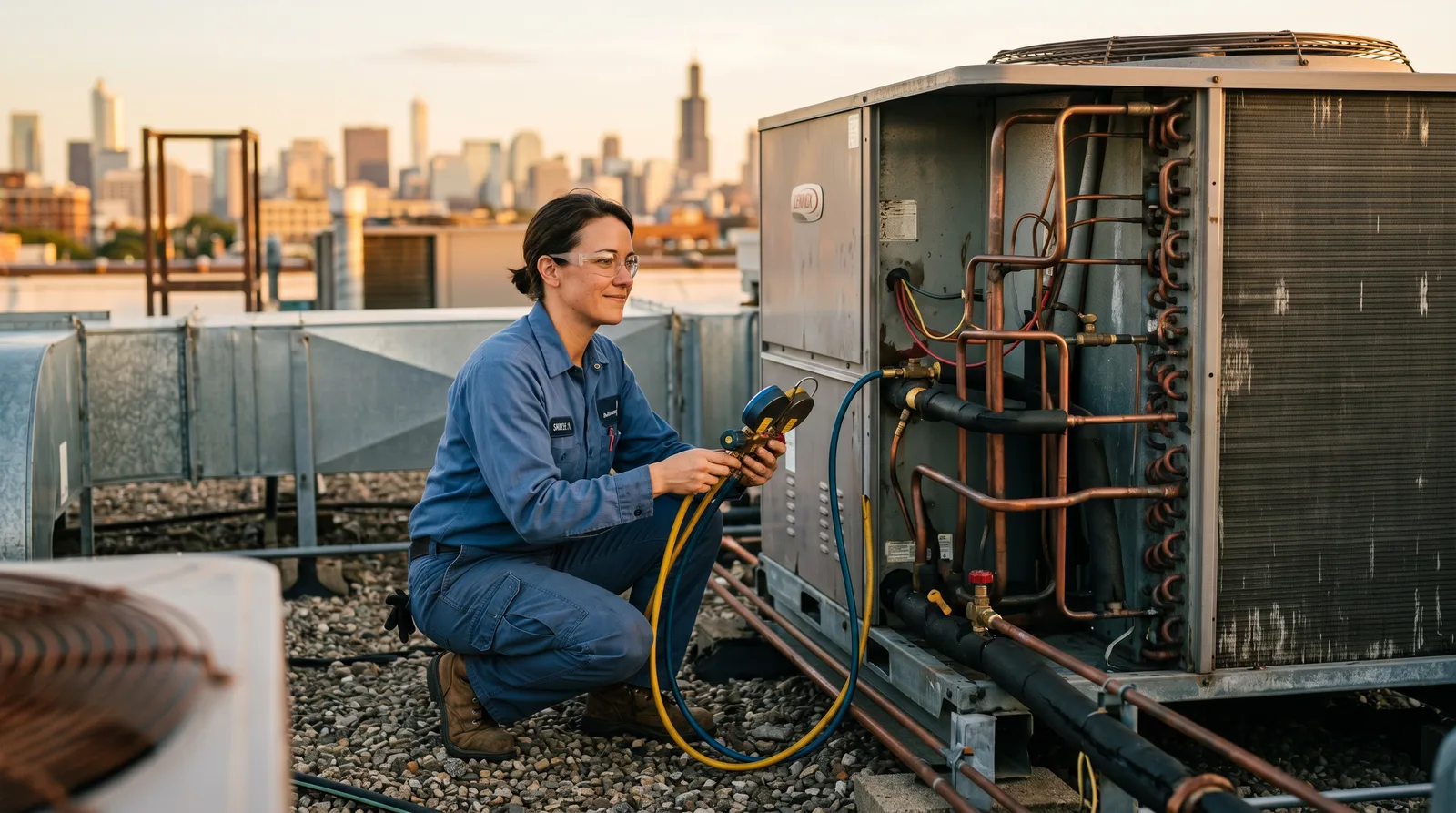
"If you understand why a component behaves the way it does, diagnosis stops being a guess and starts being a conclusion."— Stanley Jones
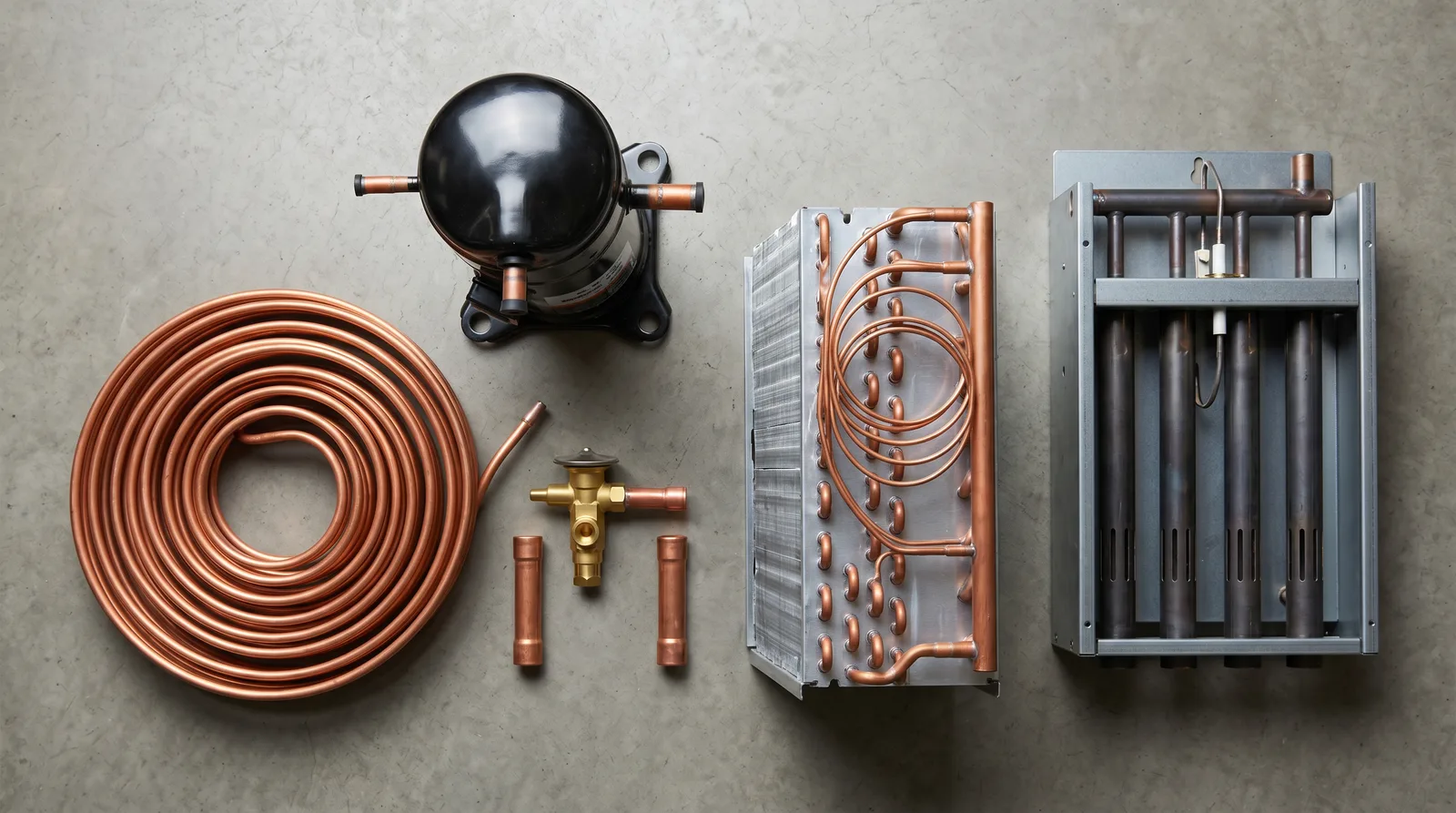
What you'll learn
What you'll be able to do
- Explain the refrigeration cycle end-to-end and trace how each component — compressor, condenser coil, TXV, and evaporator coil — contributes to heat transfer.
- Diagnose common compressor failures by interpreting amp draws, pressure readings, and audible symptoms during a service call.
- Identify condenser coil fouling, refrigerant undercharge, and airflow restrictions and apply the correct corrective procedure.
- Set and verify superheat and subcooling values at the Thermal Expansion Valve to optimize system efficiency and protect the compressor.
- Distinguish between heat pump heating and cooling modes, reverse-cycle operation, and defrost sequencing to troubleshoot cold-climate performance issues.
- Inspect and service gas furnace components — including heat exchangers, igniters, and pressure switches — and verify safe combustion before returning a unit to service.
How it works
A school that adapts to you
This isn't a set of static videos. Every lesson is generated live and tuned to where you actually are.
We learn your level
A quick placement check tailors your starting point so you're never bored or lost.
Lessons adapt as you go
Each lesson is written for your pace and your goal, adjusting as your skills grow.
Your AI coach keeps you moving
Checkpoints, feedback, and gentle nudges turn progress into a real result.
The curriculum
What's inside your school
6 modules · 13 lessons
Refrigeration Cycle Fundamentals & System Overview
Establishes the theoretical and practical foundation every subsequent module depends on. Students learn how refrigerants change state, how pressure and temperature are interrelated, and how to read the instruments used throughout the course — ensuring no gaps when component-level diagnosis begins.
- 1.1Refrigerant States, Pressure–Temperature Relationships & the Refrigeration CycleIncluded
- 1.2Reading Manifold Gauge Sets & Interpreting System PressuresIncluded
- 1.3Refrigerant Safety, Handling & EPA 608 ComplianceIncluded
Compressor: Operation, Diagnosis & Failure Analysis
Builds directly on the refrigeration cycle foundation to give students a deep understanding of how the compressor sustains system pressure differentials, what electrical and mechanical conditions cause failure, and how to confirm a diagnosis with instruments before recommending replacement — directly fulfilling the amp-draw and pressure-reading outcome.
- 2.1Compressor Types, Mechanical Operation & Role in the Refrigeration CycleIncluded
- 2.2Electrical Testing, Amp Draw Analysis & Diagnosing Common FailuresIncluded
Condenser Coil & Evaporator Coil: Heat Exchange, Airflow & Service
Examines both heat-exchange coils together so students can contrast their roles — rejection vs. absorption — while mastering the specific failure modes, diagnostic indicators, and corrective procedures for each. Sequenced after compressor work so students already understand how coil performance directly loads or unloads the compressor.
- 3.1Condenser Coil: Design, Fouling, Refrigerant Charge & Corrective ProceduresIncluded
- 3.2Evaporator Coil: Airflow, Moisture Removal, Freeze-Up & MaintenanceIncluded
Thermal Expansion Valve: Metering, Superheat & System Protection
Provides a focused deep-dive into the TXV — the metering device that controls refrigerant flow into the evaporator, governs superheat, and directly protects the compressor from liquid floodback. Sequenced after both coil lessons so students already understand the upstream (condenser subcooling) and downstream (evaporator superheat) context the TXV operates within.
- 4.1TXV Anatomy, Operating Principles & How It Protects the CompressorIncluded
- 4.2Measuring & Setting Superheat and Subcooling, Diagnosing TXV FaultsIncluded
Heat Pump Systems: Reverse-Cycle Operation, Defrost & Cold-Climate Troubleshooting
Extends students' refrigeration knowledge to heat pump systems, which use the same components learned in previous modules but add a reversing valve, check valves, and a defrost control system. Sequenced after all core refrigeration component modules so students can contrast heat pump operation against the standard cooling-only system they already understand.
- 5.1Reversing Valve Operation, Heating & Cooling Mode Refrigerant FlowIncluded
- 5.2Defrost Sequencing, Controls & Cold-Climate Performance DiagnosisIncluded
Gas Furnace: Combustion, Safety Controls & Return-to-Service Verification
Covers the gas furnace as a standalone heating system and as the air handler paired with a cooling system, ensuring students can service the full range of HVAC installations encountered in the field. Sequenced last because it introduces combustion chemistry and gas-side safety — a distinct knowledge domain from refrigeration — yet builds on the airflow and control sequencing concepts already established.
- 6.1Furnace Operation Sequence, Gas Valve, Ignition Systems & Heat Exchanger InspectionIncluded
- 6.2Pressure Switches, Limit Controls, Combustion Analysis & Return-to-Service Sign-OffIncluded
Who it's for
Is this you?

Apprentice HVAC Technicians
You're in the field but the 'why' behind what you're doing is still fuzzy — this course fills that gap fast.

Electricians Cross-Training
You know controls and wiring cold; now get the refrigeration and combustion side dialed in to become a complete HVAC tech.

EPA 608 Exam Candidates
The refrigerant safety and handling module gives you the real-world foundation that makes the exam material actually stick.

DIY Homeowners (Serious Ones)
You want to understand your system at a component level — not just change filters, but read pressures, spot problems, and talk shop with your tech.

Plumbers Adding HVAC
Your mechanical instincts transfer directly — this course gives you the refrigeration cycle and gas furnace knowledge to make HVAC a real revenue stream.

Career-Changers Entering the Trades
Coming in without a trade background, you need a course that explains the fundamentals without skipping the depth — this is exactly that.
Questions
Frequently asked
Your teacher
A note from your teacher
Stanley Jones
If you've ever stood in front of a system that "should be working" and felt a knot in your stomach — I built this course for that moment.
The trade has a training problem. Most programs rush you through procedures without ever explaining the physics underneath them. You learn to follow a checklist, but the day the system doesn't match the checklist, you're stuck. I've seen experienced technicians misdiagnose a TXV fault as a compressor problem — expensive for the customer, embarrassing for the tech — because nobody ever walked them through how a TXV actually responds to load conditions. That's not a skills gap. That's a knowledge gap. And it's completely fixable.
HVAC Mastery Pro is built around one idea: if you understand why a component behaves the way it does, diagnosis becomes logical — not lucky. We start with the refrigeration cycle because everything downstream depends on it. Then we go component by component — compressor, condenser coil, evaporator coil, TXV, reversing valve, gas furnace controls — with the kind of field-realistic detail that makes the next service call faster and the one after that even faster. I'm not going to throw theory at you and call it training. Every concept ties back to a real scenario, a pressure reading, an amp draw, or a symptom you'll actually encounter.
Here's the objection I hear most: "I'll learn on the job." And you will — eventually. But learning by trial and error on a customer's equipment is slow, stressful, and occasionally costly. This course compresses that learning curve. You'll walk onto a job site with a mental model of the whole system already in place, so the job becomes about confirming what you already understand, not discovering it under pressure.
Whether you're brand new to the trade, coming in from electrical or plumbing and cross-training into HVAC, or a homeowner who refuses to be in the dark about a system you depend on — you belong here. The knowledge in this course is the same knowledge that makes a technician someone customers call back and contractors want on their crew. Come get it.
— Stanley Jones
Start your journey today
Join get instant access — learn at your own pace with an AI coach in your corner.
- 6 modules, 13 lessons
- AI-adaptive lessons tuned to your level
- Quizzes & checkpoints to lock in progress
- Your own AI learning coach
- Learn on any device, at your pace
- Full access for as long as you're subscribed