Master commercial cooling — chillers, air coolers, and everything in between
Go from "I think it's the condenser" to a systematic, field-proven process for selecting, maintaining, and troubleshooting water chillers and air coolers — grounded in real thermodynamics and real trade practice.
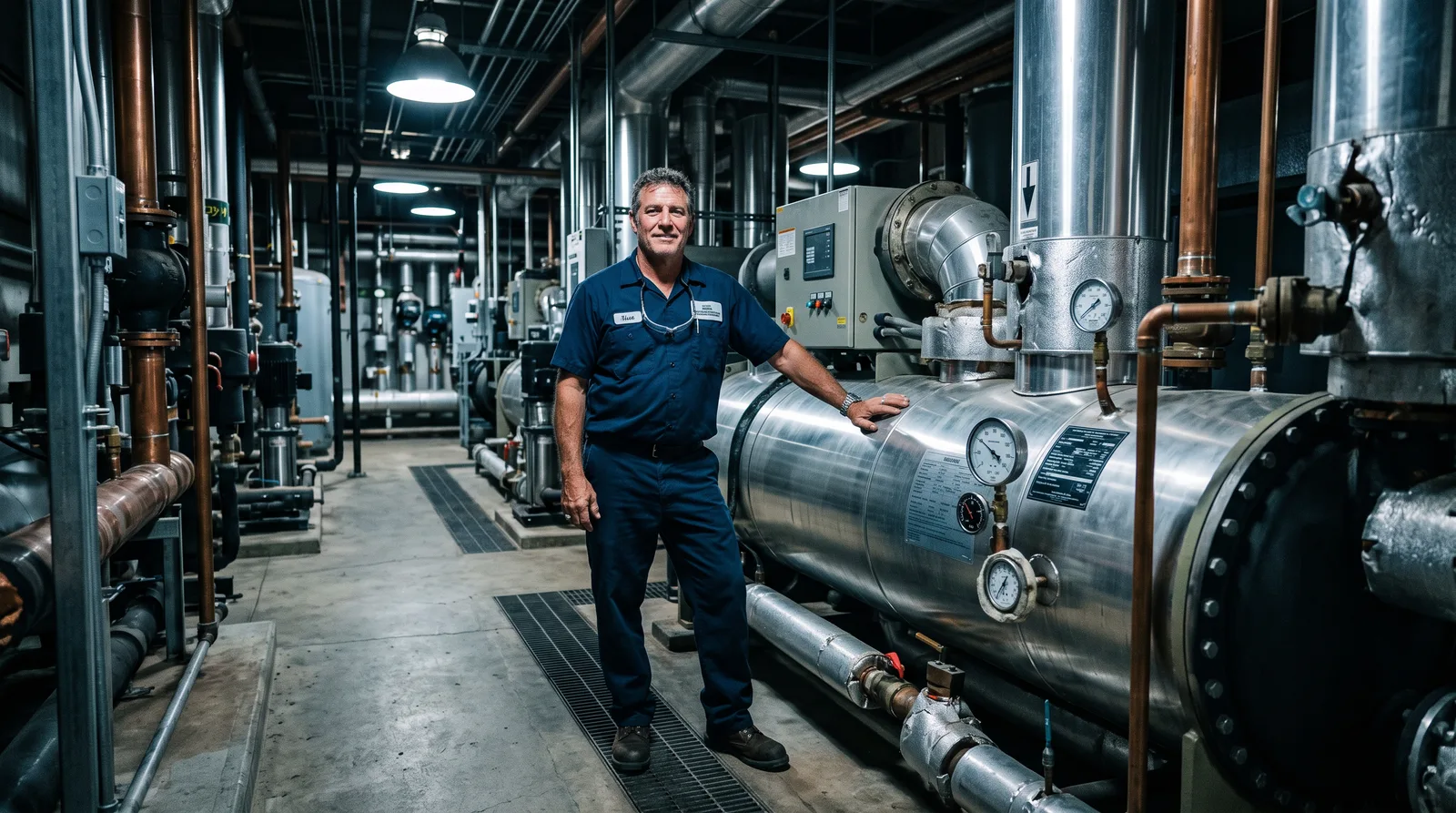
"I teach the 'why it works' alongside the 'how to do it' — because a technician who understands the physics doesn't just fix the problem in front of them, they see the next one coming."
— Todd McFarland
What you'll learn
What you'll be able to do
- Explain the fundamental thermodynamic principles behind water chillers and air coolers and articulate the key differences between the two systems.
- Read and interpret equipment schedules, piping diagrams, and manufacturer datasheets for both chiller and air-cooler units.
- Select the right cooling technology for a given building load, climate zone, and budget by applying a structured decision framework.
- Perform routine preventive maintenance tasks — including coil cleaning, refrigerant checks, and water treatment basics — on both system types.
- Diagnose common faults such as high condensing pressure, low delta-T, and fouled heat exchangers using systematic troubleshooting procedures.
- Calculate cooling capacity (tons/kW), COP, and energy cost comparisons to justify equipment choices to clients or management.
How it works
A school that adapts to you
This isn't a set of static videos. Every lesson is generated live and tuned to where you actually are.
We learn your level
A quick placement check tailors your starting point so you're never bored or lost.
Lessons adapt as you go
Each lesson is written for your pace and your goal, adjusting as your skills grow.
Your AI coach keeps you moving
Checkpoints, feedback, and gentle nudges turn progress into a real result.
The curriculum
What's inside your school
6 modules · 27 lessons

Cooling Systems Fundamentals
Establishes the thermodynamic and refrigeration-cycle foundations that underpin both water chillers and air coolers.
- 1.1Heat Transfer Principles Every HVAC Pro Must KnowIncluded
- 1.2The Vapor-Compression Refrigeration CycleIncluded
- 1.3Defining the Systems: Water Chiller vs. Air CoolerIncluded
- 1.4Cooling Capacity Metrics: Tons, kW, and COPIncluded
Water Chillers — How They Work and Where They Belong
Provides a deep dive into chiller types, system architecture, and the conditions that make chillers the right choice.
- 2.1Chiller Types: Centrifugal, Screw, Scroll, and AbsorptionIncluded
- 2.2The Chilled-Water Loop and Condenser Water LoopIncluded
- 2.3Cooling Towers and Heat Rejection for Water-Cooled ChillersIncluded
- 2.4Reading Chiller Datasheets and Equipment SchedulesIncluded
Air Coolers — How They Work and Where They Belong
Examines air-cooled systems from packaged DX units to air-cooled chillers, including their strengths and limitations.
- 3.1Air-Cooled Condenser and Direct-Expansion System ArchitectureIncluded
- 3.2Packaged Rooftop Units, Split Systems, and Air-Cooled ChillersIncluded
- 3.3Ambient Temperature Effects and Climate Zone ConsiderationsIncluded
- 3.4Reading Air-Cooler Datasheets, Piping, and Refrigerant DiagramsIncluded
Selecting the Right System — A Structured Decision Framework
Equips learners to choose between water-cooled and air-cooled solutions by applying load, climate, cost, and site criteria.
- 4.1Calculating Building Cooling Load and Peak DemandIncluded
- 4.2First Cost vs. Life-Cycle Cost AnalysisIncluded
- 4.3Site Constraints: Water Availability, Footprint, and NoiseIncluded
- 4.4Applying the Decision Framework to Real-World ScenariosIncluded
- 4.5Presenting Equipment Justifications to Clients and ManagementIncluded
Preventive Maintenance for Chillers and Air Coolers
Builds hands-on maintenance competency for both system types, covering coils, refrigerant, water treatment, and inspections.
- 5.1Coil Cleaning Procedures for Air-Cooled Condensers and EvaporatorsIncluded
- 5.2Refrigerant Checks: Subcooling, Superheat, and Leak DetectionIncluded
- 5.3Water Treatment Basics for Chilled-Water and Condenser-Water SystemsIncluded
- 5.4Chiller Tube Inspection and Eddy-Current Testing OverviewIncluded
- 5.5Building a Preventive Maintenance Schedule for Both System TypesIncluded
Troubleshooting Common Faults in Chillers and Air Coolers
Develops systematic fault-diagnosis skills for the most frequent and costly failures in both cooling system types.
- 6.1Systematic Troubleshooting Methodology for Cooling SystemsIncluded
- 6.2Diagnosing High Condensing PressureIncluded
- 6.3Diagnosing Low Delta-T Syndrome in Chilled-Water SystemsIncluded
- 6.4Identifying and Remedying Fouled Heat ExchangersIncluded
- 6.5Compressor Faults, Electrical Failures, and Controls DiagnosticsIncluded
Who it's for
Is this you?

Commercial HVAC Technicians
You're ready to move beyond residential and light commercial work and need the chiller-plant knowledge and systematic troubleshooting process that gets you taken seriously on large commercial jobs.

Mechanical Engineers
You can spec a system on paper — this course gives you the field fluency to read equipment datasheets critically, understand real-world performance tradeoffs, and have authoritative conversations with contractors and technicians.

Facilities Managers
You're responsible for the equipment budget and the PM schedule — this course gives you the technical depth to evaluate contractor recommendations, understand what's actually wrong, and make defensible capital decisions.

HVAC Project Managers
You need to move confidently between the design drawings, the equipment schedule, and the job site — and this course builds the chiller and air-cooler knowledge that keeps you credible with both engineers and field crews.

Serious DIYers & Small Building Owners
You own or operate a commercial or light-industrial property and want to understand your cooling systems well enough to maintain them intelligently, spot problems early, and stop paying for diagnostics you could do yourself.

Senior Technicians Upskilling
You've got years in the trade but want to formalize your understanding of thermodynamics, life-cycle cost analysis, and systematic troubleshooting so you can step into a lead or supervisory role with confidence.
Questions
Frequently asked
Your teacher
A note from your teacher
Todd McFarland
If you've ever stood in front of a chiller plant or a bank of rooftop units and felt like you were one fault away from being exposed — I built this course for you.
I know what it's like to be technically capable but working in a gap. You can diagnose a residential split system in your sleep, but commercial chiller work feels like a different language. Or you've been managing a facility for years and you've had to nod along while a contractor explains a $40,000 repair you can't fully evaluate. Or you're an engineer who can spec a system on paper but has never traced refrigerant through a real centrifugal chiller with a gauge set in your hand. That gap between knowing about something and truly understanding it is expensive — in callbacks, in bad decisions, and in credibility.
What I set out to build here is the course I wish had existed earlier in my career: one that starts with real thermodynamic principles — not watered down, but explained the way a smart person on the job site actually needs to understand them — and builds methodically through how water chillers and air coolers work, where they belong, how to maintain them, and how to diagnose them when they don't behave. Every topic is grounded in real equipment and real trade vocabulary. We read actual datasheets and equipment schedules. We walk through the decision framework you'd use to justify a system selection to a skeptical client or a budget-conscious building owner. We cover the faults that actually show up — high condensing pressure, low delta-T syndrome, fouled tubes — and we build a troubleshooting methodology you can apply to any system, not just the ones in these lessons.
I want to be straight with you about something: this course won't make you an expert overnight, and I'm not going to promise you outcomes I can't guarantee. What I can tell you is that if you work through this material seriously, you will understand commercial cooling systems at a level that changes how you operate in the field — how you talk to engineers, how you evaluate contractor recommendations, how quickly you isolate a fault, and how confidently you present equipment justifications. That's the transformation on offer here.
If you're ready to stop guessing and start knowing, I'd be glad to have you in the school. Come in with your questions — the harder the better. That's where the real learning happens.
— Todd McFarland
Start your journey today
Get instant access — learn at your own pace with an AI coach in your corner.
$59/mo
Recurring billing · cancel anytime
Secure checkout · Instant access
- 6 modules, 27 lessons
- AI-adaptive lessons tuned to your level
- Quizzes & checkpoints to lock in progress
- Your own AI learning coach
- Learn on any device, at your pace
- Full access for as long as you're subscribed