Learn to design and execute an IA which will give a high grade
A 5-module, project-management-style course that walks IB Chemistry students step-by-step through every stage of the Internal Assessment — from crafting a unique research question to submitting a polished, examiner-ready report.
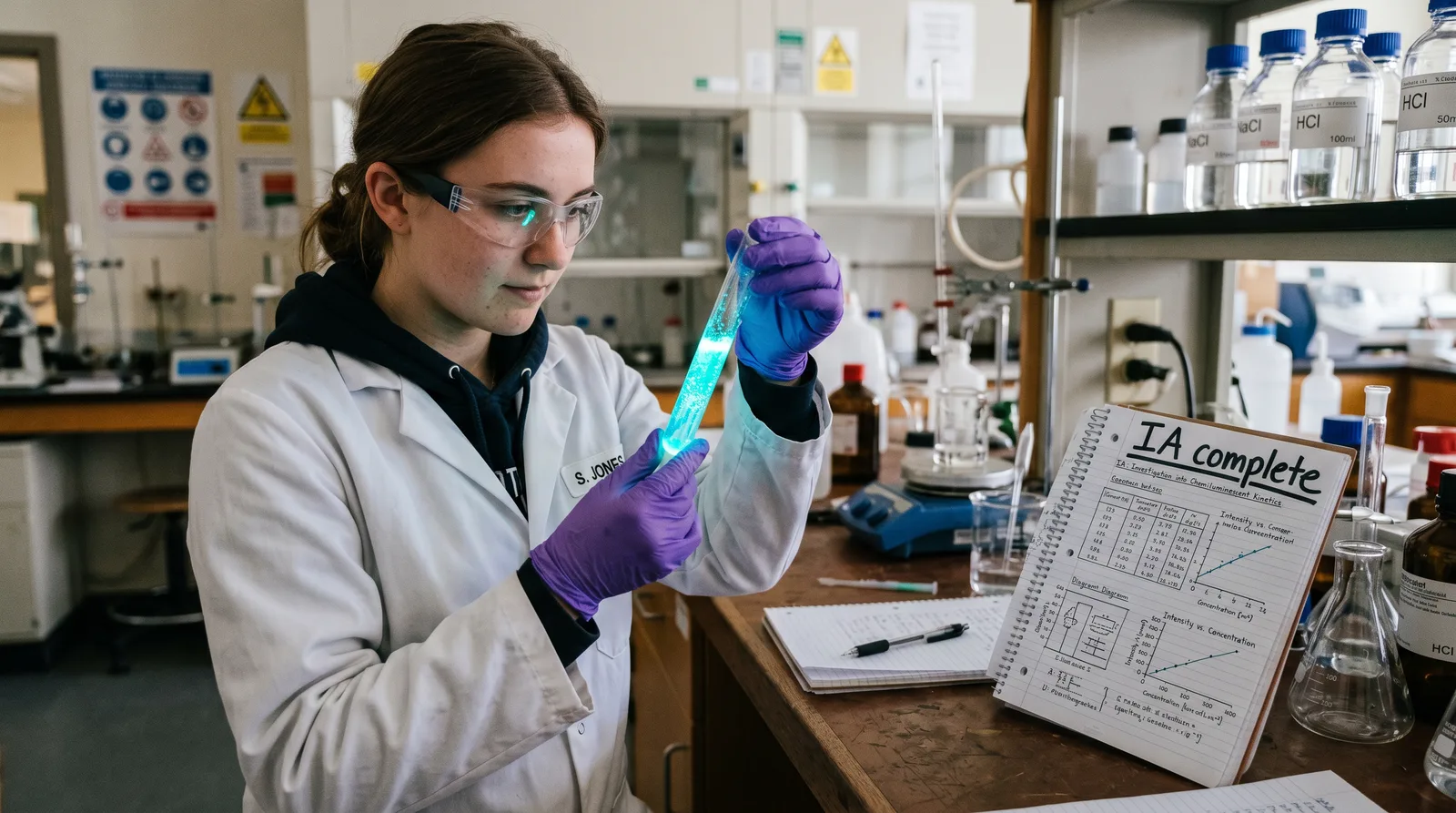
"I have not failed. I've just found 10,000 ways that won't work." — Thomas Edison
— Geoffrey Mitchell
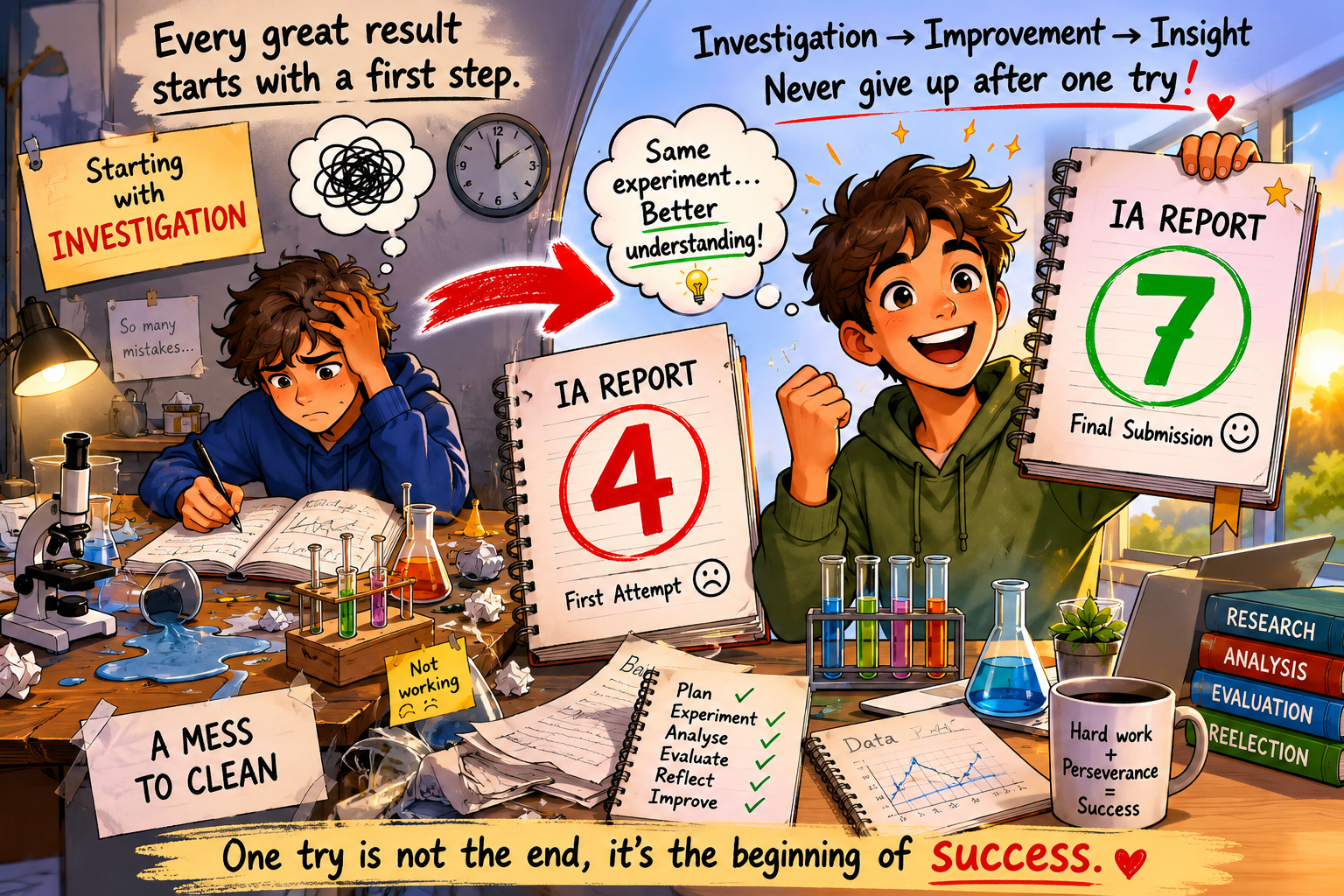
What you'll learn
What you'll be able to do
- Identify a focused, original, and personally meaningful research question that scores full marks on the IB's Personal Engagement criterion
- Design a safe, controlled, and reproducible experimental methodology that satisfies the Exploration criterion
- Collect and organise raw data into correctly labelled tables with appropriate significant figures and units
- Apply propagation of uncertainties (absolute, fractional, and percentage) to processed data and graphical analysis
- Critically evaluate systematic and random errors, and propose specific, realistic improvements rather than generic ones
- Write a complete, cohesive IA report formatted to IB standards, including a title page, citations, and appendices
- Self-assess your own draft against the official IB Chemistry IA rubric to identify and close scoring gaps before submission
- Manage the IA timeline using a project-management approach, hitting every milestone without last-minute panic
How it works
A school that adapts to you
This isn't a set of static videos. Every lesson is generated live and tuned to where you actually are.
We learn your level
A quick placement check tailors your starting point so you're never bored or lost.
Lessons adapt as you go
Each lesson is written for your pace and your goal, adjusting as your skills grow.
Your AI coach keeps you moving
Checkpoints, feedback, and gentle nudges turn progress into a real result.
The curriculum
What's inside your school
5 modules · 17 lessons

The Exploration phase
Before a single experiment is run, you need a research question that is focused, testable, and genuinely yours. This module treats RQ development like a project scoping phase — you'll audit the IB syllabus for gaps, stress-test your ideas against the criteria, and lock in a question that sets the entire IA up for success.
- 1.1What Makes a Research Question Score Full MarksIncluded
- 1.2Mining the IB Syllabus for Original AnglesIncluded
- 1.3Stress-Testing and Locking In Your RQIncluded
Methodology: Designing an Investigation Examiners Trust
A rigorous methodology isn't just a list of steps — it's a scientific argument that your results will be valid, reproducible, and meaningful. This module applies the principles of experimental design to help you build a method that earns top marks on the Exploration criterion.
- 2.1Variables, Controls, and the Logic of a Fair TestIncluded
- 2.2Writing a Method That Can Be ReplicatedIncluded
- 2.3Choosing Sample Size, Repeats, and Data VolumeIncluded
- 2.4Safety, Ethics, and CLEAPSS-Style Risk AssessmentIncluded
Data Processing: Numbers, Uncertainties, and Graphs That Speak
This is where many students lose marks they deserved. Raw data must be transformed into evidence — through correct calculations, rigorous uncertainty propagation, and graphs that genuinely support your conclusion. This module makes that process step-by-step and stress-free.
- 3.1Organising Raw Data: Tables, Units, and Significant FiguresIncluded
- 3.2Propagation of Uncertainties — Absolute, Fractional, and PercentageIncluded
- 3.3Processing Data and Presenting Calculated ResultsIncluded
- 3.4Graphs, Trendlines, and Extracting Uncertainty from GradientsIncluded
Conclusion and Evaluation: Thinking Like a Scientist
The Conclusion and Evaluation section is where students show whether they can think critically and honestly about their own science. This module teaches you to write conclusions that are evidence-based, and evaluations that go beyond 'human error' to demonstrate genuine scientific insight.
- 4.1Writing a Conclusion That Actually Concludes SomethingIncluded
- 4.2Identifying and Categorising Errors: Systematic vs. RandomIncluded
- 4.3Writing Improvements That Impress ExaminersIncluded
Formatting, Submission, and Self-Assessment: The Final 20%
A technically strong IA can still lose marks through poor formatting, missing citations, or criterion misalignment. This final module is your quality-control phase — treating submission like a professional project handoff, complete with checklists, rubric self-scoring, and a final polish process.
- 5.1IB Formatting Standards: Structure, Citations, and Word CountIncluded
- 5.2Rubric Self-Assessment: Scoring Your Own IA DraftIncluded
- 5.3The Final Polish: Examiner Eyes on Your ReportIncluded
Questions
Frequently asked
Your teacher
A note from your teacher
Geoffrey Mitchell
Hi, I'm so glad you're here. I've spent years helping IB Chemistry students navigate one of the most misunderstood parts of the Diploma Programme — the Internal Assessment. I've seen brilliant students lose marks not because their science was weak, but because nobody showed them how the IA is structured, assessed, and written to a high standard. That frustration is exactly why I built this course. I'll be walking alongside you at every stage, sharing worked examples, common examiner complaints, and the practical frameworks that consistently produce top-scoring IAs. Let's turn what feels overwhelming into something genuinely manageable — and maybe even enjoyable.
— Geoffrey Mitchell
Start your journey today
Get instant access — learn at your own pace with an AI coach in your corner.
$10/mo
Recurring billing · cancel anytime
Secure checkout · Instant access
- 5 modules, 17 lessons
- AI-adaptive lessons tuned to your level
- Quizzes & checkpoints to lock in progress
- Your own AI learning coach
- Learn on any device, at your pace
- Full access for as long as you're subscribed