IB Chemistry Mastery: S1 Structure – Complete Topic Review
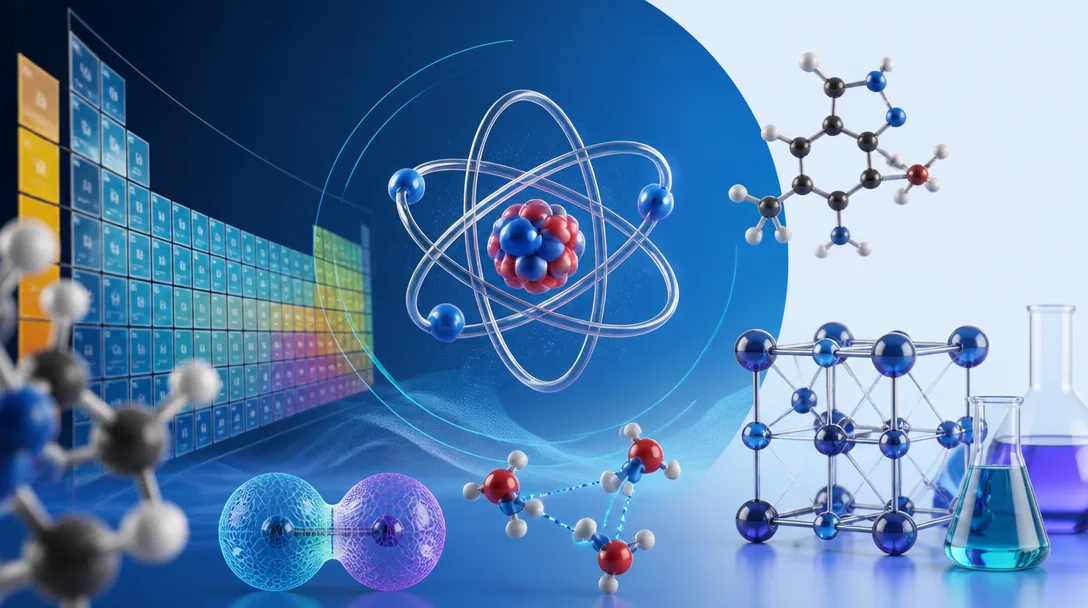
A focused, exam-ready review of IB Chemistry Topic S1 Structure — covering atomic theory, the periodic table, chemical bonding, and intermolecular forces — so you walk into your IB exam with clarity and confidence.
What you'll learn
What you'll be able to do
- Explain the models of the particulate nature of matter (S1.1) and apply them to predict physical properties of substances
- Describe the structure of the nuclear atom, including sub-atomic particles, isotopes, and mass spectrometry (S1.2)
- Write full and condensed electron configurations using both sub-level and orbital notation, and explain the evidence behind them (S1.3)
- Identify and explain periodic trends — including atomic radius, ionisation energy, electronegativity, and electron affinity — with reference to nuclear charge and shielding (S1.3)
- Distinguish between ionic, covalent, and metallic bonding and predict bond type from electronegativity data (S1.4)
- Apply VSEPR theory to predict and draw the geometry and bond angles of molecules and polyatomic ions (S1.4)
- Identify and compare intermolecular forces (London dispersion, dipole–dipole, hydrogen bonding) and use them to explain trends in melting/boiling points and solubility (S1.4)
- Decode IB exam command terms and structure high-scoring answers for S1 questions at both SL and HL
How it works
A school that adapts to you
This isn't a set of static videos. Every lesson is generated live and tuned to where you actually are.
We learn your level
A quick placement check tailors your starting point so you're never bored or lost.
Lessons adapt as you go
Each lesson is written for your pace and your goal, adjusting as your skills grow.
Your AI coach keeps you moving
Checkpoints, feedback, and gentle nudges turn progress into a real result.
The curriculum
What's inside your school
6 modules · 14 lessons

Particulate Nature of Matter (S1.1)
Establishes the conceptual foundation of the course by revisiting how chemists model matter at the particle level. Students connect macroscopic observations (states, phase changes, physical properties) to particle-level explanations, and practice translating between representations — a skill tested directly in IB Paper 1 and Paper 2.
- 1.11 – Models of Matter: Solids, Liquids, and GasesIncluded
- 1.22 – Pure Substances, Mixtures, and Physical vs. Chemical ChangesIncluded
The Nuclear Atom (S1.2)
Covers the structure of the atom in the precision that IB examiners expect — from sub-atomic particle properties and nuclear notation to isotopes, relative atomic mass calculations, and mass spectrometry. Both SL and HL students must be able to interpret mass spectra and calculate Ar from isotopic data.
- 2.11 – Sub-Atomic Particles, Nuclear Notation, and IonsIncluded
- 2.22 – Isotopes, Relative Atomic Mass, and Mass SpectrometryIncluded
Electron Configuration (S1.3 Part A)
Builds rigorous, exam-ready skill in writing electron configurations using both sub-level notation (e.g., 1s²2s²2p⁶) and orbital (box) notation. Students learn the underlying rules (Aufbau, Pauli, Hund's), connect configurations to spectral evidence, and handle HL exceptions — all practiced in IB exam formats.
- 3.11 – Sub-Level Notation and Orbital DiagramsIncluded
- 3.22 – Emission Spectra and Evidence for Energy LevelsIncluded
Periodic Trends (S1.3 Part B)
Develops students' ability to explain — not just recall — periodic trends using nuclear charge, atomic radius, and shielding as mechanistic tools. Every trend is practiced through IB-style 'explain' and 'compare' questions, with attention to anomalies (e.g., O vs. N ionisation energy, Al vs. Mg) that frequently appear in Paper 2.
- 4.11 – Atomic Radius, Ionisation Energy, and Electron AffinityIncluded
- 4.22 – Electronegativity and Periodic Table PatternsIncluded
Chemical Bonding and Molecular Geometry (S1.4 Part A)
Covers ionic, covalent, and metallic bonding in IB exam depth — including Lewis structures, formal charge (HL), resonance structures, and VSEPR theory for predicting molecular geometry and bond angles. Students practice drawing and explaining structures for molecules and polyatomic ions in the exact format required by Paper 2.
- 5.11 – Ionic and Metallic BondingIncluded
- 5.22 – Covalent Bonding and Lewis StructuresIncluded
- 5.33 – VSEPR Theory and Molecular GeometryIncluded
Intermolecular Forces, Properties, and Exam Strategy (S1.4 Part B + Exam Mastery)
Completes S1.4 by developing students' ability to identify, compare, and use intermolecular forces (London dispersion, dipole–dipole, and hydrogen bonding) to explain physical properties — the most heavily applied skill across Paper 1, Paper 2, and Paper 3. The final lesson shifts to whole-topic exam strategy, command term mastery, and timed practice under exam conditions.
- 6.11 – Intermolecular Forces: Types, Strength, and OriginsIncluded
- 6.22 – Using IMFs to Explain Physical Properties and SolubilityIncluded
- 6.33 – Full S1 Exam Strategy and Timed PracticeIncluded
Questions
Frequently asked
Your teacher
A note from your teacher
Geoffrey Mitchell
Hi, I'm so glad you've found this school — because S1 Structure is exactly the kind of topic that can make or break your IB Chemistry grade, and I've spent years helping students finally click with it.
I've taught IB Chemistry at both SL and HL, and I know the precise moments where students get lost: the jump from electron configuration rules to periodic trends, the difference between bond polarity and molecular polarity, or why intermolecular forces explain so much more than just boiling points. I built this school to address those exact sticking points — directly, visually, and always with one eye on the mark scheme.
My goal isn't to re-teach you everything from scratch. It's to give you the structured, exam-focused review that turns "I kind of get it" into "I can answer any question they throw at me." Let's get to work.
— Geoffrey Mitchell
Start your journey today
Get instant access — learn at your own pace with an AI coach in your corner.
$10/mo
Recurring billing · cancel anytime
Secure checkout · Instant access
- 6 modules, 14 lessons
- AI-adaptive lessons tuned to your level
- Quizzes & checkpoints to lock in progress
- Your own AI learning coach
- Learn on any device, at your pace
- Full access for as long as you're subscribed