Teach children how to think — not what to think
The Independent Thinker gives parents, teachers, and homeschoolers a complete, research-backed system — the 7-step Thinking Cycle, age-specific pathways, and AI-era tools — to raise children who ask better questions, chase ideas relentlessly, and never wait to be handed the answer.

The goal was never to produce children who know more — it was always to produce children who can think further.— Leigh Baumann
What you'll learn
What you'll be able to do
- Apply the 7-step Independent Thinking Cycle (Notice → Wonder → Explore → Build → Share → Reflect → Act) to any learning environment — home, classroom, homeschool co-op, or camp — with immediate, age-appropriate activities.
- Implement the Family Operating System weekly rhythm so that critical thinking becomes a daily household habit, not a special event.
- Tailor learning pathways for three distinct developmental stages: Explorer (Gr 3–5), Investigator (Gr 6–8), and Innovator (Gr 9–12), including for kids with different learning profiles.
- Use the Curiosity Score, Independent Thinker Journal, and Growth Portfolio to assess genuine intellectual growth — creativity, resilience, and question quality — completely independent of grades.
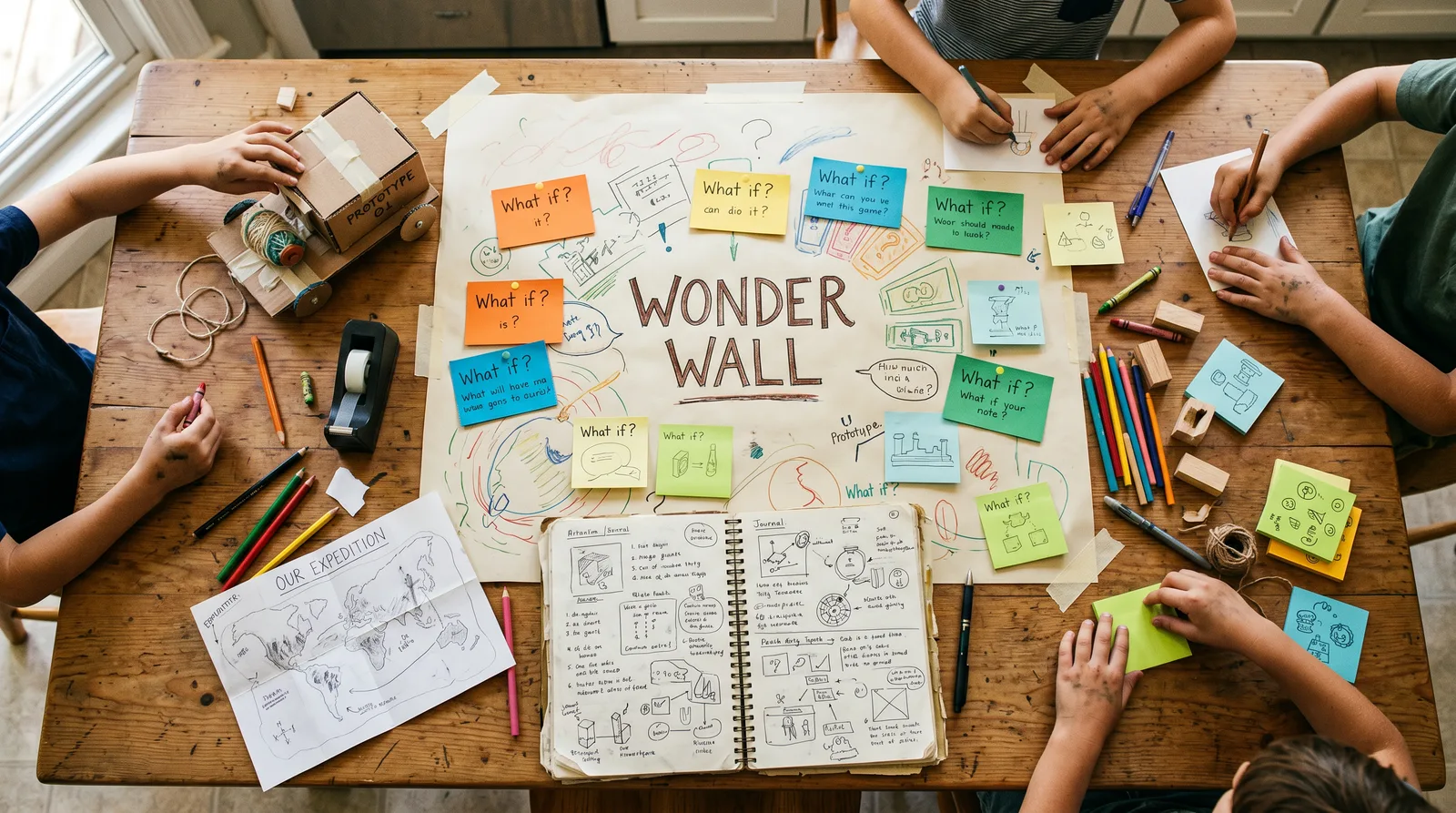
- Coach children through the Three Question Rule and Wonder Wall so they build self-directed research habits and stop waiting to be handed answers.
- Integrate AI-literacy principles into the framework so children learn to use AI as a thinking partner rather than an answer machine, positioning them as adaptable innovators in a rapidly changing world.
How it works
A school that adapts to you
This isn't a set of static videos. Every lesson is generated live and tuned to where you actually are.
We learn your level
A quick placement check tailors your starting point so you're never bored or lost.
Lessons adapt as you go
Each lesson is written for your pace and your goal, adjusting as your skills grow.
Your AI coach keeps you moving
Checkpoints, feedback, and gentle nudges turn progress into a real result.
The curriculum
What's inside your school
8 modules · 27 lessons

The Independent Thinker Framework™ — Vision, Philosophy & Research Foundation
Before anyone can implement this framework, they need to feel it — not just understand it intellectually. This opening module dismantles the 'what to think' model of schooling and replaces it with a compelling, research-backed alternative. Educators, parents, and specialists leave this module with a shared language, a clear purpose, and a burning reason to change how they show up for children. It also orients each audience — home, classroom, homeschool, camp, gifted programs, and learners with different profiles — so that every subsequent lesson lands with immediate personal relevance. This is the philosophical ignition point for the entire course.
- 1.1Why Schools Teach What to Think — and Why That's No Longer EnoughIncluded
- 1.2The Research Behind the Framework — What Science Says About How Kids Really LearnIncluded
- 1.3Understanding Your Context — Home, Classroom, Homeschool, Camp & Specialist SettingsIncluded
- 1.4Learning Outcomes by Age and Role — What Success Actually Looks LikeIncluded
The 7-Step Independent Thinking Cycle — Mastering the Core Engine
This is the heartbeat of the entire framework — the repeating loop that turns any experience into a thinking opportunity. Every facilitator, parent, teacher, and specialist must be able to run this cycle fluently and invisibly in real time, with children from age 8 to 18, in any subject, setting, or mood. This module goes deep on each step: its cognitive purpose, its age-specific expression, the adult moves that support it, and the common ways it breaks down. Participants don't just learn the cycle — they experience it, so they know in their bodies what it feels like to go through all seven steps. They also master the facilitator's paradox: the less you explain, the more they learn.
- 2.1Notice & Wonder — Training the Observing MindIncluded
- 2.2Explore & Build — From Curiosity to CreationIncluded
- 2.3Share, Reflect & Act — Where Thinking Becomes Lasting ChangeIncluded
- 2.4Facilitating the Cycle in Real Time — The Adult's RoleIncluded
Age-Specific Pathways — Explorer, Investigator & Innovator
The 7-step cycle is universal; its expression is radically different at age 9, age 13, and age 17. This module translates the framework into developmentally precise, emotionally intelligent practice for three distinct stages — while also addressing the learners who don't fit neatly into any stage: twice-exceptional students, learners with ADHD or dyslexia, profoundly gifted students, and children in multi-age home or co-op environments. Every lesson in this module is built so that participants can immediately adapt what they've learned to a specific child they know. The goal is not just differentiation — it's individualisation.
- 3.1The Explorer Pathway — Grades 3–5 (Ages 8–11): Play, Observation & Curiosity as SuperpowerIncluded
- 3.2The Investigator Pathway — Grades 6–8 (Ages 11–14): Evidence, Argument & Independent VoiceIncluded
- 3.3The Innovator Pathway — Grades 9–12 (Ages 14–18): Entrepreneurship, AI Literacy & Real-World ImpactIncluded
- 3.4Multi-Age Environments, Learning Differences & Gifted LearnersIncluded
The Family Operating System & Implementation Environments
Vision without a weekly rhythm is just inspiration. This module is the infrastructure layer: how does the Independent Thinker Framework actually run in the real environments where children live and learn? The Family Operating System gives households a simple, seven-day thinking rhythm that doesn't require a curriculum overhaul — just a reorientation of what's already happening. The classroom adaptation shows teachers how to retrofit the cycle into any subject without losing their curriculum coverage. Homeschool co-ops, camps, and gifted programs each get a specific implementation playbook. This module closes the gap between 'I love this idea' and 'I did this today.'
- 4.1The Family Operating System — Installing a Weekly Thinking RhythmIncluded
- 4.2Teacher Classroom Adaptation — Bringing Independent Thinking into Any SubjectIncluded
- 4.3Homeschool Co-ops, Gifted Programs & Camp ImplementationIncluded
Assessment Without Grades — The Curiosity Score, Journal & Growth Portfolio
Assessment is the most politically loaded word in education — and this module reframes it entirely. The goal is not to measure what children know but to document how their thinking is growing: question quality deepening, risk-taking increasing, revision becoming a habit, peer teaching improving, and mistakes being mined for insight. This module equips every participant to use three interlocking assessment tools — the Curiosity Score, the Independent Thinker Journal, and the Growth Portfolio — with confidence and fidelity. It also shows how to translate these tools into language that satisfies institutional reporting requirements without compromising their integrity.
- 5.1The Curiosity Score — Measuring What Actually MattersIncluded
- 5.2The Independent Thinker Journal — Daily Practices for a Thinking LifeIncluded
- 5.3The Growth Portfolio — Documenting an Intellectual LifeIncluded
Signature Tools — Three Question Rule, Wonder Wall & Parent Coaching
This module is the practical toolkit: the three signature instruments that make the framework usable in the most common, high-pressure moments of parenting and teaching. The Three Question Rule prevents adults from giving answers before children have thought. The Wonder Wall makes curiosity visible, social, and sustainable. Parent Coaching Scripts equip adults to navigate the moments when independent thinking collides with real life — homework pressure, test anxiety, the child who gives up, the spouse who doesn't buy in. These tools are simple enough to use tonight and deep enough to keep improving for years.
- 6.1The Three Question Rule — Becoming an Answer-Free AdultIncluded
- 6.2The Wonder Wall — Building a Household or Classroom Culture of QuestionsIncluded
- 6.3Parent Coaching Scripts & Navigating Difficult ConversationsIncluded
AI-Era Learning — Teaching Children to Think With and Beyond AI
This is the module that makes the entire framework future-proof. AI is not the enemy of independent thinking — passively consuming AI outputs without thinking is. This module builds genuine AI literacy for children at all three pathway stages: what AI can and cannot do, how to use it as a thinking partner and provocateur rather than an answer machine, how to detect AI-generated thinking vs. original thinking in your own work, and what the uniquely human cognitive capacities are that AI cannot replicate — and that the Independent Thinker Framework is specifically designed to develop. This module must be taught, not just referenced, because AI is changing faster than any curriculum can track and children need adaptive principles, not static rules.
- 7.1AI Literacy for Independent Thinkers — What AI Can and Cannot DoIncluded
- 7.2AI as Thinking Partner — The Independent Thinker's AI ProtocolIncluded
- 7.3The AI-Era Mindset — Curiosity, Adaptability & Thinking for a World That Keeps ChangingIncluded
Activities, Projects, Challenges & Course Assets — The Full Implementation Library
The course does not end here — it begins here. This final module is the implementation library: everything a facilitator, teacher, parent, or specialist needs to run the framework from day one. Signature Curiosity Projects are the flagship experiences of each pathway. Quick challenges and games are the daily sparks. Course assets — printables, journals, cards, videos, and facilitator guides — are the infrastructure that makes the framework sustainable without the facilitator needing to rebuild it from scratch every time. This module also introduces the course's ongoing community and iteration model: the framework is a living document, and participants are invited to contribute to its evolution.
- 8.1Curiosity Projects — Signature Learning Experiences by PathwayIncluded
- 8.2Challenges, Games & Quick Provocations — Daily Sparks for Independent ThinkingIncluded
- 8.3Printables, Journals, Cards, Videos & Facilitator Guides — The Asset EcosystemIncluded
Who it's for
Is this you?

Ambitious Parents
You want your child to love learning for life, not just perform well on tests — and you're ready to build that culture at home with a concrete weekly system.

Classroom Teachers
You became a teacher to spark genuine curiosity, and the 7-step cycle gives you a practical, subject-agnostic framework to do that inside any curriculum.

Homeschool Families
You're designing your child's education from scratch and want a rigorous thinking framework — not just content — at the center of everything you do.

Gifted-Program Coordinators
Your students race through content and need frameworks that stretch their thinking depth, challenge their assumptions, and build genuine intellectual resilience.

Camp & Enrichment Educators
You have limited time and high-energy learners, and the Cycle's quick provocations and curiosity projects are built to ignite deep thinking in non-traditional settings.

Parents of Teens
Your 9–12th grader is heading into an AI-driven world and needs more than credentials — the Innovator Pathway builds the adaptability and independent reasoning that will actually matter.
Questions
Frequently asked
Your teacher
A note from your teacher

Leigh Baumann
I want to start with a question I suspect you've been carrying for a while.
You've watched a child you care about — yours, or someone else's — light up with a genuinely wild idea, then slowly learn to sit still and wait for the right answer. Maybe it happened in a classroom. Maybe it happened at home. Either way, something in you recognized it as a loss. Not of knowledge — of something harder to name and much harder to recover. Curiosity. The willingness to not-know. The confidence to think out loud before you're certain.
That loss is not accidental. It's what happens when we optimize education for compliance and recall, decade after decade, and mistake busyness for learning. I've spent years sitting with that reality — in classrooms, in homes, in gifted programs, in the gap between what schools promise and what children actually need. And I built The Independent Thinker because I became convinced that the alternative isn't just possible — it's teachable. Thinking, real thinking, has a structure. And when you give children that structure and the freedom to run it themselves, something remarkable happens: they stop waiting to be told what matters, and they start finding out.
The framework at the heart of this school is the 7-Step Independent Thinking Cycle — Notice, Wonder, Explore, Build, Share, Reflect, Act. It's not a theory. It's a repeatable engine that works in a kitchen, a co-op, a classroom, a summer camp. Every module in this school is built to make that cycle practical: the Three Question Rule that teaches you to stop providing answers so your child can start building them; the Wonder Wall that turns your wall space into an invitation to think; the Curiosity Score that finally lets you see intellectual growth that grades never capture. These aren't decorative add-ons. They are the architecture of a thinking life.
I also want to be honest with you about the world your child is entering. AI is not coming — it's already here. And the children who will thrive in it are not the ones who can retrieve the most information fastest; those children will lose to a search bar every time. The children who will thrive are the ones who know how to ask the right question, sit with uncertainty, build an argument, and adapt when the ground shifts. That is precisely what this framework trains. The AI-literacy module isn't a chapter about technology — it's a chapter about intellectual sovereignty.
This school is for the parent who wants more for their child than a good GPA. It's for the teacher who got into this profession because they believed it could be different. It's for the homeschooler who is building something from the ground up and wants a framework that matches their ambition. Wherever you are starting from — Tuesday night kitchen table, fifth-grade classroom, or gifted co-op on a Friday morning — this is the place to begin. Come in. Let's build thinkers.
— Leigh Baumann
Start your journey today
Join get instant access — learn at your own pace with an AI coach in your corner.
$79/mo
Recurring billing · cancel anytime
Secure checkout · Instant access
- 8 modules, 27 lessons
- AI-adaptive lessons tuned to your level
- Quizzes & checkpoints to lock in progress
- Your own AI learning coach
- Learn on any device, at your pace
- Full access for as long as you're subscribed