Build VR that talks to the real world
Learn to wire your VR projects to live APIs, backends, multiplayer networks, and analytics pipelines — then ship them across Meta Quest, SteamVR, and WebXR with one coherent architecture.
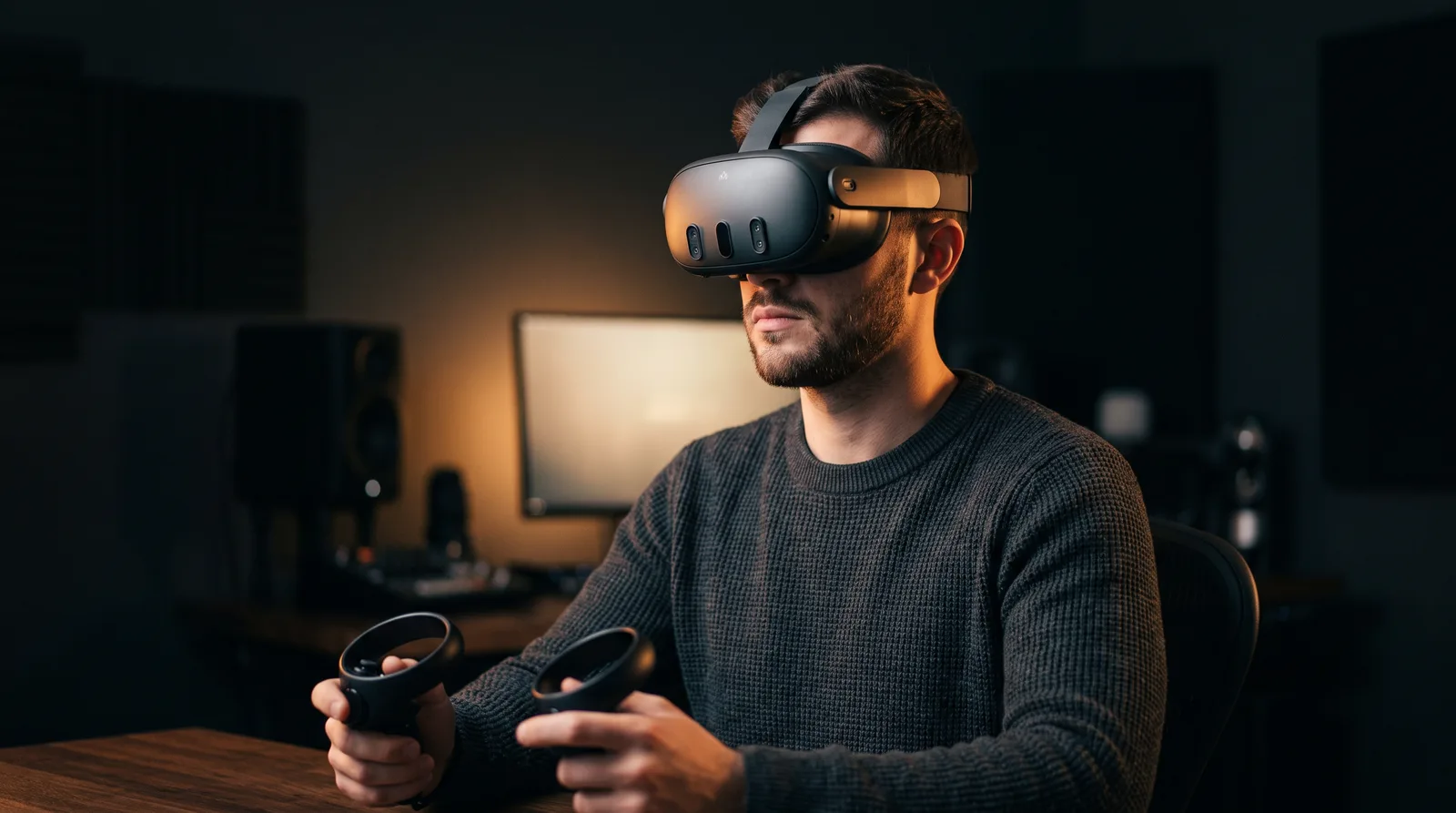
A VR project that can't talk to the world isn't a product yet — let's fix that with working code, not theory.— Freddy Foster

What you'll learn
What you'll be able to do
- Connect a VR application to third-party APIs and live data sources for dynamic, real-time experiences
- Integrate multiplayer and social layers using networking SDKs within a VR environment
- Link VR projects to backend databases and authentication systems for persistent user data
- Embed analytics and telemetry pipelines to track and optimize in-VR user behavior
- Deploy VR builds across multiple platforms (Meta Quest, SteamVR, WebXR) with a unified integration architecture
- Troubleshoot and debug cross-platform integration failures using industry-standard tools and logging practices
How it works
A school that adapts to you
This isn't a set of static videos. Every lesson is generated live and tuned to where you actually are.
We learn your level
A quick placement check tailors your starting point so you're never bored or lost.
Lessons adapt as you go
Each lesson is written for your pace and your goal, adjusting as your skills grow.
Your AI coach keeps you moving
Checkpoints, feedback, and gentle nudges turn progress into a real result.
The curriculum
What's inside your school
6 modules · 25 lessons

Integration Foundations for VR
Establishes the architecture mindset and tooling needed to connect a VR project to external systems.
- 1.1The Integration-Ready VR ProjectIncluded
- 1.2Communication Protocols in XR ContextsIncluded
- 1.3Environment Config, Secrets, and API KeysIncluded
- 1.4Testing and Mocking External Services LocallyIncluded
Connecting to Third-Party APIs and Live Data
Teaches how to fetch, stream, and render real-world data inside a VR environment dynamically.
- 2.1Making HTTP Requests from Inside a VR SceneIncluded
- 2.2Streaming Live Data with WebSocketsIncluded
- 2.3Rendering Dynamic Data as Immersive 3D UIIncluded
- 2.4Rate Limiting, Caching, and Resilience PatternsIncluded
Backend, Auth, and Persistent User Data
Connects VR applications to databases and authentication systems so user progress and identity persist across sessions.
- 3.1User Authentication Flows in VRIncluded
- 3.2Reading and Writing to a Cloud DatabaseIncluded
- 3.3Saving and Restoring VR Session StateIncluded
- 3.4Securing Data in Transit and at RestIncluded
Multiplayer and Social Layer Integration
Adds real-time networking, shared spaces, and social features to VR projects using industry SDKs.
- 4.1Choosing a Networking SDK for VRIncluded
- 4.2Synchronizing Avatars and World StateIncluded
- 4.3Voice Chat and Spatial Audio IntegrationIncluded
- 4.4Lobbies, Matchmaking, and Social PresenceIncluded
Analytics, Telemetry, and Behavior Tracking
Embeds data pipelines that capture in-VR user behavior and feed it into actionable optimization loops.
- 5.1Designing a VR Telemetry SchemaIncluded
- 5.2Integrating an Analytics SDKIncluded
- 5.3Heatmaps and Spatial Replay AnalysisIncluded
- 5.4Using Data to Iterate on VR Experience DesignIncluded
Cross-Platform Deployment and Integration Debugging
Delivers production-ready VR builds across Meta Quest, SteamVR, and WebXR while diagnosing integration failures.
- 6.1Unified Integration Architecture for Multiple PlatformsIncluded
- 6.2Platform-Specific Build Configs and API PermissionsIncluded
- 6.3Deploying to Meta Quest, SteamVR, and WebXRIncluded
- 6.4Logging, Tracing, and Diagnosing Integration FailuresIncluded
- 6.5Performance Profiling Integration OverheadIncluded
Who it's for
Is this you?

Indie VR developer
You've shipped a demo and want to add real user accounts, live data, and a path to the Meta Quest store.

Game-engine generalist
You're strong in Unity or Unreal but have never wired a VR scene to an external API or backend service.

XR startup engineer
You're building a multiplayer or social VR product and need production-grade networking and auth patterns fast.

CS student or bootcamp grad
You have coding fundamentals and VR curiosity and want a hands-on path into professional XR engineering.

WebXR builder
You're coming from a web background and want to close the gap between browser-based XR and real backend integrations.

VR experience designer
You collaborate with engineers but want to understand telemetry, analytics, and data-driven iteration well enough to lead it.
Questions
Frequently asked
Your teacher
A note from your teacher

Freddy Foster
If you're reading this, you've probably already built something in VR that you're proud of — and then hit the wall. You want to pull in live data, but HTTP requests from inside a scene feel sketchy. You want user accounts, but auth flows in XR aren't exactly well-documented. You want to go multiplayer, but the networking SDK docs assume you already know which one to pick. And somewhere in the back of your head, you know you need to ship on more than one platform eventually.
That wall is exactly what this school was built to knock down.
I designed this curriculum the way I wish someone had sat down and walked me through it: start with the integration foundations that every production VR project needs (environment config, secrets, local mocking), then layer in each integration category — APIs and live data, backend and auth, multiplayer and social, analytics and telemetry — with working code and the resilience patterns that keep things from breaking in users' hands. No theoretical fluff. No "here's a diagram, good luck." Every section ends with you having something real running.
The cross-platform deployment and debugging section is the one I'm most proud of, because it's the piece that's almost never taught. Most courses get you to a build. This one gets you to a debuggable, traceable, performance-profiled build that targets Meta Quest, SteamVR, and WebXR from a unified architecture — with the logging and tracing practices to diagnose failures when they happen, not just hope they don't.
You already know how to make VR. This school teaches you how to make VR that ships, persists, connects, and scales. Come build it with me.
— Freddy Foster
Start your journey today
Join get instant access — learn at your own pace with an AI coach in your corner.
$59/mo
Recurring billing · cancel anytime
Secure checkout · Instant access
- 6 modules, 25 lessons
- AI-adaptive lessons tuned to your level
- Quizzes & checkpoints to lock in progress
- Your own AI learning coach
- Learn on any device, at your pace
- Full access for as long as you're subscribed