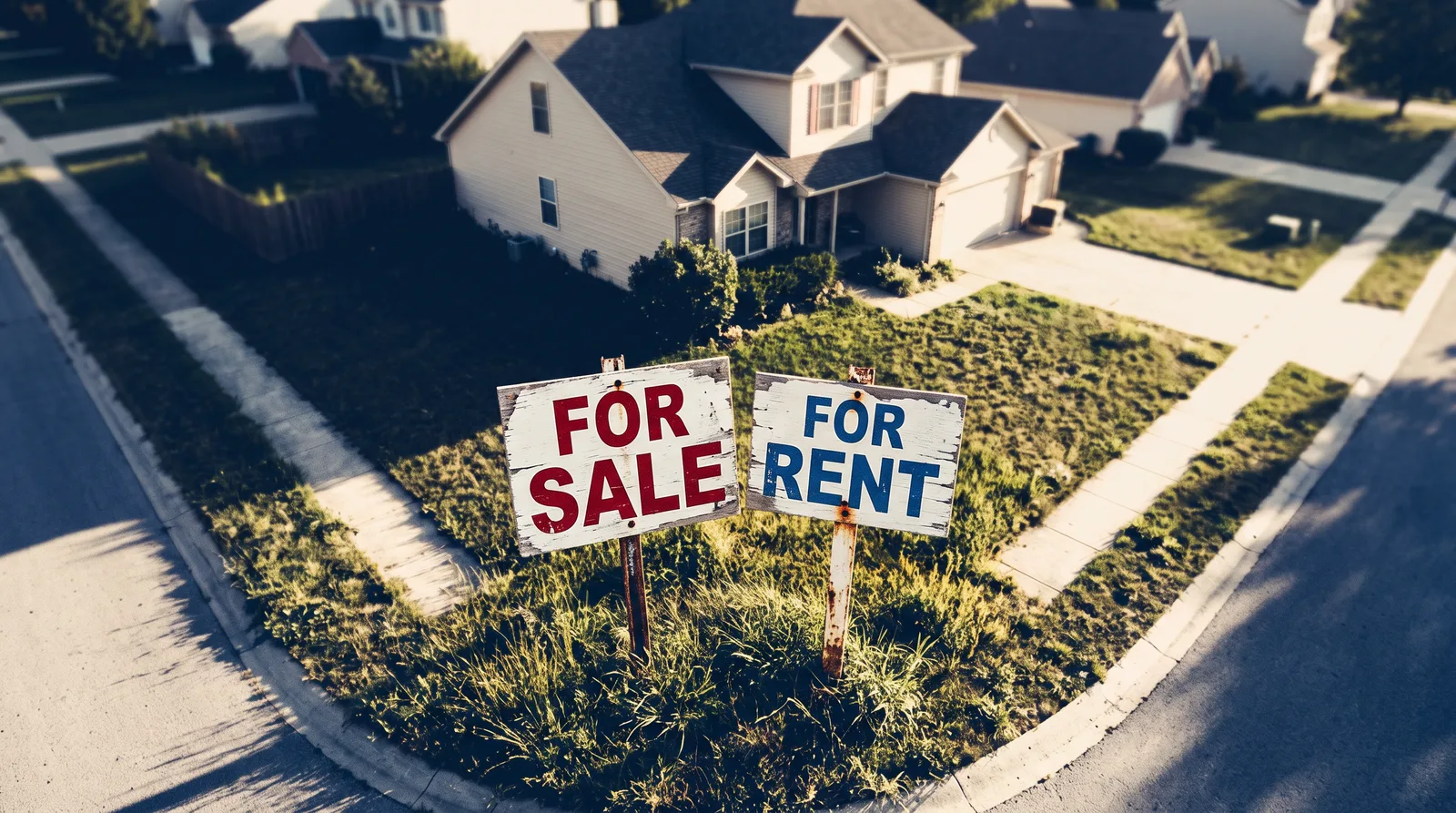
Every few months someone posts a graphic online that says renting is "throwing money away." Every few months, I want to throw my phone out the window.
Buying a home can be a powerful wealth-building move. It can also be a financial anchor that quietly drags on your net worth for years. The difference isn't in the act of buying — it's in the numbers behind your specific situation. So let's actually look at them.
The Setup: A $400,000 Home in 2025
Let's use a concrete, realistic example. You're considering a $400,000 home. The comparable rental in the same neighborhood runs $2,200 per month. Here's what both paths genuinely cost.
The True Cost of Buying
Most people calculate their mortgage payment and stop there. That's the mistake.
Mortgage payment (principal + interest) With a 20% down payment ($80,000), you're financing $320,000. At a 30-year fixed rate of roughly 6.8% — right where rates have been sitting in 2025 — your monthly principal and interest payment comes to approximately $2,090.
But that's just the beginning.
Property taxes The US average effective property tax rate hovers around 1.1% of assessed value. On a $400,000 home, that's $4,400 per year, or about $367/month.
Homeowner's insurance Plan on $150–$200/month for a home in this price range. Call it $175/month.
Private mortgage insurance (PMI) If you put down exactly 20%, you dodge PMI. But many buyers put down less. At 10% down, PMI typically adds $100–$200/month until you hit 20% equity.
Maintenance The standard rule of thumb is 1% of the home's value per year for upkeep. On a $400,000 home, budget $333/month. Some years it's nothing; others it's a new roof.
Total monthly cost of buying (20% down, no PMI): roughly $2,965/month
And that's before the $80,000 down payment left your bank account.
The True Cost of Renting
Your rent is $2,200/month. Full stop for housing costs. No surprise repair bills. No property tax bill in January.
What you do need to account for is what happens to the money you didn't spend.
The Part Nobody Talks About: Opportunity Cost
This is where the "buying always wins" crowd goes quiet.
The buyer put down $80,000. The renter kept that $80,000 invested. If that money earns a conservative 7% average annual return in a diversified index fund, it grows to roughly $314,000 in 20 years — without touching it again.
Additionally, the renter is spending about $765 less per month on housing costs than the buyer ($2,965 vs. $2,200). If that difference is invested monthly at the same 7% return, that's another $470,000+ over 20 years.
Does the homeowner's equity and appreciation offset this? It can. But it depends entirely on local appreciation rates, how long you stay, transaction costs when you sell (typically 5–6% of the sale price in agent commissions and fees alone), and whether you ever tap the equity or let it sit.
Home appreciation is real — but it's not guaranteed, and it's not free.
So When Does Buying Actually Win?
Buying makes strong financial sense when:
- You plan to stay at least 7–10 years. Transaction costs alone mean short holds rarely pencil out.
- Your local price-to-rent ratio is reasonable. Divide the home price by annual rent. A ratio above 20 often favors renting; below 15 often favors buying. At $400,000 ÷ $26,400 annual rent, you get a ratio of about 15.2 — borderline, worth analyzing carefully.
- You can comfortably afford the full cost, not just the mortgage payment, without stretching your emergency fund thin.
- You value stability and control over the flexibility to move — and you price that non-financial benefit honestly.
When Renting Actually Wins
Renting is the smarter move when:
- You're in a high-cost city with a price-to-rent ratio above 25.
- You're likely to relocate within five years.
- Your down payment opportunity cost outpaces local appreciation.
- Buying would leave you house-rich and cash-poor, with no cushion for emergencies or investing.
The Honest Bottom Line
Neither renting nor buying is universally superior. The answer lives in your specific numbers: your local market, your timeline, your down payment, your alternative investment returns, and what you value beyond money.
What I can tell you is this — anyone who skips the math and defaults to "buying is always better" is selling you a bumper sticker, not a financial plan.
Run your numbers. Know your price-to-rent ratio. Account for opportunity cost. Make the decision with your eyes open.
That's what financial literacy actually looks like — and it's the foundation of everything I teach inside AI Financial Intelligence and the Capital & Intelligence Institute. If you want to go deeper on how to analyze real estate as part of a full wealth-building strategy, that's exactly where we do the work.