Master Implant Dentistry from Biology to Final Crown
Dr. J of Anacapa Dental Art Institute leads the definitive clinical masterclass — covering every phase from patient evaluation and surgical planning through restoration, complications, and the 20-year implant — built for professionals and informed patients who refuse to work from guesswork.
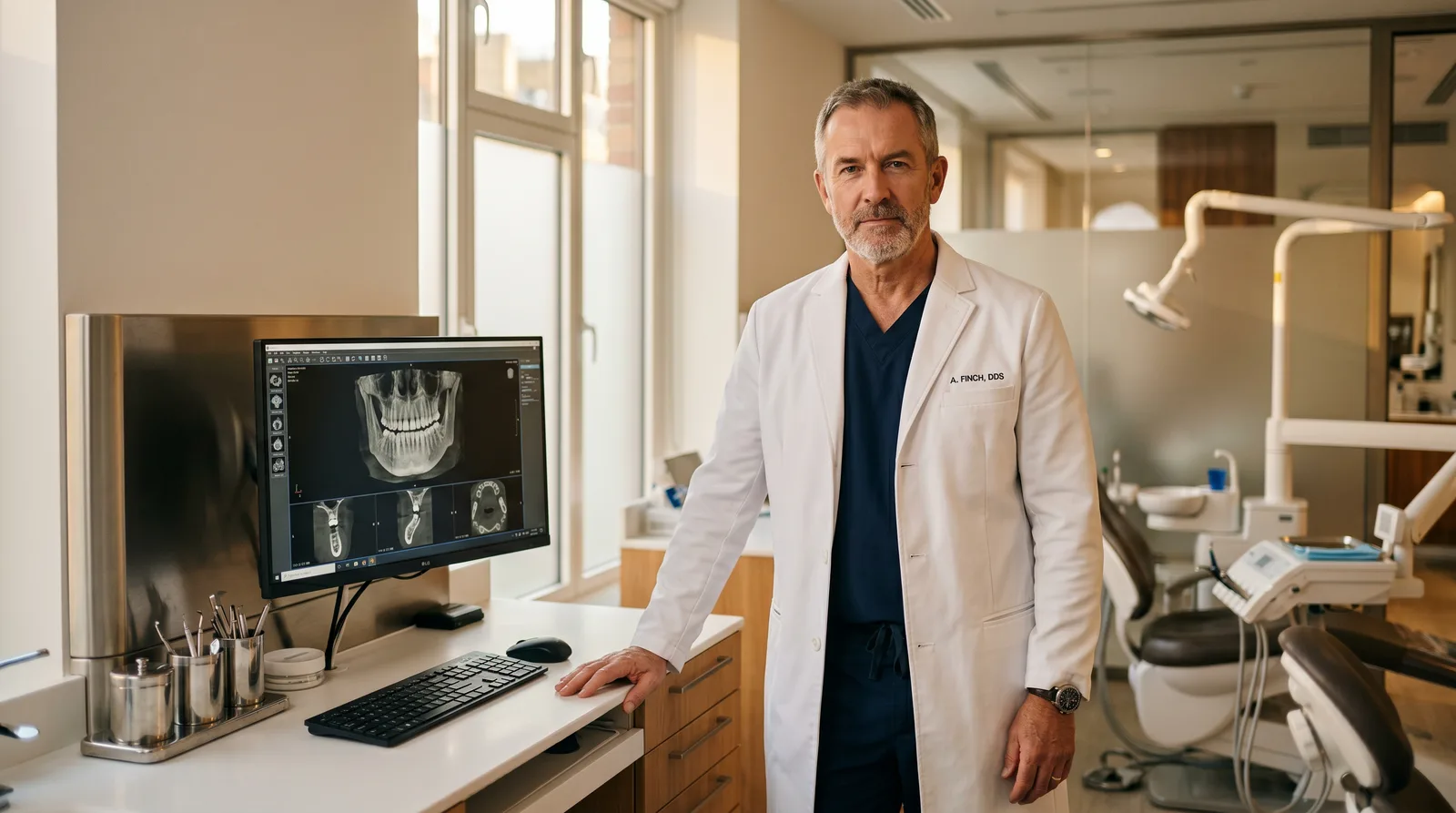
"The technique is teachable in a weekend — the judgment takes a different kind of education, and that's exactly what I'm here to give you."— Tim Devolve
What you'll learn
What you'll be able to do
- Evaluate a patient's full candidacy for dental implants — including medical history, bone quality, periodontal status, medications, and lifestyle risk factors — with clinical confidence.
- Read and interpret dental X-rays and CBCT scans to identify critical anatomical landmarks, available bone volume, and implant positioning constraints before surgery.
- Explain the complete implant journey — from consultation and records through surgery, osseointegration, restoration, and maintenance — clearly and accurately to patients, colleagues, or referral partners.
- Identify the biological and mechanical causes of implant failure, recognize early warning signs of complications, and understand the protocols used to prevent or manage them.
- Apply prosthetically driven planning principles — including esthetic-zone considerations, bite analysis, and soft-tissue management — to understand why implant position determines long-term success.
- Communicate implant treatment options ethically and persuasively using consultation frameworks, patient scripts, and case-presentation language that set realistic expectations and build informed consent.
How it works
A school that adapts to you
This isn't a set of static videos. Every lesson is generated live and tuned to where you actually are.
We learn your level
A quick placement check tailors your starting point so you're never bored or lost.
Lessons adapt as you go
Each lesson is written for your pace and your goal, adjusting as your skills grow.
Your AI coach keeps you moving
Checkpoints, feedback, and gentle nudges turn progress into a real result.
The curriculum
What's inside your school
11 modules · 46 lessons

The Big Picture of Dental Implants
This foundational module orients every type of learner — from dental student to educated patient — to the world of modern implant dentistry. Students learn what implants are, why they represent a paradigm shift in tooth replacement, and how they compare honestly against every alternative. A prerequisite mindset lesson on the biological philosophy of implants is added to ground all later clinical detail. Disclaimer: This module is educational only and does not constitute clinical training or licensure.
- 1.1Why Dental Implants Changed EverythingIncluded
- 1.2Anatomy of an Implant SystemIncluded
- 1.3Implants vs. Every Other Option — An Honest ComparisonIncluded
- 1.4The Philosophy of Implant Dentistry — Biological Thinking FirstIncluded
The Ideal Implant Candidate
This module teaches the full multidimensional assessment of patient candidacy — medical, behavioral, biological, psychological, and financial. Students learn to think in risk categories rather than binary yes/no decisions. A new lesson on psychological and expectation profiling is added because unmanaged expectations are among the most common drivers of patient dissatisfaction even when implants succeed clinically. Disclaimer: All candidacy evaluation in real clinical settings must be performed by a licensed dental professional following an in-person examination.
- 2.1Medical History and Systemic Risk FactorsIncluded
- 2.2Lifestyle, Habits, and Behavioral CandidacyIncluded
- 2.3Bone Quality, Quantity, and Periodontal ReadinessIncluded
- 2.4Age, Psychological Readiness, and Financial CandidacyIncluded
The Implant Consultation
The consultation module teaches students how to structure and lead a comprehensive implant consultation — from first contact to treatment plan presentation. This module emphasizes that the consultation is both a clinical and a human encounter. A new lesson on documentation, informed consent, and legal protection is added because the draft omitted this critical legal and ethical safeguard. Disclaimer: Consultation frameworks taught here are educational models. Real clinical consultations must be performed by licensed dental professionals.
- 3.1Listening Before Diagnosing — The Chief Complaint ConversationIncluded
- 3.2The Clinical Examination for Implant PatientsIncluded
- 3.3Presenting Options and Avoiding OverpromisingIncluded
- 3.4Documentation, Informed Consent, and Legal SafeguardsIncluded
Imaging, Records, and Diagnosis
This module teaches the full records armamentarium for implant diagnosis and planning — from two-dimensional radiography through CBCT scanning, digital impressions, photographs, and bite records. The sequencing is critical: diagnosis must precede planning, which must precede surgery. A new lesson on synthesizing records into a diagnosis summary is added because the original draft taught individual record types without teaching students how to integrate them into a clinical decision. Disclaimer: Radiographic interpretation and diagnosis must be performed by a licensed dental professional.
- 4.1Radiographic Interpretation for Implant SitesIncluded
- 4.2CBCT Scanning — What It Reveals That X-Rays CannotIncluded
- 4.3Digital Scans, Photographs, Smile Analysis, and Bite RecordsIncluded
- 4.4Synthesizing Records into a Diagnosis and Treatment PlanIncluded
Bone, Gums, and the Biological Foundation
This module addresses the most common reason implants fail before they are ever placed: inadequate biological foundation. Students learn the science and clinical management of bone loss, grafting techniques, sinus procedures, and soft tissue — understanding not just what these procedures are but why they exist and what happens when they are skipped. A new lesson connecting foundation preparation to long-term maintenance is added to complete the biological arc. Disclaimer: Surgical procedures described are for educational understanding only. Hands-on training and clinical supervision are required for surgical practice.
- 5.1Bone Loss, Resorption, and Why Foundations FailIncluded
- 5.2Grafting, Ridge Preservation, and Sinus LiftingIncluded
- 5.3Soft Tissue, Keratinized Gingiva, and Peri-Implant HealthIncluded
- 5.4Connecting Foundation to Long-Term MaintenanceIncluded
Implant Planning — Thinking Before Drilling
Planning is where clinical thinking transforms into a surgical and prosthetic roadmap. This module teaches the governing principles of prosthetically driven implant planning and shows students how position, angulation, depth, spacing, and technology intersect to determine outcomes before a single incision is made. The original draft is well-structured; a lesson on occlusal planning and load distribution is added because it was a meaningful gap given that bite analysis is listed as a target outcome. Disclaimer: Implant planning and surgical execution require advanced clinical training and licensure.
- 6.1Prosthetically Driven Planning — The Restoration DecidesIncluded
- 6.2Position, Angulation, Depth, and SpacingIncluded
- 6.3Guided Surgery, Surgical Stents, and Technology in PlanningIncluded
- 6.4Esthetic-Zone Planning — When Everything Is VisibleIncluded
- 6.5Occlusal Planning and Load DistributionIncluded
Surgery Day — From Preparation to Sutures
This module walks the student through surgery day with the level of detail needed to understand the procedure — not to perform it unsupervised. Clinical students and dental professionals understand the procedural steps, rationale, and safety checkpoints. Non-clinical learners understand what their patient or patient's advocate is experiencing. A new lesson on anesthesia, patient comfort, and anxiety management is added because it was listed in the original course concept but not in the lesson structure. Disclaimer: Surgical training requires hands-on clinical supervision under licensed instructors. This module is educational only.
- 7.1Anesthesia, Patient Comfort, and Anxiety ManagementIncluded
- 7.2Pre-Surgical Preparation — The Day Before and the Morning OfIncluded
- 7.3The Implant Placement Procedure — Step by StepIncluded
- 7.4Post-Operative Care — Managing the First Two WeeksIncluded
Healing, Osseointegration, and the Restorative Phase
This module covers the biological and clinical events between surgery and final restoration — the period that most non-clinical learners do not fully understand and most clinical learners underestimate. Students learn the science of osseointegration, how to monitor for success or failure, and how the transition from healed implant to final crown is managed. A new lesson on provisionalization as a clinical tool is added because the original draft moved directly from abutments to final restoration without addressing the critical role of temporary restorations in shaping the outcome. Disclaimer: Clinical monitoring and restoration require professional training.
- 8.1Osseointegration — The Biology of Implant AcceptanceIncluded
- 8.2Monitoring Healing and Recognizing Early FailureIncluded
- 8.3Provisionalization — Using Temporaries to Shape the OutcomeIncluded
- 8.4Abutments, Impressions, and the Final RestorationIncluded
Complications, Failures, and How Masters Prevent Them
No implant course is complete without a rigorous, honest treatment of what goes wrong and why. This module addresses biological, mechanical, prosthetic, esthetic, and surgical complications in sequence. The original draft is well-structured. A new lesson on psychological and medicolegal complications is added because patient dissatisfaction, complaints, and claims — even after clinical success — are real outcomes that dental professionals must be prepared for. Disclaimer: Complication management requires advanced clinical training and should not be attempted without proper licensure and supervision.
- 9.1Biological Complications — Peri-Implantitis and InfectionIncluded
- 9.2Mechanical and Prosthetic ComplicationsIncluded
- 9.3Esthetic Complications and When Implants DisappointIncluded
- 9.4Surgical Complications and Nerve SafetyIncluded
- 9.5Psychological and Medicolegal ComplicationsIncluded
Maintenance, Longevity, and the 20-Year Implant
Maintenance is not an afterthought — it is the final determinant of whether a 20-year implant is achievable. This module teaches clinical maintenance protocols, patient self-care education, the changing systemic health picture over time, and how late complications differ from early ones. A new lesson on practice systems for implant maintenance is added because individual clinical knowledge must translate into office protocols to produce consistent outcomes. Disclaimer: Maintenance protocols should be implemented under professional supervision.
- 10.1The Implant Maintenance Appointment — What Is DifferentIncluded
- 10.2Patient Self-Care, Compliance, and Long-Term Success HabitsIncluded
- 10.3Late Complications, Changing Systemic Health, and Implant LongevityIncluded
- 10.4Practice Systems for Implant MaintenanceIncluded
Communication, Case Presentation, and the Patient Journey
The final module integrates all prior clinical knowledge into the communication and professional frameworks that bring the implant journey together. Students learn complete consultation scripts, interdisciplinary communication standards, ethical obligations, and how to build a practice culture that serves implant patients excellently. A new lesson on marketing ethics and building referral relationships is added to serve the referral partner and practice-building audiences identified in the course objectives. Disclaimer: This module is educational and does not constitute legal or financial advice. Compliance with local regulations for patient communication and marketing is the responsibility of each professional.
- 11.1The Complete Patient Consultation ScriptIncluded
- 11.2Referring to Specialists and Communicating Across the TeamIncluded
- 11.3Ethical Standards, Informed Consent, and Clinical BoundariesIncluded
- 11.4Building a Patient-Centered Implant Practice — Marketing Ethics and Referral RelationshipsIncluded
Who it's for
Is this you?

Dental Students
Build a rigorous implant foundation before you graduate — so your first real case doesn't feel like your first real case.

General Dentists Expanding
Gain the biological reasoning and planning frameworks that turn implant-curious into implant-confident — without guesswork.

Treatment Coordinators
Master the consultation language, case-presentation scripts, and ethical frameworks that make every patient conversation count.

Dental Assistants
Understand every stage you're supporting — from pre-surgical prep to post-op care — so you can anticipate, assist, and communicate with authority.

Educated Patients
Know exactly what your provider should be evaluating, what imaging matters, and what to expect at every step of your own implant journey.

Referral Partners
Understand Dr. J's clinical philosophy, candidacy standards, and restoration-first approach so you can refer — and collaborate — with full confidence.
Questions
Frequently asked
Your teacher
A note from your teacher
Tim Devolve
If you've ever sat across from a patient who asked you "So how does this actually work?" — and felt the gap between what you knew and what you could confidently, clearly explain — then you already understand why I built this school.
I'm Dr. J, founder of Anacapa Dental Art Institute. I've spent my career placing implants, but more importantly, I've spent it thinking about implants — the biology, the failures, the near-misses, the moments when a case went beautifully and the moments when it didn't, and the hard work of understanding exactly why. What I've learned is this: the clinical technique is teachable in a weekend. The judgment — knowing which patient to work up, which scan to order, which complication is brewing before it declares itself, which restorative choice will still look right in fifteen years — that takes a different kind of education.
That's what Last Word on Implants is. Not a protocol. Not a checklist. A complete, honest, biology-first education in what dental implants actually are, how they actually work, what makes them succeed, and what makes them fail. We start where every good implant case starts — with the patient in front of you — and we follow the full arc: evaluation, imaging, planning, surgery, healing, restoration, maintenance, and the long game of keeping that implant healthy for twenty years. We don't skip complications because they're uncomfortable. We go there on purpose, because I believe that a clinician who hasn't studied failure carefully is not yet ready to promise success.
I also built this for people who aren't placing implants themselves. Treatment coordinators who need to speak fluently and ethically to patients. Dental assistants who want to understand what they're supporting, not just what instrument comes next. Referral partners who deserve to understand the clinical standards I hold and why. And patients — because an informed patient is the best patient, and because you deserve to understand every stage of the journey you're about to take. The level of language in this school is professional but never locked. If you can read this paragraph, you can follow this course.
My promise to you is simple: when you finish, nothing about this topic will feel opaque or intimidating again. You'll have a framework for thinking through cases you haven't seen yet. You'll know the questions to ask, the findings to look for, the conversations to have, and the standards to hold. That's the last word on implants — and it's yours.
— Tim Devolve
Start your journey today
Join get instant access — learn at your own pace with an AI coach in your corner.
$197/mo
Recurring billing · cancel anytime
Secure checkout · Instant access
- 11 modules, 46 lessons
- AI-adaptive lessons tuned to your level
- Quizzes & checkpoints to lock in progress
- Your own AI learning coach
- Learn on any device, at your pace
- Full access for as long as you're subscribed