Master implant dentistry from diagnosis to decade-long success
A definitive, documentary-style masterclass from Dr. J of Anacapa Dental Art Institute — built for clinicians, students, and educated patients who want to understand every stage of the implant journey with clinical precision and zero shortcuts.
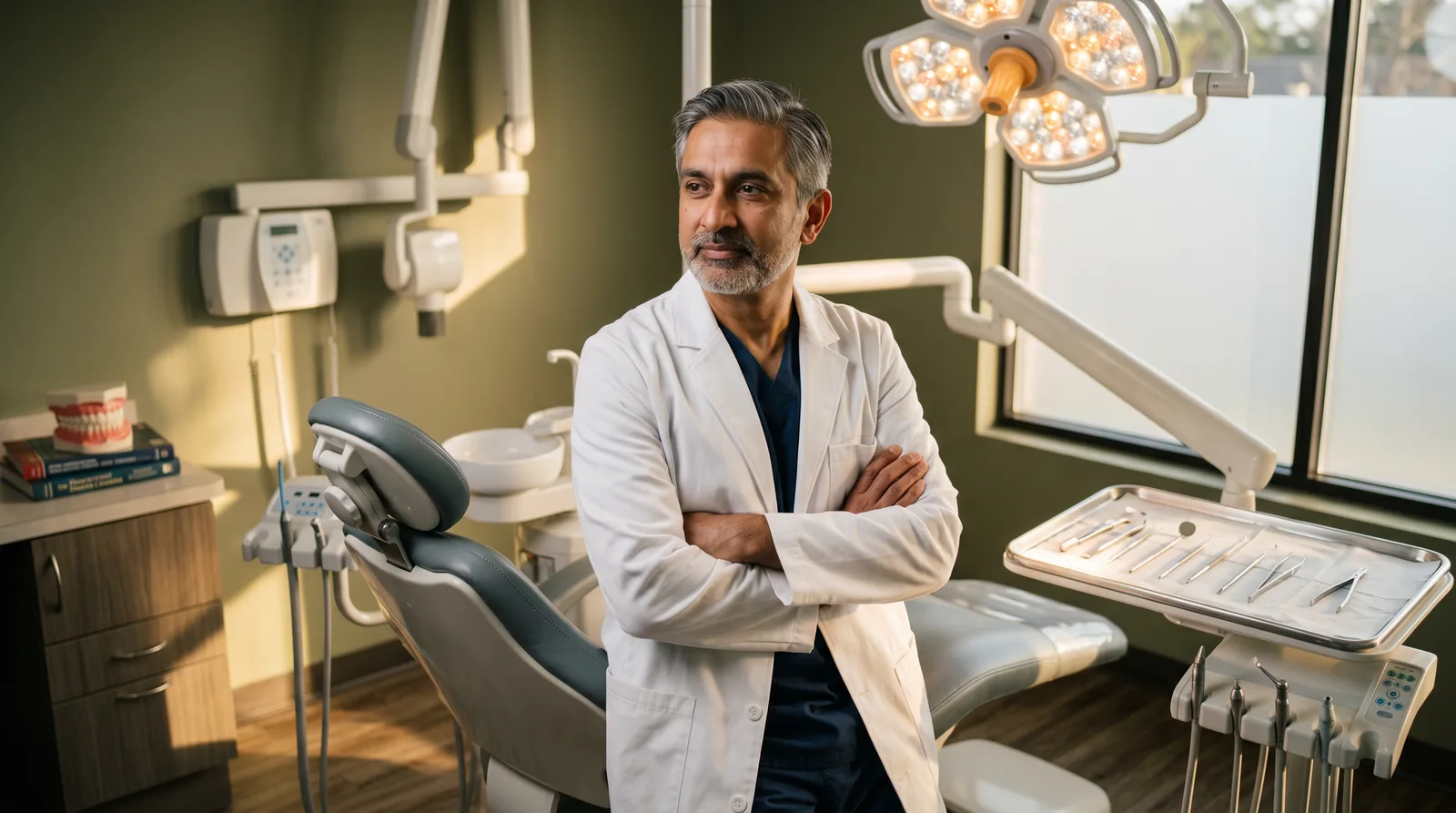
"Great implant outcomes begin with great thinking — and great thinking is something I can teach."— Tim Devolve
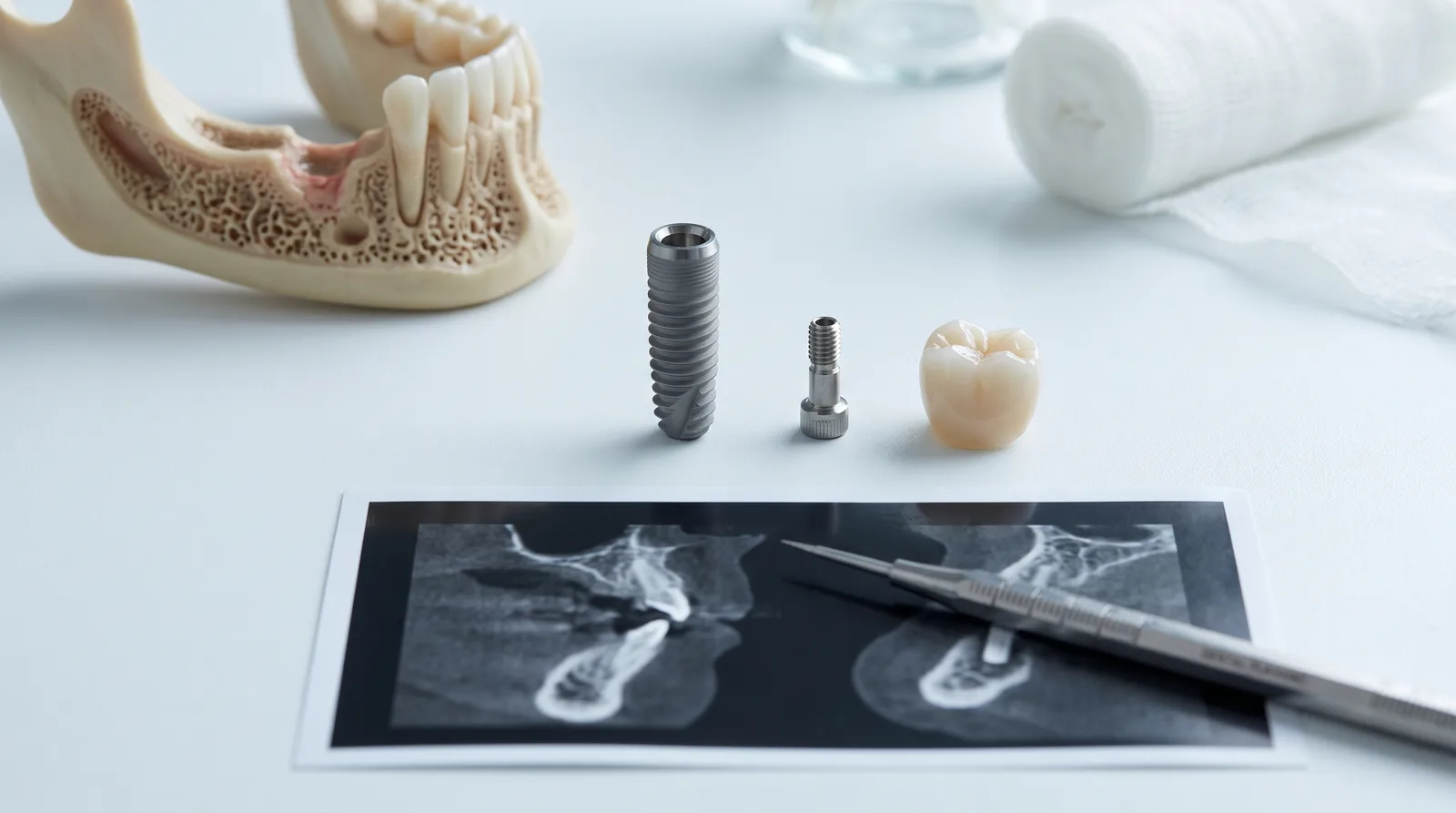
What you'll learn
What you'll be able to do
- Evaluate a patient's systemic health, bone quality, and soft-tissue foundation to understand implant candidacy and risk factors
- Interpret CBCT scans, periapical X-rays, and digital records well enough to follow a clinician's prosthetically driven implant plan from diagnosis to final restoration
- Trace the full surgical and healing sequence — placement, osseointegration, abutment connection, and provisionalization — and explain each phase clearly to patients or colleagues
- Identify the most common causes of implant failure (biological, mechanical, and esthetic) and describe the clinical decisions that prevent or manage them
- Communicate implant treatment options, timelines, risks, and realistic outcomes with confidence, using evidence-based language that builds trust without overpromising
- Apply a structured maintenance and long-term monitoring framework so that restored implants are protected, complications are caught early, and patient relationships endure
How it works
A school that adapts to you
This isn't a set of static videos. Every lesson is generated live and tuned to where you actually are.
We learn your level
A quick placement check tailors your starting point so you're never bored or lost.
Lessons adapt as you go
Each lesson is written for your pace and your goal, adjusting as your skills grow.
Your AI coach keeps you moving
Checkpoints, feedback, and gentle nudges turn progress into a real result.
The curriculum
What's inside your school
11 modules · 35 lessons

The Big Picture of Dental Implants
This foundational module orients every audience — from dental students to educated patients — by establishing what dental implants are, how they evolved, and why they represent the gold standard for tooth replacement. It also compares implants with all major alternatives so students can contextualize every lesson that follows.
- 1.1Why Implants Changed EverythingIncluded
- 1.2What Implants Can and Cannot DoIncluded
- 1.3The Implant Team: Who Does WhatIncluded
The Ideal Implant Candidate
Before a single radiograph is ordered, clinicians must understand the patient in front of them. This module teaches systematic evaluation of medical, behavioral, psychological, and financial candidacy — establishing the critical prerequisites that determine whether implant therapy is appropriate, premature, or contraindicated. This module must precede the consultation and imaging modules, as candidacy screening informs which records are needed.
- 2.1Medical History and Systemic Risk FactorsIncluded
- 2.2Smoking, Lifestyle, and Behavioral CandidacyIncluded
- 2.3Managing Patient Expectations and Financial ReadinessIncluded
The Implant Consultation
The consultation is where trust is built or lost. This module teaches the structured, patient-centered approach Dr. J uses at Anacapa Dental Art Institute: listening deeply, examining thoroughly, presenting options ethically, and closing in a way that serves the patient's long-term health rather than a short-term sale. Prerequisite: Modules 1 and 2.
- 3.1Listening to the Chief ComplaintIncluded
- 3.2The Clinical Examination: What to Look For and WhyIncluded
- 3.3Presenting Options, Explaining Risks, and Closing EthicallyIncluded
Imaging, Records, and Diagnosis
Accurate diagnosis depends on complete, high-quality records. This module teaches students to understand every record type used in implant planning — from the humble periapical film to the CBCT scan — and explains how each contributes uniquely to a safe, prosthetically driven diagnosis. Prerequisite: Module 3 (consultation generates the record-gathering prescription).
- 4.1Periapical X-Rays and Panoramic Films: What They Tell You and What They Don'tIncluded
- 4.2CBCT Scans: Reading the Third DimensionIncluded
- 4.3Digital Scans, Bite Records, and Smile AnalysisIncluded
Bone, Gums, and the Biological Foundation
An implant placed into inadequate bone or surrounded by insufficient soft tissue is an implant at risk. This module builds a thorough understanding of the biological substrate that makes implants possible — and what must be done when it is absent. Prerequisite: Module 4 (imaging is needed to assess the foundation before planning augmentation).
- 5.1Bone Biology and Why Bone Is LostIncluded
- 5.2Ridge Preservation, Bone Grafting, and Sinus LiftsIncluded
- 5.3Soft Tissue, Keratinized Mucosa, and Why Gums MatterIncluded
Implant Planning: Thinking Before Drilling
Planning is where implant dentistry is won or lost — not in the operatory. This module teaches the intellectual framework of prosthetically driven, patient-specific implant planning, from 3D virtual positioning to esthetic-zone nuance. Prerequisite: Modules 4 and 5 (records and biological foundation must be understood before planning can be meaningful).
- 6.1Prosthetically Driven Planning: Starting at the CrownIncluded
- 6.2Position, Angulation, Depth, and Safety ZonesIncluded
- 6.3Guided Surgery, Surgical Templates, and Digital WorkflowsIncluded
- 6.4Esthetic Zone Planning: Where Precision Becomes ArtIncluded
Surgery Day: From Prep to Suture
This module walks through the clinical choreography of implant surgery: preparation, execution, and immediate post-operative management. The goal is not to train surgeons — that requires clinical education and supervised experience — but to give every member of the team a complete, accurate mental model of what happens on surgery day. Educational disclaimer is reinforced prominently throughout.
- 7.1Pre-Surgical Preparation: Patient, Team, and SetupIncluded
- 7.2The Placement Sequence: What Happens at the OsteotomyIncluded
- 7.3Healing, Sutures, and Post-Op ManagementIncluded
Healing and Osseointegration
Osseointegration is the biological miracle that makes implant dentistry possible — and it is not guaranteed. This module teaches the cellular and tissue-level events that occur between placement and loading, how clinicians confirm successful integration, and what can interrupt or prevent it. Prerequisite: Module 7 (students must understand what was placed before studying how it heals).
- 8.1The Biology of OsseointegrationIncluded
- 8.2Healing Timelines, Protocols, and Confirming IntegrationIncluded
The Restorative Phase: From Abutment to Final Crown
The restorative phase is where the clinical work becomes visible — and where restorative precision determines the long-term success of everything done surgically. This module covers every step from abutment selection through final crown delivery and occlusal verification. Prerequisite: Module 8 (integration must be confirmed before restoration begins).
- 9.1Abutment Selection: The Bridge Between Biology and EstheticsIncluded
- 9.2Impressions, Digital Scans, and Communicating with the LabIncluded
- 9.3Provisional Restorations and Emergence Profile DevelopmentIncluded
- 9.4Final Restoration Delivery and Occlusal ManagementIncluded
Complications: Biological, Mechanical, and Esthetic
No course on implant dentistry is complete without an honest, thorough accounting of what goes wrong and why. This module equips students to recognize, understand, and — where possible — prevent the full spectrum of implant complications. Understanding failure makes every prior module's lessons more meaningful. Prerequisite: all preceding modules.
- 10.1Biological Complications: Peri-Implant Mucositis and Peri-ImplantitisIncluded
- 10.2Mechanical Complications: Fractures, Loosening, and WearIncluded
- 10.3Esthetic Complications: When the Crown Looks WrongIncluded
- 10.4Early vs. Late Failure: Recognizing, Managing, and LearningIncluded
Maintenance, Monitoring, and Long-Term Success
The implant journey does not end at crown delivery. This final module teaches students that long-term implant success is an active, structured, team-delivered commitment. It builds directly on the complications module and closes the full course arc from patient evaluation to lifelong care. This is also where the investment in implant dentistry — for patients and for practices — is protected.
- 11.1The Implant Maintenance ProtocolIncluded
- 11.2Patient Education for Long-Term SuccessIncluded
- 11.3Monitoring, Escalation, and Knowing When to ReferIncluded
Who it's for
Is this you?

Dental students
Build the clinical reasoning framework — from CBCT reading to complication management — that turns classroom theory into confident, structured implant knowledge before you ever enter practice.

General dentists expanding into implants
Understand the surgical decisions behind the cases you restore, or prepare to place your own — with prosthetically driven planning, guided surgery, and esthetic zone precision covered in full.

Dental assistants
Know every phase of the implant sequence — from osteotomy to final crown delivery — so you can anticipate needs, support your clinical team, and speak to patients with genuine authority.

Treatment coordinators
Gain the precise, evidence-based language to guide patients through candidacy, timelines, risks, and financial decisions without overpromising or losing their trust.

Educated patients
Understand exactly what is being planned for your body — from the CBCT scan to osseointegration to long-term maintenance — so you can ask the right questions and make genuinely informed decisions.

Referring clinicians
Deeply understand Dr. J's clinical philosophy, standards, and decision-making so you can refer with confidence and communicate meaningfully with your patients about what their care involves.
Questions
Frequently asked
Your teacher
A note from your teacher
Tim Devolve
If you're reading this, you already understand something important: in implant dentistry, a shallow understanding is a liability — for the clinician, for the team, and ultimately for the patient.
Maybe you're a dental student who has watched implant placement in clinic but still can't fully trace the clinical logic from the pre-op CBCT to the final crown. Maybe you're a general dentist who restores implants placed by others and wants to understand the surgical decisions that shaped the case you inherited. Maybe you're a treatment coordinator who fields questions from patients every day about timelines, risks, and what "osseointegration" actually means — and you want to answer with the kind of quiet confidence that comes from real knowledge. Or maybe you're a patient who has been told you need implants, and you refuse to go through a procedure this significant without understanding exactly what is being done to your body and why.
I've spent my career placing and restoring implants, and the more cases I've done, the more convinced I am that outcomes are decided long before surgery day. They're decided in the consultation room, when we listen carefully to what the patient actually needs. They're decided at the radiograph viewer, when we read not just what the CBCT shows but what it implies about bone volume, angulation, and anatomical risk. They're decided at the planning table, when we think prosthetically — starting at the crown and working backward to the osteotomy. Every module in this course is built around that philosophy: precise thinking protects patients.
What I've tried to build here is the course I wish had existed when I was learning implant dentistry — one that doesn't skip the biology to get to the exciting parts, that treats complications as essential curriculum rather than cautionary footnotes, and that gives you a framework rigorous enough to apply across the full range of cases you'll encounter. We cover candidacy and systemic risk, imaging and diagnosis, bone grafting and soft tissue management, guided surgery, the restorative sequence, and long-term maintenance — because a dental implant isn't a procedure, it's a commitment that spans decades.
I can't promise you that watching this course makes you a surgeon. What I can promise is that by the end of it, you will understand implant dentistry the way a thoughtful, experienced clinician understands it — with enough depth to ask the right questions, make sound decisions, explain complex concepts clearly, and recognize when something is going wrong before it becomes a failure. That kind of knowledge protects patients. And it's the only kind worth having.
I'm glad you're here. Let's get to work.
— Tim Devolve
Start your journey today
Join get instant access — learn at your own pace with an AI coach in your corner.
$197/mo
Recurring billing · cancel anytime
Secure checkout · Instant access
- 11 modules, 35 lessons
- AI-adaptive lessons tuned to your level
- Quizzes & checkpoints to lock in progress
- Your own AI learning coach
- Learn on any device, at your pace
- Full access for as long as you're subscribed