Eliminate waste. Control flow. Build a team that never stops improving.
Master the principles of Lean Thinking to eliminate waste, streamline operations, and build a culture of continuous improvement — whether you're on the shop floor or in a corporate office.
"Give me a team that can see waste clearly and knows exactly how to close the gap — and the results take care of themselves."— Dr. J Sebaaly
What you'll learn
What you'll be able to do
- Map and analyze a full value stream to pinpoint every source of waste in a process
- Apply the 5S methodology to create and sustain a clean, organized, high-performance workplace
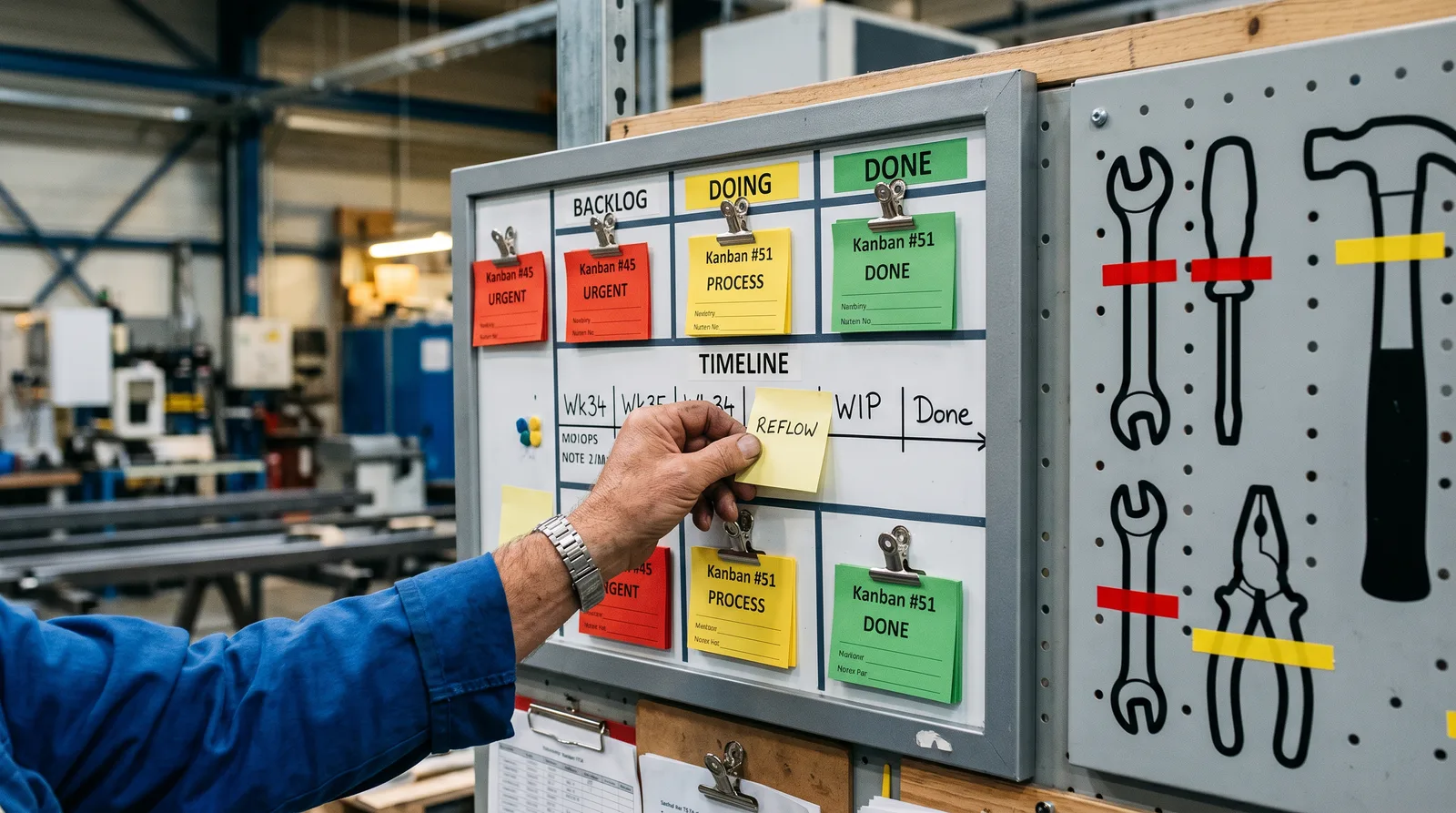
- Design and implement Kanban pull systems to control flow and reduce overproduction
- Run structured Kaizen events that engage frontline teams and deliver measurable results
- Use A3 problem-solving to diagnose root causes and present clear, data-backed improvement plans
- Build a Lean management cadence — daily huddles, visual boards, and leader standard work — that sustains gains long-term
How it works
A school that adapts to you
This isn't a set of static videos. Every lesson is generated live and tuned to where you actually are.
We learn your level
A quick placement check tailors your starting point so you're never bored or lost.
Lessons adapt as you go
Each lesson is written for your pace and your goal, adjusting as your skills grow.
Your AI coach keeps you moving
Checkpoints, feedback, and gentle nudges turn progress into a real result.
The curriculum
What's inside your school
6 modules · 21 lessons

Lean Foundations — Thinking in Value and Flow
Establishes the mental models and vocabulary every learner needs before touching any Lean tool. Learners first define value from the customer's perspective, then trace how value flows (or fails to flow) through a system, and finally survey the eight wastes so they can recognize waste on sight. The industry-adaptation lesson ensures the mindset transfers outside manufacturing — closing a common gap where learners assume Lean is 'factory only.' This module is deliberately placed first because every downstream tool (VSM, 5S, Kanban, Kaizen, A3) depends on these foundations.
- 1.1The Five Lean Principles in PracticeIncluded
- 1.2Seeing the Eight Wastes — DOWNTIME in Your Own WorkIncluded
- 1.3Lean Across Industries — Adapting the Mindset Beyond ManufacturingIncluded
Value Stream Mapping — See the Whole, Fix the System
Delivers the first major target outcome: learners can map a full value stream, quantify every source of waste, and design a prioritized improvement roadmap. The three lessons follow a strict build sequence — draw first, analyze second, redesign third — mirroring the actual VSM practice sequence used in industry. A prerequisite bridge to Module 1 is built into Lesson 1 so learners who need a refresher on waste categories can self-check before mapping.
- 2.1Reading and Drawing a Current-State Value Stream MapIncluded
- 2.2Analyzing the Current State — Quantifying Waste in the StreamIncluded
- 2.3Designing the Future-State Map and Improvement RoadmapIncluded
5S and Visual Management — Build the Workplace That Thinks for You
Delivers the 5S target outcome in full while extending it to visual management and error-proofing — the natural completion of a well-organized workplace. The module is sequenced after VSM because learners now know where in the value stream to focus 5S effort. Visual controls and Andon are retained as Lesson 3 because they operationalize the standards created in Lessons 1–2 and provide a bridge to the pull-system logic in the next module. A new Lesson 4 on mistake-proofing (Poka-Yoke) is added to close a prerequisite gap: learners cannot fully sustain 5S gains without understanding how to design out the human errors that cause workplaces to degrade.
- 3.1Sort, Set in Order, Shine — Executing the First Three S'sIncluded
- 3.2Standardize, Sustain, and Score — Making 5S StickIncluded
- 3.3Visual Controls and Andon — Making Problems Impossible to IgnoreIncluded
- 3.4Mistake-Proofing (Poka-Yoke) — Designing Out Human ErrorIncluded
Pull Systems and Kanban — Control Flow, Kill Overproduction
Delivers the Kanban design and implementation target outcome. The module is sequenced after 5S/Visual Management because Kanban systems depend on visual signals and organized storage locations established in the previous module, and because learners now have a future-state roadmap (from VSM) that tells them where pull systems should be inserted. The three original lessons are preserved and strengthened with richer descriptions and activities that cover piloting, measurement, and scaling — ensuring the full implementation lifecycle is covered.
- 4.1Pull vs. Push — The Logic of Demand-Driven FlowIncluded
- 4.2Designing a Kanban System — Cards, Bins, and SupermarketsIncluded
- 4.3Implementing and Improving Kanban — Piloting, Measuring, and ScalingIncluded
Kaizen and A3 Problem-Solving — Structured Improvement at Every Level
Delivers two target outcomes in one module: running structured Kaizen events and using A3 thinking for root-cause analysis and improvement planning. This sequencing is intentional — A3 is introduced after Kaizen event planning because A3 often emerges from a Kaizen event's problem-diagnosis phase, and because learners now have VSM roadmaps, 5S standards, and Kanban baselines that give them real improvement targets to work on. A new Lesson 4 on presenting and following up A3s closes a gap: learners must be able to communicate findings and track implementation, not just complete the A3 document.
- 5.1Planning and Launching a Kaizen EventIncluded
- 5.2Running the Kaizen Event — Observe, Analyze, Improve, VerifyIncluded
- 5.3A3 Thinking — From Symptom to Root Cause to CountermeasureIncluded
- 5.4Presenting and Following Up the A3 — Closing the PDCA LoopIncluded
Lean Management System — Sustain the Gains and Lead the Culture
Delivers the final target outcome: building a Lean management cadence that sustains all previous improvements long-term. This module is correctly placed last — it is the operating system that prevents backsliding on 5S, Kanban, and Kaizen gains. The three original lessons are preserved and strengthened. A new Lesson 4 on building a Lean culture and developing a continuous-improvement capability pipeline closes the final gap: technical tools alone do not sustain Lean; leaders must actively develop the people and structures that keep improvement self-regenerating.
- 6.1Daily Huddles and Tier Boards — The Heartbeat of Lean LeadershipIncluded
- 6.2Leader Standard Work — Making Leadership Itself LeanIncluded
- 6.3Layered Process Audits and Continuous Improvement CultureIncluded
- 6.4Building Lean Capability — Coaching, Developing People, and Sustaining the CultureIncluded
Who it's for
Is this you?

Operations Managers
You're accountable for throughput and quality — this course gives you the full system to design processes that perform consistently without constant intervention.

Manufacturing Team Leads
You're closest to the work and you see the waste every day — learn the structured tools to fix it and lead your team through real, lasting improvements.

Business Owners
You need to do more with the team and resources you have — Lean Thinking gives you the framework to streamline operations without burning people out.

Process Improvement Pros
Whether you're a CI coordinator or a Six Sigma practitioner, this course sharpens your Lean toolkit with every core method from VSM to A3 to Kaizen facilitation.

Service & Office Leaders
Lean isn't just for factories — if you manage any workflow, queue, or handoff, the same principles that eliminate shop-floor waste will streamline your operation too.

Supply Chain & Logistics Managers
Pull systems, Kanban, and flow control are built for your world — learn to design demand-driven logistics that cut overproduction and reduce costly inventory buffers.
Questions
Frequently asked
Your teacher
A note from your teacher

Dr. J Sebaaly
If you've ever spent a Monday morning firefighting the same problem you firefought last Monday — you already understand why Lean exists. Not as a philosophy. As a survival skill.
I built Lean Thinking Lab for the people actually running operations: the manager trying to hit throughput targets with a team that's stretched thin, the team lead who knows the process is broken but can't get anyone to slow down long enough to fix it, the business owner who's read the books and still isn't sure where to start. I know that audience, because that's the environment where this material gets tested. Not in a classroom — on the floor, in the conference room, in the weekly stand-up where things either hold together or they don't.
Here's what I want you to understand before you decide whether this is for you: Lean is not about working harder, and it's not about cutting people. It's about designing systems where the right work flows to the right place at the right time — and where every person on your team can see a problem the moment it appears and knows exactly what to do about it. That's what this curriculum teaches. We start with Value Stream Mapping so you can see your whole system at once. We move through 5S, visual management, Kanban, and Kaizen so you have concrete tools for every layer of your operation. And we finish with the Lean management system — the daily cadence, the leader behaviors, the audit routines — because without that infrastructure, the gains don't last. I've seen too many good improvement projects fade out within six months because no one built the management habits to hold them. We fix that here.
The biggest objection I hear is: "We tried Lean and it didn't stick." I believe you. And I'd bet the reason is that the effort focused on tools and skipped the culture. This course doesn't let you skip the culture. You'll finish with a playbook not just for improving your processes, but for developing the people around you into problem-solvers who don't need you to drive every fix.
If you're ready to stop managing chaos and start managing a system — this is where we start. Come in with your real process in mind. You'll leave with a map, a plan, and the habits to execute it.
— Dr. J Sebaaly
Start your journey today
Join get instant access — learn at your own pace with an AI coach in your corner.
$59.99/mo
Recurring billing · cancel anytime
Secure checkout · Instant access
- 6 modules, 21 lessons
- AI-adaptive lessons tuned to your level
- Quizzes & checkpoints to lock in progress
- Your own AI learning coach
- Learn on any device, at your pace
- Full access for as long as you're subscribed