Read the cards like you were born to do it
Learn to read the 36-card Lenormand deck with confidence — from single-card meanings to the full Grand Tableau. A grounded, practical approach to one of history's most precise divination systems.
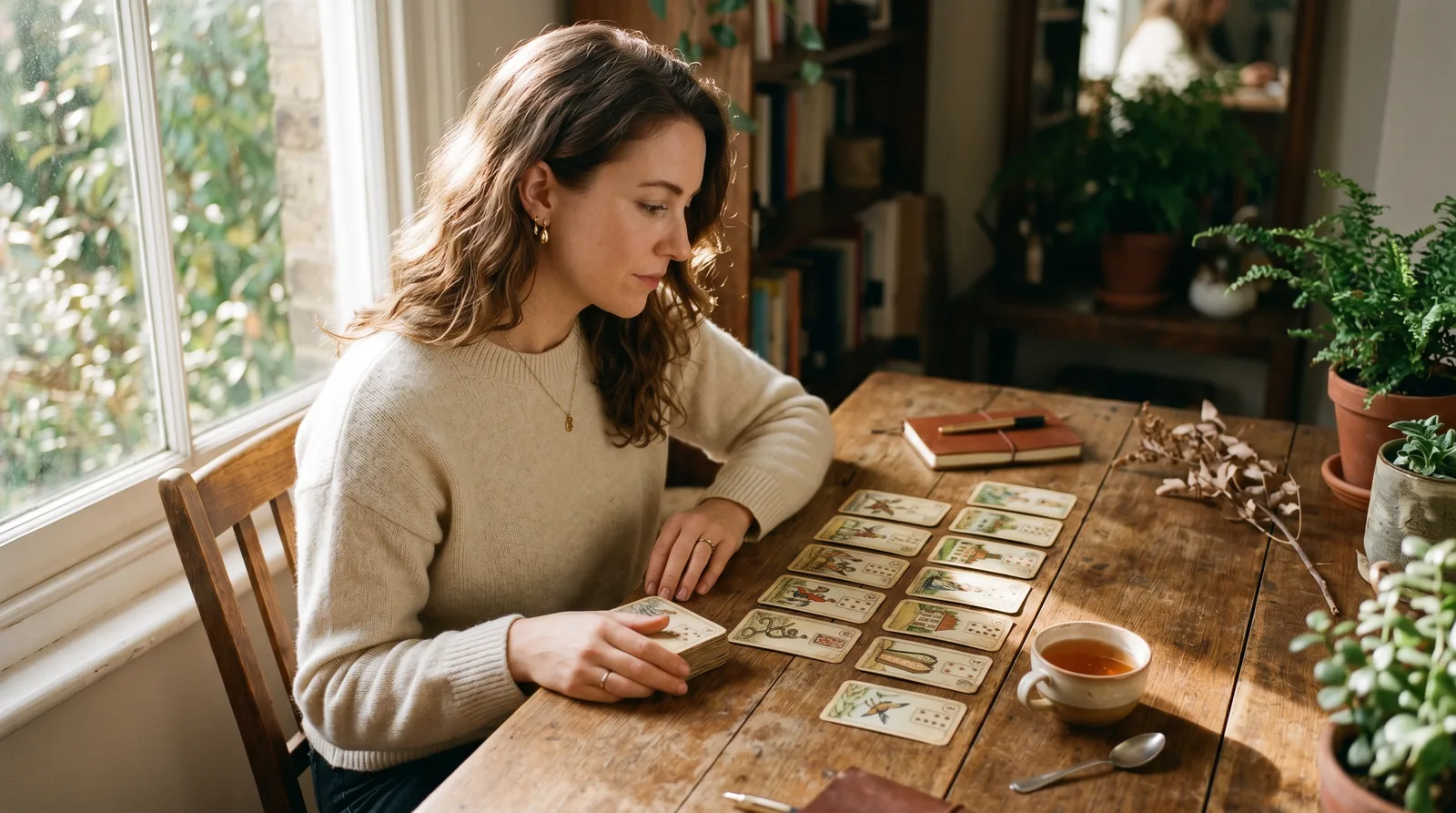
"I built this course so that the moment Lenormand clicks for you — and it will click — you have everything you need to keep going."
— Carla Paton
What you'll learn
What you'll be able to do
- Identify and interpret all 36 Lenormand cards using traditional keywords, symbolism, and positive/challenging expressions
- Construct fluent card combinations and read pairs and triplets as clear, narrative sentences
- Perform accurate readings with classic spreads, from two-card pulls to five-card lines and beyond
- Apply advanced techniques — houses, directions, proximity, and knighting — to unlock deeper layers of meaning
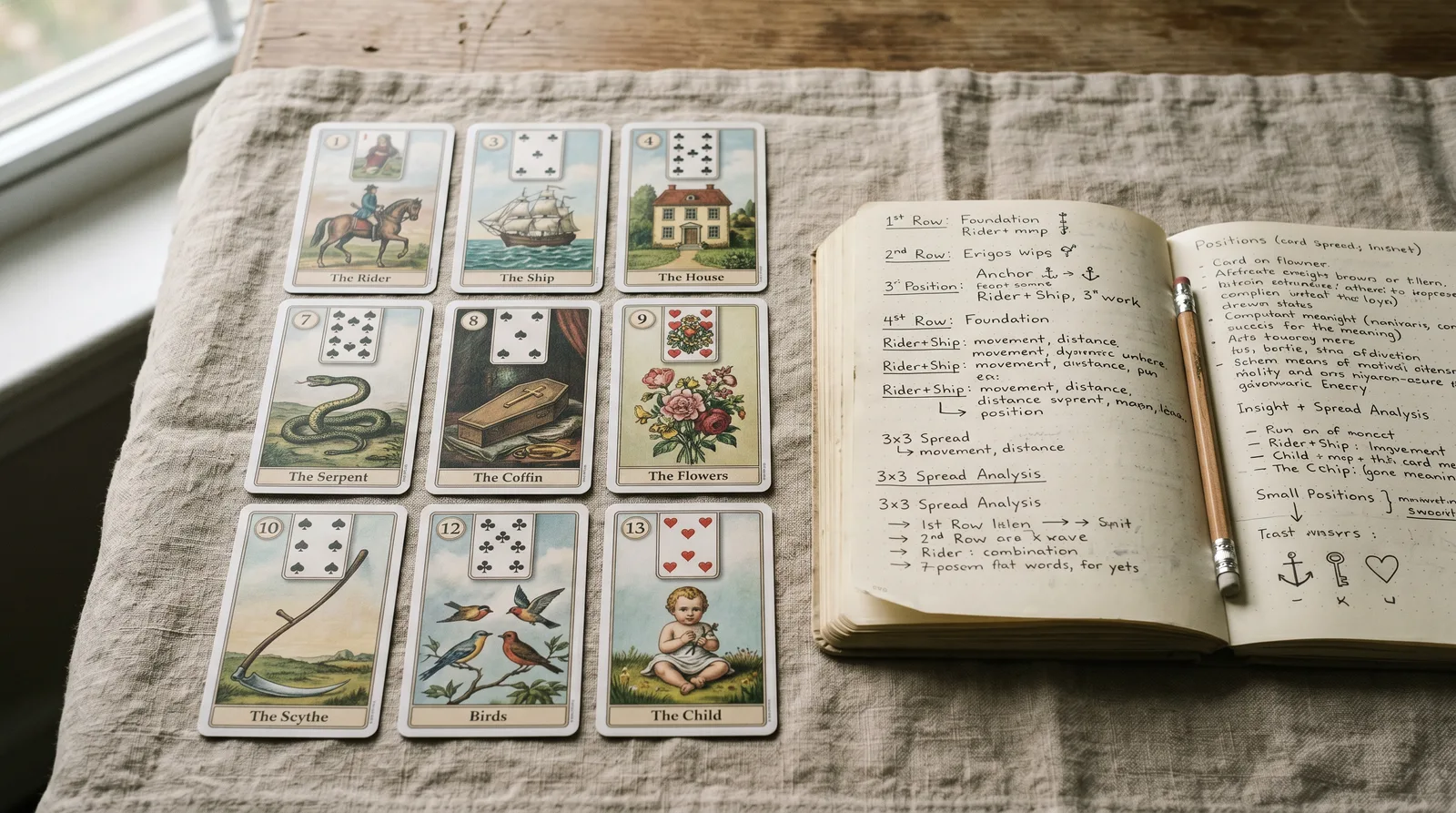
- Lay out and interpret the Grand Tableau, Lenormand's signature full-deck spread
- Conduct clear, ethical readings for yourself and others with a consistent personal style rooted in tradition
How it works
A school that adapts to you
This isn't a set of static videos. Every lesson is generated live and tuned to where you actually are.
We learn your level
A quick placement check tailors your starting point so you're never bored or lost.
Lessons adapt as you go
Each lesson is written for your pace and your goal, adjusting as your skills grow.
Your AI coach keeps you moving
Checkpoints, feedback, and gentle nudges turn progress into a real result.
The curriculum
What's inside your school
6 modules · 19 lessons

Foundations of Lenormand
Establishes the essential historical, structural, and philosophical groundwork before any card meaning is introduced. Students leave this module knowing what makes Lenormand distinctive, how its symbolic language is built, and how to set up a consistent daily practice — all prerequisites for everything that follows.
- 1.1The World of Lenormand: History, Tradition, and the 36-Card DeckIncluded
- 1.2How Lenormand Thinks: The Language of Nouns, Verbs, and ModifiersIncluded
- 1.3Meeting the Deck: Setting Up Your PracticeIncluded
All 36 Cards: Meanings, Symbolism, and Keywords
Provides thorough, systematic coverage of every card in the Lenormand deck — its traditional image, core keywords, positive and challenging expressions, playing-card correspondence, and most common combination partners. Students learn each card as a building block of the system's shared language, not as an isolated meaning to memorise, establishing the vocabulary on which all combination and spread work depends.
- 2.1Cards 1–12: The Personal World (Rider to Whip)Included
- 2.2Cards 13–24: The Social and Material World (Child to Heart)Included
- 2.3Cards 25–36: The Broader World and Destiny (Ring to Cross)Included
The Art of Combination: Reading Pairs, Triplets, and Card Sentences
Transforms isolated card knowledge into fluent Lenormand reading by teaching the combinatorial grammar of the system. Students progress from two-card pairs through three-card triplets to five-card narrative lines, learning to construct clear, specific sentences rather than lists of meanings. This module is the interpretive engine of the course — every spread technique taught later depends on the fluency built here.
- 3.1Two-Card Combinations: Building the Core SentenceIncluded
- 3.2Three-Card Lines and Triplet ReadingIncluded
- 3.3Reading in Narrative Sequences: Five-Card Lines and the Story ArcIncluded
Spreads and Layouts: From Simple Draws to Complex Formations
Introduces the major Lenormand spread formats — from targeted two- and three-card draws through dedicated topic spreads and the nine-card square — and teaches the crucial skill of incorporating timing. Students gain structured frameworks for answering specific real-world questions and build the layout-reading confidence needed before tackling the Grand Tableau. Sequenced after combination training so students read each position as a sentence, not a standalone card.
- 4.1Dedicated Topic Spreads: Relationship, Career, and Decision LayoutsIncluded
- 4.2The Nine-Card Square: Lenormand's Mid-Complexity SpreadIncluded
- 4.3Timing in Lenormand: Cards, Seasons, and Sequential CluesIncluded
Advanced Techniques: Directions, Proximity, Knighting, and Houses
Teaches the four advanced reading techniques that distinguish experienced Lenormand readers from beginners: directional facing, proximity and distance, knighting, and the house system. Each technique adds a layer of contextual meaning on top of the card's base interpretation — enabling readers to answer not just 'what' but 'how', 'how much', 'how soon', and 'in which area of life'. Positioned after spread mastery so students can immediately practice within known layout frameworks.
- 5.1Directions and Facing: What Cards See and AvoidIncluded
- 5.2Proximity and Distance: Reading What's Near and FarIncluded
- 5.3Knighting: Extending Your Reading's ReachIncluded
- 5.4The House System: Every Card Has a HomeIncluded
The Grand Tableau: Reading the Full Deck
Brings all prior learning to its culmination in the Grand Tableau — Lenormand's defining full-deck spread. Students learn to lay the tableau correctly, navigate its spatial logic, apply every advanced technique from Module 5, extract layered narratives across life areas, and deliver a complete, cohesive reading. The module closes by transitioning from technique to personhood: ethics, reading for others, style development, and the ongoing practice that separates a course graduate from a true reader.
- 6.1Laying the Grand Tableau: Formats, Orientation, and First StepsIncluded
- 6.2Reading the Grand Tableau: Layers, Lines, and NarrativeIncluded
- 6.3Personalising Your Practice: Style, Ethics, and Reading for OthersIncluded
Who it's for
Is this you?

Curious beginners
You've always been drawn to divination but never found a system that felt approachable — this course gives you a grounded, step-by-step entry point with no prior knowledge needed.

Tarot readers seeking clarity
You love tarot but crave something more direct and literal — Lenormand's noun-verb grammar and precise combinations offer a refreshing, structured counterpart to your existing practice.
Self-reflection seekers
You want a reliable personal tool for navigating decisions and daily questions — and Lenormand's clear, practical answers make it ideal for grounded, everyday self-guidance.

Tradition-minded learners
You want to learn a system the right way, rooted in history — this course teaches classical keywords, the House system, and the Grand Tableau as the tradition intended.

Aspiring reading practitioners
You'd love to read cards for friends or eventually others — the course closes with ethics, personal style, and reading-for-others guidance to prepare you for exactly that.
Visual and pattern thinkers
You think in symbols, sequences, and connections — Lenormand's combinatorial logic and the sweeping pattern of the Grand Tableau will feel like a language built for your mind.
Questions
Frequently asked
Your teacher
A note from your teacher

Carla Paton
If you've ever felt drawn to cartomancy but weren't sure where to start — or if you've dabbled in tarot and suspected there was something more direct waiting for you — I want you to know that feeling is pointing you somewhere real.
Lenormand is a system that rewards you quickly. There's no sprawling library of archetypes to memorise before you can do a useful reading. There's a grammar — nouns, verbs, modifiers — and once that clicks, the cards start speaking in plain, clear sentences. That moment when a two-card combination suddenly reads like an obvious answer rather than a puzzle to decode? That's what I've built this course to get you to, as smoothly as possible.
What I've tried to do in Lenormand Unlocked is give you the kind of structured, tradition-rooted foundation that I wish had existed when I first picked up this deck. We go through all 36 cards — not as a list to endure, but as a living vocabulary to absorb, with real examples and both their bright and shadowed expressions. Then we start combining them, because that's where Lenormand truly comes alive. Pairs. Triplets. Five-card story arcs. Each step builds on the last, so by the time we reach the Grand Tableau, it doesn't feel overwhelming — it feels earned.
I know the Grand Tableau can look intimidating. Thirty-six cards laid out across a table, all speaking to each other at once. But I promise you: once you've walked through the Houses, learned to trace directions and use knighting, and practised reading in narrative layers, that full-deck spread becomes the most satisfying thing you'll do with a deck of cards. It's not magic — well, perhaps it is a little — but mostly it's a learnable skill, and one you are absolutely capable of.
My approach here is warm but precise. I take this tradition seriously, and I want you to feel that respect for its history and depth throughout the course. But I never want the learning to feel heavy or esoteric. Plain language, vivid examples, and a pace that lets you breathe — that's what you'll find here. Come curious. Leave fluent.
— Carla Paton
Start your journey today
Get instant access — learn at your own pace with an AI coach in your corner.
$19/mo
Recurring billing · cancel anytime
Secure checkout · Instant access
- 6 modules, 19 lessons
- AI-adaptive lessons tuned to your level
- Quizzes & checkpoints to lock in progress
- Your own AI learning coach
- Learn on any device, at your pace
- Full access for as long as you're subscribed