Help your child find shapes hiding everywhere
A hands-on, play-based math adventure that teaches children ages 5–7 to discover 2D and 3D shapes hiding in their everyday world — no worksheets required. Through tactile games, real-life hunts, and joyful movement, little learners build genuine number sense and geometric thinking from the very start.

"I don't teach shapes — I help children discover that shapes were all around them the whole time."— Nisky
What you'll learn
What you'll be able to do
- Identify and name core 2D shapes (circle, square, triangle, rectangle) by sight and touch in everyday objects
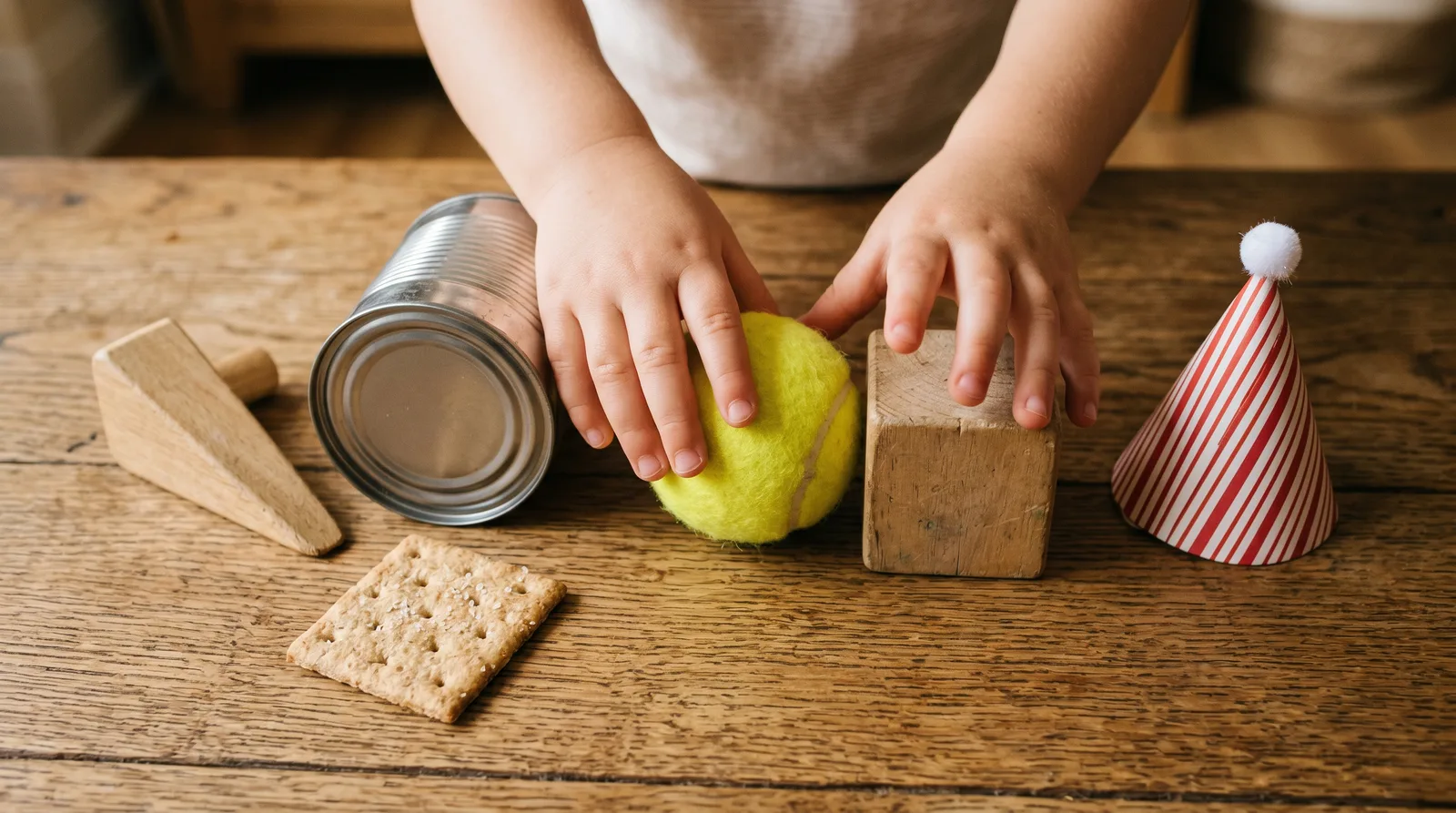
- Recognise key 3D shapes (sphere, cube, cylinder, cone) by handling real household items like tins, balls, and boxes
- Complete a 'shape hunt' independently — searching a room and sorting found objects by their geometric properties
- Describe shapes using simple spatial vocabulary: corners, edges, faces, flat, and curved
- Sort and group a mixed collection of objects by shape, building early classification and logical-thinking skills
- Connect shape knowledge to basic number sense by counting corners and faces, laying the groundwork for future geometry
How it works
A school that adapts to you
This isn't a set of static videos. Every lesson is generated live and tuned to where you actually are.
We learn your level
A quick placement check tailors your starting point so you're never bored or lost.
Lessons adapt as you go
Each lesson is written for your pace and your goal, adjusting as your skills grow.
Your AI coach keeps you moving
Checkpoints, feedback, and gentle nudges turn progress into a real result.
The curriculum
What's inside your school
4 modules · 11 lessons

Meet the Flat Shapes
Children are introduced to the four core 2D shapes through sight and touch, building confident recognition before any written work is introduced. Lessons are sequenced from the most familiar shapes to slightly more complex ones, with every concept anchored to real, everyday objects the child can hold and feel.
- 1.1Hello, Circle and Square!Included
- 1.2Hello, Triangle and Rectangle!Included
- 1.3Corners, Edges, and the Words We UseIncluded
Discover the Solid Shapes
Children move from flat 2D shapes into the world of 3D shapes, always using real household items they can handle. The module is sequenced to build naturally on 2D knowledge: children first explore spheres and cubes (the most distinct solids), then cylinders and cones, and finally discover the link between 2D faces and the 3D shapes they just met — providing the conceptual bridge required by the target outcomes.
- 2.1Spheres and Cubes — Roll or Stack?Included
- 2.2Cylinders and Cones — Everyday Shape StarsIncluded
- 2.32D Meets 3D — Faces and Flat FriendsIncluded
Shape Hunt Adventures
With a solid foundation in both 2D and 3D shapes and the vocabulary to describe them, children now apply their knowledge actively in the real world. The module moves deliberately from a guided group investigation to a fully independent solo shape hunt, scaffolding the autonomy required by the target outcome while keeping the experience joyful and game-like.
- 3.1Becoming a Shape DetectiveIncluded
- 3.2My Solo Shape HuntIncluded
Sort It, Group It, Know It
The final module consolidates everything by shifting from recognition and hunting to higher-order classification and early number-sense tasks. Children sort mixed collections, count corners and faces, and use full descriptive language to compare shapes — cementing every target outcome and laying the groundwork for future geometry work.
- 4.1Sorting by ShapeIncluded
- 4.2Counting Corners and FacesIncluded
- 4.3Shape Talk — Describing and ComparingIncluded
Who it's for
Is this you?

Worksheet-weary parents
You want your child to build real math skills but you're done fighting over pencil-and-paper drills — this is the hands-on, joyful alternative you've been looking for.

Early-years classroom teachers
The shape-hunt and sorting activities slot perfectly into an early-years setting, sparking group discussion and physical exploration that whole-class worksheets simply can't.

Home-educating families
A fully structured, self-contained geometry unit means you get a clear learning arc without having to plan every activity from scratch — using only things already in your home.

Parents of wiggly learners
If your child learns by moving, touching, and doing rather than sitting still, the tactile games and movement-based hunts in this course were made specifically for them.

Caregivers boosting school readiness
Whether your child is heading into reception or already in Key Stage 1, this course builds the foundational shape and spatial vocabulary that underpins early school maths.

Screen-time-conscious families
Lessons prompt children to look up, pick things up, and explore the physical world — making this one of the most genuinely screen-light learning experiences available.
Questions
Frequently asked
Your teacher
A note from your teacher
Nisky
I know that look. It's the one your child gives a worksheet — that little flicker of do I have to? before they've even picked up the pencil. I've seen it a hundred times, and here's what I've learned after years in early-years education: it's not that young children don't love math. It's that drill-and-fill was never really designed for the way they actually learn.
Children aged 5 to 7 are built to discover. They want to touch things, carry things, sort things into piles, and announce their findings at the top of their lungs. Little Shape Explorers starts right there — with a circle in a biscuit tin lid, a sphere in a orange sitting on the kitchen counter, a triangle hiding in a sandwich. No special equipment. No worksheets. Just wide-open eyes and the whole house as a classroom.
We move through the course in three big adventures. First, we meet the flat shapes — really meet them, by finding them in real life and feeling their corners and edges with our fingers. Then we discover the solid shapes, learning the brilliant difference between things that roll and things that stack. Finally, your child graduates to becoming a Shape Detective — hunting independently, sorting confidently, and describing what they find using proper geometric language. Corners. Faces. Curved. Flat. Real words, earned through real exploration.
The thing I hear most from parents after their children finish is some version of: "They won't stop pointing out shapes everywhere we go." That's the moment I'm designing for. Not a test score — a habit of noticing. A child who looks at the world and sees the mathematics already living inside it.
If you've been searching for a way to make early math feel less like school and more like play — and still genuinely build the skills your child needs — you've found it. Come explore with us. The shapes are already hiding everywhere. Let's find them together.
— Nisky
Start your journey today
Join get instant access — learn at your own pace with an AI coach in your corner.
$5/mo
Recurring billing · cancel anytime
Enrolling a child? Sign up as a parent — you'll add your student right here after.
Secure checkout · Instant access
- 4 modules, 11 lessons
- AI-adaptive lessons tuned to your level
- Quizzes & checkpoints to lock in progress
- Your own AI learning coach
- Learn on any device, at your pace
- Full access for as long as you're subscribed