Cook like a chef, think like a scientist, eat like a poet
Mario Linguine Culinary Academy teaches you the unbreakable rules behind every great dish — the food science, the technique, and the professional mindset — so you never need to blindly follow a recipe again.
"Recipes are just the beginning — once you understand why the technique works, the whole kitchen opens up to you."
— Robert T Burroughs
What you'll learn
What you'll be able to do
- Execute foundational knife skills and heat-control techniques with professional precision, adapting them confidently to any recipe or ingredient.
- Apply food science principles — the Maillard reaction, emulsification, gluten development, and seasoning balance — to troubleshoot and correct mistakes in real time.
- Build classic stocks, mother sauces, and their derivatives from scratch, understanding the structural logic that makes every sauce work.
- Fabricate, cure, and cook proteins correctly and fabricate fresh pasta from dough to finished dish, including regional Italian shapes and fillings.
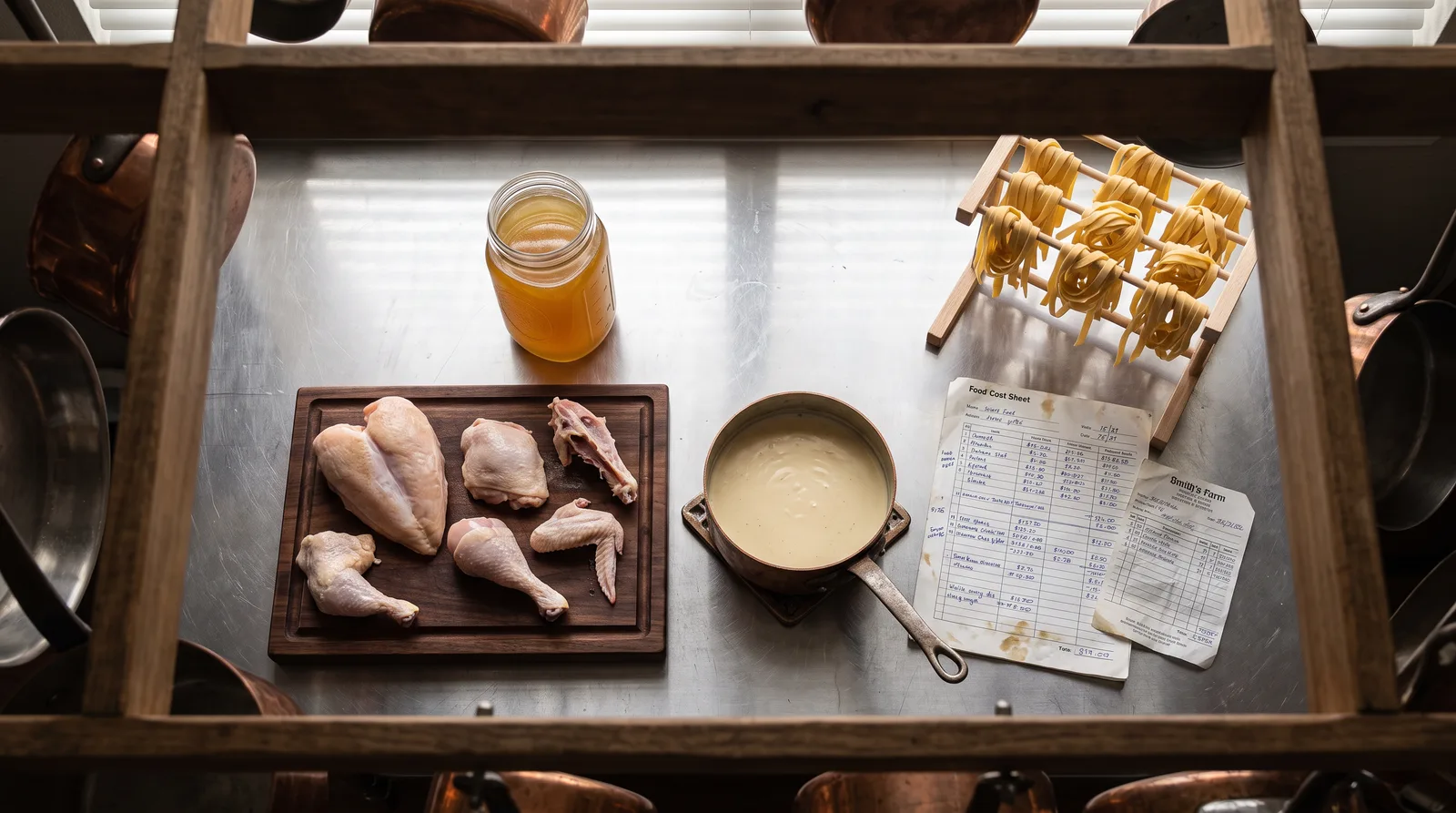
- Develop and cost a menu like a food entrepreneur: calculate food-cost percentages, reduce waste, source seasonally, and tell a farm-to-table story.
- Capture compelling food photographs and apply wine-pairing and barbecue principles to present and serve complete, restaurant-quality dining experiences.
How it works
A school that adapts to you
This isn't a set of static videos. Every lesson is generated live and tuned to where you actually are.
We learn your level
A quick placement check tailors your starting point so you're never bored or lost.
Lessons adapt as you go
Each lesson is written for your pace and your goal, adjusting as your skills grow.
Your AI coach keeps you moving
Checkpoints, feedback, and gentle nudges turn progress into a real result.
The curriculum
What's inside your school
6 modules · 30 lessons

The Professional Kitchen Mindset & Knife Mastery
Establishes how professional cooks think, work, and set up their environment, then builds precise knife skills as the foundation of all technique.
- 1.1Thinking Like a ChefIncluded
- 1.2Knife Anatomy & SelectionIncluded
- 1.3Core Cuts & Precision SkillsIncluded
- 1.4Knife Maintenance & SharpeningIncluded
- 1.5Speed, Safety & Kitchen EfficiencyIncluded
Heat, Food Science & the Art of Seasoning
Explains the physics and chemistry behind every cooking method so students can control heat intentionally and season food with professional confidence.
- 2.1How Heat Works: Conduction, Convection & RadiationIncluded
- 2.2Dry-Heat Cooking MethodsIncluded
- 2.3Moist-Heat & Combination Cooking MethodsIncluded
- 2.4The Science of SeasoningIncluded
- 2.5Emulsification, Gluten & Other Key Food Science PrinciplesIncluded
Stocks, Mother Sauces & Their Derivatives
Teaching Goal
Take the student from having little or no understanding of classical sauces to being able to confidently build, modify, troubleshoot, pair, and improvise sauces using the logic of the classical French system — while recognizing that great sauce traditions extend far beyond France.
A student may enter this lesson not knowing the difference between béchamel and mayonnaise. That is acceptable.
By the end, that same student should be able to make a proper Mornay, explain why it works, recognize what can cause it to become grainy or greasy, select an appropriate cheese, adjust its consistency for the intended dish, and understand how the same principles connect to sauces and preparations found throughout the world.
The objective is professional understanding without requiring professional experience.
Begin With the Family Tree
Never teach small sauces as a vocabulary list.
Teach every sauce through five questions:
Where did we start? — the parent sauce or structural foundation.
What did we add or change?
What did that change do? — flavor, texture, aroma, acidity, richness, color or stability.
Why does the sauce work?
Where can we use the same principle elsewhere?
The student should learn to see sauces as systems.
Example: Béchamel → Mornay
Start with béchamel:
Milk + white roux + seasoning = béchamel
Then transform it:
Béchamel + cheese = Mornay
But do not stop with the formula.
Explain why the roux thickens the milk, why cheese should generally be incorporated away from aggressive heat, why some cheeses melt more smoothly than others, why excessive heat can create a greasy or grainy sauce, and why the desired consistency changes depending upon whether the Mornay will coat vegetables, enrich gratin, accompany eggs, or become part of another preparation.
The student hasn't merely learned a recipe.
They have learned sauce behavior.
Classical Derivative Families
Explore the important derivatives of all five mother sauces in meaningful depth.
Béchamel
Study Mornay, Soubise, Nantua-style preparations, mustard variations and other appropriate derivatives.
Connect the family to preparations such as:
gratins
croque monsieur
lasagne
baked pasta
vegetable preparations
cheese sauces
creamy casserole structures
Discuss where classical terminology and modern culinary usage differ.
Velouté
Study the major velouté families and the importance of the stock underneath them.
Explore Suprême, Allemande and appropriate wine-, mushroom-, cream- and liaison-finished sauces.
Teach the student to ask:
Chicken, fish or veal velouté?
The liquid foundation changes the identity and appropriate use of the finished sauce.
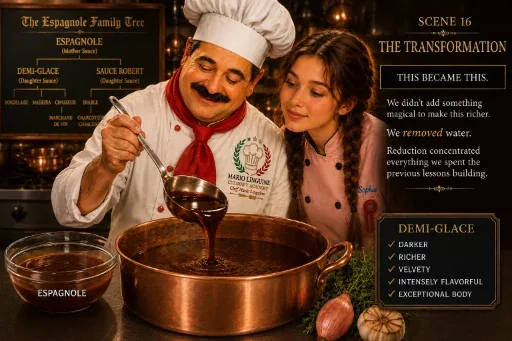
Espagnole & Demi-Glace
Move deeply into the brown-sauce family:
Bordelaise
Chasseur
Robert
Madeira
Marchand de Vin
mushroom derivatives
wine reductions
mustard-based derivatives
Show how reduction concentrates flavor and why a sauce intended for beef should not simply taste like thickened beef stock.
Teach balance among gelatin, reduction, aromatics, alcohol, acidity, fat and seasoning.
Hollandaise
Move beyond “butter and egg yolks.”
Study:
Béarnaise
Choron
Mousseline
Maltaise
appropriate herb and reduction variations
Use these sauces to teach emulsification at a deeper level.
Students should understand what is happening between water, fat and emulsifier, how temperature affects that relationship, why hollandaise breaks and how a broken sauce can often be rescued.
Tomato
Explore both the historical classical French mother sauce and the much larger world of tomato-based sauces.
This distinction matters.
Classical French tomato sauce is not the universal ancestor of every tomato sauce on Earth.
Use it as the doorway into understanding how different culinary traditions manipulate the same ingredient in radically different ways.
Beyond Escoffier: The International Sauce Kitchen
Once students understand the French organizational system, expand the concept.
Compare classical sauce structures with sauces and condiments from other culinary traditions without pretending that every international sauce is a derivative of a French mother sauce.
Explore examples such as:
Italy: salsa di pomodoro, ragù, pesto Genovese, salsa verde, aglio e olio, butter-and-cheese emulsions and pan sauces.
Mexico: salsa roja, salsa verde, mole, adobo and chile-based sauces.
Spain: romesco, allioli and sofrito-based preparations.
India: gravies constructed from onions, tomatoes, spices, dairy, nuts and other regional foundations.
East and Southeast Asia: soy-based sauces, fermented sauces, curry pastes, coconut-based sauces, dipping sauces and starch-thickened preparations.
Middle East and Eastern Mediterranean: tahini sauces, yogurt sauces, toum and herb-based sauces.
Students should compare techniques rather than force these cuisines into French classifications.
Ask:
What thickens it?
Where does the fat come from?
Where does the acidity come from?
What carries the aroma?
Is it an emulsion?
Is it reduced?
Is it fermented?
Is it cooked or raw?
What creates balance?
Now the student is learning to analyze virtually any sauce placed in front of them.
Sauce Troubleshooting
Treat mistakes as part of professional sauce education.
Students must learn to diagnose:
broken emulsions
scorched dairy
raw flour flavor
lumpy roux-thickened sauces
greasy cheese sauces
grainy Mornay
weak stock
over-reduced sauces
sauces that are too salty after reduction
excessive acidity
excessive sweetness
muddy flavor
poor nappe
incorrect viscosity
skin formation
dull color
poorly incorporated butter
improperly cooked wine
sauces overwhelmed by alcohol
seasoning before versus after reduction
Do not merely tell students how to fix a problem.
Explain what happened.
From Recipe Follower to Saucier
Progressively remove the recipe.
Early exercise:
Make Mornay using a complete formula.
Intermediate exercise:
Given béchamel, Gruyère, Parmesan, Dijon and seasonings, construct an appropriate sauce for cauliflower gratin.
Advanced exercise:
You have roasted chicken, shallots, mushrooms, white wine, chicken stock, butter, Dijon mustard, herbs and cream. Develop a sauce for the chicken and explain every decision.
Final challenge:
Give the student an unfamiliar dish and a selection of available ingredients.
Require them to design a sauce by determining:
the foundation → the flavor direction → the technique → the balance → the consistency → the finish.
The student must defend the choices.
Standard for Mastery
Memorizing the five mother sauces is not mastery.
Naming twenty derivatives is not mastery.
A student has mastered this lesson when they can walk into a kitchen, examine the ingredients available, understand the dish being prepared, and confidently say:
“I know how to build a sauce for this — and I know why it will work.”
- 3.1Stock Fundamentals: Bones, Aromatics & TimeIncluded
- 3.2The Five Mother SaucesIncluded
- 3.3Small Sauces & DerivativesIncluded
- 3.4Pan Sauces, Reductions & DeglazingIncluded
- 3.5Modern Sauce Techniques & TroubleshootingIncluded
Proteins, Pasta & Italian Regional Cuisine
Covers professional protein fabrication, curing, and cooking alongside fresh pasta production and the regional Italian traditions that give dishes their identity.
- 4.1Meat Fabrication: Breaking Down Primal CutsIncluded
- 4.2Curing, Brining & MarinatingIncluded
- 4.3Cooking Proteins to PerfectionIncluded
- 4.4Fresh Pasta: Dough Science & Classical ShapesIncluded
- 4.5Filled Pasta, Saucing Logic & Regional Italian TraditionsIncluded
Baking, Barbecue & Capturing the Plate
Develops bread and pastry fundamentals, live-fire barbecue mastery, food photography skills, and wine-pairing knowledge to complete the dining experience.
- 5.1Baking Science: Flour, Leavening & StructureIncluded
- 5.2Bread & Pizza FundamentalsIncluded
- 5.3Barbecue: Fire, Smoke & Low-and-Slow TechniqueIncluded
- 5.4Wine Knowledge & Food PairingIncluded
- 5.5Food Photography: Lighting, Composition & StorytellingIncluded
Menu Development, Food Costing & Farm-to-Table Entrepreneurship
Transforms culinary skill into business acumen by teaching menu design, food-cost control, seasonal sourcing, and the farm-to-table story.
- 6.1Menu Design PrinciplesIncluded
- 6.2Food Costing & Recipe CostingIncluded
- 6.3Waste Reduction & Whole-Ingredient CookingIncluded
- 6.4Seasonal Sourcing & the Farm-to-Table PhilosophyIncluded
- 6.5Telling Your Food Story: Brand, Concept & LaunchIncluded
Who it's for
Is this you?

The Passionate Home Cook
She's moved beyond cookbooks and wants to understand the science and technique behind every dish she makes.

The Aspiring Culinary Pro
He's eyeing culinary school or a kitchen career and wants the professional foundation — knife skills, sauces, and proteins — before he walks through the door.

The Food Entrepreneur
She's building a food concept and needs both the culinary credibility and the business skills — menu costing, seasonal sourcing, and brand storytelling — to make it viable.

The Serious Dinner Party Host
He wants to cook restaurant-quality meals for guests and finally master the plating, wine pairing, and sauce-building that separate good from extraordinary.

The Food Content Creator
She creates food content and wants both deeper culinary knowledge and the food photography skills to make every dish look as stunning as it tastes.

The Career-Changer
He's leaving a corporate career to pursue his love of food and needs a rigorous, structured culinary education that treats him like the serious adult learner he is.
Questions
Frequently asked
Your teacher
A note from your teacher
Robert T Burroughs
If you've ever stood at the stove, followed a recipe to the letter, and still ended up with something flat — too salty, or not salty enough, a sauce that broke, a sear that steamed — you already know the problem. Recipes tell you what to do. Almost none of them tell you why.
That gap is where most cooks stay stuck. And it's exactly the gap I built this Academy to close.
I've spent my career in professional kitchens and culinary education, and the single biggest thing I've learned is this: the cooks who improve fastest aren't the ones who practice the most. They're the ones who understand the most. When you know why an emulsion breaks, you can fix it. When you understand how conduction, convection, and radiation behave differently, you stop overcooking and undercooking by instinct and start cooking by knowledge. When you've built a proper stock from bones and aromatics and time, every sauce you make for the rest of your life gets better — because you understand the structure underneath it.
That's the philosophy behind every lesson in this Academy. We move from knife skills and kitchen mindset all the way through stocks, mother sauces, protein fabrication, fresh pasta, baking, barbecue, food photography, and the full business of menu development and farm-to-table entrepreneurship. The curriculum is thorough because cooking is thorough. But I've always believed that rigor and warmth aren't opposites — and you'll find both in abundance here. I'll explain the Maillard reaction the way I'd explain it to a curious friend at the kitchen table, not in a lecture hall.
Here's the objection I hear most: "I'm just a home cook — is this too advanced for me?" The honest answer is that professional technique was never meant to be gatekept. The reason great chefs cook the way they do isn't magic — it's knowledge, and knowledge can be shared. Whether you're cooking for your family, building a food brand, or dreaming about culinary school, this Academy will meet you exactly where you are and take you somewhere genuinely further.
I'm so glad you're here. Let's get into the kitchen together — and this time, let's understand every single thing we do there.
— Robert T Burroughs
Start your journey today
Get instant access — learn at your own pace with an AI coach in your corner.
$49/mo
Recurring billing · cancel anytime
Secure checkout · Instant access
- 6 modules, 30 lessons
- AI-adaptive lessons tuned to your level
- Quizzes & checkpoints to lock in progress
- Your own AI learning coach
- Learn on any device, at your pace
- Full access for as long as you're subscribed