Master Nursing Care Plans: An AI-Tutor & Course
From your first med-surg rotation through NP-level SOAP notes, Nursing Care Plan Tutor gives you a specialty-by-specialty framework — built on NANDA-I, real patient scenarios, and evidence-based rationales — so you can stop guessing and start documenting with genuine clinical confidence. This is an AI-Adaptive learning course and tutoring program that takes you through the lessons, quizzes, flashcards, and study guides based on your individual responses and questions. It was created by a ICU/ER R.N. who loves using technology to solve real world problems.
"A care plan written with real clinical reasoning isn't busywork — it's advocacy on paper, and I'll show you exactly how to write one."— AIAdaptiveSchool
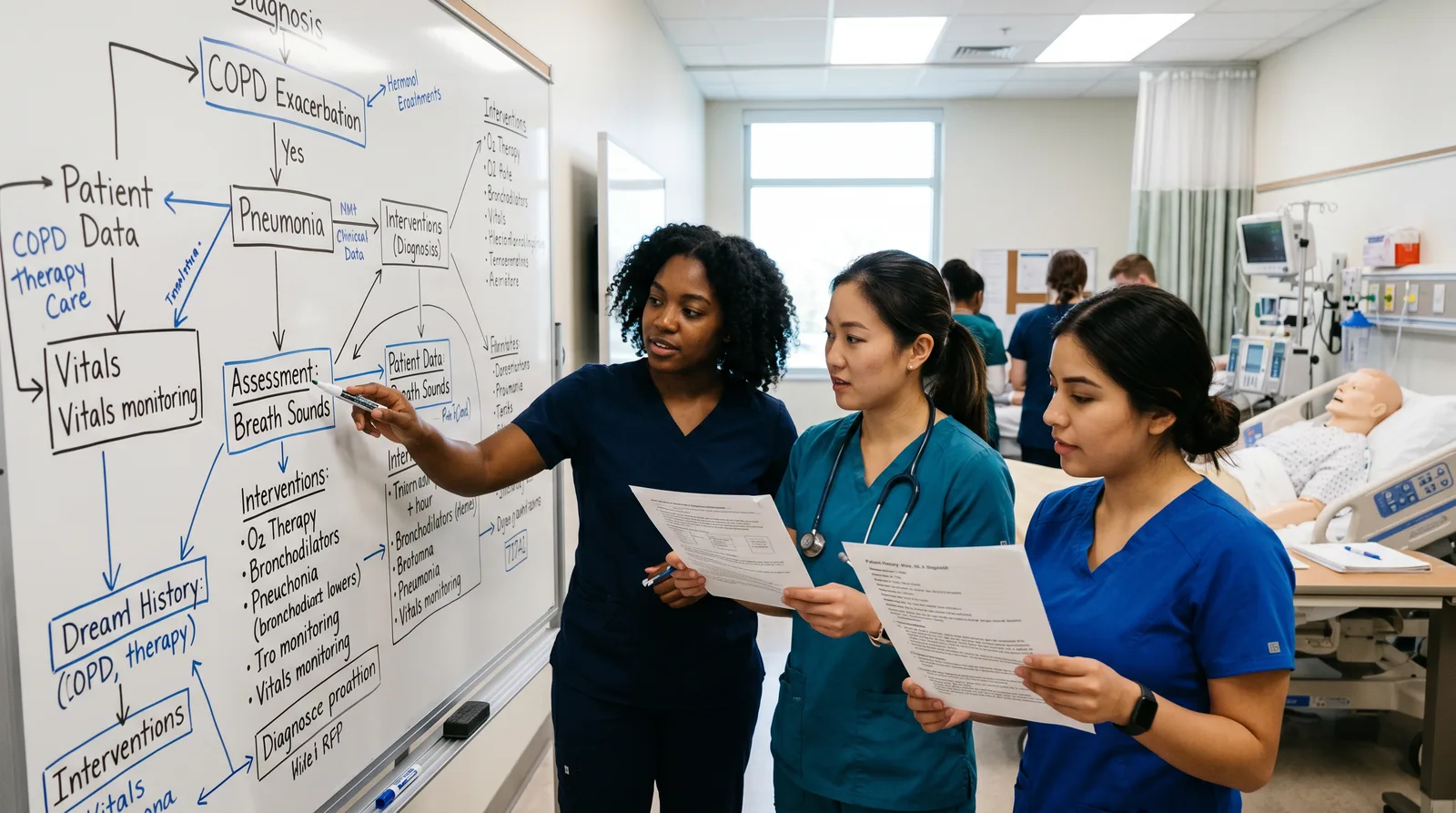
What you'll learn
What you'll be able to do
- Write complete, NANDA-I–aligned nursing care plans with accurate diagnoses, measurable goals, evidence-based interventions, and evaluations for any adult med-surg patient
- Construct specialty-specific care plans across pediatrics, OB-GYN, psychiatric, emergency, critical care, home health, community health, school nursing, holistic, forensic, and geriatric nursing rotations
- Identify priority nursing diagnoses using clinical cues and apply Maslow's hierarchy and ABC frameworks to rank patient problems confidently
- Develop culturally sensitive, patient-centered care plans for vulnerable populations including geriatric, pediatric, and psychiatric patients
- Translate NANDA-I nursing diagnoses into SOAP-note and problem-list formats used in advanced practice, bridging RN clinical thinking to NP-level differential reasoning
- Critically evaluate and revise existing care plans using outcome-based evaluation criteria, preparing for NCLEX-style questions and real-world clinical documentation standards
How it works
A school that adapts to you
This isn't a set of static videos. Every lesson is generated live and tuned to where you actually are.
We learn your level
A quick placement check tailors your starting point so you're never bored or lost.
Lessons adapt as you go
Each lesson is written for your pace and your goal, adjusting as your skills grow.
Your AI coach keeps you moving
Checkpoints, feedback, and gentle nudges turn progress into a real result.
The curriculum
What's inside your school
6 modules · 29 lessons

Foundations of Nursing Care Plans
Builds the universal framework every nursing student needs before writing a single care plan, covering NANDA-I, clinical reasoning, and priority-setting tools.
- 1.1Anatomy of a Nursing Care PlanIncluded
- 1.2NANDA-I Nursing Diagnoses ExplainedIncluded
- 1.3Clinical Cue Clustering and Data InterpretationIncluded
- 1.4Prioritizing Problems with Maslow and ABCsIncluded
- 1.5Writing SMART Goals and Measurable OutcomesIncluded
Evidence-Based Interventions and Evaluation
Moves students from diagnosis and goal-setting to selecting research-supported interventions and critically evaluating whether care plans are working.
- 2.1Choosing Evidence-Based Nursing InterventionsIncluded
- 2.2Writing Intervention Rationales That Demonstrate Clinical ThinkingIncluded
- 2.3Evaluating Patient Outcomes and Revising the PlanIncluded
- 2.4Avoiding Common Care Plan ErrorsIncluded
- 2.5NCLEX-Style Thinking Applied to Care PlansIncluded
Medical-Surgical Nursing Care Plans for Adults
Walks students through high-priority adult med-surg conditions across major body systems, practicing complete care plans for each specialty area.
- 3.1Cardiovascular ConditionsIncluded
- 3.2Respiratory ConditionsIncluded
- 3.3Neurological ConditionsIncluded
- 3.4Endocrine and Metabolic ConditionsIncluded
- 3.5Gastrointestinal, Renal, and Musculoskeletal ConditionsIncluded
Specialty Clinical Rotations — Part 1
Guides students through writing specialty-specific care plans for pediatrics, OB-GYN, and psychiatric nursing, emphasizing population-unique diagnoses and ethical considerations.
- 4.1Pediatric Nursing Care PlansIncluded
- 4.2Obstetric and Gynecological Nursing Care PlansIncluded
- 4.3Psychiatric and Mental Health Nursing Care PlansIncluded
- 4.4Cultural Sensitivity and Patient-Centered Language in Specialty Care PlansIncluded
Specialty Clinical Rotations — Part 2
Extends specialty care plan practice to emergency, critical care, home health, community health, school, holistic, forensic, and geriatric nursing settings.
- 5.1Emergency Nursing Care PlansIncluded
- 5.2Critical Care Nursing Care PlansIncluded
- 5.3Home Health and Community Health Nursing Care PlansIncluded
- 5.4School Nursing, Holistic, and Forensic Nursing Care PlansIncluded
- 5.5Geriatric Nursing Care PlansIncluded
Bridging to Nurse Practitioner-Level Clinical Reasoning
Introduces RN-to-NP bridge students to how nursing care plan thinking translates into SOAP notes, problem lists, differential diagnosis, and advanced practice documentation.
- 6.1From Nursing Diagnosis to Medical Differential DiagnosisIncluded
- 6.2Translating Care Plans into SOAP Note FormatIncluded
- 6.3Problem Lists and Chronic Disease Management at the NP LevelIncluded
- 6.4Ordering and Interpreting Diagnostics to Inform the PlanIncluded
- 6.5Prescriptive Authority, Collaborative Practice, and Care CoordinationIncluded
Who it's for
Is this you?

ADN Students in Med-Surg
You need a repeatable process for writing NANDA-I–aligned care plans before your next clinical post-conference, and this clinic gives you exactly that — starting with the foundations most programs skip.

BSN Students in Specialty Rotations
Whether you're in peds, OB, psych, or the ICU, the specialty-specific modules walk you through the priority diagnoses and documentation norms for each unique patient population.

New Graduate RNs
You're past school but your care plan confidence hasn't caught up to your clinical instincts yet — this clinic helps you translate what you already know at the bedside into documentation that reflects your expertise.

RN-to-NP Bridge Students
The advanced section closes the gap between nursing diagnosis and medical differential reasoning, guiding you through SOAP notes, problem lists, and the clinical thinking expected at the practitioner level.

NCLEX Preppers
Care plan mastery and NCLEX success use the same clinical reasoning muscles — prioritizing problems, selecting evidence-based interventions, and evaluating outcomes under pressure.
Nurses Returning to School
If your care plan fundamentals have gotten rusty or were never solid to begin with, this clinic rebuilds your foundation systematically before taking you into advanced practice territory.
Questions
Frequently asked
Your teacher
A note from your teacher

AIAdaptiveSchool
If you've ever sat down to write a nursing care plan and felt your brain go completely blank — I want you to know that's not a sign you're in the wrong profession. It's a sign you were handed a template and told to figure it out. That's not education. That's a frustration tax, and you've already paid enough of it.
I created Care Plan Clinic because I've watched brilliant, caring nursing students and new grads second-guess themselves on paper in ways they never would at the bedside. You can listen to lung sounds, catch a subtle change in a patient's affect, and notice the early signs of deterioration before anyone else in the room — but then you sit down to write the care plan and it feels like you're translating your clinical thinking into a foreign language. The problem isn't your intelligence. The problem is that nobody gave you a reliable process for bridging what you see and know as a nurse to what ends up on the page.
That's exactly what this clinic is built to do. We start with the fundamentals that most programs rush past: how to cluster clinical cues into meaningful patterns, how to rank patient problems when everything feels urgent, and how to write goals that are specific enough to actually measure. Then we move through every major clinical rotation — not with generic advice, but with the priority diagnoses, real patient scenarios, and specialty-specific norms you need to document confidently in med-surg, pediatrics, OB, psych, the ED, the ICU, home health, community settings, and more. For those of you bridging to NP practice, we go further — into SOAP note translation, differential reasoning, chronic disease management, and the collaborative practice realities of advanced roles.
I won't condescend to you. I won't bury you in jargon. And I won't pretend that care plans are exciting just to keep you engaged — but I will show you that mastering them is genuinely empowering. A care plan written with real clinical reasoning is advocacy on paper. It's proof that you see your patient fully. That matters.
You already think like a nurse. Let me help you write like one. The clinic is open — come on in.
— AIAdaptiveSchool
Start your journey today
Join get instant access — learn at your own pace with an AI coach in your corner.
$5/mo
Recurring billing · cancel anytime
Secure checkout · Instant access
- 6 modules, 29 lessons
- AI-adaptive lessons tuned to your level
- Quizzes & checkpoints to lock in progress
- Your own AI learning coach
- Learn on any device, at your pace
- Full access for as long as you're subscribed