Interpret any ABG with clinical confidence
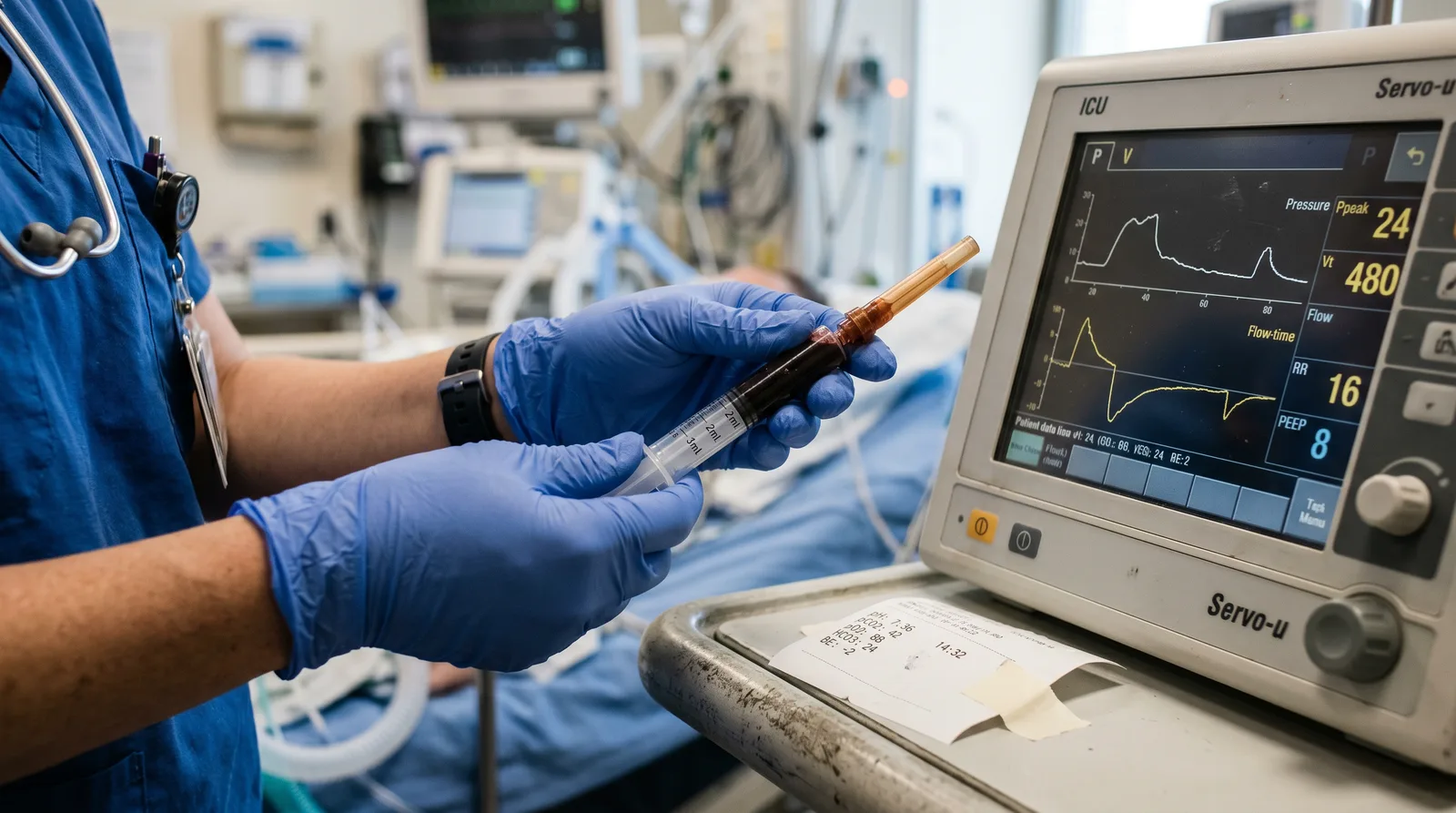
A clinically rigorous, level-by-level school that takes nurses from ABG basics to expert-level critical care mastery — covering biochemistry, patient assessment, ventilator management, nursing interventions, and drug therapy for adult patients in ICU, ER, PACU, and OR settings.

"When you understand the physiology, the ABG stops being a puzzle and starts being your patient telling you exactly what they need."— AIAdaptativeSchool
What you'll learn
What you'll be able to do
- Systematically interpret any ABG result using a stepwise clinical framework, correctly identifying respiratory vs. metabolic acidosis and alkalosis with full or partial compensation
- Explain the underlying biochemistry of acid-base balance — including the bicarbonate buffer system, Henderson-Hasselbalch equation, and renal and respiratory compensatory mechanisms — and connect them directly to patient lab values
- Recognize the clinical signs and symptoms in adult patients for each ABG disorder and accurately predict which imbalances are present before the lab result returns
- Recommend and anticipate physician orders with confidence, including evidence-based nursing interventions for each acid-base disturbance across ICU, ER, PACU, and OR critical care environments
- Adjust and interpret ventilator settings (FiO₂, tidal volume, respiratory rate, PEEP, I:E ratio) to correct respiratory and mixed acid-base imbalances in mechanically ventilated adult patients
- Apply targeted drug therapy regimens — including sodium bicarbonate, acetazolamide, bronchodilators, diuretics, and sedation protocols — to pharmacologically correct ABG imbalances in adult critical care patients
How it works
A school that adapts to you
This isn't a set of static videos. Every lesson is generated live and tuned to where you actually are.
We learn your level
A quick placement check tailors your starting point so you're never bored or lost.
Lessons adapt as you go
Each lesson is written for your pace and your goal, adjusting as your skills grow.
Your AI coach keeps you moving
Checkpoints, feedback, and gentle nudges turn progress into a real result.
The curriculum
What's inside your school
6 modules · 22 lessons

ABG Foundations: The Biochemistry of Acid-Base Balance
This foundational module establishes the biochemical and physiological bedrock every nurse needs before interpreting any ABG. Students explore how the body defines and defends pH, master the buffer systems that act within seconds to milliseconds, and decode every value printed on an ABG report. Designed for beginners but essential for intermediate and advanced students who want to close knowledge gaps. Explainer videos animate molecular-level processes; infographics map buffer systems visually; slides provide reference tables for all normal ABG ranges.
- 1.1Acid-Base Chemistry and the Body's Buffer SystemsIncluded
- 1.2Respiratory Regulation of pH: The Lungs as an Acid-Base OrganIncluded
- 1.3Renal Regulation of pH: The Kidneys as the Long-Game BufferIncluded
- 1.4Reading an ABG Report: Every Value and What It MeansIncluded
Systematic ABG Interpretation: The Stepwise Clinical Framework
This is the core interpretation module. Students master a rigorous, reproducible 5-step clinical framework and apply it to every ABG pattern: respiratory acidosis, respiratory alkalosis, metabolic acidosis, metabolic alkalosis, and complex mixed disorders. Intermediate learners build interpretive speed and accuracy; advanced learners tackle mixed disorders, compensation adequacy, and Winter's formula. Explainer videos walk through each step on real ABG examples; slides provide the framework as a portable quick-reference; infographics map compensation relationships visually.
- 2.1The 5-Step ABG Interpretation MethodIncluded
- 2.2Respiratory Acidosis and Alkalosis: Recognition and PatternsIncluded
- 2.3Metabolic Acidosis and Alkalosis: Recognition and PatternsIncluded
- 2.4Mixed Acid-Base Disorders and Complex Clinical CasesIncluded
Clinical Signs, Symptoms, and Bedside Recognition
This module bridges biochemistry and interpretation with the physical patient. Students learn to recognize the clinical signs and symptoms of every acid-base disorder in adult patients before the lab result returns — a critical ICU, ER, and PACU competency. Pattern recognition, early warning signs, and system-by-system assessment are taught. Explainer videos show real clinical presentations; infographics map signs and symptoms by disorder; slides provide head-to-toe assessment frameworks nurses can use at the bedside.
- 3.1Signs and Symptoms of Respiratory Acid-Base DisordersIncluded
- 3.2Signs and Symptoms of Metabolic Acid-Base DisordersIncluded
- 3.3Predicting ABGs Before the Lab Returns: Clinical Pattern RecognitionIncluded
Nursing Interventions and Anticipating Physician Orders
This module transforms knowledge into action. Students learn evidence-based nursing interventions for every ABG disorder across ICU, ER, PACU, and OR settings, and develop the clinical confidence to anticipate physician orders, advocate for patients using SBAR, and recommend evidence-based interventions directly to medical providers. Independent nursing actions are clearly distinguished from collaborative and physician-driven interventions. Advanced learners are trained to lead bedside ABG management discussions with the medical team.
- 4.1Evidence-Based Nursing Interventions for Respiratory Acid-Base DisordersIncluded
- 4.2Evidence-Based Nursing Interventions for Metabolic Acid-Base DisordersIncluded
- 4.3Anticipating Physician Orders: SBAR, Clinical Advocacy, and Proactive NursingIncluded
Ventilator Management: Correcting ABG Imbalances in Mechanically Ventilated Patients
This module is the definitive ventilator management resource for nurses in ICU, ER, PACU, and OR settings. Students learn every major ventilator setting and mode, understand precisely how each setting affects ABG values, and develop the clinical competency to interpret ventilator-ABG relationships, recognize when settings need adjustment, and recommend evidence-based changes to the medical team. Beginners master the basics; advanced students manage complex mixed disorders and assess weaning readiness. Explainer videos demonstrate ventilator interfaces; infographics map setting-to-ABG relationships; slides serve as clinical reference cards.
- 5.1Ventilator Basics: Settings, Modes, and Their ABG EffectsIncluded
- 5.2Correcting Respiratory Acidosis and Alkalosis via Ventilator AdjustmentsIncluded
- 5.3PEEP, FiO₂, and Oxygenation: Managing the PaO₂ Side of the ABGIncluded
- 5.4Ventilator Management in Mixed Disorders and Weaning ReadinessIncluded
Drug Therapy for ABG Imbalances: Pharmacological Correction in Adult Critical Care
This final module delivers a comprehensive, agent-by-agent pharmacological curriculum for correcting ABG imbalances in adult critical care patients. Every major drug class is covered: alkalizing agents, carbonic anhydrase inhibitors, diuretics, bronchodilators, corticosteroids, sedation and analgesia, and neuromuscular blockade agents. For each drug or drug class, students learn the mechanism of action on acid-base balance, clinical indications tied to specific ABG disorders, dosing considerations, nursing monitoring priorities, adverse effects, and drug interactions. Evidence-based regimens for DKA, ARDS, COPD exacerbation, metabolic alkalosis, and post-operative respiratory depression are applied throughout.
- 6.1Sodium Bicarbonate, Citrate, and Alkalizing AgentsIncluded
- 6.2Acetazolamide, Diuretics, and Agents for Metabolic AlkalosisIncluded
- 6.3Bronchodilators, Corticosteroids, and Respiratory Drug TherapyIncluded
- 6.4Sedation, Analgesia, and Neuromuscular Blockade in Ventilated PatientsIncluded
Who it's for
Is this you?

Nursing students in clinicals
Build a rigorous ABG foundation before your first critical care rotation so you walk in reasoning — not guessing.

New grad ICU nurses
Close the gap between classroom mnemonics and real ventilated patients by mastering the 5-step framework and evidence-based interventions from day one.

Experienced ER nurses
Sharpen your bedside pattern recognition so you can predict acid-base disorders and anticipate orders before the lab result even returns.

PACU & OR nurses
Gain the ventilator and drug therapy fluency to manage post-anesthesia respiratory compromise and mixed disorders with precision and confidence.

ICU charge nurses
Deepen your pharmacological and ventilator management expertise — including sedation protocols and weaning readiness — to lead your team at the highest clinical level.

RNs cross-training to critical care
Make a confident transition into the ICU or ER by systematically mastering the acid-base reasoning, drug therapy, and ventilator skills the unit demands.
Questions
Frequently asked
Your teacher
A note from your teacher

AIAdaptativeSchool
If you've ever stood at a patient's bedside staring at an ABG result and felt a wave of uncertainty — you're not behind, and you're not alone. Most nursing programs give you a framework, a mnemonic, and a worksheet. Then you hit the ICU, and you're looking at a pH of 7.28, a bicarb of 14, and a CO₂ of 32 on a septic patient who's working hard to breathe, and no mnemonic in the world tells you what to do next. That gap — between knowing the label and understanding the physiology — is exactly what this school is designed to close.
I built this curriculum around a simple conviction: ABG interpretation isn't a skill you look up. It's a clinical reasoning process that has to become second nature, and it only becomes second nature when you understand why every value moves the way it does. That's why this school starts at the biochemistry — not to make it harder, but to make everything else easier. When you understand the bicarbonate buffer system and how the kidneys and lungs compensate in real time, the patterns stop being arbitrary and start being predictable. You stop memorizing and start reasoning.
From that foundation, we build fast. By the time you're in Module 4, you're not just interpreting ABGs — you're walking into a room, reading your patient's clinical presentation, and forming a working diagnosis before the lab calls back. You're framing your SBAR with precision, anticipating the orders before they're written, and advocating from a position of genuine clinical authority. That's the transformation this school is designed to produce: not just competence, but the kind of confident, proactive clinical judgment that changes patient outcomes.
I know the biggest objection: you're busy, you're already under pressure in your unit, and you're not sure you have the bandwidth for a course this rigorous. Here's what I'd ask you to consider — the cost of uncertainty in critical care is real, and it compounds every shift. This school is structured level by level precisely so you can build systematically, reinforce at each stage, and arrive at ventilator management and drug therapy with the foundation to actually absorb it. You don't have to master it all at once. You just have to start.
If you're a nursing student heading into your first clinical rotation, a new grad walking into the ICU, or an experienced RN who wants to go from competent to truly expert — this school was built for where you are right now. Come ready to think critically, use the correct terminology, and hold yourself to a high clinical standard. Your patients are counting on exactly that.
— AIAdaptativeSchool
Start your journey today
Join get instant access — learn at your own pace with an AI coach in your corner.
$1/wk
Recurring billing · cancel anytime
Secure checkout · Instant access
- 6 modules, 22 lessons
- AI-adaptive lessons tuned to your level
- Quizzes & checkpoints to lock in progress
- Your own AI learning coach
- Learn on any device, at your pace
- Full access for as long as you're subscribed