
Read Hamlet like a scholar, think like a critic
A rigorous, line-by-line journey through Shakespeare's greatest tragedy — from first reading to scholarly confidence. Learn to decode Early Modern English, analyze character and soliloquy, and engage with four centuries of critical thought.
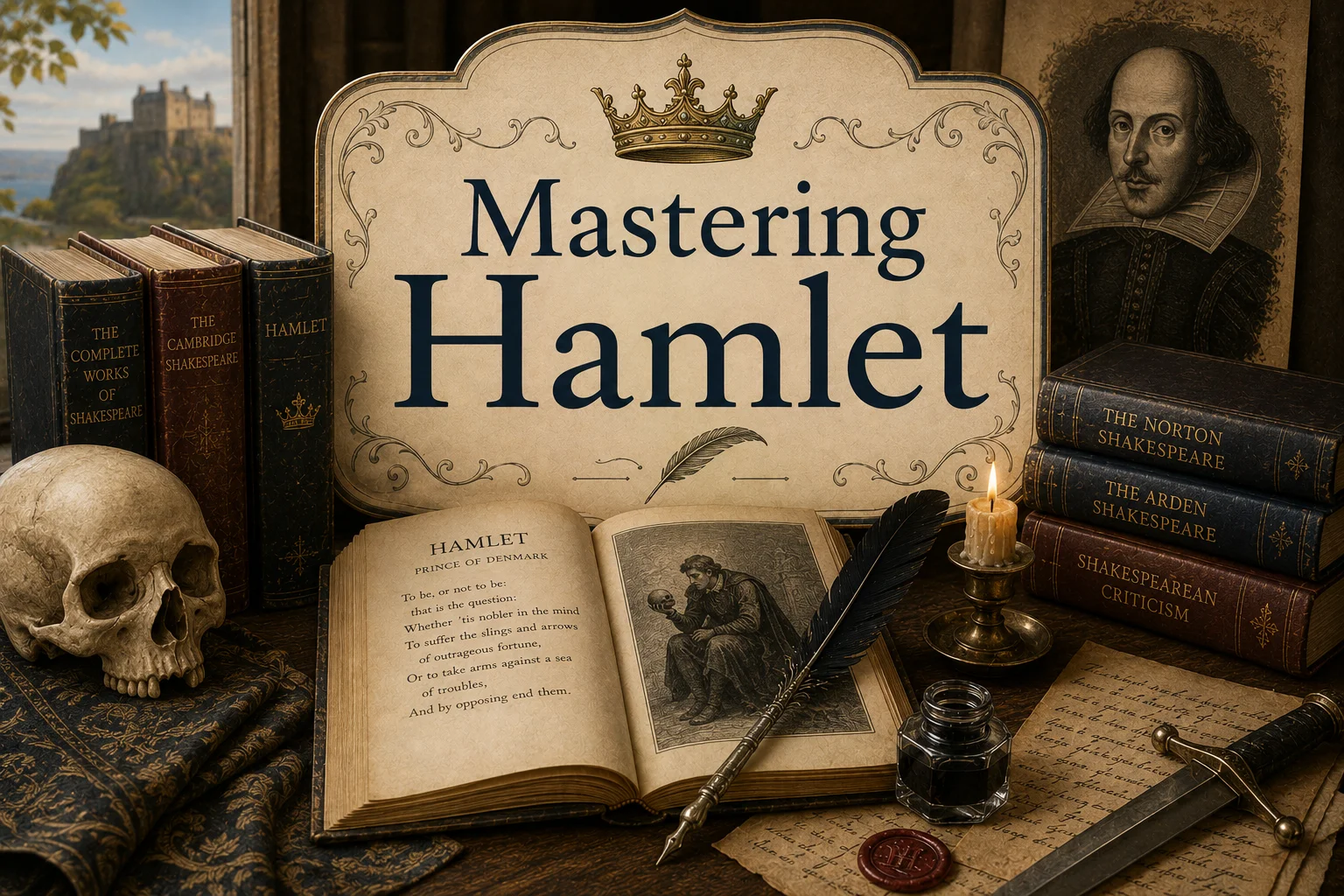
"The gap between following the plot and genuinely inhabiting the text is real — and every module in this school is designed to close it."
— Carla Paton

What you'll learn
What you'll be able to do
- Read Hamlet fluently in its original Early Modern English, decoding Shakespeare's vocabulary, syntax, and wordplay with confidence.
- Perform detailed close readings of every act and scene, identifying how language, structure, and imagery build meaning.
- Interpret all major soliloquies line by line, understanding their philosophical weight and dramatic function.
- Situate the play within its Elizabethan context — Renaissance thought, revenge tragedy conventions, religious uncertainty, and political power.
- Apply multiple critical lenses — psychoanalytic, feminist, New Historicist, and performance-based — to form original interpretations of Hamlet's characters and themes.
- Write well-evidenced literary analyses that move fluently between textual detail and broader argument, suitable for academic or professional contexts.
How it works
A school that adapts to you
This isn't a set of static videos. Every lesson is generated live and tuned to where you actually are.
We learn your level
A quick placement check tailors your starting point so you're never bored or lost.
Lessons adapt as you go
Each lesson is written for your pace and your goal, adjusting as your skills grow.
Your AI coach keeps you moving
Checkpoints, feedback, and gentle nudges turn progress into a real result.
The curriculum
What's inside your school
6 modules · 24 lessons

Reading Shakespeare's Language
Before students can engage meaningfully with Hamlet's themes or close-read its scenes, they need a reliable toolkit for navigating Early Modern English. This foundational module builds that toolkit systematically — covering grammar, vocabulary, poetic form, and performance — so that all subsequent reading and analysis rests on confident, independent engagement with the original text rather than summaries or modern translations.
- 1.1Early Modern English: Grammar and SyntaxIncluded
- 1.2Vocabulary, Wordplay, and PunsIncluded
- 1.3Verse, Prose, and Poetic FormIncluded
- 1.4Performance, Rhetoric, and the Spoken TextIncluded
The World of the Play: Elizabethan Contexts
Hamlet emerges from a specific historical, religious, and intellectual moment. This module provides the contextual knowledge students need to understand why the play's questions felt urgent to its first audiences and why they remain so today. Lessons move from the broad genre conventions of revenge tragedy through the theological controversy surrounding ghosts, the political anxieties of the Elizabethan court, and the Renaissance humanist ideas that shape Hamlet's extraordinary interiority. This contextual grounding precedes act-by-act reading so that students encounter the scenes with the right interpretive equipment.
- 2.1The Revenge Tragedy GenreIncluded
- 2.2Religion, the Reformation, and the Ghost's TheologyIncluded
- 2.3Political Power, Succession, and the Elizabethan CourtIncluded
- 2.4Renaissance Humanism, Melancholy, and the SelfIncluded
Act-by-Act Close Reading
With language skills and historical context firmly in place, students now read the play in full — act by act — through guided close reading. Each lesson focuses on the dramatic and thematic work of its act, modelling and then practising the skills of scene-level analysis: how Shakespeare builds tension, develops character, deploys imagery, and advances argument through specific language choices. This is the experiential core of the course, and it deliberately precedes the dedicated soliloquy module so that students encounter those speeches within their dramatic context first.
- 3.1Act 1: The World Out of JointIncluded
- 3.2Act 2: Performance and SurveillanceIncluded
- 3.3Act 3: The CrisisIncluded
- 3.4Act 4: Fracture and FloodIncluded
- 3.5Act 5: Endings and AcceptanceIncluded
The Soliloquies
Having encountered all of Hamlet's soliloquies in dramatic context during Module 3, students now return to them for deep, dedicated line-by-line analysis. This module treats the soliloquies as the philosophical and psychological spine of the play: each one maps a new stage in Hamlet's thinking, and together they trace an arc from paralysed grief to hard-won acceptance. Lessons are grouped to reflect that philosophical arc rather than simply proceeding chronologically, and the module builds directly toward the literary analysis writing taught in Module 6.
- 4.1The First and Second Soliloquies: Grief, Disgust, and the Limits of ActionIncluded
- 4.2The Third and Fourth Soliloquies: Doubt, Theatre, and the Test of the GhostIncluded
- 4.3The Final Soliloquies: The Readiness and AcceptanceIncluded
Characters, Themes, and Critical Perspectives
This module moves from the text itself to the critical conversation around it. Students deepen their understanding of character and theme through multiple interpretive lenses — psychoanalytic, feminist, New Historicist, and performance-based — and learn to apply those lenses as analytical tools rather than mechanical labels. The module also covers the play's symbolism and imagery in a dedicated lesson, and introduces the feminist critical perspective as a fully independent lens (rather than absorbed into a character lesson), correcting an imbalance in the draft curriculum. Each lesson builds toward the independent critical writing required in Module 6.
- 5.1Hamlet: Delay, Interiority, and the Problem of IdentityIncluded
- 5.2Ophelia and Gertrude: Women, Power, and Feminist RecoveryIncluded
- 5.3Claudius, Polonius, and Laertes: Foils and the Ethics of ActionIncluded
- 5.4Symbolism, Imagery, and Recurring MotifsIncluded
- 5.5Critical Lenses in Practice: Psychoanalytic, Feminist, New Historicist, and Performance-Based ReadingsIncluded
Adaptations, Legacy, and the Art of Literary Analysis
The final module moves outward from the text to its afterlife and inward to students' own analytical writing. Students explore how major stage and film adaptations have reinterpreted the play, examine Hamlet's extraordinary reach into later literature and culture, and — in the module's culminating sequence — build a complete literary essay from first close reading to polished argument. The writing lessons are expanded and sequenced more carefully than in the draft to ensure that all the skills developed across the course are mobilised in the final written work.
- 6.1Stage and Film AdaptationsIncluded
- 6.2Hamlet's Afterlife: Influence and Cultural LegacyIncluded
- 6.3Writing Literary Analysis: From Close Reading to ArgumentIncluded
Who it's for
Is this you?

University students
Essay deadlines, seminar prep, or exam revision — this course gives you the close-reading skills and critical vocabulary to write about Hamlet with genuine scholarly confidence.

Secondary school teachers
Deepen your own command of the text, the contexts, and the criticism so you can walk into every Hamlet lesson with something new and intellectually alive to offer your students.

Actors and directors
Understanding the rhetorical structure, philosophical weight, and performance history of every soliloquy transforms how you approach the role in the rehearsal room.

Serious lifelong learners
You've always known Hamlet was worth understanding properly — this course finally gives you the rigorous, guided pathway to get there on your own terms.

Creative writers
Studying how Shakespeare builds character, manipulates form, and layers imagery will sharpen your own craft in ways that no writing workshop quite replicates.

Independent scholars
Whether you're researching an adaptation, exploring critical theory, or revisiting a text you studied long ago, this course offers the depth and intellectual seriousness the subject demands.
Questions
Frequently asked
Your teacher
A note from your teacher

Carla Paton
If you've ever finished reading Hamlet — or watching it, or studying it for an exam — with the nagging feeling that you understood the story but missed the play, you're in exactly the right place. That gap between following the plot and genuinely inhabiting the text is real, and it's not a reflection of your intelligence. It's a consequence of not yet having the tools that make Shakespeare's language, his theatrical thinking, and his extraordinary intellectual world fully available to you. This school exists to close that gap.
I designed this curriculum because I believe that Hamlet deserves to be read seriously — not reverently, not timidly, but with the kind of close, rigorous, curious attention that the text rewards at every level. The play is dense with wordplay you can only catch if you understand Early Modern English. It's in constant, knowing dialogue with the revenge tragedy tradition. Its theological stakes — the Ghost, purgatory, damnation — only become legible against the backdrop of the Reformation. And Hamlet himself only becomes fully comprehensible when you understand Renaissance melancholy, the philosophy of action, and the extraordinary theatrical self-consciousness that Shakespeare builds into every soliloquy. These aren't academic extras. They're the play.
I know that "literary theory" can sound like a door being closed rather than opened. So I want to be direct: the psychoanalytic, feminist, New Historicist, and performance-based frameworks in this course are taught as instruments of interpretation, not as ends in themselves. You'll apply them to specific passages, specific characters, specific scenes — and you'll find that they genuinely help you say more precise and more interesting things about a text you thought you already knew. Ophelia and Gertrude, in particular, look entirely different once you've read them through a feminist recovery lens. Claudius becomes a far more complex figure when you approach the court through a New Historicist eye.
What I'm most committed to, though, is the close reading itself. Act by act, scene by scene, soliloquy by soliloquy. The patience to sit with a verse line and ask what it is doing — not just what it means, but how it means, and why Shakespeare made this particular choice in this particular moment. That habit of attention is the single most transferable thing this course can give you, whether you're an actor working on a role, a teacher preparing a lesson, a student writing an essay, or a reader who simply loves this play and wants to love it more intelligently.
The readiness, as Hamlet finally concludes, is all. Come ready to read carefully, to think hard, and to be surprised by how much more there is to find.
— Carla Paton
Start your journey today
Get instant access — learn at your own pace with an AI coach in your corner.
$19/mo
Recurring billing · cancel anytime
Secure checkout · Instant access
- 6 modules, 24 lessons
- AI-adaptive lessons tuned to your level
- Quizzes & checkpoints to lock in progress
- Your own AI learning coach
- Learn on any device, at your pace
- Full access for as long as you're subscribed