Decode any medical term on sight
Master the roots, prefixes, and suffixes that build clinical language — so you can read a patient chart, ace a certification exam, and communicate precisely in any healthcare setting, starting from zero.

Once you see the system inside medical language, you'll never look at an unfamiliar term and feel lost again.— Tracy Burke
What you'll learn
What you'll be able to do
- Decode unfamiliar medical terms instantly by identifying roots, prefixes, and suffixes
- Correctly spell and pronounce over 500 high-frequency clinical terms
- Interpret terminology across major body systems — cardiology, neurology, gastroenterology, and more
- Read and understand clinical notes, lab reports, and patient charts with confidence
- Build a working medical vocabulary for exams such as the CMA, NCLEX, or MCAT
- Communicate precisely with clinical teams, reducing errors in documentation and handoffs
How it works
A school that adapts to you
This isn't a set of static videos. Every lesson is generated live and tuned to where you actually are.
We learn your level
A quick placement check tailors your starting point so you're never bored or lost.
Lessons adapt as you go
Each lesson is written for your pace and your goal, adjusting as your skills grow.
Your AI coach keeps you moving
Checkpoints, feedback, and gentle nudges turn progress into a real result.
The curriculum
What's inside your school
6 modules · 26 lessons

The Building Blocks of Medical Language
Introduces the logic of medical word construction — roots, prefixes, suffixes, and combining forms — so students can decode any term systematically.
- 1.1How Medical Terms Are BuiltIncluded
- 1.2Word Roots and Combining FormsIncluded
- 1.3Prefixes: Modifying Meaning from the FrontIncluded
- 1.4Suffixes: Completing the Clinical PictureIncluded
- 1.5Decoding and Building Terms: Putting It All TogetherIncluded
Spelling, Pronunciation, and Plurals
Builds the accuracy and fluency students need to correctly spell, say, and pluralize clinical terms in real healthcare settings.
- 2.1Pronunciation Rules for Medical TermsIncluded
- 2.2Spelling Pitfalls and Silent LettersIncluded
- 2.3Forming Plurals the Medical WayIncluded
- 2.4Abbreviations, Acronyms, and SymbolsIncluded
Terminology Across Body Systems
Applies word-part knowledge to the vocabulary of major body systems, from the heart and brain to the digestive tract and beyond.
- 3.1Cardiovascular and Respiratory TerminologyIncluded
- 3.2Neurological and Musculoskeletal TerminologyIncluded
- 3.3Gastrointestinal and Urinary TerminologyIncluded
- 3.4Endocrine, Reproductive, and Integumentary TerminologyIncluded
- 3.5Hematology, Immunology, and Oncology TerminologyIncluded
Diagnostic and Procedural Language
Focuses on the terminology of tests, imaging, surgeries, and treatments so students can accurately interpret and document clinical events.
- 4.1Laboratory Tests and ValuesIncluded
- 4.2Diagnostic Imaging TermsIncluded
- 4.3Surgical and Procedural Suffixes in ActionIncluded
- 4.4Pharmacology Terminology EssentialsIncluded
Reading Clinical Documents with Confidence
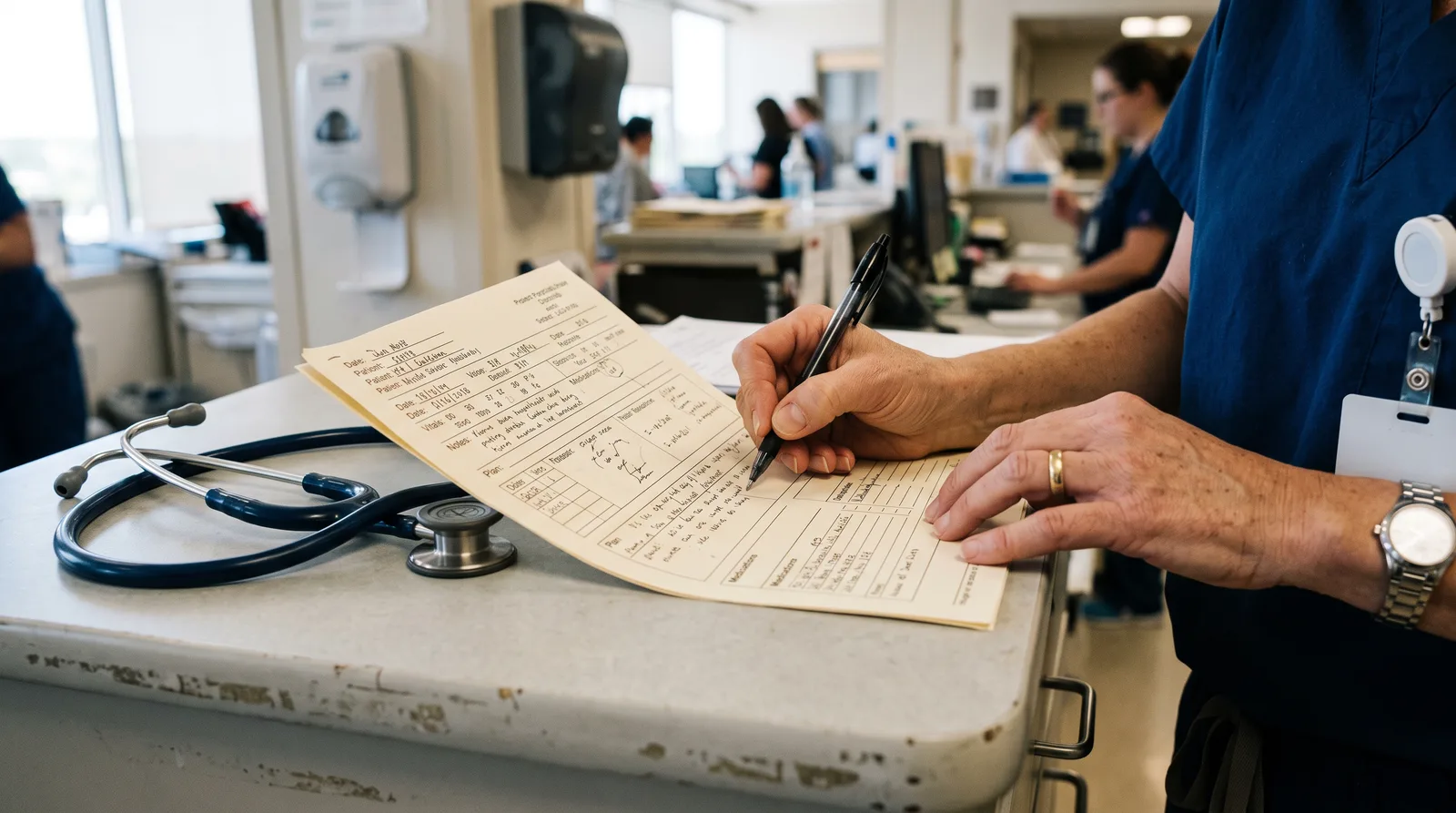
Trains students to interpret real-world clinical texts — chart notes, discharge summaries, lab reports, and referral letters — fluently and accurately.
- 5.1Anatomy of a Patient ChartIncluded
- 5.2Decoding SOAP Notes and Clinical NarrativesIncluded
- 5.3Lab Reports and Diagnostic SummariesIncluded
- 5.4Discharge Summaries and Referral LettersIncluded
Exam Preparation and Professional Fluency
Consolidates and applies the entire course vocabulary to high-stakes exams and real clinical communication scenarios.
- 6.1Medical Terminology for the CMA and Certification ExamsIncluded
- 6.2Precision Communication in Clinical TeamsIncluded
- 6.3Building Your Personal Medical Vocabulary SystemIncluded
- 6.4Comprehensive Vocabulary Review and Final AssessmentIncluded
Who it's for
Is this you?

Pre-Med Students
Build the clinical vocabulary foundation that makes biochemistry, anatomy, and MCAT reading comprehension significantly less daunting.

Nursing Students
Read charts, decode SOAP notes, and walk into NCLEX prep with the terminology fluency that boards — and clinical instructors — expect.

Medical Assistants
Sharpen documentation precision and communicate more confidently with clinical teams by mastering the language behind every procedure and diagnosis.

Allied Health Career-Changers
Step into healthcare from another field without the language barrier — learn the system that makes clinical terms logical, not intimidating.

Healthcare Support Staff
From medical billing to patient intake, understanding clinical terminology means fewer errors, faster work, and greater confidence every shift.

Certification Exam Preppers
Whether you're sitting for the CMA or another allied health credential, this course targets the high-frequency terminology exams test most.
Questions
Frequently asked
Your teacher
A note from your teacher

Tracy Burke
If you've ever stared at a clinical term — maybe something like pericardiocentesis or cholecystolithiasis — and felt a quiet panic set in, I want you to know that feeling is completely normal. And it's completely temporary.
Most people who struggle with medical terminology aren't struggling because the words are too complex. They're struggling because nobody showed them the system. Medical language isn't random — it's built from a surprisingly small set of Latin and Greek parts, stacked in predictable patterns. Once you see that, everything changes. A word that looked impossible becomes a phrase you can read aloud, define, and spell correctly the first time.
That's exactly what I built Medical Word Lab to teach. We start with the architecture — roots, combining forms, prefixes, suffixes — and we build from there. We work through pronunciation and spelling rules that actually make sense when you understand where the words come from. We move through the major body systems so your vocabulary connects to real clinical context, not just a list on a page. And then we get into the documents you'll actually use on the job or in your training: patient charts, SOAP notes, lab reports, discharge summaries. Because knowing words in isolation is one thing; reading a live clinical document with confidence is what you actually need.
I know a lot of you are balancing this alongside clinicals, a job, a family, or all three. So I've built this course to be methodical and efficient — no fluff, no unnecessary detours. Every lesson is designed so you leave it with something you can use immediately, whether that's a new set of word roots, a pronunciation rule that finally clicks, or the ability to read a section of a patient chart you couldn't before.
By the end of Medical Word Lab, you won't have memorized a dictionary. You'll have internalized a system — and that system will keep working for you long after the course is over, through your exams, through your first clinical rotations, and into your career. I'm glad you're here. Let's get to work.
— Tracy Burke
Start your journey today
Join get instant access — learn at your own pace with an AI coach in your corner.
$49.99 · 30 days access
Recurring billing · cancel anytime
Enrolling a child? Sign up as a parent — you'll add your student right here after.
Secure checkout · Instant access
- 6 modules, 26 lessons
- AI-adaptive lessons tuned to your level
- Quizzes & checkpoints to lock in progress
- Your own AI learning coach
- Learn on any device, at your pace
- Full access for as long as you're subscribed