Master a thousand years of Church history
From the ruins of Rome to the eve of the Reformation, this rigorous survey takes serious learners through the primary sources, landmark thinkers, and world-shaping events that made the medieval Church one of history's most consequential institutions.
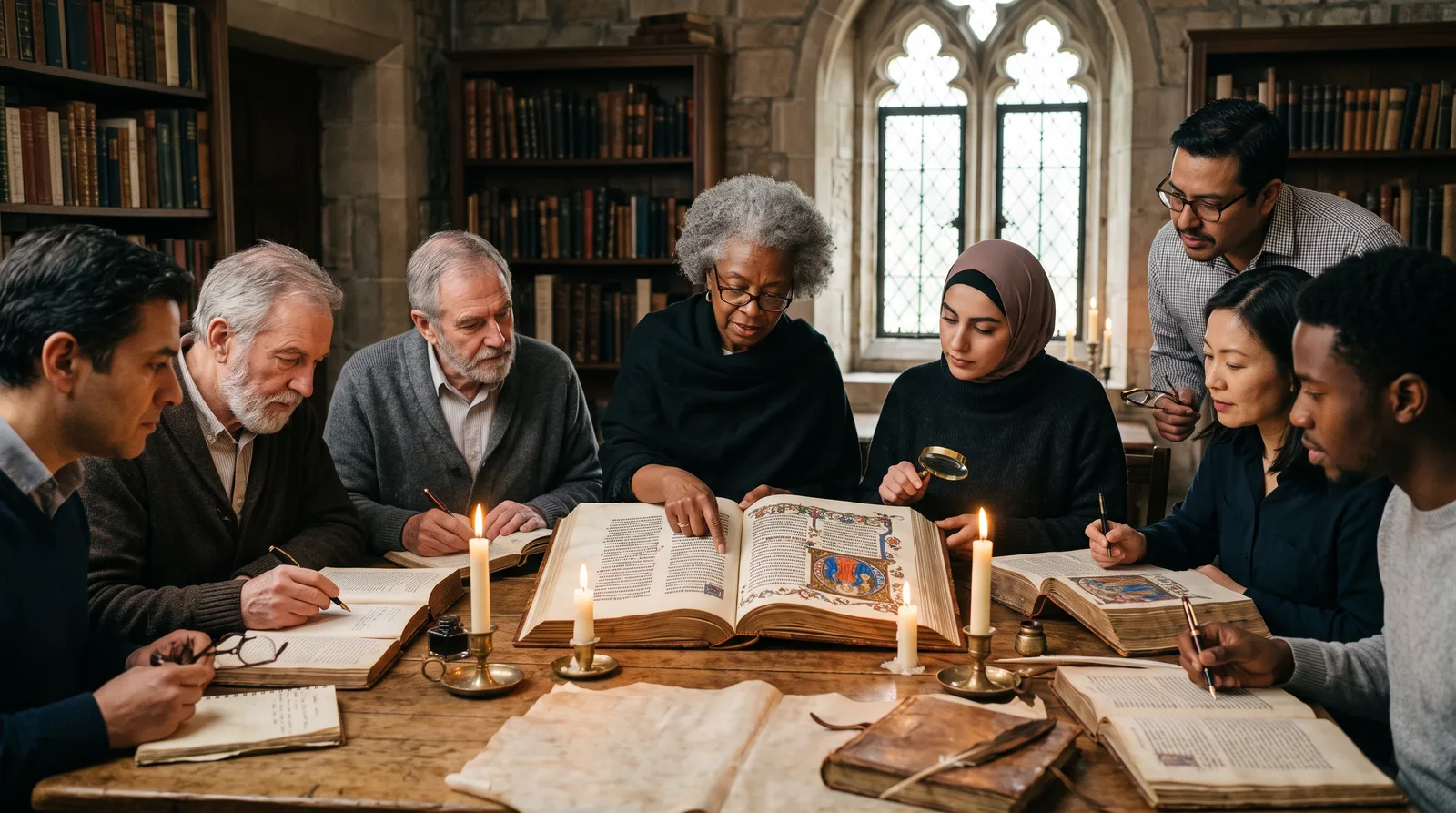
"The medieval Church deserves neither a halo nor a verdict — it deserves to be understood, and that's exactly what we're going to do."
— Theoria
What you'll learn
What you'll be able to do
- Trace the transformation of Christianity from the collapse of the Western Roman Empire through the fifteenth century, situating key events within their political and cultural contexts.
- Analyze the writings and theological contributions of major medieval thinkers — including Gregory the Great, Thomas Aquinas, Julian of Norwich, and Thomas à Kempis — with critical discernment.
- Explain the causes, course, and consequences of landmark events such as the Great Schism of 1054, the Crusades, the rise of scholasticism, and the reform movements that preceded the Reformation.
- Engage primary historical sources — papal decrees, monastic rules, theological treatises, and mystical writings — evaluating them alongside modern scholarship.
- Describe the development of sacramental theology, canon law, monastic spirituality, and medieval mysticism, and trace how each continues to shape Christian doctrine and practice today.
- Assess the medieval Church's achievements and failures with historical empathy and nuance, avoiding both idealization and anachronistic judgment.
How it works
A school that adapts to you
This isn't a set of static videos. Every lesson is generated live and tuned to where you actually are.
We learn your level
A quick placement check tailors your starting point so you're never bored or lost.
Lessons adapt as you go
Each lesson is written for your pace and your goal, adjusting as your skills grow.
Your AI coach keeps you moving
Checkpoints, feedback, and gentle nudges turn progress into a real result.
The curriculum
What's inside your school
6 modules · 31 lessons

The Church After Rome: Foundations of Medieval Christianity (5th–7th Centuries)
Examines how Christianity restructured itself amid the collapse of Roman imperial authority, establishing the theological and institutional foundations that would define the medieval Church.
- 1.1The Fall of the West and the Survival of the ChurchIncluded
- 1.2Gregory the Great and the Shaping of the Medieval PapacyIncluded
- 1.3Monasticism: Benedict, the Rule, and the Monastic MovementIncluded
- 1.4The Byzantine Church: Eastern Christianity and Its Distinct PathIncluded
- 1.5Reading the Sources: How Historians Study the Early Medieval ChurchIncluded
Expansion and Evangelization: Christianity Across Europe (6th–10th Centuries)
Follows the missionary movements that carried Christianity from the British Isles to Scandinavia and Eastern Europe, tracing the figures, methods, and cultural negotiations involved.
- 2.1Patrick, Augustine of Canterbury, and the Christianization of BritainIncluded
- 2.2Boniface and the Evangelization of the Germanic PeoplesIncluded
- 2.3Cyril, Methodius, and Christianity Among the Slavic PeoplesIncluded
- 2.4Charlemagne, the Carolingian Church, and the Idea of Christian EmpireIncluded
- 2.5Popular Piety, Saints, and Relics in Early Medieval ChristianityIncluded
Church and State: Power, Reform, and the High Medieval Papacy (10th–12th Centuries)
Investigates the struggle between ecclesiastical and secular authority, the reform movements that reshaped the papacy, and the emergence of the Holy Roman Empire as a defining tension of medieval life.
- 3.1The Investiture Controversy and the Limits of Papal PowerIncluded
- 3.2The Cluniac Reform and the Renewal of Monastic and Papal LifeIncluded
- 3.3The Great Schism of 1054: East and West DividedIncluded
- 3.4The Crusades: Holy War, Politics, and the Christian ImaginationIncluded
- 3.5Anselm, Faith, and Reason: Theology at the Turn of the Twelfth CenturyIncluded
The Life of the Mind: Scholasticism, Universities, and Theological Debate (12th–13th Centuries)
Traces the rise of cathedral schools and universities, the recovery of Aristotle, and the flowering of scholastic theology through its greatest practitioners and its fiercest critics.
- 4.1Abelard, Bernard, and the Battle Over Method in TheologyIncluded
- 4.2The Rise of Universities and the Birth of Scholastic CultureIncluded
- 4.3Thomas Aquinas and the Summa TheologiaeIncluded
- 4.4Bonaventure and the Franciscan Alternative to Dominican ScholasticismIncluded
- 4.5Heresy, the Inquisition, and the Boundaries of OrthodoxyIncluded
Worship, Sacraments, and Sacred Space: The Texture of Medieval Christian Life
Examines how medieval Christians encountered God through sacramental theology, canon law, the liturgical calendar, Gothic architecture, and the visual culture of the Church.
- 5.1The Seven Sacraments: Theology, Development, and Pastoral PracticeIncluded
- 5.2Canon Law and the Institutional ChurchIncluded
- 5.3Gothic Cathedrals, Sacred Art, and Theology in Stone and GlassIncluded
- 5.4The Liturgical Year: Time, Worship, and Community in Medieval ChristianityIncluded
- 5.5The Mendicant Orders: Franciscans, Dominicans, and Urban ChristianityIncluded
Mysticism, Crisis, and Reform: The Late Medieval Church (14th–15th Centuries)
Explores the spiritual flowering and institutional crises of the late Middle Ages — including plague, schism, and conciliarism — alongside the mystics and reformers who prepared the ground for the Reformation.
- 6.1Catherine of Siena, Julian of Norwich, and the World of Medieval MysticismIncluded
- 6.2The Black Death, Suffering, and the Crisis of FaithIncluded
- 6.3The Western Schism, Conciliarism, and the Question of Church AuthorityIncluded
- 6.4Thomas à Kempis and the Devotio ModernaIncluded
- 6.5Wycliffe, Hus, and the Reform Movements on the Eve of the ReformationIncluded
- 6.6Medieval Christianity's Enduring Legacy: From the Middle Ages to TodayIncluded
Who it's for
Is this you?

Theology students
Fills the medieval gap that most seminary and undergraduate curricula cover too briefly, grounding doctrinal formation in its historical development.

Faith-formed adults
For Catholics, Orthodox Christians, and Protestants who want to understand where their tradition's sacraments, liturgy, and ecclesiology actually came from.

Independent historians
Brings the rigor of primary-source analysis and current scholarship to serious self-directed learners who've outgrown popular history.

Philosophy enthusiasts
Traces the scholastic revolution — Anselm, Abelard, Aquinas, Bonaventure — for anyone who wants to understand how medieval thinkers shaped Western intellectual life.

Lifelong learners
Designed for curious, experienced readers who want university-level depth without jargon, delivered at a pace that rewards reflection.

Reformation-era readers
Provides essential context for anyone studying Luther, Calvin, or the Protestant Reformation — you can't understand the break without understanding what was being broken.
Questions
Frequently asked
Your teacher
A note from your teacher

Theoria
If you've ever found yourself frustrated by a history of Christianity that skips from the Apostles to Luther with a vague wave at "the medieval period," you'll understand why this course exists.
The medieval Church is often the most misread epoch in Christian history — alternately romanticized into a golden age of faith and caricatured as a millennium of superstition and corruption. Neither portrait survives contact with the primary sources. What you actually find, when you read Gregory the Great's pastoral letters or sit with the logic of the Summa Theologiae or follow Julian of Norwich as she wrestles with suffering in her anchorhold, is something far more interesting than either myth: a living institution, full of brilliant and flawed people, attempting to hold together a civilization while arguing furiously about what Christianity actually demands.
That is what I want to share with you. This course covers the full arc — from the fifth century, when the institutional Church stepped into the vacuum left by Rome's collapse, through the fifteenth, when reformers within and beyond the Church were insisting that something had to change. We move through the Christianization of Europe, the great rupture of 1054, the Crusades, the scholastic revolution at Paris and Oxford, the sacramental and liturgical life of ordinary medieval Christians, and the mystical and conciliar movements of the late Middle Ages. At every stage, we read the sources. I believe that engaging a primary text — even a demanding one — is worth more than any amount of secondary summary, and I've built the course accordingly.
I also believe that historical understanding requires a particular kind of discipline: the willingness to understand before you evaluate, to ask why an institution or a thinker did what they did before deciding what you think of it. That doesn't mean withholding judgment forever — the course takes the Crusades, the Inquisition, and the Western Schism seriously as failures as well as events. But it does mean approaching a thousand years of history with the patience it deserves.
Whether you come to this as a theology student, a committed Christian trying to understand your tradition's roots, a historian filling in a gap, or simply a serious reader who finds the Middle Ages endlessly fascinating, this course is for you. Come prepared to read carefully, think hard, and leave knowing something real.
— Theoria
Start your journey today
Get instant access — learn at your own pace with an AI coach in your corner.
$39/mo
Recurring billing · cancel anytime
Secure checkout · Instant access
- 6 modules, 31 lessons
- AI-adaptive lessons tuned to your level
- Quizzes & checkpoints to lock in progress
- Your own AI learning coach
- Learn on any device, at your pace
- Full access for as long as you're subscribed