Master Microbiology. Pass Your Exam.
A clinically grounded, board-focused microbiology course that turns dense, intimidating material — from bacterial genetics to immunology to antimicrobial resistance — into high-yield knowledge you can apply the moment the exam clock starts.
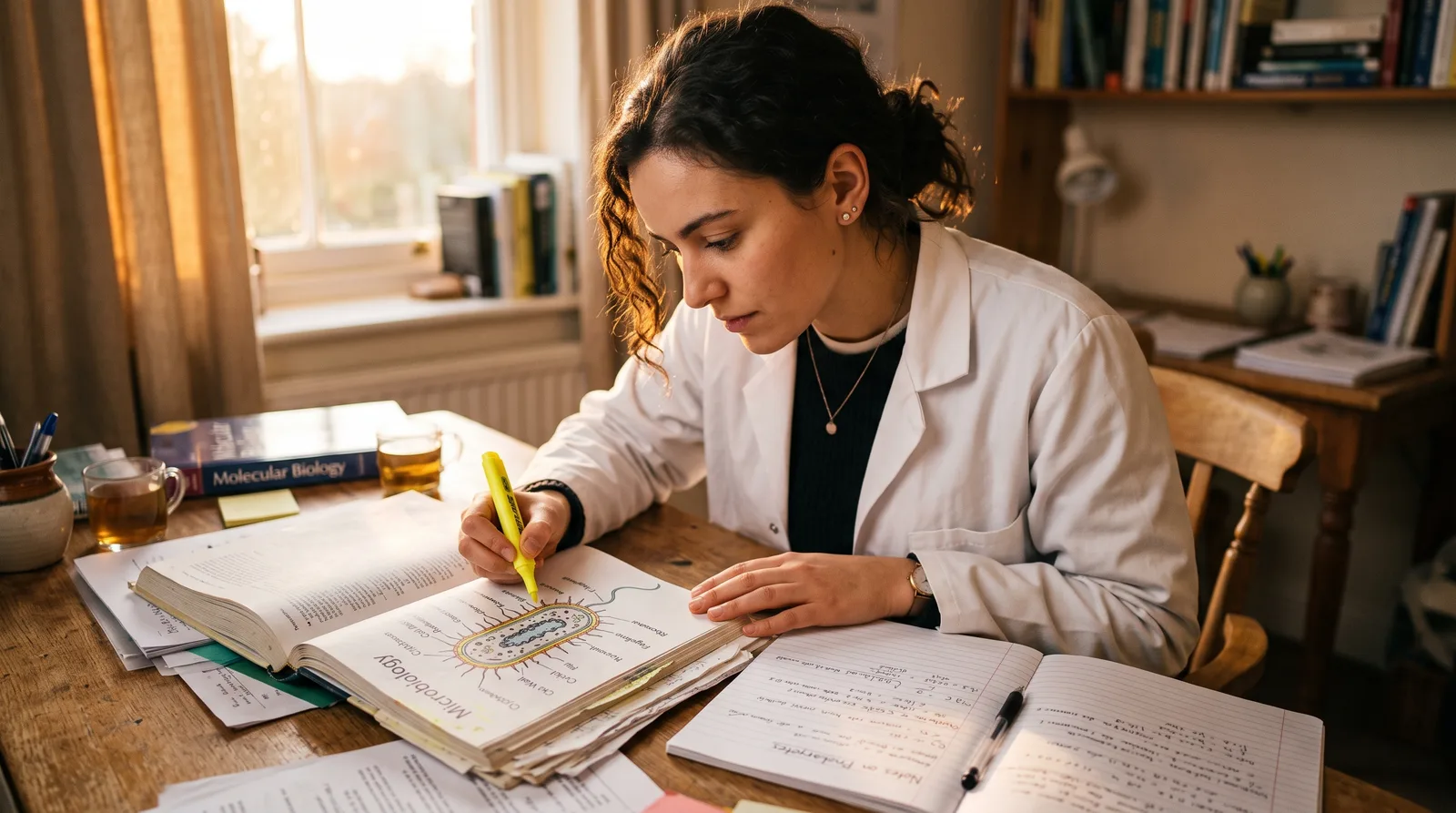
"I don't just want you to pass — I want you to walk into that exam room knowing exactly why every answer is right."
— biologyteachermae
What you'll learn
What you'll be able to do
- Identify and classify major groups of bacteria, viruses, fungi, and parasites by their key structural and metabolic features
- Explain mechanisms of microbial pathogenesis and how microorganisms evade host immune defenses
- Apply knowledge of sterilization, disinfection, and antimicrobial agents to clinical and lab scenarios
- Interpret laboratory diagnostic methods — including culture, staining, and serology — as tested on board exams
- Answer high-yield exam questions on the human microbiome, infectious disease, and epidemiology with speed and accuracy
- Build a personalized review strategy using practice questions, mnemonics, and spaced repetition to maximize exam performance
How it works
A school that adapts to you
This isn't a set of static videos. Every lesson is generated live and tuned to where you actually are.
We learn your level
A quick placement check tailors your starting point so you're never bored or lost.
Lessons adapt as you go
Each lesson is written for your pace and your goal, adjusting as your skills grow.
Your AI coach keeps you moving
Checkpoints, feedback, and gentle nudges turn progress into a real result.
The curriculum
What's inside your school
6 modules · 30 lessons

Foundations of Microbiology
Establishes the core concepts, terminology, and classification frameworks every exam taker needs before diving into specific organisms.
- 1.1The Microbial World: Scope and ClassificationIncluded
- 1.2Prokaryotic vs. Eukaryotic Cell StructureIncluded
- 1.3Microscopy and Staining TechniquesIncluded
- 1.4Microbial Growth, Nutrition, and MetabolismIncluded
- 1.5Sterilization, Disinfection, and AntisepsisIncluded
Bacteriology: Structure, Genetics, and Pathogenesis
Provides a deep, exam-focused mastery of bacterial biology — from cell wall architecture to the genetic mechanisms that drive virulence and resistance.
- 2.1Bacterial Cell Wall and MembraneIncluded
- 2.2Bacterial Genetics: Replication, Mutation, and RepairIncluded
- 2.3Horizontal Gene Transfer: Transformation, Transduction, and ConjugationIncluded
- 2.4Virulence Factors and Mechanisms of PathogenesisIncluded
- 2.5Clinically Important Bacteria: Gram-Positive OrganismsIncluded
- 2.6Clinically Important Bacteria: Gram-Negative and Atypical OrganismsIncluded
Virology, Mycology, and Parasitology
Covers the structural, reproductive, and pathogenic features of viruses, fungi, and parasites as tested across major board exams.
- 3.1Viral Structure, Classification, and ReplicationIncluded
- 3.2Clinically Important DNA and RNA VirusesIncluded
- 3.3Fungal Biology and Clinically Important FungiIncluded
- 3.4Parasitology: Protozoa and HelminthsIncluded
- 3.5Prions and Unconventional Infectious AgentsIncluded
Immunology and Host-Pathogen Interactions
Builds exam-ready mastery of innate and adaptive immunity, hypersensitivity, and the strategies pathogens use to evade host defenses.
- 4.1Innate Immunity: First-Line DefensesIncluded
- 4.2Adaptive Immunity: T Cells, B Cells, and AntibodiesIncluded
- 4.3Hypersensitivity Reactions: Types I–IVIncluded
- 4.4Immune Evasion Strategies of PathogensIncluded
- 4.5Vaccines, Immunodeficiencies, and Transplant ImmunologyIncluded
Antimicrobial Agents and Resistance
Equips students to answer board questions on antibiotic classes, mechanisms of action, and the molecular basis of antimicrobial resistance.
- 5.1Antibacterial Drugs: Mechanisms and TargetsIncluded
- 5.2Antiviral, Antifungal, and Antiparasitic AgentsIncluded
- 5.3Mechanisms of Antimicrobial ResistanceIncluded
- 5.4Clinical Pharmacology: Selecting and Monitoring AntimicrobialsIncluded
Laboratory Diagnosis, Epidemiology, and Exam Strategy
Integrates clinical lab methods, infectious disease epidemiology, and a structured exam review strategy to maximize test-day performance.
- 6.1Diagnostic Microbiology: Culture, Isolation, and IdentificationIncluded
- 6.2Serological and Molecular Diagnostic MethodsIncluded
- 6.3Infectious Disease Epidemiology and the Human MicrobiomeIncluded
- 6.4Hospital-Acquired Infections and Infection ControlIncluded
- 6.5Exam Strategy: Practice Questions, Mnemonics, and Spaced RepetitionIncluded
Who it's for
Is this you?

Pre-med students
Building the microbiology and immunology foundation that the USMLE Step 1 tests hard — and wants it to actually make sense.

Nursing students
Needs the infection control, pharmacology, and host-pathogen content that shows up on the NCLEX without drowning in irrelevant detail.

MedTech & lab science students
Preparing for ASCP licensure and needs sharp command of diagnostic methods — culture, staining, serology, and molecular techniques.

Biology majors
Taking a upper-division microbiology or immunology course and wants a rigorous resource that goes beyond the textbook and into exam-ready clarity.

Retakers & gap-year students
Already attempted a board exam or licensure test and needs a structured, high-yield reviewer to close gaps and rebuild confidence.

Allied health students
In a physician assistant, respiratory therapy, or similar program where microbiology is board-tested and a solid, approachable resource is hard to find.
Questions
Frequently asked
Your teacher
A note from your teacher
biologyteachermae
If you're staring down a microbiology syllabus — or a board exam date — and feeling the weight of everything you're supposed to know, I want you to hear this first: the problem isn't your ability. The problem is that most microbiology instruction wasn't designed with your exam in mind. It was designed for coverage, not clarity.
I built Micro Mastery because I know what it feels like to sit in a lecture where bacterial genetics, viral replication, and immunology are all flying past at the same speed, with no signal about what's actually going to matter when the test comes. This course is my answer to that. Every topic in here — from Gram stain logic and horizontal gene transfer to hypersensitivity reactions and antimicrobial resistance mechanisms — is taught the way I'd explain it to a student who needs to genuinely understand it, not just recognize it on a flashcard.
Here's what I want you to know about how this course is built. We don't just cover organisms — we follow the clinical logic. Why does Staphylococcus aureus cause the infections it does? What makes a pathogen able to evade your immune system? How does a drug's mechanism of action predict where resistance will emerge? When you understand the why, the what becomes far easier to hold onto — and far easier to apply under exam pressure. That's the difference between studying and being ready.
We also take exam performance seriously as a skill in itself. The final section of this course isn't a bonus afterthought — it's a core part of what I'm teaching you. Diagnostic microbiology framed the way boards test it, infectious disease epidemiology, hospital-acquired infection control, and a full exam strategy built around practice questions, mnemonics, and spaced repetition. You'll finish this course knowing the material and knowing how to deploy it.
Whether you're preparing for the USMLE, NCLEX, ASCP, or your toughest university final, you belong here. Come in with your questions, your gaps, and your exam date on the calendar. I'll meet you where you are, and we'll get you ready. Let's go.
— biologyteachermae
Start your journey today
Get instant access — learn at your own pace with an AI coach in your corner.
$39/mo
Recurring billing · cancel anytime
Secure checkout · Instant access
- 6 modules, 30 lessons
- AI-adaptive lessons tuned to your level
- Quizzes & checkpoints to lock in progress
- Your own AI learning coach
- Learn on any device, at your pace
- Full access for as long as you're subscribed