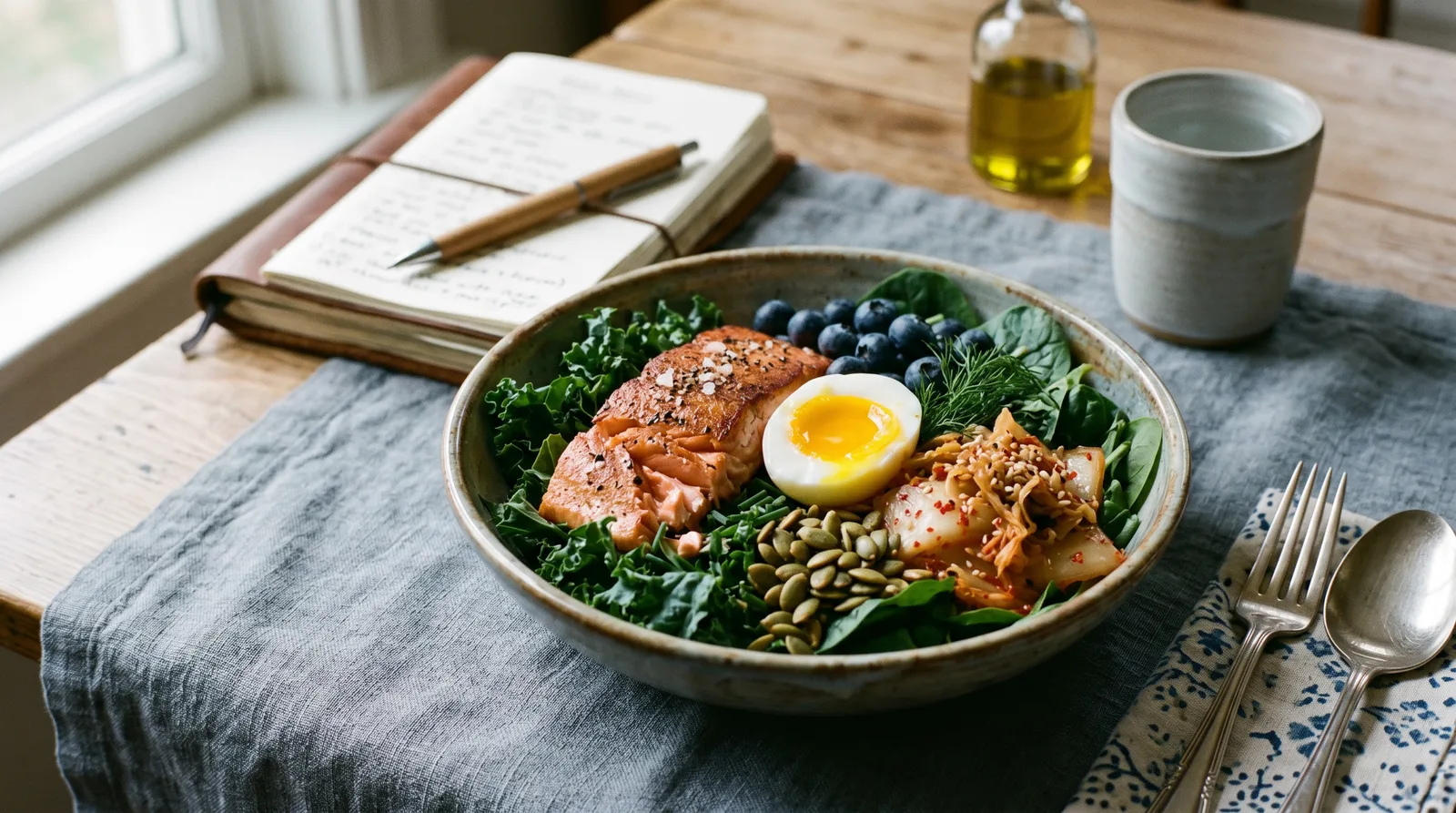
Feed your mental health, not just your body
Six evidence-based modules teach you exactly which foods, nutrients, and eating patterns support depression, anxiety, ADHD, and bipolar disorder — so you can walk into your next grocery run with a brain-health plan, not a guess.

"Food isn't a cure — but when you understand how it works in your brain, it becomes one of the most empowering things you can actually control."— wellnesswithnowalls
What you'll learn
What you'll be able to do
- Identify the specific nutrients and dietary patterns most strongly linked to depression, anxiety, ADHD, and bipolar disorder
- Read nutrition labels and grocery lists through a "brain health" lens, choosing foods that support neurotransmitter production and reduce neuroinflammation
- Build a personalized weekly meal framework that stabilises blood sugar and supports mood regulation throughout the day
- Understand how the gut-brain axis works and apply practical steps to improve gut microbiome diversity for mental wellbeing
- Navigate common medication-nutrient interactions (e.g. lithium and sodium, MAOIs and tyramine) safely and confidently
- Create a sustainable, realistic nutrition action plan that integrates with — not against — your existing mental health treatment
How it works
A school that adapts to you
This isn't a set of static videos. Every lesson is generated live and tuned to where you actually are.
We learn your level
A quick placement check tailors your starting point so you're never bored or lost.
Lessons adapt as you go
Each lesson is written for your pace and your goal, adjusting as your skills grow.
Your AI coach keeps you moving
Checkpoints, feedback, and gentle nudges turn progress into a real result.
The curriculum
What's inside your school
6 modules · 20 lessons

Food and the Brain: Building Your Foundation
Establishes the scientific and practical groundwork for the entire course. Students learn why nutrition is a legitimate, evidence-based component of mental health care, how key nutrients influence brain chemistry, and what neuroinflammation is — setting up every condition-specific and practical module that follows.
- 1.1Why Nutrition Belongs in Your Mental Health ToolkitIncluded
- 1.2Neurotransmitters, Nutrients, and Your MoodIncluded
- 1.3Neuroinflammation: The Hidden DriverIncluded
Condition-Specific Nutrition: Depression, Anxiety, ADHD, and Bipolar Disorder
Applies the foundational science from Module 1 to four distinct mental health conditions. Each lesson identifies the most robustly evidenced nutrients and dietary patterns for that condition, providing targeted knowledge students can act on immediately and refine in the planning modules later.
- 2.1Eating for Depression: Omega-3s, Folate, and the Mediterranean PatternIncluded
- 2.2Eating for Anxiety: Blood Sugar Stability and Calming NutrientsIncluded
- 2.3Eating for ADHD: Iron, Zinc, Magnesium, and Protein TimingIncluded
- 2.4Eating for Bipolar Disorder: Stability, Inflammation, and RhythmIncluded
Reading Labels and Shopping with a Brain-Health Lens
Translates the scientific knowledge from Modules 1 and 2 into everyday consumer skills. Students learn to critically read nutrition labels and ingredient lists for brain-health relevance, and to build practical, affordable grocery strategies — closing the gap between 'knowing what to eat' and 'actually buying it.'
- 3.1Decoding Nutrition Labels for Mental HealthIncluded
- 3.2Building a Brain-Health Grocery ListIncluded
The Gut–Brain Axis: Your Second Brain
Provides a thorough, accessible explanation of gut–brain communication pathways (vagus nerve, enteric nervous system, microbial metabolites, immune signalling) and translates this into concrete dietary strategies for building microbiome diversity and eliminating common gut disruptors — directly supporting mood regulation and mental health outcomes.
- 4.1How Your Gut Talks to Your BrainIncluded
- 4.2Feeding Your Microbiome: Fibre, Fermented Foods, and DiversityIncluded
- 4.3Gut Disruptors: What's Working Against YouIncluded
Navigating Medication–Nutrient Interactions Safely
Equips students with the knowledge to safely identify and manage clinically significant interactions between psychiatric medications and food, nutrients, and supplements. This module prioritises safety and positions nutrition as a complement to — never a replacement for — prescribed treatment.
- 5.1Why Food and Medication Don't Always MixIncluded
- 5.2Lithium, Sodium, and Fluid: What Every Bipolar Patient Needs to KnowIncluded
- 5.3MAOIs, Tyramine, and the Hypertensive Crisis: Eating Safely on AntidepressantsIncluded
- 5.4Other Key Interactions: Stimulants, Antipsychotics, and SupplementsIncluded
Building Your Personal Mental Health Nutrition Plan
Synthesises all prior modules into a personalised, sustainable, and clinically integrated nutrition action plan. Students move from knowledge to long-term practice: structuring their meals around mood regulation, developing psychological resilience around eating, collaborating with their care team, and creating a living document that evolves with their recovery.
- 6.1Blood Sugar, Meal Timing, and Your Mood RhythmIncluded
- 6.2Stress, Emotional Eating, and Keeping Nutrition ConsistentIncluded
- 6.3Integrating Nutrition with Your Clinical Treatment TeamIncluded
- 6.4Your Living Nutrition Action PlanIncluded
Who it's for
Is this you?

Living with depression
They're in treatment but want to understand how omega-3s, folate, and the Mediterranean dietary pattern can meaningfully support their day-to-day mood.

Managing anxiety
They've never connected blood sugar crashes to their anxiety spikes, and they're ready to learn the dietary strategies that bring more calm and stability.

Adult with ADHD
They want practical guidance on iron, zinc, magnesium, and protein timing — nutrients the research links to focus, regulation, and executive function.

Bipolar disorder patient
They need condition-specific nutrition support — including the critical lithium–sodium interaction and dietary approaches to mood rhythm and inflammation.

Carer or family member
They cook for or alongside a loved one with a mental health diagnosis and want to make food choices that genuinely support, never inadvertently undermine, their care.

Medication-aware patient
They're on antidepressants, antipsychotics, or mood stabilisers and want to understand exactly which foods and supplements to approach with care — and why.
Questions
Frequently asked
Your teacher
A note from your teacher
wellnesswithnowalls
If you're managing a mental health condition — or supporting someone who is — you already know how much effort goes into just keeping things steady. The appointments, the adjustments, the days when doing the basics feels like a lot. I see you, and I want to start there.
What I also know, from working at the intersection of nutrition and mental health, is that the conversation about food almost never happens in a clinical setting. Not because it doesn't matter — the research is genuinely compelling — but because a fifteen-minute appointment doesn't leave much room for it. So people leave without ever hearing that omega-3 fatty acids play a role in depression, that blood sugar instability can look and feel like anxiety, that the gut microbiome has a direct line to mood regulation, or that certain foods can interfere with medications in ways that really matter.
That gap is why I built Mind Nourished. I wanted to create the resource I wish every one of my clients had walked in with — something thorough enough to be genuinely useful, honest enough not to overpromise, and clear enough that you don't need a science degree to act on it. This school covers the full picture: the foundational brain-nutrition science, condition-specific guidance for depression, anxiety, ADHD, and bipolar disorder, the gut–brain axis, how to read a label with your mental health in mind, and — critically — how to eat safely around medications like lithium and MAOIs that have real dietary implications most people are never told about.
What I'm not going to do is tell you that food is a cure, or hand you a rigid meal plan and call it personalised care. What I will do is give you evidence-based tools, plain language, and a framework you can actually build into your real life — one that works alongside your clinical team, not as a workaround to it. You deserve to feel informed and empowered at the grocery store, at the dinner table, and in the room with your prescriber.
If you're ready to add one more genuine tool to your mental health toolkit — without the overwhelm, the wellness hype, or the unrealistic promises — I'm really glad you're here. Let's get into it together.
— wellnesswithnowalls
Start your journey today
Join get instant access — learn at your own pace with an AI coach in your corner.
$39/mo
Recurring billing · cancel anytime
Secure checkout · Instant access
- 6 modules, 20 lessons
- AI-adaptive lessons tuned to your level
- Quizzes & checkpoints to lock in progress
- Your own AI learning coach
- Learn on any device, at your pace
- Full access for as long as you're subscribed