Stop looking for the exit
A rigorous, first-person encounter with U.G. Krishnamurti's most destabilizing claims — about thought, the self, seeking, and the body. No consolation offered. No new framework waiting at the end.
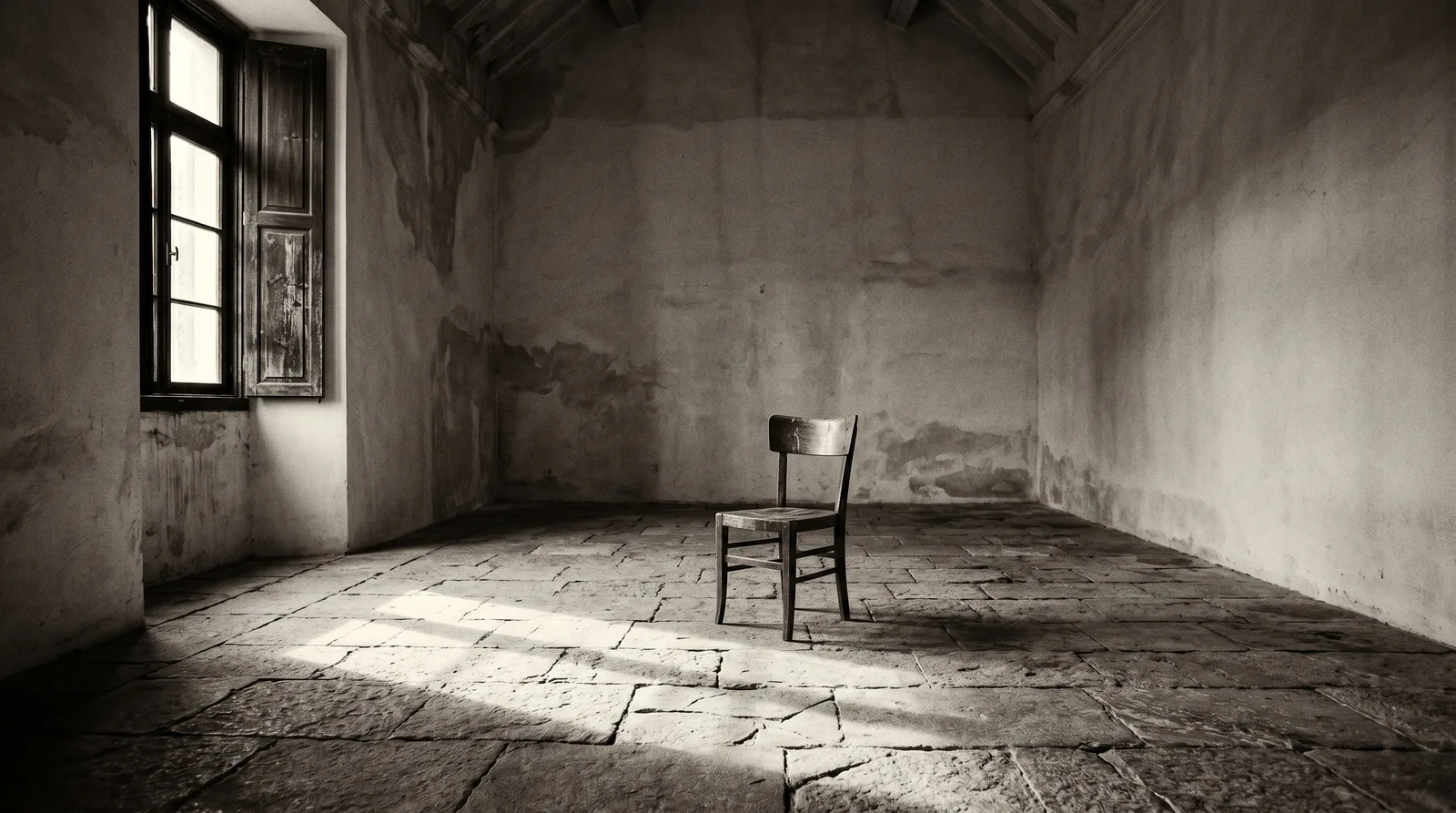
I'm not offering you a way through — I'm offering you a precise look at why you keep looking for one.— Joseph Riggio

What you'll learn
What you'll be able to do
- Accurately reconstruct U.G. Krishnamurti's core critique of thought, the self, and the desire for enlightenment in your own words
- Distinguish U.G.'s 'natural state' from superficially similar concepts in Advaita, Zen, and Theravāda — and explain why he rejected all of them
- Identify the specific mechanisms by which culture, language, and spiritual seeking perpetuate psychological suffering, according to U.G.'s model
- Apply a rigorous first-person inquiry to your own experience of seeking, exposing the circular logic of wanting to be free from wanting
- Engage critically with U.G.'s most provocative claims — on consciousness, death, and the body — neither dismissing them nor uncritically accepting them
- Hold genuine uncertainty about the nature of mind and identity without reaching for a new belief system to fill the gap
How it works
A school that adapts to you
This isn't a set of static videos. Every lesson is generated live and tuned to where you actually are.
We learn your level
A quick placement check tailors your starting point so you're never bored or lost.
Lessons adapt as you go
Each lesson is written for your pace and your goal, adjusting as your skills grow.
Your AI coach keeps you moving
Checkpoints, feedback, and gentle nudges turn progress into a real result.
The curriculum
What's inside your school
6 modules · 24 lessons

The Man and the Demolition
Establishes who U.G. was, why he resists every category we might place him in, and what kind of encounter this course demands.
- 1.1Not a Teacher, Not a SageIncluded
- 1.2The Calamity: What Happened to U.G.Included
- 1.3How to Read U.G. Without Domesticating HimIncluded
- 1.4The Shape of a ReckoningIncluded
Thought on Trial
Subjects U.G.'s central critique of thought — its structure, its self-serving loops, and its violence — to rigorous examination.
- 2.1The Mechanical Strangler: U.G.'s Model of ThoughtIncluded
- 2.2The Self as Thought's FictionIncluded
- 2.3Language as ContaminationIncluded
- 2.4Can Thought See Itself? The Collapse of IntrospectionIncluded
The Wanting to Be Free from Wanting
Turns the lens directly on spiritual seeking itself, exposing the circular logic U.G. identified at the heart of the liberation project.
- 3.1Seeking as the Problem, Not the PathIncluded
- 3.2The Market of Moksha: Culture's Spiritual IndustryIncluded
- 3.3First-Person Audit: Mapping Your Own SeekingIncluded
- 3.4The Circular Logic Trap: Wanting Freedom from WantingIncluded
U.G. Against the Traditions
Rigorously distinguishes U.G.'s natural state from superficially similar concepts in Advaita Vedanta, Zen, and Theravāda Buddhism.
- 4.1Not Turīya: Why U.G. Rejected AdvaitaIncluded
- 4.2Not Satori: The Quarrel with ZenIncluded
- 4.3Not Nibbāna: U.G. and Theravāda's CessationIncluded
- 4.4The Natural State as Non-EventIncluded
The Body, Death, and Consciousness
Confronts U.G.'s most extreme and disorienting claims about the body's intelligence, personal death, and the non-existence of consciousness as we conceive it.
- 5.1The Body Without a MasterIncluded
- 5.2Death as Biological Event, Not Existential ProblemIncluded
- 5.3Consciousness: A Word Pointing at NothingIncluded
- 5.4Critical Engagement: Where U.G. Can and Cannot Be ChallengedIncluded
Living Without Ground
Sits honestly with what remains after U.G.'s demolition — not a new framework, but a disciplined capacity to hold genuine uncertainty.
- 6.1The Temptation of the Next SystemIncluded
- 6.2Uncertainty as Endpoint, Not WaystationIncluded
- 6.3What Honest Engagement with U.G. Actually ChangesIncluded
- 6.4No Conclusion: A Final ReckoningIncluded
Who it's for
Is this you?

The ex-meditator
Years of practice left them more fluent in spiritual language than actually changed, and they want an honest autopsy of what the seeking was really doing.

The post-nonduality skeptic
They've moved through Advaita and Neo-Vedanta and find the conclusions familiar but the terrain suspiciously comfortable — U.G.'s refusal to comfort them is the first thing that's felt honest.

The analytic philosopher
They want U.G.'s claims about thought, consciousness, and the self treated as philosophical propositions — to be reconstructed precisely and tested, not celebrated.

The burned-out seeker
They've spent real time and money on the spiritual marketplace and are ready to examine — without self-pity — how the market of moksha worked on them specifically.

The comparative religion scholar
They need the exact philosophical grounds of U.G.'s break with Advaita, Zen, and Theravāda laid out rigorously, not summarized into a vague 'he rejected it all.'

The intellectual at the edge
Therapy, philosophy, and secular mindfulness have all hit a ceiling — they're drawn to U.G. because he refuses to make the uncertainty livable on easy terms.
Questions
Frequently asked
Your teacher
A note from your teacher
Joseph Riggio
You've probably already spent time with the frameworks. Maybe you've sat retreats, read the nonduality canon, worked through the Upanishads or the Pali suttas. At some point something started to feel off — not wrong exactly, but managed. The teachings began to feel like they were handing you a way to feel okay about your situation rather than a way to see it clearly. And then you found U.G., or someone mentioned him, and something in the bluntness landed differently.
The problem is that U.G. is easy to encounter and hard to actually reckon with. His transcribed conversations are deliberately disorganized. He repeats himself. He refuses to be systematic. The result is that most people either dismiss him after a few pages — too aggressive, too nihilistic, no positive teaching — or absorb him selectively, turning the pieces that resonate into a new kind of spiritual position. Neither of those is the honest engagement he was demanding.
The Calamity School is built around the question of what it would actually mean to take U.G. seriously — not as a guru, not as a contrarian provocateur, but as a philosopher making specific, falsifiable-ish claims about the nature of thought, self, seeking, and the body. The curriculum gives you the structure his books deliberately refuse: a clear map of his core arguments, the exact grounds of his quarrel with Advaita, Zen, and Theravāda, a first-person inquiry into the circular logic of your own seeking, and a critical section that doesn't protect his claims from scrutiny.
I won't tell you U.G. was right. I won't tell you the natural state is available to you, or that engaging with this material will produce a recognizable change in your life. What I can tell you is that there is a rigorous way to engage with his challenge — and a lazy way. The lazy way is to let his most provocative lines wash over you as a kind of dark aesthetic, a bracing alternative to positive thinking. The rigorous way is to follow the argument, apply it to your actual experience of seeking, and refuse to reach for a new belief system when the ground gets uncomfortable.
That's what this school is for. If you're willing to sit with the possibility that there is no path — examined carefully, without flinching, without making that possibility into its own consoling framework — then this is the right place to do it.
— Joseph Riggio
Start your journey today
Join get instant access — learn at your own pace with an AI coach in your corner.
$39/mo
Recurring billing · cancel anytime
Secure checkout · Instant access
- 6 modules, 24 lessons
- AI-adaptive lessons tuned to your level
- Quizzes & checkpoints to lock in progress
- Your own AI learning coach
- Learn on any device, at your pace
- Full access for as long as you're subscribed